Key Takeaways:
- A fractional SDR looks cheap on paper. The real cost is your time. If you're the one training and tracking them, you've hired yourself a second job.
- Outbound results are thin right now. Cold emails reply at 1–5% (Belkins/QuickMail data), and cold calls connect on only 4–9% of dials (Cognism). A part-time rep with no system rarely beats those averages.
- Inbound leads cost about 60% less per lead than outbound and close far higher, 14.6% for SEO leads versus 1.7% for cold outreach (HubSpot). For most $1M–$10M founders, that math is hard to ignore.
- Outbound isn't dead. It's just unforgiving. It works when you have a tight ICP, a real script, daily coaching, and clean tracking. It fails when it's a part-time hire nobody manages.
- The question isn't "SDR or no SDR." It's "do I have a system that would make any channel work?" If you don't, adding a fractional SDR just adds cost and noise.
A founder asked me this a few weeks ago. "Louie, everyone's telling me to hire a fractional SDR to fill my pipeline. It's only a couple grand a month. Is it worth it?"
Here's what I told him. The couple grand a month isn't the cost. You are.
Because when you bring on a part-time rep to do outbound, someone has to train them on your product, your ICP, your objections, and your process. Someone has to listen to their calls, read their emails, and tell them what to fix. Someone has to track whether any of it is actually working. And if you're a founder still running most of your own sales, that someone is you.
I've spent fifty years in sales. I've built outbound teams that crushed it and I've watched outbound hires burn cash for months and produce nothing. The difference was never the rep. It was whether there was a system around them.
So let's do this honestly. I'll give you the case for a fractional SDR and the case against. Then I'll tell you what I'd actually do if I were sitting in your chair at $1M–$10M ARR.
First, What a Fractional SDR Actually Is
A Sales Development Rep, sometimes called a BDR, is the person at the top of the funnel. They don't close. Their whole job is to start conversations. Cold email, cold calls, LinkedIn outreach, following up on the leads your marketing brings in. The goal is one thing: booked meetings for whoever closes, which right now is probably you.
A fractional SDR is that same role, part-time. Usually through an agency or a contractor, usually somewhere between a few hundred and a few thousand dollars a month depending on how many hours and how much they're doing for you. The pitch is seductive. You get pipeline without a full salary, without benefits, without a long-term commitment.
That pitch is half true. And the half that isn't true is the half that costs you.
The Case FOR a Fractional SDR
I'm not here to trash outbound. I built a company on it. So let me make the honest argument for why a fractional SDR can be a smart move.
You get pipeline fast, and you get it on demand
Inbound takes months to build. Outbound can put a meeting on your calendar this week. If you have a short runway, a new product to validate, or a specific list of dream accounts you want in front of, outbound is the only channel that lets you go get them on purpose instead of waiting for them to find you.
It's a fraction of the cost of a full-time hire
A full-time in-house SDR is not cheap once you load in everything. Look at the real number before you assume part-time is the obvious answer.
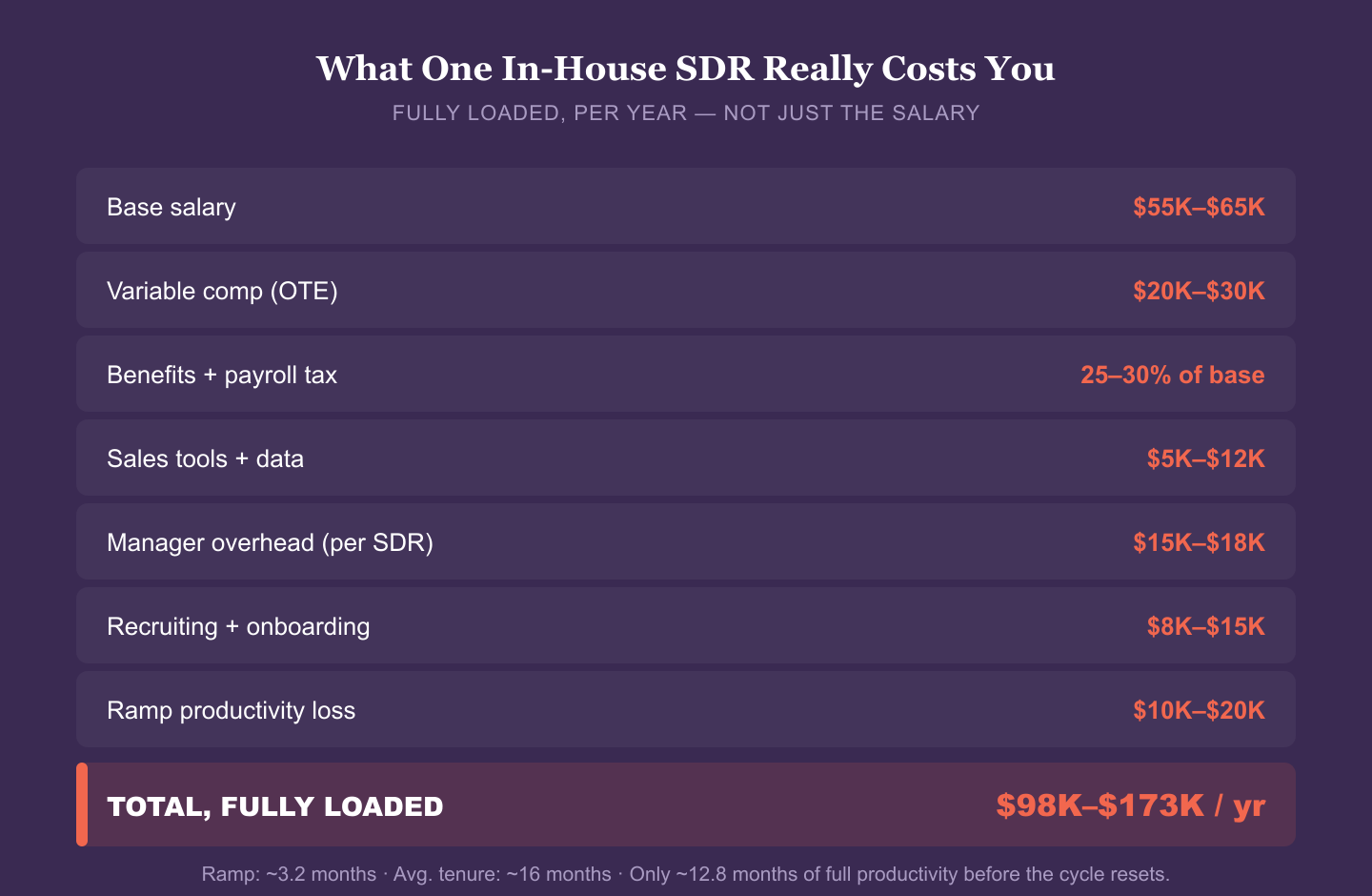
A fully loaded in-house SDR runs $98,000 to $173,000 a year once you add benefits, tools, management, recruiting, and ramp loss (SalesHive, Martal). Against that, a fractional SDR at $2,000–$4,000 a month looks like a bargain. If you genuinely can't justify a full seat yet, part-time lets you test the channel without betting the year on it.
A good agency comes with tooling and reps who've done it before
The better outbound agencies bring the data, the sequencing software, the deliverability setup, and reps who've run thousands of calls. You're not building an outbound stack from scratch. For a founder who has never run outbound, that shortcut has real value, as long as you remember it's a shortcut, not a system.
Outbound isn't dead. It's just unforgiving. It rewards precision and punishes everything else.
The Case AGAINST a Fractional SDR
Now the other side. And this is where I land for most of the founders I work with.
The real cost isn't their fee. It's your time
The /ceo program I run values a founder's time at $300 an hour. Now do the math on an SDR. To get a part-time rep producing, you're looking at product training, ICP training, script writing, objection handling, and then daily call reviews and email reviews to keep them on track. That's not a couple hours a month. Done right, outbound coaching is a 15-minute session every single morning, listening to the good calls, reinforcing what works. I've taught sales managers to do exactly that. It's the right way to run a rep. But you're not a sales manager. You're the founder, and every hour you spend babysitting outbound is an hour you're not closing deals or building the business.
Outbound results are thin right now, and a part-timer rarely beats the average
Let's be honest about the numbers. Cold email reply rates sit around 1–5% for most campaigns (Belkins, QuickMail). Cold call connect rates run just 4–9% of dials reaching a live human (Cognism), and the average B2B SDR books roughly one qualified meeting every 40 to 80 dials. Cold outreach closes at about 1.7% (HubSpot). Those are the averages for full-time reps with support. A part-time rep who isn't dialed into your business, working your list a few hours a week, tends to land below average, not above it.
The revolving door eats your investment
Even full-time SDRs churn hard. Average tenure is about 14–18 months and annual turnover runs 30–39% (Orum, Bridge Group). Ramp time to full productivity is roughly 3.2 months. So you invest months getting someone competent, and the clock is already running out. With a fractional contractor rotating across other clients, the loyalty and continuity are even shakier. You can retrain that person every quarter and never build any compounding value.
The same money often buys more in inbound
This is the argument I keep coming back to for founders at your stage. Inbound leads cost roughly 60% less per lead than outbound, and they convert far better because the buyer came to you with intent already in hand.
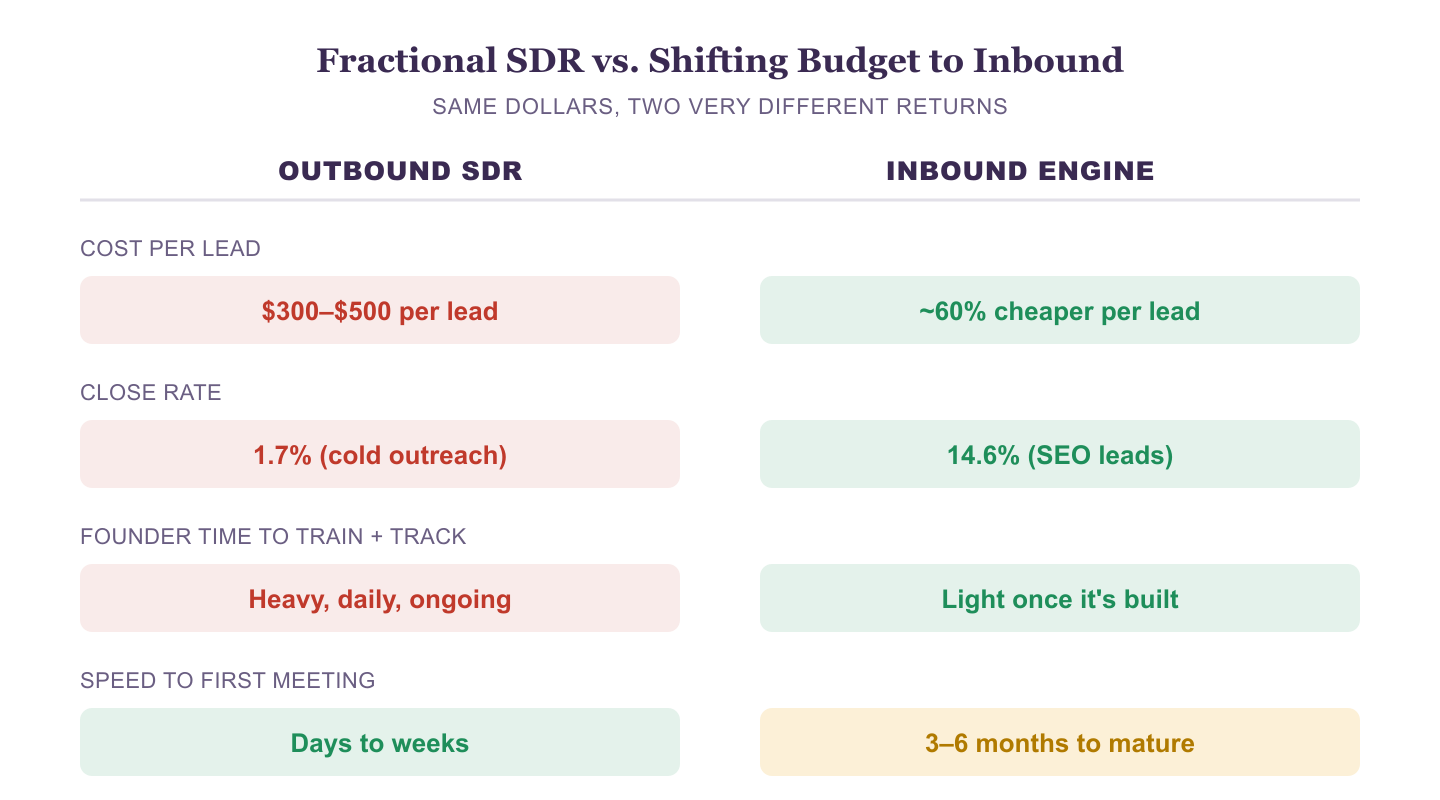
Look at the close rates. SEO-driven inbound leads close at 14.6%. Cold outreach closes at 1.7% (HubSpot). That's not a rounding error, that's an order of magnitude. For a founder with limited hours and limited dollars, shifting some of that outbound budget into content, LinkedIn, and a search-friendly site can produce more qualified conversations with less of your time. It's slower to start. It compounds. And unlike a contractor, the assets you build stay yours forever.
A fractional SDR with no system is just a more expensive way to be disappointed. Fix the system first, then decide who runs the channel.
The Real Question: Do You Have a System, or Just a Seat?
Here's what fifty years taught me. The founders who hire an SDR and get burned aren't victims of outbound. They're victims of hiring a person to fill a hole where a system should be.
Outbound works, when it works, because of what's around the rep. A tight ICP so you're not spraying strangers. A real script that's been tested, not improvised. Clean data. Four funnel stages at most, so you can actually forecast. A daily coaching cadence. And KPIs that measure the leading activity, not just the lagging result. When those things exist, an SDR, fractional or full-time, has a fighting chance. When they don't, you're paying someone to fail slowly.
So before you spend a dollar on a fractional SDR, answer these:
- Can you name your ICP in one sentence, with the specific trigger that makes them a buyer right now?
- Do you have a written script and sequence that's already converted, or would the rep be guessing?
- Who is going to coach and track this person every week, and is that realistically going to be you?
- Do you have an Accountability Document that spells out exactly what "good" looks like for the role?
- Would that same money produce more qualified conversations in inbound over the next two quarters?
If you can't answer those cleanly, you don't have an SDR problem. You have a system problem. And no hire, fractional or full-time, fixes a system problem. It just puts a face on it.
This is exactly the work I do with founders in the Founder's Corner. We build the ICP, the qualifying standard, the pipeline stages, the operating cadence, and the hiring and onboarding system, so that when you do add a rep, you're plugging them into a machine that already runs. Whether that channel ends up being outbound, inbound, or both becomes an informed decision instead of a two-grand-a-month gamble. If you're leaning toward outbound, my guide on why prospects go silent is worth a read before you hand a list to anyone.
So, Is a Fractional SDR Worth It? My Honest Answer
Yes, in exactly one situation. You have a proven, written outbound motion that's already produced meetings, a tight ICP, and someone other than you to coach and track the rep. In that case a fractional SDR is a smart, capital-efficient way to scale a channel you've already validated.
No, in the situation most $1M–$10M founders are actually in. You're still closing most deals yourself, you don't have a documented outbound system, and the SDR would report to a founder who has no time to manage them. In that case, the fee is the smallest part of what it'll cost you, and your dollars will almost always do more shifted into inbound while you build the system underneath.
The channel isn't your problem. The missing system is. Fix that, and the SDR question answers itself.
Frequently Asked Questions
Q: What's the difference between a fractional SDR and a fractional BDR?
In practice, very little. Both titles describe the top-of-funnel role that starts conversations and books meetings but doesn't close. Some companies use SDR for reps who work inbound leads and BDR for reps who do pure cold outbound, but the terms are used interchangeably far more often than not. "Fractional" just means part-time, usually through an agency or contractor. Whichever label you use, the economics and the management burden I describe above are the same.
Q: How much does a fractional SDR cost?
Most fractional or outsourced SDR arrangements run $2,000 to $6,000 a month depending on hours, activity volume, and whether the agency supplies data and tooling. That's genuinely cheaper than a fully loaded in-house SDR, which runs $98,000 to $173,000 a year. But the fee is only the visible cost. The hidden cost is the founder time required to train, coach, and track the rep, plus the low return if there's no system around them. Cheap and effective are not the same thing.
Q: Is outbound sales still worth it in 2026?
Outbound still works, but it's less forgiving than it used to be. Cold email reply rates sit around 1–5% and cold call connect rates around 4–9% of dials. The teams that win with outbound have a tight ICP, tested scripts, clean data, and daily coaching. The teams that lose treat it as a spray-and-pray activity. So the honest answer is: outbound is worth it if you run it as a disciplined system, and a waste of money if you don't. That's true whether the rep is full-time, fractional, or you.
Q: Should I invest in inbound marketing instead of a fractional SDR?
For a lot of $1M–$10M founders, yes, at least with part of the budget. Inbound leads cost about 60% less per lead and close at dramatically higher rates because the buyer arrives with intent. The tradeoff is time: inbound takes three to six months to mature, where outbound can book a meeting this week. The smartest founders don't pick one forever. They use inbound to build a compounding, lower-cost engine and use targeted outbound to go after specific dream accounts. What they don't do is hand outbound to an unmanaged part-timer and call it a strategy.
Q: How much of my time will a fractional SDR really take?
More than the sales pitch admits. To run an SDR properly you want a short coaching session most mornings, listening to their best calls and reinforcing what works, plus weekly pipeline and KPI review. If you're the one doing that, budget several hours a week, every week, indefinitely. That's the number founders forget to put on the invoice. If you don't have those hours, either don't hire the SDR yet or bring in someone whose job is to manage the channel for you.
Q: When does a fractional SDR actually make sense?
When you've already proven the outbound motion yourself, you can hand the rep a written ICP, a tested script, and a clear Accountability Document, and you have someone other than the founder to coach and track them. In that situation a fractional SDR is a capital-efficient way to scale a channel you know converts. The mistake is using a fractional SDR to discover whether outbound works for you. That's founder work, or the work of a Fractional Sales Leader, not a task to outsource to a part-time contractor.
Before you hire anyone to fill your pipeline, build the system that makes them work.
The Founder's Corner is a 12-week program that gets you out of doing all the selling yourself. We build your ICP, your qualifying standard, your pipeline stages, and your hiring and onboarding system, so your next hire plugs into a machine instead of a mess. See how it works and whether it's a fit for where you are.
See How the Founder's Corner Can Help You →About the Author
Louie Bernstein
Fractional Sales Leader with 50 years of sales experience helping $1M–$10M ARR companies build scalable, repeatable sales systems. Founder of MindIQ (INC 500). LinkedIn Top Voice in Sales Management, Sales Operations, and Sales Coaching.