Key Takeaways:
- B2B buyers rank active listening as the number-one skill they want in a salesperson (38%, LinkedIn State of Sales). Sales managers rank it eighth when they hire. That gap is where your deals leak.
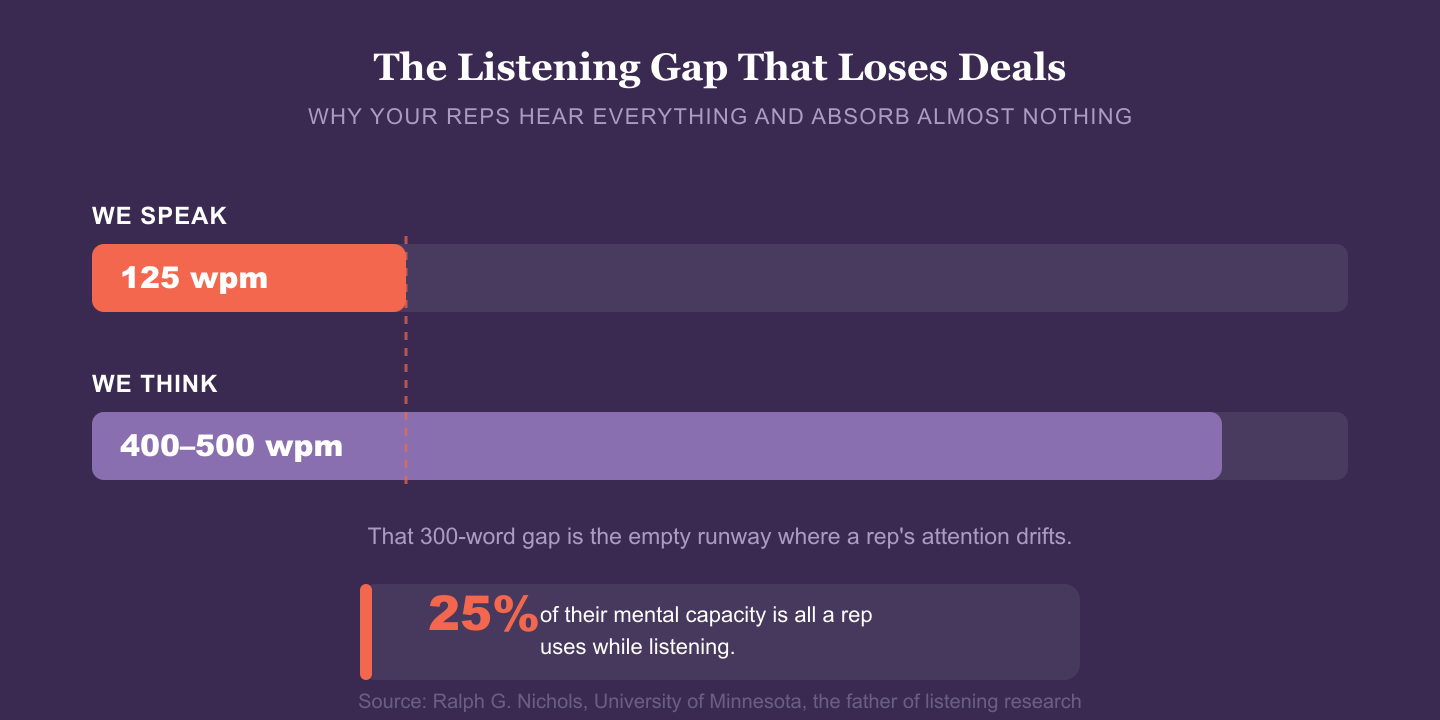
- We speak at about 125 words a minute but think at 400 to 500 (Ralph Nichols, University of Minnesota). That spare mental capacity is exactly why your reps' attention drifts while a prospect is still talking.
- Full-body listening means listening with your eyes, your ears, and your full presence. Not sitting there waiting for your turn to talk.
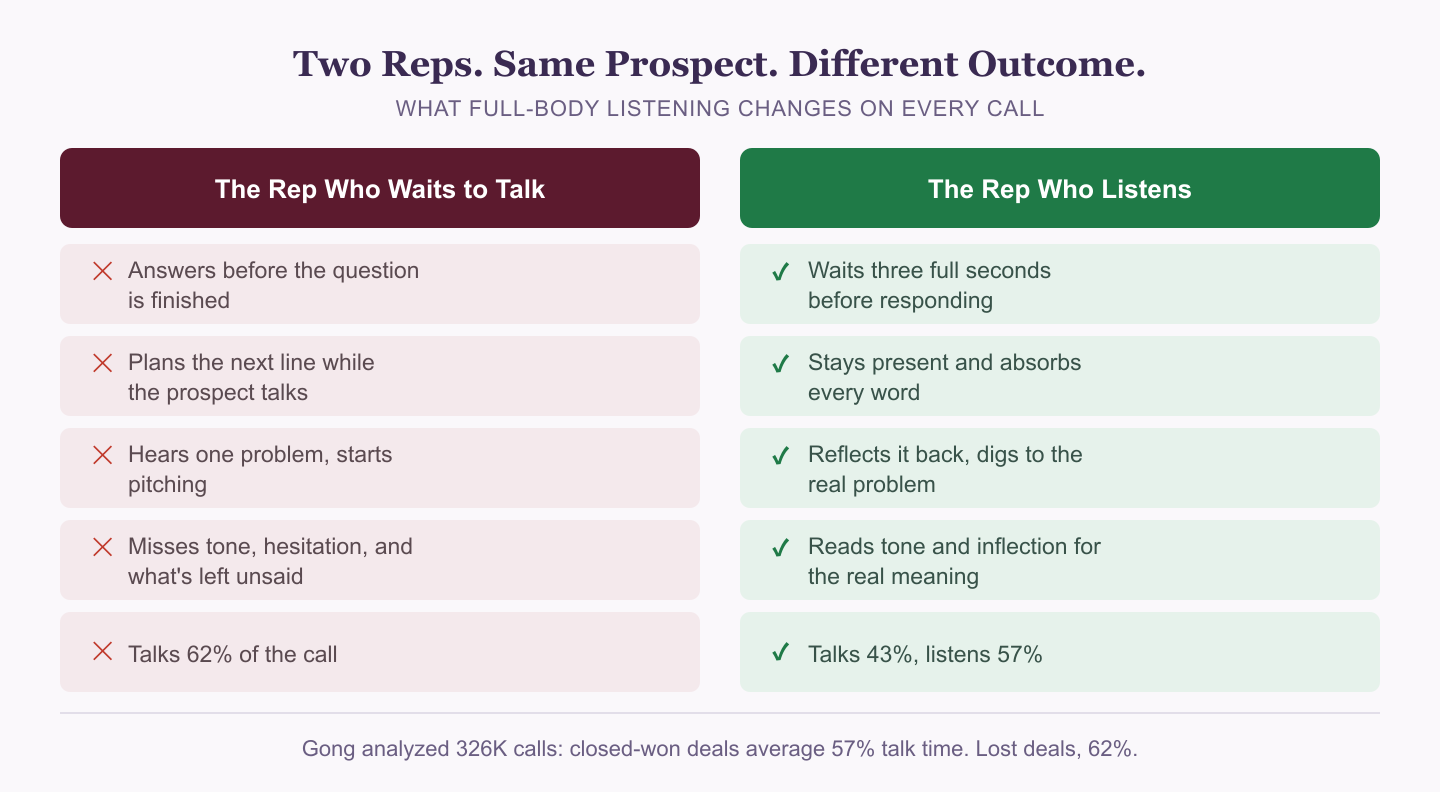
- Gong studied 326,000 sales calls: reps in closed-won deals talk 57% of the time. Reps in lost deals talk 62%. Five points of listening separates winning from losing.
- Listening is a skill you can teach. Week 11 of my sales training is built on one drill and a three-second rule any founder can install on their team this week.
- If your team has no sales process at all, listening drills won't save you. Listening is a discipline you layer onto a system. Build the system first, then coach the listening. That's the exact order I work in.
When LinkedIn asked B2B buyers what they want most from a salesperson, the top answer wasn't product knowledge. It wasn't price. It was active listening. 38% named it, the single most-wanted trait on the list (LinkedIn State of Sales). The same research found sales managers rank listening eighth when they hire.
Read that again. The thing your buyers care about most is the thing your hiring barely screens for.
I've spent fifty years in sales, and I'll tell you what I tell every founder I work with. A lot of the deals your team is losing this quarter aren't lost on price or product. They're lost because your reps showed up to talk instead of to listen. They rehearsed the pitch, memorized the feature list, and then spent the call waiting for a gap to jump into. The prospect felt it. And they bought from someone who made them feel heard.
The good news: listening is a skill, not a personality trait. You can teach it. Here's how.
Why Your Reps Aren't Really Listening
Everybody talks about the importance of listening, but few people ever hear anything. Most salespeople are so anxious to get their pitch out, or to answer a question before it's finished being asked, that they never actually absorb what the prospect said. It isn't laziness. It's wiring.
Ralph Nichols, the University of Minnesota professor known as the father of listening research, found that we speak at about 125 words a minute but think at 400 to 500. Your rep's brain has three or four times more capacity than the conversation is using. So while the prospect is still describing their problem, the rep's mind runs off to load the next question, rehearse the demo, or think about lunch. Nichols measured the result: when we listen to the average speaker, we're using only about 25% of our mental capacity. We forget roughly half of what we just heard almost immediately.
That's the gap. And it's where deals quietly die, because the prospect is usually telling you exactly how to sell to them. If your rep is only half there, they miss it.
You were given two ears and one mouth for a reason. If a salesperson isn't listening at least twice as much as they're talking, they probably aren't doing their job.
Full-Body Listening: Listen With More Than Your Ears
I love the phrase full-body listening. It captures something most sales training misses. Real listening isn't a passive thing you do with your ears while the rest of you checks out. It's active. You listen with your eyes, your posture, your attention, and your ears all at once. The prospect can tell the difference in about ten seconds, and so can you, because full-body listening is the only kind that actually gives you the information you need.
There are four habits I've taught for decades. Teach these to your team and you'll change the quality of every call they run.
1. Look them in the eye
Don't glare, but consciously make eye contact. It signals to the other person that you're paying attention, and on video calls it's the single easiest thing to get wrong. A rep reading their notes or glancing at Slack is telling the prospect they don't matter. Eyes on the person. Every time.
2. Stop rehearsing your next line
While the other person is talking, don't be thinking about what you're going to say next. It's a bad habit, and it's the exact moment you miss the most important thing they say. Trust that if you actually heard them, your next question will come to you. It always does.
3. Reflect it back
Occasionally repeat back all or part of what they said. Keep it conversational and don't be a parrot. If a prospect says, "Louie, I'm going to have a tough time getting this past the Operations Committee," it's fine to reply, "Operations can be tough. How do other things get through that committee?" Now they know you heard them, and you just learned how decisions really flow in their company. Two wins from one sentence.
4. Listen for tone and inflection
It's not always what people say, it's how they say it. Your prospect may be saying one thing and meaning another. I once had a buyer tell me, after we'd sent a proposal and agreed on a date to review it, that he "hadn't had time to look at it." I could hear in his voice that he had no intention of looking at it. So I asked, "You're really not interested enough yet to start going through our proposal, are you?" He said, "No." That saved both of us weeks. You only catch that if you're listening with your whole body.
The Three-Second Rule, and One Drill to Teach It
Here's the simplest rule I know for installing better listening, and you can put it on your team this week. Have your reps wait three seconds before answering, even when they already know the answer.
Three seconds does two things. It gives the impression they're actually listening, which builds trust. And more often than not, a better response comes to them during the pause. Silence isn't awkward on a sales call. It's productive. When a prospect finishes a thought and the rep doesn't instantly jump in, the prospect usually keeps going, and what comes next is frequently the real answer.
Now the drill I use in Week 11 of my training. It's a role play, and it works.
- Pair up two reps. One plays the salesperson, one plays a genuinely interested prospect.
- The salesperson gets exactly one sentence to introduce themselves and the company. That's it.
- The rest of the "sale" has to be made entirely with questions, and each question must be built on the answer the prospect just gave.
- Because you can't ask a good next question without hearing the last answer, the drill forces real listening. It sharpens questioning at the same time.
Listening and questioning go hand in hand. How can a rep know what to ask if they haven't heard what the other person is saying? Run this drill in a sales meeting and you'll watch it click for people who've been selling for years.
Quit selling and start letting your prospects buy. You do that by asking prepared, relevant questions and then actually listening to the answers. Inside those answers, the customer is telling you how the deal is going to flow.
How to Coach Listening on Your Team
You can't coach what you can't hear. If you're a founder still running most of the deals yourself, this is one of the first things you'll want to hand off well, because a team that listens scales in a way a team that pitches never will. Here's how I coach it.
Record and review the calls. Listening to recordings of your reps' calls tells you instantly how well they're listening to the person on the other end. Pay attention to the cues that a rep is distracted: paper shuffling, typing on the keyboard, answering before the question is done. Those sounds are the tell.
Run a total recall. At the end of a call or a meeting, ask the rep to reconstruct what the prospect actually said. Not what they think they heard. The specific problem, the cost, the decision process, the timeline. The gaps in their recall are the gaps in their listening, and now you know exactly what to coach.
Model it, then flip it. Make calls with your salespeople watching and listening to you. Then have them make calls while you watch and listen to them. Debrief every one. Listening is caught as much as it's taught, and reps copy what they see their leader do.
What Full-Body Listening Is Actually Worth
This isn't a soft skill with a soft payoff. Gong analyzed 326,000 sales calls and found the reps in closed-won deals talked 57% of the time. In lost deals, reps talked 62%. Their earlier research pegged the winning talk-to-listen ratio at roughly 43% talking, 57% listening. A handful of percentage points, in the right direction, is the measurable difference between the deals you win and the ones you don't.
Stack that on top of the buyer data. Active listening is the number-one trait buyers want, and the salespeople they eventually trust are the ones who made them feel understood before pitching anything. When your team learns to run a real discovery call and listen their way to the actual problem, close rates move. Reps stop guessing and start hearing the deal.
One honest caveat, because I'd rather tell you the truth than sell you a drill. If your company has no sales process and no system underneath it, teaching listening alone won't fix your numbers. Listening is one of 21 disciplines that sit on top of a working process. If a rep listens beautifully but there's no qualification, no defined stages, and no way to forecast, you'll just have very attentive salespeople losing deals in an organized way. You build the system first, then coach the listening into it. That's the order that works, and it's exactly the order I take founders through.
Frequently Asked Questions
Q: What is full-body listening in sales?
Full-body listening means paying attention with your eyes, your posture, your attention, and your ears all at once, not just waiting for your turn to talk. On a sales call it looks like real eye contact, no multitasking, reflecting back what the prospect said, and picking up on tone and inflection. It's the difference between hearing words and actually absorbing what the prospect means. Prospects feel it immediately, and it's the kind of listening that surfaces the information you need to win the deal.
Q: What's a good talk-to-listen ratio on a sales call?
Gong's research points to roughly 43% talking and 57% listening for top performers. In their study of 326,000 calls, reps in deals that closed talked about 57% of the time, while reps in lost deals talked 62%. The simple version I teach: if you're talking more than your prospect, you're pitching. Stop and ask a question. Your prospect should be doing most of the talking on a discovery call, because that's where your data comes from.
Q: Can you actually teach an experienced rep to listen better?
Yes. Listening is a skill, not a personality trait, and it responds to practice like any other. The hard part is that experienced reps have often built a strong habit of talking, so you're unwinding a habit as much as teaching a skill. The three-second pause, the one-sentence role play, and reviewing recorded calls together are the fastest ways I've found to break the old habit. I've watched thirty-year veterans get sharper on this in a matter of weeks once someone actually coached it.
Q: How do I know if my reps are listening on calls I'm not on?
Record the calls and listen back for the tells. Interrupting, answering before the question is finished, paper shuffling, keyboard typing, and long stretches where the rep is doing most of the talking. Then run a total recall: ask the rep to reconstruct exactly what the prospect said about their problem, the cost, the decision process, and the timeline. The gaps in their recall are the gaps in their listening, and that's precisely what you coach next.
Q: My founder-led team has no real sales process yet. Should I start with listening?
No, and I'd be doing you a disservice to say otherwise. Listening is a discipline that sits on top of a working sales process. If there's no qualification, no defined stages, and no way to forecast, then better listening just makes your team more pleasant while they keep losing deals. Build the system first. Then the listening drills have something to plug into, and they compound. Starting from zero isn't a disqualifier, it's actually the easiest place to start, because there are no bad habits to unwind first.
Q: How is this different from generic "active listening" training?
Most active-listening training is a one-day workshop that everyone forgets by Friday. What actually changes behavior is coaching it into real calls, week after week, against a real sales process. That means recorded-call reviews, the three-second rule, the one-sentence drill, and a manager who models it and then debriefs. It's not a seminar. It's a discipline you install and reinforce until it becomes how your team sells. That ongoing coaching is what a Fractional Sales Leader is built to do.
Your reps are on calls right now, waiting for their turn to talk.
Teaching a team to really listen, and building the process it plugs into, is exactly what I do with founders at $1M to $10M in revenue. See how the Founder's Corner turns founder-led selling into a system your team can run without you.
See How the Founder's Corner Works →Prefer to just talk it through? Book a 30-minute call.
About the Author
Louie Bernstein
Fractional Sales Leader with 50 years of sales experience helping $1M–$10M ARR companies build scalable, repeatable sales systems. Founder of MindIQ (INC 500). LinkedIn Top Voice in Sales Management, Sales Operations, and Sales Coaching.