You're ready to hire your first salesperson when you've proved a repeatable way to win customers and made your sales decisions teachable. Before posting the job, document who qualifies, how discovery works, what moves a deal forward, and when the rep needs help. Then test those instructions with someone else. A hire should add selling capacity, not depend on you to supply every next move.
Key Takeaways
- Hire when someone else can follow your sales decisions, not simply when your calendar is full.
- Review five wins, three losses, and two stalled deals as a starting exercise. Capture the buyer evidence behind your decisions.
- CRM stages should describe buyer progress. Sending a proposal doesn't prove a prospect is ready to buy.
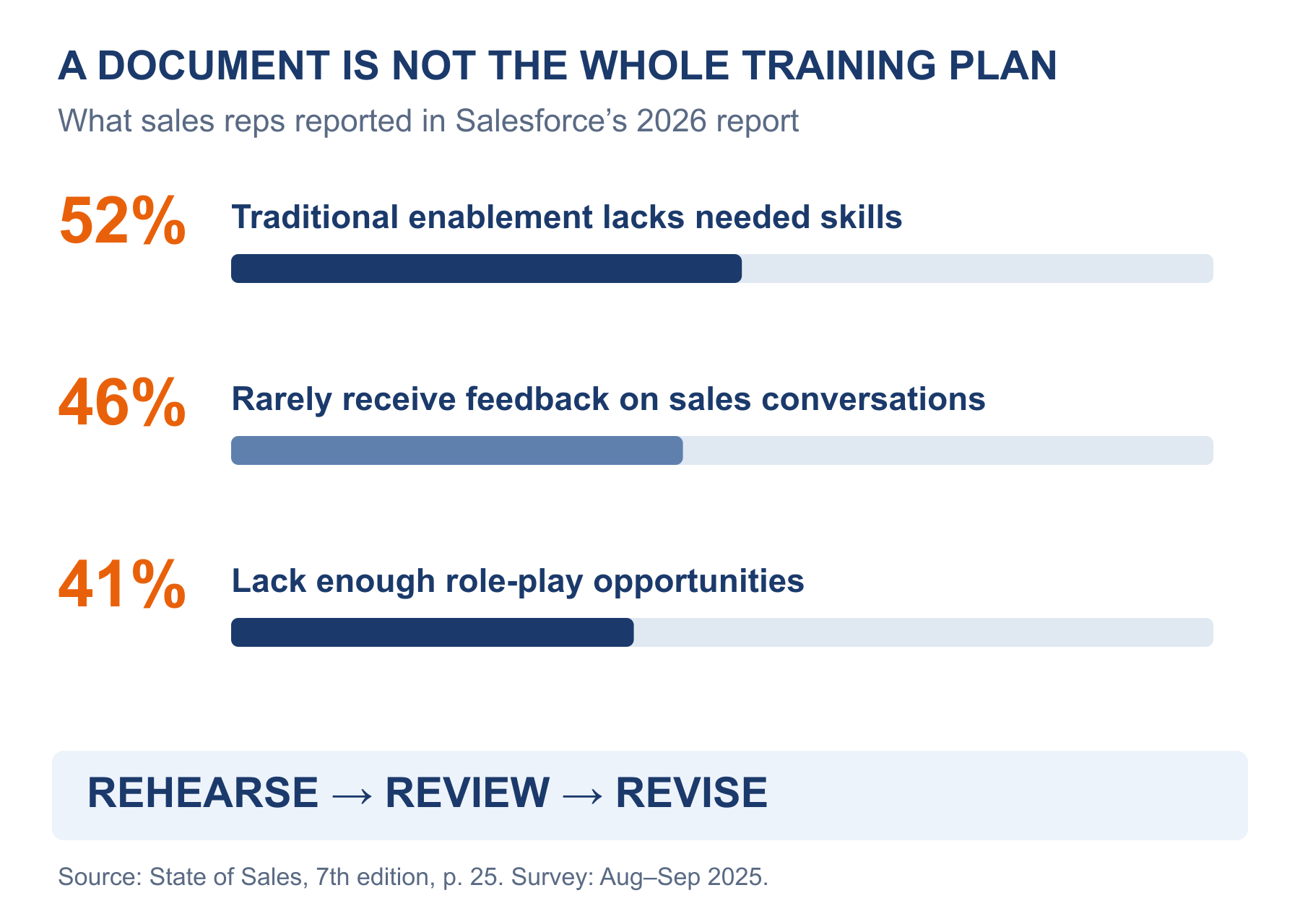
- In Salesforce's 2026 report, 52% of sales reps said traditional enablement didn't provide the skills they needed. Documents need practice and feedback.
- Define the first salesperson's job, lead source, ramp milestones, and manager before you make an offer.
You can hear a prospect's first answer and know whether the conversation is worth another half hour. You know when to push, when to pause, and when a polite objection means the deal is going nowhere.
Your first salesperson doesn't know any of that. And watching you sell won't reveal every decision you made silently.
For a founder at $1M to $10M ARR, the work before hiring is making those decisions visible. The useful question isn't whether you've written a Sales Playbook. It's whether another person can use the playbook when the buyer goes off script.
What do I need to have in place first?
Before hiring your first salesperson, have a proven buyer profile, a repeatable sales process, usable deal instructions, and a clear role with a funded ramp plan. Those pieces let a new rep work toward specific outcomes. Without them, you're asking the rep to figure out the business while also carrying a sales target.
Separate a capacity problem from a sales problem
Look at your recent customers. Do similar buyers purchase for similar reasons, through a process you can describe? Or does every win require a different offer, custom product promise, or personal favor? Revenue alone doesn't answer the readiness question.
A founder can win through authority that a new employee won't have. An old colleague returning your call is different from an unfamiliar buyer trusting your company. Mark relationship-driven wins separately so you don't build the rep's target around access the rep can't reproduce.
If you can't yet win consistently in a defined market, stay involved in selling and test the offer. You can hire someone explicitly to help discover a market, but that's a different job from hiring a salesperson to repeat a proven process. Set the expectations accordingly.
Write the economics and ownership down
Budget for salary, commissions, tools, recruiting, and your own coaching time while revenue builds. Use your actual sales cycle and margins to plan the cash requirement. Don't assume the rep's first month will look like your best month.
Write an Accountabilities Document that names the buyer, territory, lead sources, pipeline responsibilities, and results the role owns. State who manages the rep and what the founder still handles. A full-cycle salesperson, an inbound closer, and someone who books meetings need different instructions and targets.
How do I turn what's in my head into a usable Sales Playbook?
Turn founder intuition into a Sales Playbook by reviewing real deals and recording the evidence that changed your next move. Start with wins, losses, and stalled opportunities, not an empty template. A rep needs to understand what you noticed, what you asked, and why you advanced or stopped the deal.
Step 1: Pull a small, mixed set of deals
Start with five wins, three losses, and two stalled deals. That's a practical exercise, not a research sample or a proven threshold for hiring. Choose deals from the market your first rep will serve. Add more examples when the initial set doesn't reveal a consistent pattern.
Collect call notes, permitted recordings, emails, proposals, and CRM entries. Look for the point where a buyer became serious, a prospect stopped responding, or you realized there was no fit. Don't rewrite the history to make every decision sound brilliant.
Step 2: Capture the decision behind the words
- What did the buyer say or do that mattered? Record the words or observable behavior.
- What did you believe those signals meant? Separate your interpretation from the evidence.
- What question did you ask to check your interpretation? Include the follow-up, not just the opening question.
- What did you do next, and why? Name the condition for advancing, pausing, or disqualifying.
- What should a rep do if the buyer gives a different answer? Write a branch, not a rigid script.
For example, 'They're interested' tells a rep very little. 'The operations leader described missed delivery dates, agreed the problem needs fixing this quarter, and invited finance to the next call' gives the rep something to verify. Interest and a buying process aren't the same thing.
Step 3: Keep the first version small
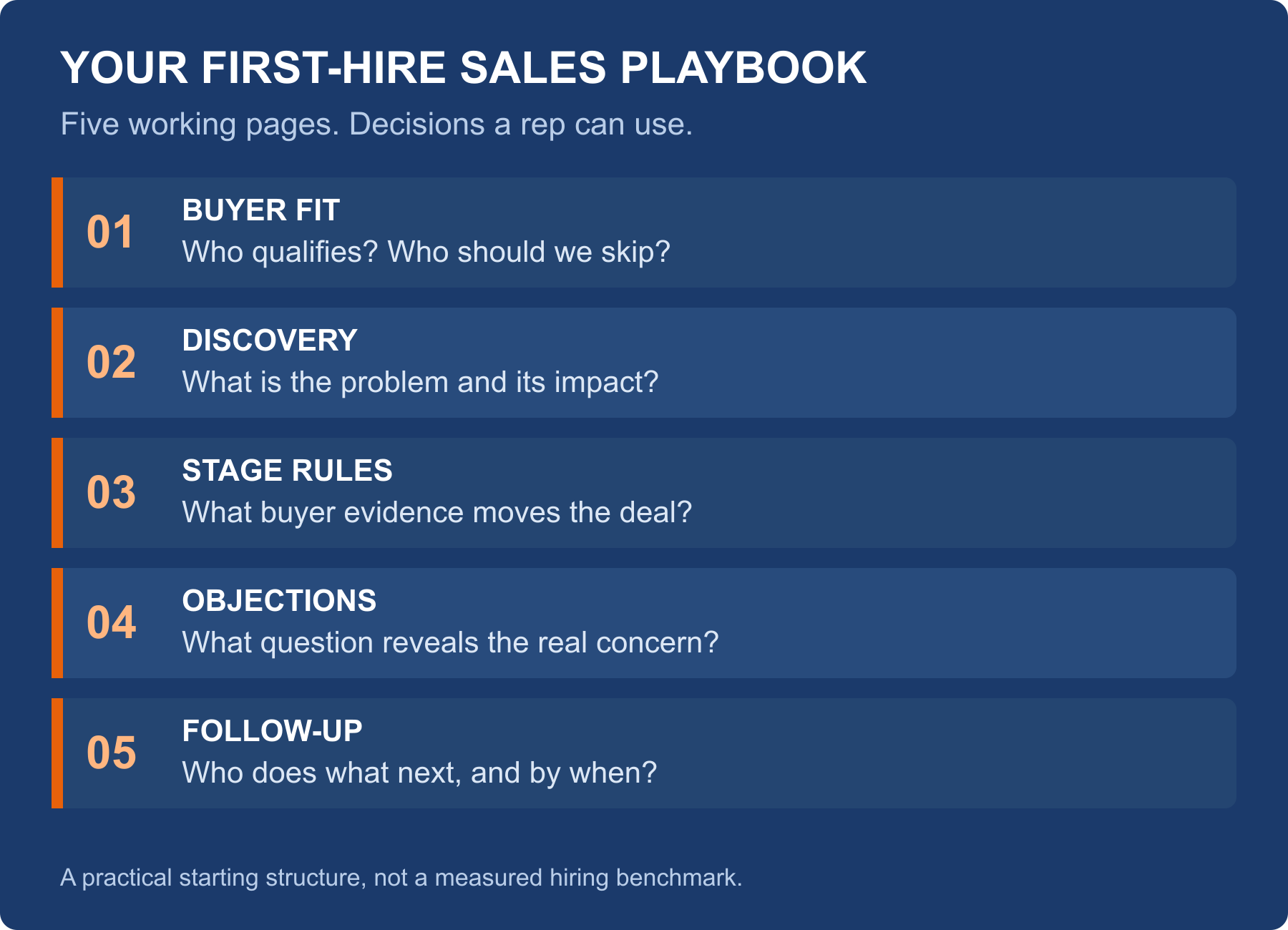
Build five working pages: buyer fit, discovery, stage rules, objections, and follow-up. Link useful examples underneath each page. Put the current version where a rep can find the answer during a working day. Assign one owner to update the playbook after call reviews.
Write down the decision a salesperson needs to make, not just the sentence you happened to say.
What should my rep qualify, and how should the CRM stages work?
Your first salesperson should qualify buyer fit, the business problem, the reason to act, and the path to a decision. CRM stages should require evidence of buyer progress before an opportunity advances. Clear exit criteria keep a rep's optimism from becoming your forecast and show you exactly where coaching is needed.
Step 4: Give discovery a clear job
Write questions that uncover the current situation, the cost of leaving the problem alone, the desired outcome, and the people involved in approval. Include disqualifiers, such as an unsupported use case or an implementation requirement you can't meet. The rep should know when to stop pursuing.
In Salesforce's 2026 report, 69% of sales professionals said measurable ROI mattered more to customers than a year earlier (Salesforce, 2026, page 8). The report surveyed 4,050 sales professionals across 22 countries in August and September 2025. The survey isn't specific to first hires; use the finding as a reason to teach business-impact questions, not as a forecast for your company.
Don't have the rep manufacture an ROI number to fill a field. Ask the buyer how the problem affects time, cost, revenue, or risk. Record the assumptions and who confirmed them. An honest unknown should become a discovery task, not an invented answer.
Step 5: Make stage advancement observable
| Example stage | Evidence needed to advance |
|---|---|
| Discovery | Buyer fit and a business problem are confirmed; missing qualification answers are named. |
| Solution review | Buyer confirms the proposed approach addresses the problem; needed stakeholders are involved. |
| Commercial review | Scope and terms are being evaluated through a known approval process, with a dated next step. |
| Closed won | Your defined booking requirements are met, such as a signed agreement and any required payment. |
Adapt the stages to your sale. A security review may deserve its own stage in one business and be irrelevant in another. Keep unqualified leads outside the qualified opportunity forecast. A demo delivered or email sent is an activity, not proof that the buyer moved.
Keep the essential CRM fields short: problem, impact, decision participants, decision process, next action, owner, and date. Define what belongs in each field. Review a sample deal together so 'decision maker identified' means more than a name copied from LinkedIn.
How do I document objections and follow-up without writing a giant manual?
Document objections as short decision guides and follow-up as buyer commitments with owners and dates. Each objection entry needs a clarifying question, an honest response, and a next step. Each follow-up should connect to a problem the buyer named. A library is useful when a rep can apply the answer under pressure.
Step 6: Build an objection entry from a real exchange
Take 'Your price is too high.' Record the context, then give the rep a question: 'Too high compared with another option, the budget available, or the value you expect?' Those answers call for different conversations. A discount doesn't solve a buyer's doubt about whether the product will work.
Include approved proof, pricing boundaries, and the condition that requires help. If the buyer needs a capability you don't offer, say so. Don't put a clever rebuttal in the playbook when the honest answer is that the prospect isn't a fit.
Step 7: Write follow-up that earns the next conversation
Give the rep a short recap template: the buyer's problem, what was agreed, open questions, and the next action with an owner and date. For a proposal, add how the buyer will evaluate the offer and when the relevant people will review it.
Agree on a follow-up cadence that matches your buyers. Explain when to close an inactive opportunity or move the contact to nurture. Repeated 'just checking in' emails aren't a substitute for a reason to act. A rep should be able to explain why the next message helps the buyer.
What I've seen founders get wrong
In my work with sales teams, the temptation is to jump into a stuck deal and close it for the rep. I've written about that pattern because rescuing the deal can leave the salesperson with exactly the same skill gap. The next difficult conversation comes back to the founder.
Use the playbook review to coach the missing decision. Ask what evidence the rep has, what remains unknown, and what question would resolve the gap. When you do need to join a call, name your role beforehand and debrief the reasoning afterward. The goal is to teach judgment.
How do I know the playbook is good enough to hire against?
Your playbook is good enough to hire against when another person can use it to explain qualification, choose a defensible next step, and recognize when help is required. Test the instructions before you depend on the hire for revenue. A finished document shows that you wrote something; a rehearsal shows whether the instructions work.
Step 8: Run a rehearsal before recruiting
Ask a colleague or sales adviser unfamiliar with the deal to use the playbook in a mock discovery call. Give them an anonymized buyer scenario with an objection and a missing decision-maker. Watch whether they find the relevant guidance without you supplying every answer.
Salesforce's 2026 report found that 52% of reps said traditional enablement didn't provide needed skills, 46% rarely received feedback on sales conversations, and 41% lacked enough role-play opportunities (Salesforce, 2026, page 25). These are self-reported training gaps, not measured effects of a specific playbook. Build practice and feedback into your own ramp plan.
Score the rehearsal on observable behavior: did the person uncover the problem, distinguish facts from assumptions, identify a fit issue, and secure a useful next step? If they stumble because the instruction is missing, revise the page. If the instruction is clear but the skill is weak, practice the skill.
Step 9: Hire for the sale you actually have
Use the tested playbook to build an interview scorecard. Look for experience with comparable buyers, deal sizes, sales cycles, and lead sources. Give shortlisted candidates the same short role-play and evaluate their questions, listening, and response to feedback. Don't reward a polished pitch that skips discovery.
Set 30-, 60-, and 90-day milestones around learning and demonstrated execution, with revenue expectations tied to your actual cycle. Schedule coaching and pipeline reviews before day one. Write the escalation rules for pricing exceptions, product promises, and strategic accounts. Independence requires boundaries as well as instructions.
You're ready to hire when the rep has a job to execute and a manager to learn from. Being tired of selling isn't the same test.
Related ReadingHow to Run a Discovery Call With a New Prospect →
Frequently Asked Questions
Can I hire someone to build the playbook for me?
Yes, if building the sales process is explicitly part of the role and you budget time for the work. An experienced Fractional Sales Leader can help extract and test your process. A new rep hired to hit quota shouldn't quietly inherit an undefined process-building job.
Do I need expensive software before my first salesperson starts?
No. Start with a shared playbook and a CRM that reliably records qualification, next steps, and deal ownership. Add tools when a specific recurring task justifies them. Software can't supply a buyer definition or decide what makes an opportunity qualified.
Should I record every founder sales call?
Record calls only with appropriate notice and consent under the rules that apply to the conversation. Where recording isn't appropriate, use detailed notes and buyer-approved recaps. Capture the reason behind your decisions while the conversation is fresh.
Should my first salesperson be commission-only?
Don't use commission-only pay to avoid budgeting for a ramp. Choose a lawful compensation plan suited to the role and market, and put the terms in writing. Ask whether a capable candidate can realistically earn the promised amount using the pipeline and process you can provide.
How should I handle confidential customer examples in training?
Remove identifying and sensitive information unless you're authorized to use it. Preserve the sales lesson: buyer role, business problem, decision path, and next action. A rep doesn't need confidential commercial terms to understand why you qualified or disqualified a deal.
What if the new rep suggests a better way to sell?
Test the suggestion against actual buyer responses and update the playbook when the evidence supports it. Give the rep room to improve the process within pricing and product boundaries. A Sales Playbook should preserve useful learning, not freeze the founder's habits forever.
Get your sales decisions out of your head.
If you're a founder at $1M to $10M ARR preparing for your first sales hire, I'll help you turn your selling experience into a usable system. Learn how a Fractional Sales Leader can help at LouieBernstein.com.
Schedule a 30-Minute CallAbout the Author
Louie Bernstein
Louie Bernstein is a Fractional Sales Leader with 50 years of sales experience. He founded MindIQ and helps B2B founders build repeatable sales processes, develop their teams, and reduce dependence on founder-led selling.