Key Takeaways:
- Cutting costs across the board is the reflex most founders reach for in a downturn. It is also the fastest way to kill your business.
- Only 9% of companies come out of a recession stronger than they went in (Harvard Business Review, 4,700 firms). The ones that do cut selectively and keep investing. They do not panic-cut.
- Cut the non-essentials. Never cut sales or customer service. Keeping a customer costs 5 to 25 times less than winning a new one (Bain).
- A downturn puts more top talent on the market than any other moment. That is when you upgrade your team, not shrink it.
- Review your cash every single week. Running out of cash is cited in 38% of startup failures (CB Insights). It is almost always preventable.
- Cut the waste, double down on your strengths, and get closer to your customers. That is how you win while everyone else is panicking.
Every time the economy wobbles, I get the same question from founders. "Louie, shouldn't I cut costs in a recession?"
My answer usually surprises them. Slashing costs can be the fastest way to kill your business.
I don't say that to be contrarian. I say it because I've lived it. I led my company through four recessions over 22 years running it. Twice I had 24 employees depending on me while the economy was falling apart. It wasn't pretty. But I learned what actually works when the storm hits, and it's almost the opposite of what the panic-voice in your head is telling you to do.
If you're a founder somewhere between $1M and $10M in revenue, still doing most of the selling yourself, a downturn is the moment that separates the companies that come out stronger from the ones that quietly disappear. Here's how to be in the first group.
The Instinct That Feels Safe and Isn't
When revenue gets shaky, the reflex is to grab a red pen and start crossing out line items. It feels responsible. It feels like control. And on a spreadsheet, every dollar you cut drops straight to the bottom line, so it looks like progress.
The problem is that most founders cut the wrong things. They cut the parts of the business that actually bring in money because those are the most expensive, and expensive is what the panic-voice wants gone. That's how you turn a slow quarter into a death spiral.
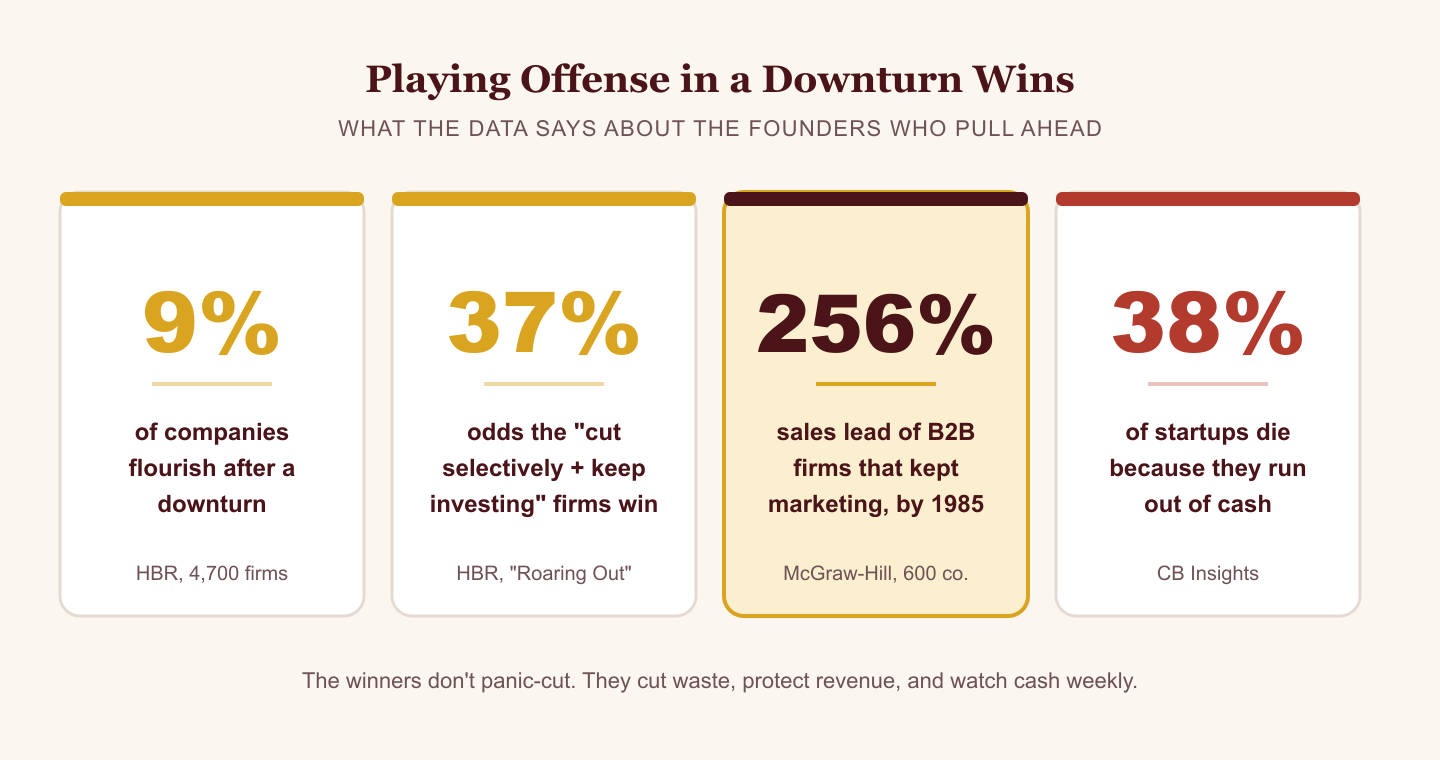
The data on this is clear, and it's worth sitting with. Harvard Business Review studied 4,700 companies across three recessions. Only 9% of them came out healthier than they went in, beating their rivals by at least 10% in sales and profit growth (Gulati, Nohria & Wohlgezogen, HBR). The companies most likely to be in that winning group weren't the deepest cutters and they weren't the reckless spenders. They were the ones who cut costs selectively, on operational waste, while they kept investing in the things that drive growth. HBR gives that group a 37% chance of pulling away from the pack. The pure cost-cutters had the lowest odds of all.
"A recession is when the bank calls you in for a meeting. A depression is when the bank cancels your line of credit. Know the difference, and don't treat the first one like the second."
There's a difference between trimming fat and cutting muscle. Founders who can't tell them apart cut both, and the business never recovers its strength. The rest of this article is about knowing which is which.
Cut the Non-Essentials, and Nothing Else Yet
Yes, you cut. But you start with the waste, not the muscle. Almost every company I've ever looked inside is carrying dead weight it forgot it was paying for.
What actually qualifies as non-essential
Go line by line through your spend and pull the things that don't touch a customer or a sale:
- Software subscriptions half your team forgot they had. Audit every recurring charge. You'll be shocked.
- Discretionary travel and events that felt fine when times were good and don't move a deal forward now.
- Vanity projects and nice-to-haves. The rebrand, the new office plant service, the initiative nobody can tie to revenue.
- Ad channels that never proved themselves. Not marketing as a whole. The specific channels with no measurable return.
- Redundant tools that overlap with something you already pay for.
None of that hurts a customer. None of it costs you a sale. Cutting it makes you leaner and buys you runway. That's the whole point of the exercise, to free up cash so you can protect and even strengthen the parts that matter.
The line you don't cross
Here's the sort I run in my head, and I've put it in front of you below so you can run it in yours. On one side is what you cut first. On the other is what you protect at all costs, no matter how tempting it looks on the spreadsheet.
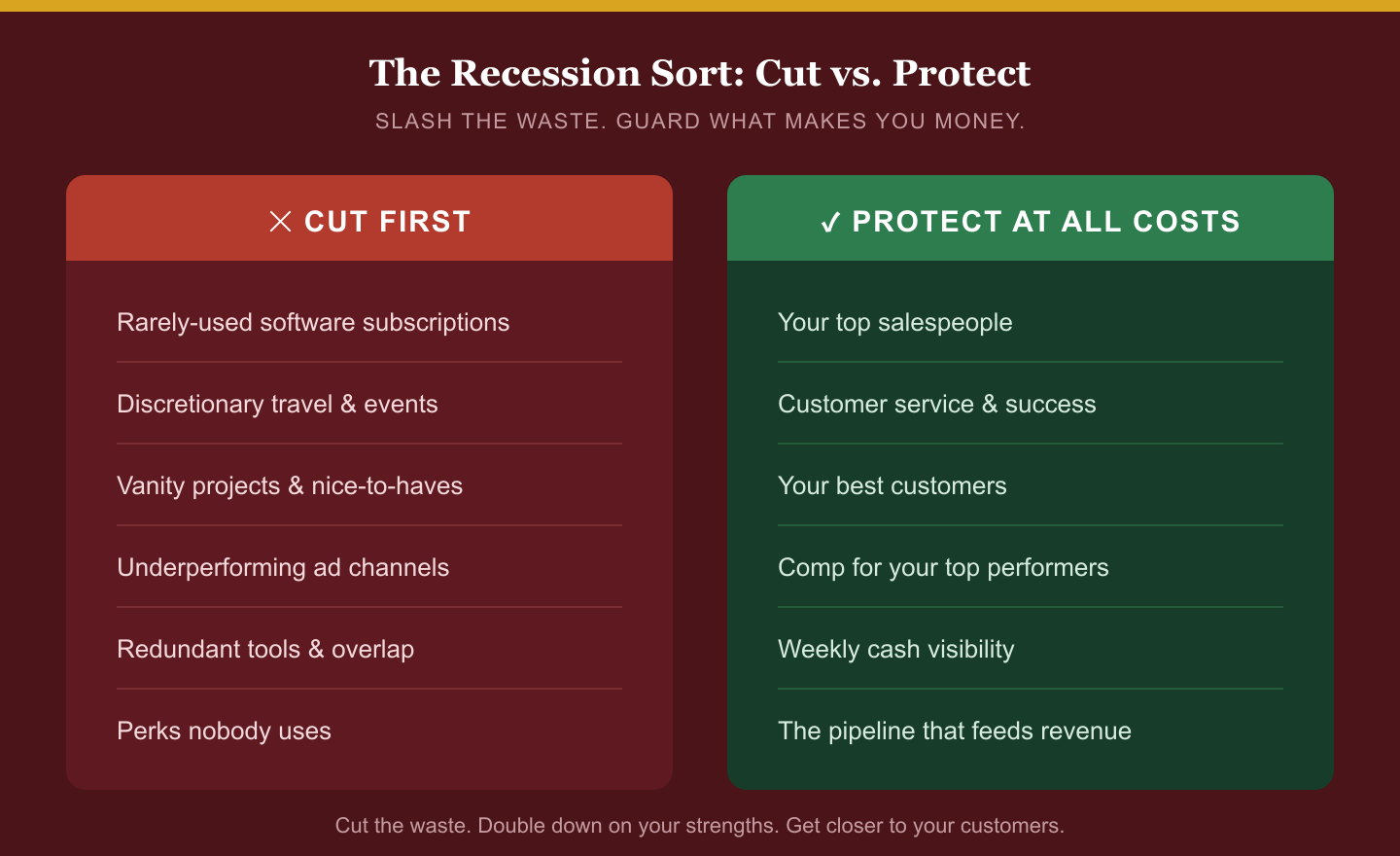
Notice what's on the protect side. Every one of those items either brings money in or keeps money from walking out the door. That's the test. If a line item feeds revenue or retention, it isn't a cost. It's the engine. You don't unbolt the engine to make the car lighter.
Never Cut Sales or Customer Service
This is the one I'll die on. When money gets tight, sales and customer service look like big, cuttable expenses. They're not expenses. They're the two functions standing between you and going out of business.
Your existing customers are your lifeline
In a downturn, keeping the customers you already have is worth more than it's ever been. Acquiring a new customer costs 5 to 25 times more than retaining an existing one, and a 5% lift in retention can raise profits anywhere from 25% to 95% (Bain & Company, Fred Reichheld). When budgets everywhere are getting scrutinized, the fastest way to lose revenue is to let service slip and give a nervous customer a reason to leave.
So do the opposite of cutting. Get closer. Call your best customers more often, not less. Ask how they're holding up and how you can help. Train your team to sell like trusted advisors, because a recession is exactly when consultative selling wins and product-pushing dies. Your customers are more worried than you are. Show them you understand the spot they're in, and you'll come out the other side with loyalty your competitors gave away.
Pull back on selling and your competitors eat your share
Here's a number that should stop you cold. McGraw-Hill studied 600 B2B companies through the 1981 to 1982 recession. The firms that kept their sales and marketing pressure on during the downturn had sales 256% higher by 1985 than the ones that pulled back (McGraw-Hill Laboratory of Advertising Performance). Same recession. Wildly different outcomes. The difference was who kept showing up while the other guy went quiet.
If anything, this is the moment to increase compensation for your top performers. Your best salesperson is your single best ROI, and a downturn is when you least want them tempted to look elsewhere. Protect the people who bring in the money.
Cutting your sales team to survive a recession is like throwing your oars overboard to make the boat lighter. It floats a little higher for a minute. Then you can't go anywhere.
Buy Top Talent While It's on Sale
Here's the opportunity almost nobody talks about, because it feels backward. A downturn is the best hiring market you will ever see.
When companies panic-cut, they lay off good people. During the last major recession, U.S. unemployment peaked at 10% in October 2009 (Bureau of Labor Statistics). That's a lot of talented, capable people suddenly available who would never have taken your call in a boom. Some of them are exactly the salesperson or operator you couldn't get anywhere near a year ago.
While your competitors are shrinking, you can be selectively upgrading. This is how the 9% who come out stronger do it. They treat the downturn as a talent buying window. You don't need to hire a crowd. You need to add one or two people who are meaningfully better than what you had, at a moment when they're actually reachable. That single decision can carry you into the recovery with a stronger team than you started with.
Watch Your Cash Every Single Week
Everything above depends on one discipline: knowing exactly where your cash is, all the time. Not monthly. Weekly.
Running out of cash is cited in 38% of startup failures, second only to building something the market didn't want (CB Insights). And the brutal part is how preventable it usually is. Founders run out of cash not because the money vanished overnight, but because they weren't looking closely enough to see it draining, week over week, until it was too late to react.
A weekly cash review doesn't need to be fancy. Cash in, cash out, what's committed, how many weeks of runway you have at the current burn. Fifteen honest minutes. Do that, and you'll spot trouble while you still have room to steer. A few more moves that let you sleep at night:
- Write out your worst-case scenario. On paper. You'll have a plan ready, and you'll sleep better having faced it.
- Cross-train your people so the business bends instead of breaking if you have to run leaner.
- Communicate with your team. They aren't blind. Give them the facts and your plan to get through it.
- Keep your sales playbook and operations up to date, so knowledge doesn't walk out the door if people do.
The storm may come. With the right preparation, you weather it. It's your job to make sure the company is still standing after it passes, and it always passes.
The Real Question Under the Question
Here's what I've noticed after four recessions and a lot of founder conversations. The founders who panic-cut sales are almost always the ones who are the sales department. When you're the only one who can really sell, sales feels risky and expensive, because it all runs through you. So when fear hits, that's what you reach for.
That's the actual vulnerability. Not the recession. The fact that your revenue depends entirely on you. A downturn just exposes it. If you're stuck in founder-led sales with no repeatable system, a bad quarter doesn't just dent the numbers, it threatens the whole company, because there's no engine to keep selling when you're stretched thin, distracted, or worn out.
The fix isn't a full-time VP of Sales you can't justify in a downturn. It's building a sales system your team can actually run, so revenue doesn't live or die by your calendar. That's the work I do with founders between $1M and $10M as a Fractional Sales Leader, and it's exactly what makes a company recession-resistant instead of recession-fragile.
One honest note. If you have no sales process in place at all yet, that's not a reason to skip this. It's the reason to start. The whole point is to build that first repeatable system, and there's no better time than when the pressure is forcing you to get disciplined anyway.
Frequently Asked Questions
Q: Should I cut costs in a recession at all?
Yes, but selectively. Cut the non-essentials: unused software, discretionary travel, vanity projects, ad channels with no measurable return. What you don't cut is anything that brings in revenue or keeps a customer. Harvard Business Review found the companies most likely to come out of a recession stronger were the ones that cut waste and kept investing in growth at the same time, not the deepest cutters. Trim fat, protect muscle.
Q: Why shouldn't I cut my sales team to save money?
Because your sales team is what keeps revenue coming in, and revenue is what survives a recession. Companies that kept their sales and marketing pressure on through the 1981 to 1982 recession had sales 256% higher by 1985 than the ones that pulled back (McGraw-Hill). Cutting sales to save money is like throwing the oars overboard to lighten the boat. If anything, protect and reward your top performers so you don't lose them.
Q: What should I actually focus on to survive a downturn?
Four things. Cut the non-essentials. Protect sales and customer service. Add top talent while it's available and cheaper to reach. Review your cash every single week. Underneath all four is getting closer to your existing customers, because keeping a customer costs 5 to 25 times less than winning a new one (Bain). Do those, and you're playing offense while your competitors hide.
Q: Isn't a recession a strange time to hire?
It's actually the best time. When other companies panic-cut, strong people hit the market who wouldn't have taken your call in a boom. U.S. unemployment hit 10% in the last major recession (Bureau of Labor Statistics), which meant a lot of capable talent was suddenly reachable. You don't hire a crowd. You add one or two people who are clearly better than what you had, and you walk into the recovery stronger than you started.
Q: How often should I review cash flow in a downturn?
Weekly, without exception. Running out of cash is cited in 38% of startup failures (CB Insights), and it's almost always because the founder wasn't watching closely enough to see it coming. A fifteen-minute weekly review of cash in, cash out, and weeks of runway lets you spot trouble while you can still steer. Pair it with a written worst-case plan so you're never reacting blind.
Q: I'm still the one doing all the selling. Where do I even start?
Start by admitting that's the real risk, not the recession. When revenue runs entirely through you, one hard quarter threatens the whole business. The move is to build a repeatable sales system your team can run without you. You don't need a full-time VP of Sales to do it. A Fractional Sales Leader builds that first system with you, and a downturn is the right time to get disciplined about it, not to put it off.
Want to win while everyone else is panicking?
The founders who come out of a downturn stronger don't panic-cut. They protect revenue and build a sales system their team can run without them. That's exactly what I do with founders at $1M to $10M in revenue. Even if you have no sales process in place yet, this is where you start.
See How the Founder's Corner Works →Prefer to just talk it through? Book a 30-minute call.
About the Author
Louie Bernstein
Fractional Sales Leader with 50 years of sales experience helping $1M–$10M ARR companies build scalable, repeatable sales systems. He led his own company through four recessions over 22 years and made the INC 500 as founder of MindIQ. LinkedIn Top Voice in Sales Management, Sales Operations, and Sales Coaching.