Sales practice for founder-led teams
Your reps shouldn't need you to supply the next question on every difficult call. Give them a place to rehearse the conversation before the buyer is listening. These five drills turn daily training into work your team can actually use.

By Louie Bernstein · Last updated
Daily sales drills help reps rehearse specific buyer conversations before real calls. Choose one skill, give the buyer a realistic prompt, let the rep try, offer one correction, and repeat. Practice discovery, qualification, objections, next steps, and product value. Judge the routine by changed behavior on calls, not attendance alone.
Start with the buyer conversations your reps repeatedly hand back to you. For a B2B founder at $1M to $10M ARR, a useful drill develops the judgment a salesperson needs when you aren't in the meeting. Choose the weakest moment in your actual sales process before choosing tomorrow's exercise.
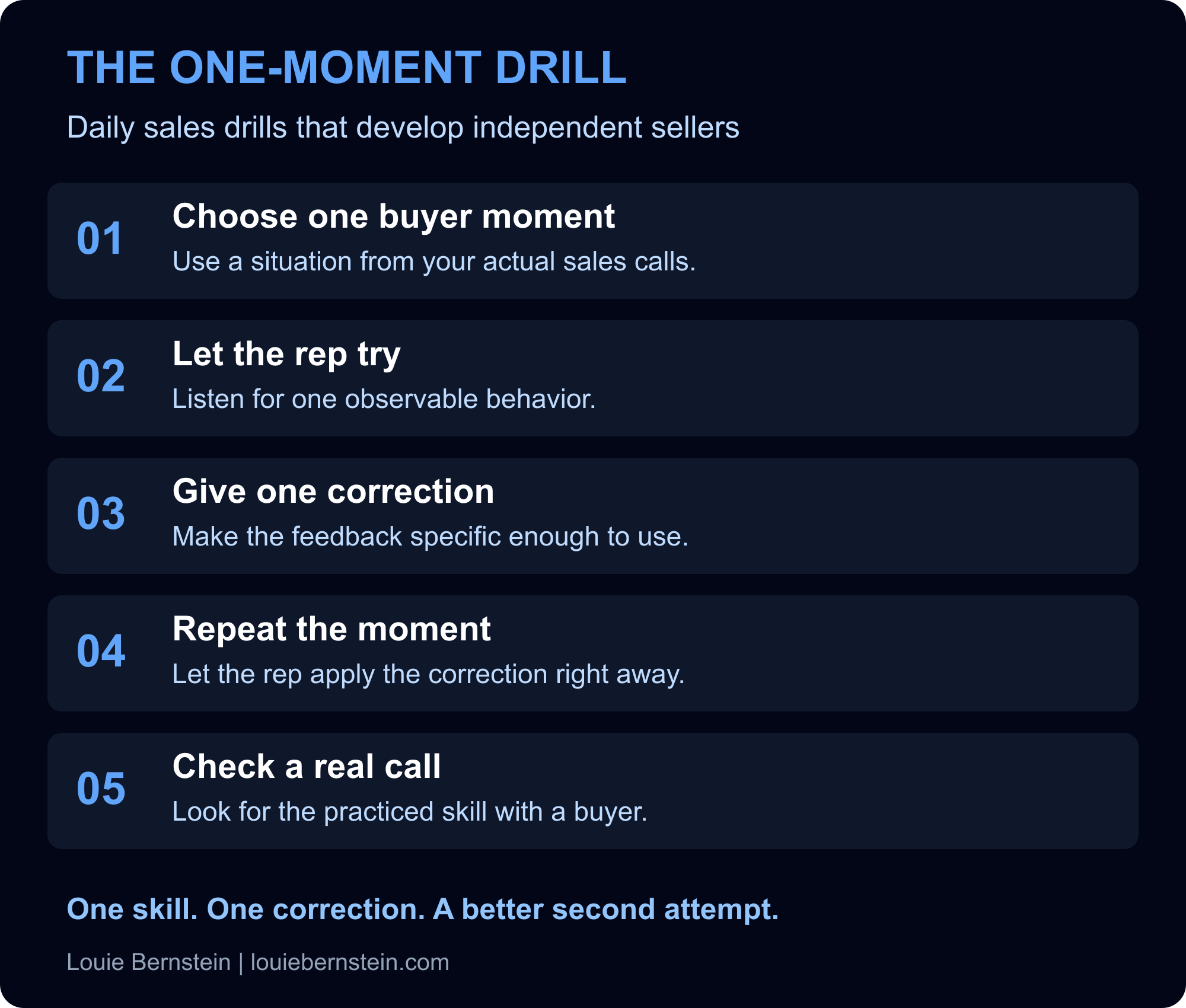
The One-Moment Drill is a practice routine: rehearse one buyer moment, coach one observable behavior, repeat the moment, and check the behavior on a real call. The name describes the narrow scope. You're developing a skill the rep can use, rather than asking someone to perform an entire sales meeting from memory.

Buyer prompt: 'Our reporting takes too long.' Give the buyer a private fact: the operations manager spends Friday afternoon rebuilding numbers for Monday's meeting. The rep's job is to understand the work and its effect before showing a feature. Ask a natural follow-up, listen to the answer, and explore what the delay prevents. Don't reward a long list of questions delivered without listening.
Run the conversation for two minutes. The observer writes down whether the rep's next question used something the buyer actually said. Ask the buyer which question helped them explain the problem. Then repeat from the opening line with one correction. Change the private fact next time so the rep has to listen instead of reciting yesterday's successful question.
What good looks like: The rep connects a follow-up question to the buyer's answer and confirms a business consequence without inventing one.
Buyer prompt: 'Send us a proposal and we'll take a look.' The buyer likes the idea but hasn't involved the person who approves the purchase. Give the rep only the information they'd reasonably have at this stage. Ask them to establish what decision the proposal supports, who needs to participate, and whether a next conversation is warranted. The aim isn't to force every prospect into an opportunity.
After the first attempt, ask the rep to separate what the buyer confirmed from what the rep assumed. Have the buyer explain what remains unknown. Practice a respectful question about the decision process, then run the moment again. A rep who uncovers a poor fit has done useful work. Don't score qualification by how many deals remain open.
What good looks like: The rep names the missing qualification evidence and agrees on a next step that fits the buyer's actual situation.
Buyer prompt: 'Your price is too high.' Give the buyer a reason, such as comparing your service with a smaller scope of work. The rep shouldn't know that reason in advance. Ask the rep to acknowledge the concern and clarify the comparison before defending the price. A polished answer to the wrong objection still leaves the buyer's concern unresolved.
The observer listens for an immediate discount or a speech about value before the concern is understood. Give feedback on that specific choice. On the second attempt, have the rep ask a question in their own words and explain only the relevant difference. Don't turn the buyer into an opponent who rejects everything. Make the resistance believable enough to require judgment.
What good looks like: The rep identifies what the buyer is comparing and responds to that concern without offering an automatic discount.
Buyer prompt: 'That was helpful. Send me something.' The rep has two minutes left in the meeting. Ask the rep to summarize the problem accurately and suggest a next action with a reason for the buyer to participate. 'I'll check in next week' is a seller activity. A working session to confirm requirements has a purpose both sides can evaluate.
Ask the buyer to push back once: 'I don't know if we need another meeting.' The rep must explain the proposed action without pretending urgency exists. Let the buyer decline when the fit isn't there. Replay the close and ask the observer to record the action, owner, and date actually agreed. A calendar invitation alone doesn't establish that the buyer sees value.
What good looks like: Both sides understand the next action, who owns it, when it happens, and why it helps the buyer decide.
Buyer prompt: 'What would our team do differently with your product?' Give the rep a specific role and workflow, such as an operations lead reconciling information across systems. The rep has to connect a relevant capability to a change in that person's work. Stop the feature tour. Ask the rep to explain the difference simply enough that the buyer could repeat it to a colleague.
Invite a senior rep to lead this drill or ask someone from product to play the buyer. A product expert can correct an inaccurate claim while a salesperson checks whether the explanation answers the question. Repeat with a different buyer role. Don't promise savings, integrations, or results your team can't support. A confident explanation still needs to be accurate.
What good looks like: The rep describes a supported capability, the buyer's relevant workflow change, and a question that checks whether the change matters.

A daily commitment gives your team a regular place to work on the small conversations that decide whether a sale moves forward. In our company, we held sales training every business day at noon, allowed lunch, and usually stayed within 33 minutes. Monday through Thursday typically used a course lesson; Friday covered product or industry training. That was our routine, not a claim that every team needs exactly 33 minutes. For the broader management habits behind that commitment, read how to build a desire in your team to learn and get better.
A daily drill gives the lesson a job. Reps bring a difficult buyer moment, try a response, hear feedback, and leave knowing where they'll apply the correction. Keep useful questions and examples in your Sales Playbook. Update that guide when the team learns something worth repeating. You don't need a new topic every day. Repeat the same skill against different situations until reps can apply it without the founder supplying the words. Systems before people means giving the team a shared standard to practice.
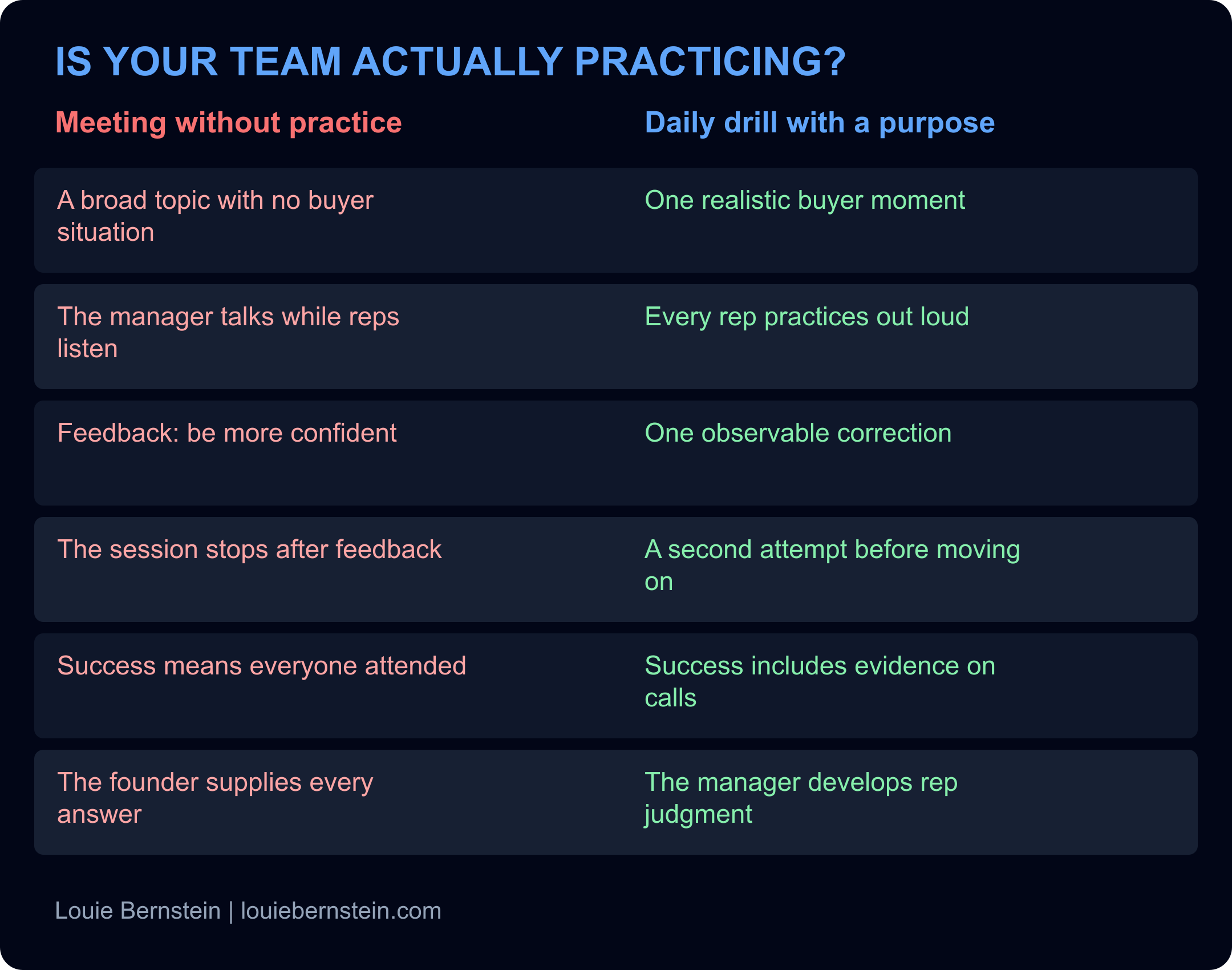
A useful drill ends with a better attempt and a clear application. Use this comparison to inspect your next session. The downloadable PNG contains the same six checks as the accessible text table.

| Meeting without practice | Daily drill with a purpose |
|---|---|
| ✕ A broad topic with no buyer situation | ✓ One realistic buyer moment |
| ✕ The manager talks while reps listen | ✓ Every rep practices out loud |
| ✕ Feedback: be more confident | ✓ One observable correction |
| ✕ The session stops after feedback | ✓ A second attempt before moving on |
| ✕ Success means everyone attended | ✓ Success includes evidence on calls |
| ✕ The founder supplies every answer | ✓ The manager develops rep judgment |
Protect a short block and prepare the buyer situation before people arrive. Here's a suggested 15-minute drill you can use within a longer training session. The minutes below are a starting agenda, not a measured formula or a reconstruction of every session we ran.
Name the skill and the observable standard. Give the buyer their private facts. Put people in pairs, or groups of three when you have an observer. Keep the brief short enough to start practicing promptly. For remote teams, use breakout rooms and the same call medium reps use with buyers.
Give both partners a turn as the rep. After each first attempt, ask the rep what they noticed, then give one specific correction. Replay the difficult moment. The manager should listen and coach rather than taking over the conversation. If the group is too large to observe everyone, rotate the people you listen to across the week.
Each rep names a real call where the skill belongs. Record the behavior practiced and what changed in the second attempt. Keep the notes brief. At the next session, ask what happened with the buyer. Use that answer to select the next drill instead of filling the calendar with unrelated lessons.
Compare the same behavior on a small, consistent sample of calls before and after practice. For discovery, listen for follow-up questions grounded in the buyer's answer. For next steps, inspect the action, owner, date, and buyer agreement. Review similar call types so you aren't comparing first meetings with late-stage negotiations. Watch relevant sales results over time, while allowing for lead quality, deal mix, and product changes. Practice scores alone don't prove revenue impact.
Put responsibility for the schedule, coaching, and call checks in the manager's Accountabilities Document. Senior reps can lead lessons, but the manager owns the routine. Keep individual coaching constructive and private when needed. The founder's job is to inspect whether the system develops independent sellers, not to become the permanent training department. If a rep struggles, narrow the moment and practice again before adding another technique.
Louie Bernstein, Fractional Sales Leader who helps B2B founders at $1M–$10M ARR escape founder-led sales.
Louie wrote How to Be a Professional Salesperson. His course describes daily training, real-deal discussions, and senior reps teaching lessons. A deal review gave the team different perspectives and new questions to try with prospects. Those discussions become drills when the salesperson rehearses the next conversation. Fractional Sales Leadership connects that practice with a documented process, coaching, and clear management ownership.
I recommend a short practice every business day as a management commitment your team can maintain. Revisit the skill that needs work rather than introducing a new topic each time. There's no universal research-established daily dose. Adjust the length and format to your selling day, and check whether practice changes actual buyer conversations.
Keep one exercise narrow enough for an attempt, feedback, and a repeat. The suggested 15-minute agenda on this page gives partners time to take turns. Our company's broader training sessions usually stayed within 33 minutes. A short drill and a full training session serve different purposes; don't stretch the exercise just to fill the calendar.
A peer, manager, or product colleague can play the buyer when they have a realistic brief. Give them a role, a problem, and a reason behind the opening objection. They should answer consistently with those facts. The goal is a believable conversation that develops judgment, not a contest to make the salesperson fail.
Use moments your team actually faces: a vague problem in discovery, a proposal request before qualification, a price objection, a meeting ending without a next step, or a buyer asking what your product changes. Set one observable standard for each scenario. Change the details so reps have to listen rather than memorize a response.
Look for the practiced behavior on real calls and in the relevant CRM evidence. Review a consistent sample before and after training. Track sales results over time, but don't attribute every change to practice. Attendance, confidence, and a good second attempt are useful signals; they don't establish that the rep used the skill with a buyer.
If your reps still need you for every difficult buyer moment, let's look at the process and coaching behind the problem. As your Fractional Sales Leader, I can help put the Sales Playbook, daily practice, and management accountability in place. Start with a conversation about where your team gets stuck.
Talk to Louie for 30 Minutes