Give them the best tool to succeed.
Short answer: Build a desire to learn by making sales training useful, consistent, and connected to today's work. Give your team a short lesson, time to practice it, and specific feedback. Protect that time on the calendar. When reps see themselves handle a difficult conversation better, learning has a purpose they can recognize.
Key Takeaways
- Daily sales training needs a protected time, a clear skill, and a chance for every rep to practice.
- A short lesson becomes useful when salespeople apply it to their product and an actual buyer situation.
- The manager's job is to develop the rep's judgment, including when the founder isn't in the room.
- A shared resource library works best when each resource includes an exercise and a reason to use it.
- Measure learning through changed behavior on calls, then follow the sales results over time.
You send your salespeople a good podcast. You buy a course. You forward a video about discovery. Next week, you're still answering the same questions and rescuing the same conversations.
For a B2B founder at $1M to $10M ARR, that gets expensive. Your calendar becomes the place where every unfinished sales lesson lands. You can't keep closing the team's deals and build the rest of the company.
Your people need tools. They also need a regular place to use them, make mistakes, and improve. Give them that environment and a reason to come back tomorrow.
What makes salespeople want to learn?
Salespeople have a reason to learn when the lesson helps them handle a problem they recognize. Start with the conversation they're struggling to have, then choose the training.
That might be a buyer who won't explain the cost of a problem. A prospect who asks for a proposal before discovery is finished. Or a rep who ends every meeting with, "I'll follow up next week," without getting agreement on what happens next.
Give the rep a useful win
Ask each salesperson to bring one difficult moment from a recent call. Pick a moment the team can work on together. You don't need the full account history. You need the buyer's words and the question the rep wishes they'd asked.
Practice that moment. Give one correction. Try it again. Now the salesperson can hear the difference between the first attempt and the second. That's a much stronger reason to return than being told that professional development is important.
Keep the standard high without turning practice into a public judgment of someone's ability. Let people struggle with a question. Ask what they noticed before you give your answer. If you're always the first person to speak, you're still doing their thinking.
Give your team a place to get better before the buyer is on the other end of the call.
Consistency makes learning part of the job
Put training on the calendar at a time your team can protect. Keep the sessions short enough to maintain, and make application part of every session.
In my course, How to Be a Professional Salesperson, I describe our company's routine: sales training every business day at noon, usually no longer than 33 minutes. The lesson took only a few minutes to read. We used the remaining time to apply it to our product or a sale someone was working on.
The manager led the discussion and got input from the salespeople. That last part matters. A room full of people listening to the manager talk isn't the same as a room full of people practicing.
Use the limit to protect the selling day
The 33 minutes gave the session a boundary. It wasn't a claim that minute 33 produces a special result. Choose a schedule that fits your business and time zones. Noon worked for us. Your best time may be different.
There's research behind spreading practice out. A study of 64 bank employees found better transfer quality with spaced sales training than with training concentrated together. It didn't find an advantage on every measure (Kauffeld and Lehmann-Willenbrock, 2010). That supports repeated practice, not a guaranteed revenue increase or one ideal session length.
Don't cancel the session every time the pipeline gets busy. That teaches reps the calendar commitment isn't real. If a buyer meeting creates a conflict, arrange a short practice with a partner and bring the learning back to the group.
Run the Learn, Apply, Repeat routine
Learn, Apply, Repeat is a daily sales training routine: study one useful idea, rehearse it against a real buyer situation, and revisit what happened when you used it. It gives the manager a simple structure and the team a clear job.
Here's one way I'd divide a 33-minute session. The breakdown below is a suggested agenda you can adapt, rather than a claim that every session in my course followed these exact minutes.
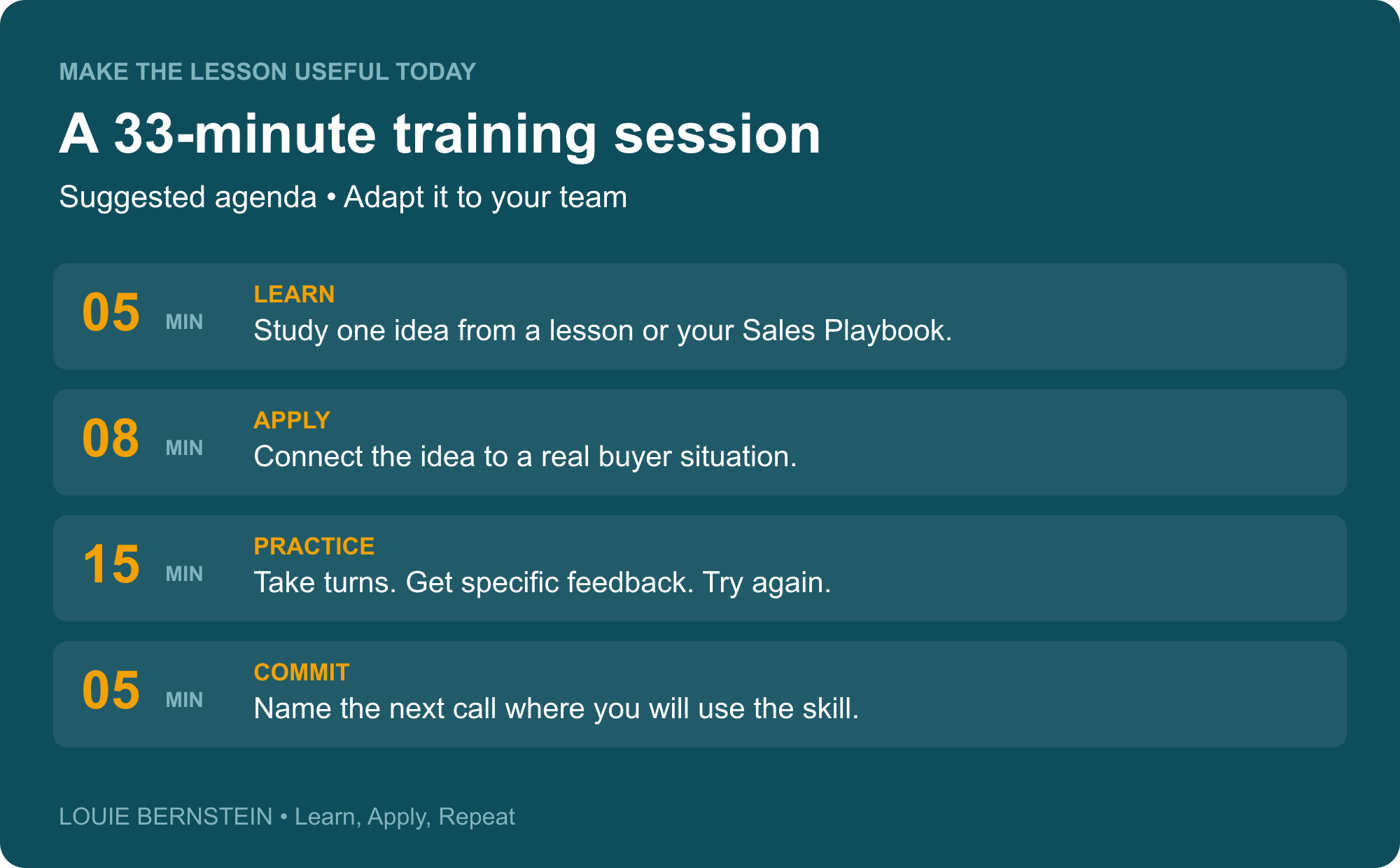
1. Learn one idea, 5 minutes
Use a course lesson, a short video, or a page from your Sales Playbook. State the skill in plain language: "Today we're practicing how to ask about the effect of a problem." Keep the lesson narrow enough that people can actually try it.
2. Apply it to your business, 8 minutes
Ask where that skill shows up in your sales process. What does your buyer usually say? What information does the rep need before moving the opportunity forward? Write a sample question together, then check that it sounds like something a person would say.
3. Practice and give feedback, 15 minutes
Work in pairs so everyone gets a turn. One person plays the buyer; the other asks the question and listens. Switch roles. Keep the buyer realistic. A practice partner who agrees with everything doesn't give the rep much to learn.
Coach an observable behavior. "You asked three questions before letting me answer" gives someone a clear change to make. "Be more confident" doesn't. Run the moment again after the correction, while the feedback is still fresh.
4. Commit to a next action, 5 minutes
Each rep names where they'll use the skill. At the next session, ask what happened. A buyer's unexpected answer can become tomorrow's practice. Add useful language to the Sales Playbook so the lesson becomes available to the next hire, too.
Give them a resource library they can use
Build a small, shared list of relevant resources and attach a practical exercise to each one. A resource earns its place by helping your team do a specific part of the job.
My course includes homework for sales managers: develop your own list of sales training resources that apply to your business and make them available to the team. You can start with free lessons on my YouTube channel, which summarize ideas from the course.
Organize around the work
Use folders or a simple page for discovery, qualification, objections, next steps, and product knowledge. For each item, include the link, the skill it teaches, and an exercise. Name the person who keeps it current. Five useful resources beat a directory nobody opens.
For example, pair a lesson on listening with a real call excerpt. Ask the rep to identify where the buyer raised a problem and where the salesperson changed the subject too soon. Then practice a follow-up question. That's an assignment someone can complete and discuss.
| Resource sitting unused | Resource connected to practice |
|---|---|
| A discovery video forwarded to everyone | One question practiced against a current buyer problem |
| A long list of podcasts | One selected episode with a discussion prompt |
| A product presentation to memorize | A buyer scenario requiring a relevant explanation |
| A Sales Playbook opened during onboarding | A working guide updated after useful practice |
| A course marked complete | A skill demonstrated and reviewed on real calls |
Ask reps to contribute resources, too. Have them explain who the lesson helps and how they'd practice it. You're developing their ability to judge advice, which matters when there's more sales content available than anyone could use.
Make improvement visible without taking over
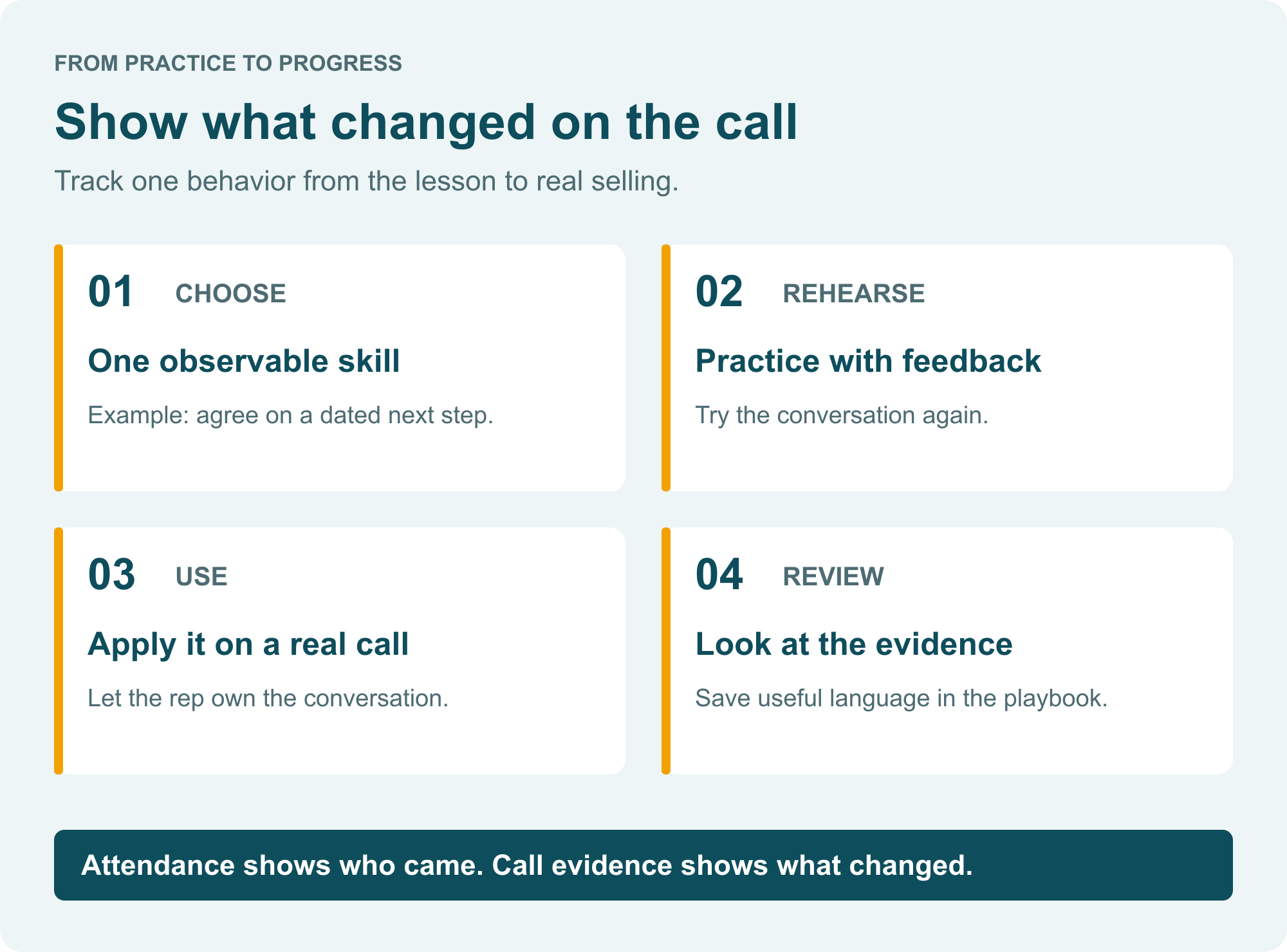
Track a specific behavior from practice to actual selling. Let the rep show what changed, and use the evidence to choose the next lesson.
Inspect one skill at a time
If you're practicing agreed next steps, review whether a sample of calls ends with a buyer-approved action, owner, and date. Record what you see before training and review comparable calls afterward. Attendance tells you who showed up. It doesn't tell you whether the buyer conversation changed.
Follow the relevant sales results over time, such as opportunities progressing after discovery. Keep the context: lead quality, pricing, and product changes can affect those results, too. One good week doesn't prove training caused the increase.
Give the manager ownership
Put responsibility for the training schedule, participation, and follow-through in the manager's Accountabilities Document. A founder can help choose priorities without leading every session. The manager should be able to run the routine while you're working on the rest of the business.
Start this week with one problem your reps face repeatedly. Choose one lesson. Book the sessions. Bring a real situation and make everyone practice. At the end of the week, ask each rep to show where they used the skill and what they still need help with.
When that routine runs without you supplying every answer, your team is building the ability you hired them for. That's progress toward a sales function that can operate without the founder in every conversation.
Related ReadingHow Do I Coach Reps Who Think They Don't Need It? →
Frequently Asked Questions
How do you motivate a sales team?
Connect training to a problem the team wants to solve. Give reps a useful lesson, time to practice, and feedback they can act on. Recognize a specific improvement and ask where they used it. Make learning a regular part of the job instead of waiting for a missed target.
How do you train a sales team?
Choose one skill from your sales process, explain it briefly, and practice it against a realistic buyer situation. Give each rep a turn and a specific correction. Agree where they'll use the skill, then review what happened at the next session.
How often should sales training be conducted?
My course describes training every business day, usually within 33 minutes. Choose a protected time your team can maintain. The important requirements are consistency, practice, and follow-through. A daily meeting that contains only a lecture won't accomplish the same job.
How is coaching different from sales training?
Training introduces a skill or method. Coaching helps a salesperson apply it, notice what happened, and improve the next attempt. A short daily session can include both: a lesson first, then practice and feedback connected to your team's actual work.
How do you measure a coach's impact?
Start with observable changes in the skill being coached, such as stronger discovery follow-up questions or clearer agreed next steps. Review real calls and CRM evidence. Then watch the related sales results over time, allowing for changes in the market, product, and quality of opportunities.
Build a team that keeps getting better
If you're still the person your reps need for every difficult conversation, let's look at the training and management system behind them. Fractional Sales Leadership can help you build the Sales Playbook, practice routine, and accountability your team needs to sell with more independence.
Learn about working with Louie
Schedule a 30-Minute CallAbout the Author
Louie Bernstein, Fractional Sales Leader who helps B2B founders at $1M–$10M ARR escape founder-led sales.
Louie wrote How to Be a Professional Salesperson, a course with practical lessons and homework for salespeople and sales managers. His work focuses on repeatable sales processes, Sales Playbooks, coaching, and team independence.