Key Takeaways:
- If your revenue would collapse the day you stepped away, you're not the founder of a company. You're the sales department. That's a valuation problem, not just a time problem.
- Owner-dependent companies sell for 30–50% less than owner-independent ones (multiple valuation studies). The bottleneck isn't just costing you weekends. It's costing you the exit.
- "Just hire a VP of Sales" is a six-figure coin flip. Average VP of Sales tenure is 19 months, and 75% fail inside that window (Gong / SBI). Build the system first, then hire into it.
- Businesses don't scale. Systems scale. A documented process, real pipeline stages, Accountabilities Document, a qualifying standard, and a weekly cadence are what let the company grow without you.
- You don't fix founder-led sales with more hustle. You fix it by building an engine your team can run, so revenue keeps coming when you step away.
You didn't set out to run the sales department. It just happened.
In the early days, you were the best person to sell your product. Nobody knew it better. So you closed the first customer, then the next hundred, and somewhere along the way selling stopped being a phase and became your job.
Now you're doing $1M, $3M, maybe $8M in ARR. And you're still the one on the deals that matter. Still the person the reps loop in when a deal gets real. Still the reason the number hits, or doesn't.
So here's the uncomfortable question. If you took ninety days off, what happens to your revenue?
If the honest answer is "it falls off a cliff," you're not the founder of a company. You're the sales department. And that's a far more expensive problem than it looks.
You Didn't Build a Company. You Built a Job.
There's a moment I see in almost every founder I talk to at this stage. They've built something real. Revenue is growing. Customers love them. And yet they can't take their foot off the gas for a single week without sales slowing down.
That's not a growth stage. That's a ceiling. Because a company that only works when you're in the room isn't a company yet. It's a job you can't quit, with a payroll attached.
I've lived this. I bootstrapped and ran a company for 22 years and built it into an INC 500 winner. For a long stretch, I was the pipeline. When I was selling, the number moved. When I got pulled into everything else a founder gets pulled into, it stalled. The business didn't grow on hustle. It grew when I finally built a system other people could run.
"Founder-led selling is your best skill and your biggest liability at the same time. It's not a badge of honor. It's a single point of failure."
The reason this matters isn't just your calendar. It's what a buyer sees. When you go to raise, sell, or even just hire senior people, the first thing a sharp investor checks is how dependent the revenue is on you. If the answer is "completely," they price that risk into the deal. Owner-dependent small and midsize companies sell for 30–50% less than comparable owner-independent ones, according to multiple valuation studies. On a $3M business, a 40% discount is $1.2M. That's the founder discount, and it's real money.
What Being the Sales Department Actually Costs
Do the math on your own time first. If an hour of your time is worth $300 and you spend 20 hours a week running and closing sales, that's more than $300,000 a year of the most expensive labor in your company, spent on work a trained team should be doing.
And that's before the hidden costs. The deals you miss because you were buried in other deals. The hire you keep delaying. The forecast you can't trust. The growth that stalls at the edge of your calendar. The toll it takes on you and the people at home.
Here are the numbers that should stop you cold.
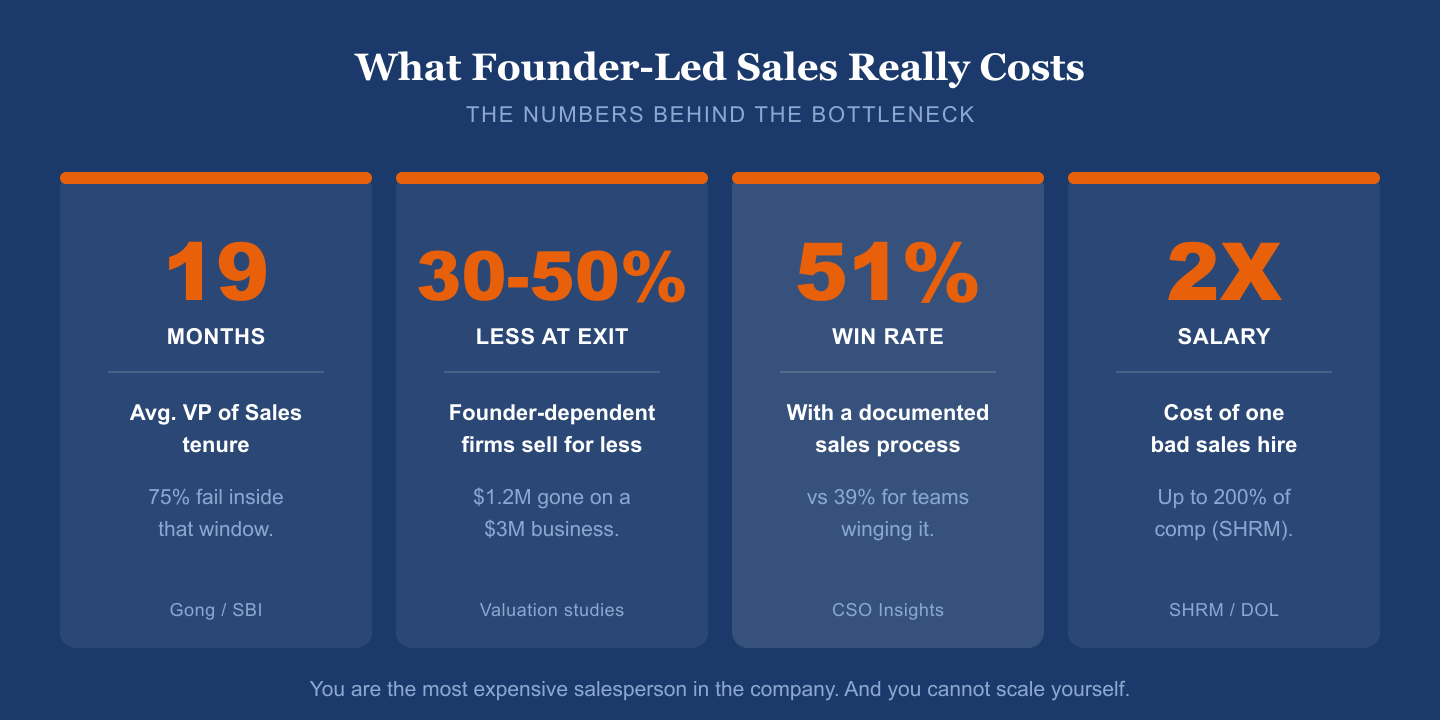
Look at that middle number. Teams that run a documented sales process win 51% of their deals. Teams that wing it win 39% (CSO Insights). That's a 12-point swing on the same leads, the same product, and the same market. The difference isn't talent. It's a system.
You are the most expensive salesperson in your company. And you cannot scale yourself.
Why "Just Hire a VP of Sales" Backfires
Most founders in this spot reach for the obvious lever. Hire a VP of Sales, hand them the keys, and get your life back. It sounds right. It usually isn't, at least not yet.
The average VP of Sales lasts 19 months, and roughly 75% of first-time VP of Sales hires fail inside that window (Gong / SBI). A mis-hire at a $100,000 base can cost well over $1 million once you count lost deals, stalled pipeline, and the reps who leave in the chaos. The Society for Human Resource Management puts the cost of a bad hire at 50–200% of salary, and executive roles sit at the top of that range.
Here's why those hires fail so often. You hand a new leader a business where the entire sales process lives in the founder's head. There's no documented playbook, no defined pipeline stages, no qualifying standard, no CRM anyone trusts. So the VP does the only thing they can. They start selling deals themselves to hit the number. Twelve months later you've spent six figures and you've simply rented a second, temporary version of you.
A VP of Sales inherits a system and makes it better. If there's no system to inherit, you're not hiring a leader. You're hiring a very expensive lottery ticket.
The order matters. Build the engine first. Then, when you hire, you hire into something that already works, and any good rep or leader can run it. That's the difference between a hire that scales you and a hire that replaces you for eighteen months.
The Fix Isn't More Hustle. It's a System.
Businesses don't scale. Systems scale. When founders finally get out of the trap, it's never because they found more energy. It's because they built the five or six pieces that let the work happen without them. Here's what that engine looks like.
1. A documented sales process
Not a vague idea in your head. A written playbook that spells out how you find, qualify, and close a customer, step by step. One of the most common complaints reps have when they start a new job is that nobody hands them a document explaining how sales actually works there. Remove that hurdle and a new rep can hit the ground running instead of guessing for six months. Your best customers are already showing you this process. You just haven't written it down yet.
2. Pipeline stages you can actually forecast
Stages a prospect earns their way into, not stages you assign on a hunch. When your pipeline is defined by real buyer behavior, your forecast stops being hope-ium and becomes a number you can defend. That's what lets you plan cash flow, hiring, and inventory without a knot in your stomach.
3. Accountabilities Document for every role
Every person on the team should have a written standard for what they own and when. What gets done, by whom, by when. No surprises, no "I didn't know that was my job." An Accountability Document is how you make expectations visible, so performance stops depending on you standing over someone's shoulder.
4. A strict qualifying standard tied to your ICP
Reps waste enormous time chasing deals that were never going to close. A written qualifying standard, built from your Ideal Customer Profile, keeps them focused on prospects with a real pain, a budget, urgency, and a decision-maker involved. I love the expression "accelerate the inevitable." Good qualifying does exactly that. It gets you to yes or no faster and protects your reps' time and your money.
5. A weekly operating cadence and a CRM you trust
A rhythm the team runs without you in the room. Pipeline reviews, deal debriefs, and a forecast conversation that happen on schedule, whether or not you show up. And a CRM that's the single source of truth, so the state of the business lives in one place instead of in your memory. If it's not in the CRM, it didn't happen.
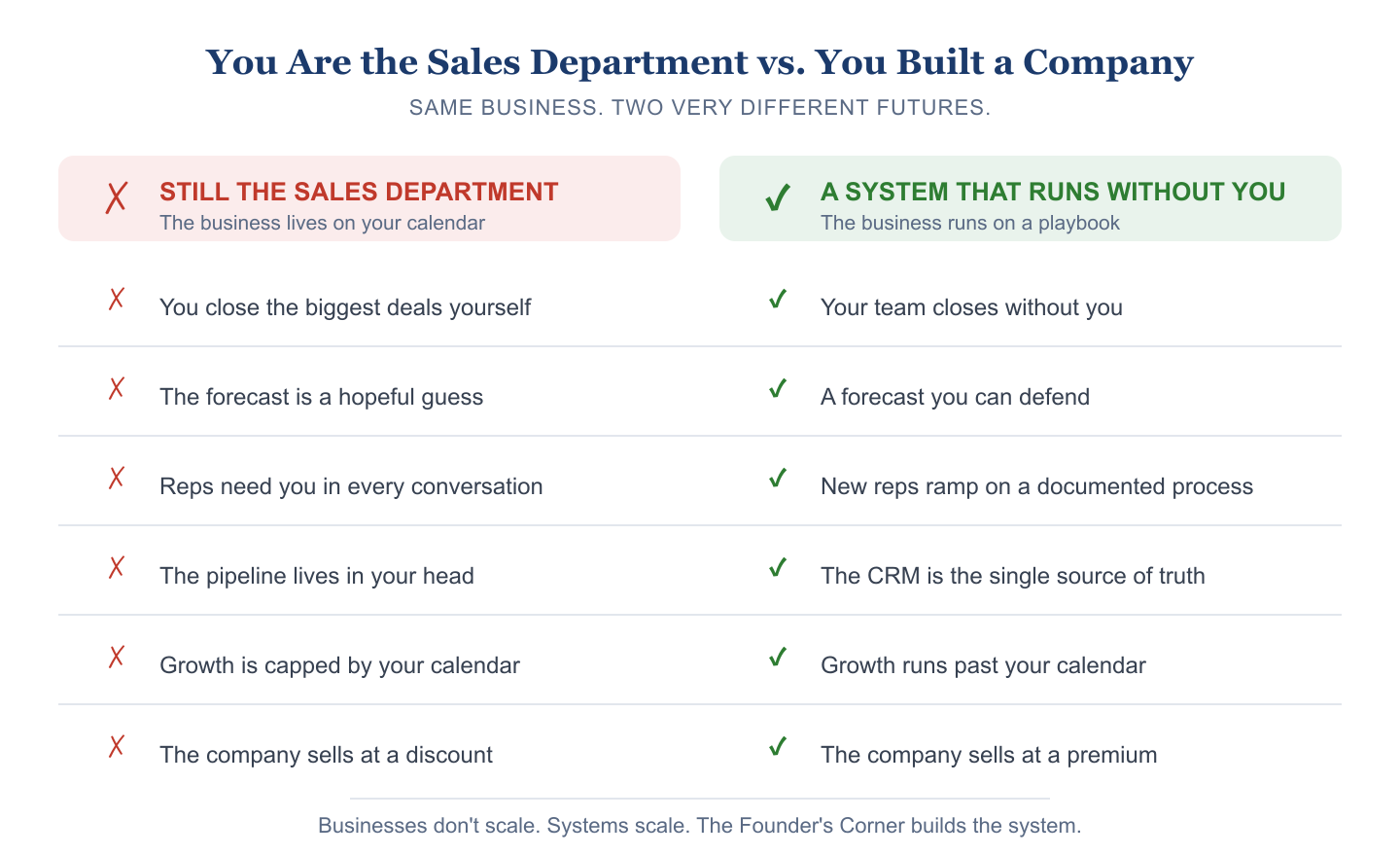
Put those pieces together and you get the shift that actually matters. Not "the founder sells a little less." A company that runs on a playbook instead of on your calendar.
How to Start Stepping Out
You don't fix this by disappearing overnight and hoping. You do it in a deliberate order. Here's how I'd start this week.
Write down how you win. Take your last five customers. Who reached out first? What problem did they mention first? What made them trust you? What almost stopped them from buying? What finally made them say yes? Answer those and a pattern emerges. That pattern is your sales process. It's been there the whole time.
Define who you're allowed to chase. Write your ICP and a hard qualifying standard from it. Then hold the team to it. This one change stops the slow bleed of time your reps spend on prospects who were never going to buy.
Give the reps something to inherit. An Accountability Document per role, a documented onboarding path, and a weekly cadence they run. New reps ramp on the system, not on your availability.
Hand off the smaller deals first. Don't start with your biggest account. Move the mid-size deals to the team, watch the system hold, then step out of larger and larger conversations as trust builds. The founder exit is a handoff, not a cliff.
This is exactly the work I did with a founder who was closing every deal himself. One year later, his sales were up 61% and the business turned its first profit in years. It wasn't more hustle. It was a system, built one piece at a time, so the company stopped living or dying on his calendar.
The goal isn't to become a better salesperson. You're already good. The goal is to stop being the salesperson, so you can go back to being the CEO.
If you're at $1M to $10M in revenue and you can't afford, or don't yet need, a full-time VP of Sales, this is exactly the gap a Fractional Sales Leader fills. You get the senior sales leadership that builds the engine, for a fraction of the cost of a six-figure hire, and you keep every system we build.
Frequently Asked Questions
Q: How do I know if I'm the real sales department, and not just an involved founder?
Run the ninety-day test. If you stepped away for a quarter, would revenue hold or fall off a cliff? If it falls, you're the sales department. Other signs: you close the biggest deals personally, reps loop you into every real conversation, your forecast is a guess, and the pipeline really lives in your head instead of in the CRM. Being involved is fine. Being the single point of failure is the problem.
Q: Why does founder-led sales eventually break every company?
Because it doesn't scale, and it hides risk. Your time is finite, so growth caps at the edge of your calendar. Great reps leave when everything bottlenecks with you. Forecasts become fiction because the real state of every deal lives in your memory. And the day you get sick or want to step away, there's no system to catch the revenue. It happens slowly, until one day you realize you built yourself a job, not a company.
Q: Shouldn't I just hire a VP of Sales to take this off my plate?
Eventually, yes. Right now, probably not. Average VP of Sales tenure is 19 months and most first-time VP hires fail inside that window (Gong / SBI), largely because they inherit no system to run. A mis-hire at a $100,000 base can cost over $1 million with lost pipeline factored in. Build the documented process, pipeline stages, and cadence first. Then hire into something that works, so a leader improves your engine instead of becoming a temporary replacement for you.
Q: How does this affect what my company is worth?
Directly. Owner-dependent companies sell for 30–50% less than owner-independent ones, and buyers apply a key-person discount specifically because the revenue relies on you. On a $3M business, a 40% discount is $1.2M off the price. Reducing founder dependency isn't just about your quality of life. It's one of the highest-return things you can do to make the business sellable at a premium.
Q: I'm not at $1M yet. Is it too early to fix this?
It's the best time. Earlier-stage founders can build the right habits before the wrong ones set in. You don't need a big team to write down your process, define your ICP, and set a weekly cadence. Doing it now means you scale on a system from the start, instead of untangling a mess later when the business is bigger and the stakes are higher.
Q: How long does it take to get out of founder-led sales?
You can build the core engine in about twelve weeks, working one focused hour a week: process, ICP, pipeline stages, Accountabilities Document, hiring and onboarding, a weekly cadence, CRM discipline, and the founder handoff. The full exit takes longer as you hand off progressively bigger deals and let the system prove itself. But you'll feel the shift fast, because a real forecast and a team that runs its own pipeline review change your week almost immediately.
Would your sales survive without you?
The Founder's Corner is a 12-week program that turns founder-led sales into a system your team can run, for a fraction of the cost of a full-time VP of Sales. See exactly how it works, week by week, and whether it's a fit for where you are now.
See How The Founder's Corner Works →Or book a free 30-minute call. No pitch. If it's not a fit, I'll tell you.
About the Author
Louie Bernstein
Fractional Sales Leader with 50 years of sales experience helping $1M–$10M ARR companies build scalable, repeatable sales systems. Founder of MindIQ (INC 500). LinkedIn Top Voice in Sales Management, Sales Operations, and Sales Coaching.