Key Takeaways:
- Yes. Defining a repeatable sales process is not a side project for a Fractional Sales Leader. It's the first thing we build, because everything else depends on it.
- A sales process is not a diagram on a whiteboard. It's a documented, teachable system: who you sell to, how a deal qualifies, what has to be true to advance, and how you forecast.
- Companies with a formal sales process grow revenue 18% faster than companies without one (Harvard Business Review). This is the single most researched idea in sales, and it holds up.
- Starting from zero is not a disqualifier. A greenfield with no systems is often the easiest founder to help, because there are no bad habits to unwind first.
- A Fractional Sales Leader can't help you if you want someone to be your sales team forever. The job is to build the process and hand it to people who run it without you.
Companies with a formal, well-defined sales process grow revenue 18% faster than companies that sell by feel (Harvard Business Review). Read that again. Not a better product. Not a bigger team. A written-down process.
So when a founder at $1M to $10M ARR asks me, "Can a Fractional Sales Leader actually help me define my sales process?" my answer is short. Yes. It's the first thing I do, and it's the thing that finally lets the business grow past you.
Here's the part most founders don't want to hear. You already have a sales process. It just isn't written down, it isn't repeatable, and it lives entirely in your head. You are the process. That's exactly the problem we're going to fix.
Let me walk you through what defining a sales process really means, how I build one, and the one situation where a Fractional Sales Leader genuinely can't help you.
The Short Answer: Yes, and It's Where I Start
Every founder I work with is fantastic at selling their own product. You have to be, or you wouldn't have gotten to a million in revenue. But being a great seller and having a great sales process are two very different things.
You close deals because you know your market cold, you read prospects in real time, and you make a hundred small judgment calls on every call without even noticing. None of that is written down. None of it is teachable. And that's why the first salesperson you hired probably struggled, and why revenue still stalls the week you go on vacation.
Defining a sales process means taking everything that's in your head and turning it into a system someone else can run. Not a watered-down version of you. A documented, repeatable method that a new rep can follow and get results with, without fifteen years of your instincts.
You don't have a sales problem. You have a founder-dependency problem. The sales process is how you solve it.
Understanding the Capability: Building a Foundational Sales Infrastructure
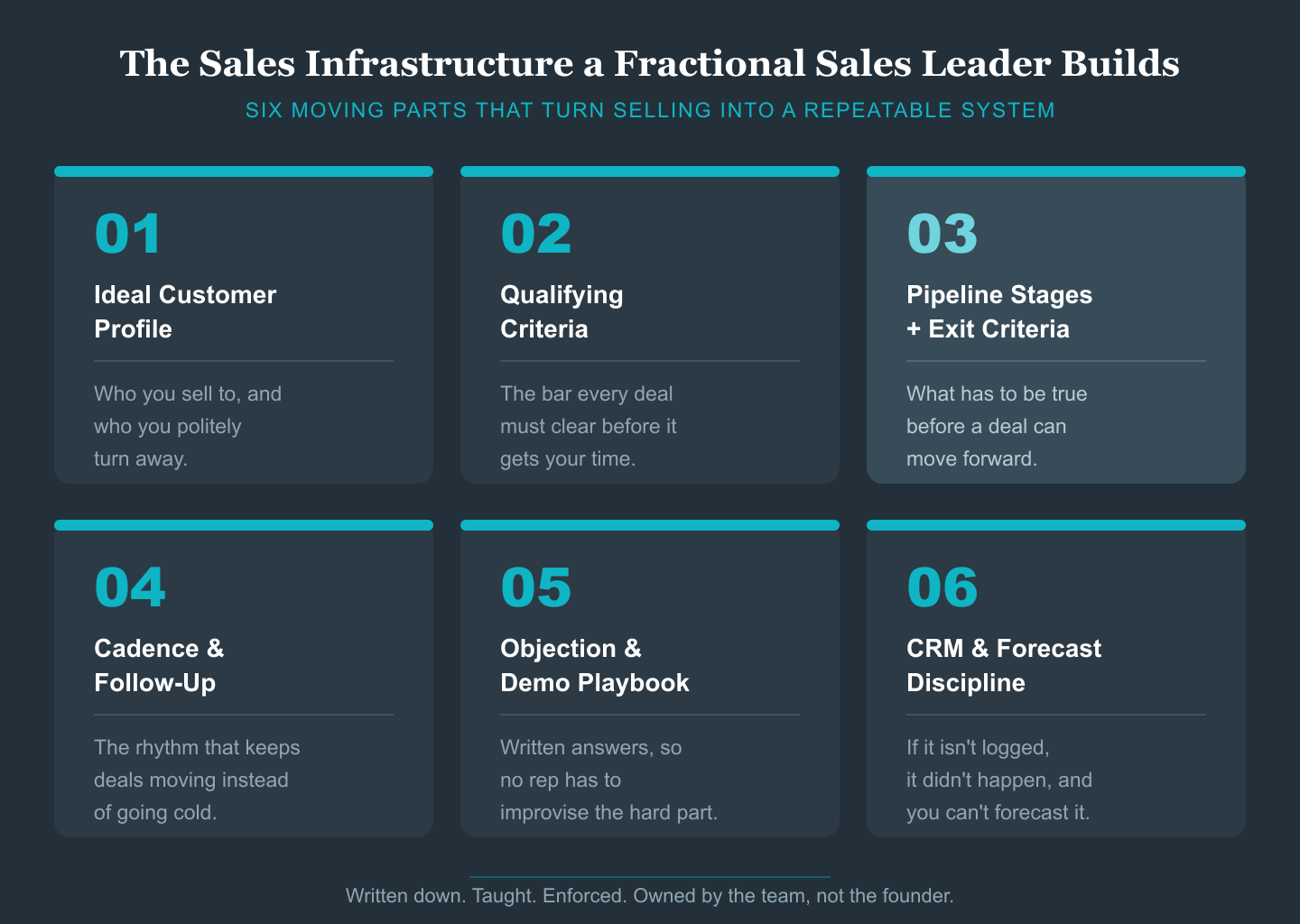
When people hear "sales process," they picture a flowchart with a few boxes and arrows. That's not it. A real sales process is an infrastructure. It's the set of moving parts that turns selling from an art only you can perform into a system your team can run every day.
There are six pieces I build. Miss any one of them and the whole thing wobbles.
It starts with who you sell to
Every process starts with a written Ideal Customer Profile. What does your best customer look like? Their size, their industry, who makes the buying decision, how long they took to close, and what they all had in common. Get this wrong and your whole team chases deals that were never going to close. Get it right and you stop wasting the most expensive resource you have, which is selling time.
Then how a deal earns your time
Next come qualifying criteria. I love the expression "accelerate the inevitable." Written, ordered qualifying questions make sure your team is spending time on deals that can actually close: prospects who have a real pain, a budget, urgency, and a seat at the decision. A prospect who fails those tests isn't a loss. Finding out early is a win, because it hands their time back to a deal that can close.
Then pipeline stages with exit criteria
This is the centerpiece, and it's the piece founders skip. Every stage in your pipeline needs exit criteria: the specific things that must be true before a deal is allowed to move to the next stage. Not "it feels good." Concrete facts. Did we confirm the budget? Did we meet the decision-maker? Without exit criteria, your pipeline is a wish list, and your forecast is fiction. Reps spend only 28% of their week actually selling (Salesforce). Clear stages are how you stop wasting the other 72% on deals that were never real.
Then the rhythm, the answers, and the record
The last three pieces make the system run day to day. A cadence calendar so no deal goes cold from silence. An objection and demo playbook so no rep has to improvise the hardest moments of the sale. And CRM discipline, because if a deal isn't logged, it didn't happen and you can't forecast it. Companies with a dynamic, actively managed sales process hit quota 37% more often than companies working from an informal one (CSO Insights). The difference is discipline, and discipline is what these six pieces install.
How a Fractional Sales Leader Actually Builds It
Defining your process isn't a workshop where I hand you a template and leave. It's built from your reality, in a specific order. Here's how I do it.
- 1. I reverse-engineer your wins. We go through your last 10 to 20 closed deals and map what actually happened. Where did they come from? What made them qualify? What moved them forward? Your process already exists inside those deals. My job is to extract it.
- 2. I write down your ICP and qualifying bar. We define, on paper, exactly who you sell to and what makes a prospect worth your team's time. This one document kills more wasted effort than anything else we do.
- 3. We build the pipeline stages and exit criteria. We name each stage and write the facts that must be true to advance. Now "the deal is progressing" means something specific instead of a gut feeling.
- 4. We put it in the CRM and make it the source of truth. The process only works if it lives where the work happens. We configure the CRM to match the stages, so the pipeline reflects reality, not optimism.
- 5. We install the weekly rhythm. A pipeline review, a forecast, and a cadence your team runs whether you're in the room or not. This is the moment the business starts to run without you.
All of this becomes a living document. In my world it's a sales playbook: the job functions, the scripts, the qualifying questions, the objection responses, the demo flow, the rules. It's the thing a new rep reads before they ask you a question, and it's the reason your team stops depending on you for every answer. If you want the deeper version of how I diagnose where a process is leaking, read how to know if your sales process is broken.
Founder-Led Chaos vs. a Defined Process
The difference isn't subtle. It shows up in every part of the business, from your forecast to how fast a new hire ramps. Here's the same six situations, run two different ways.
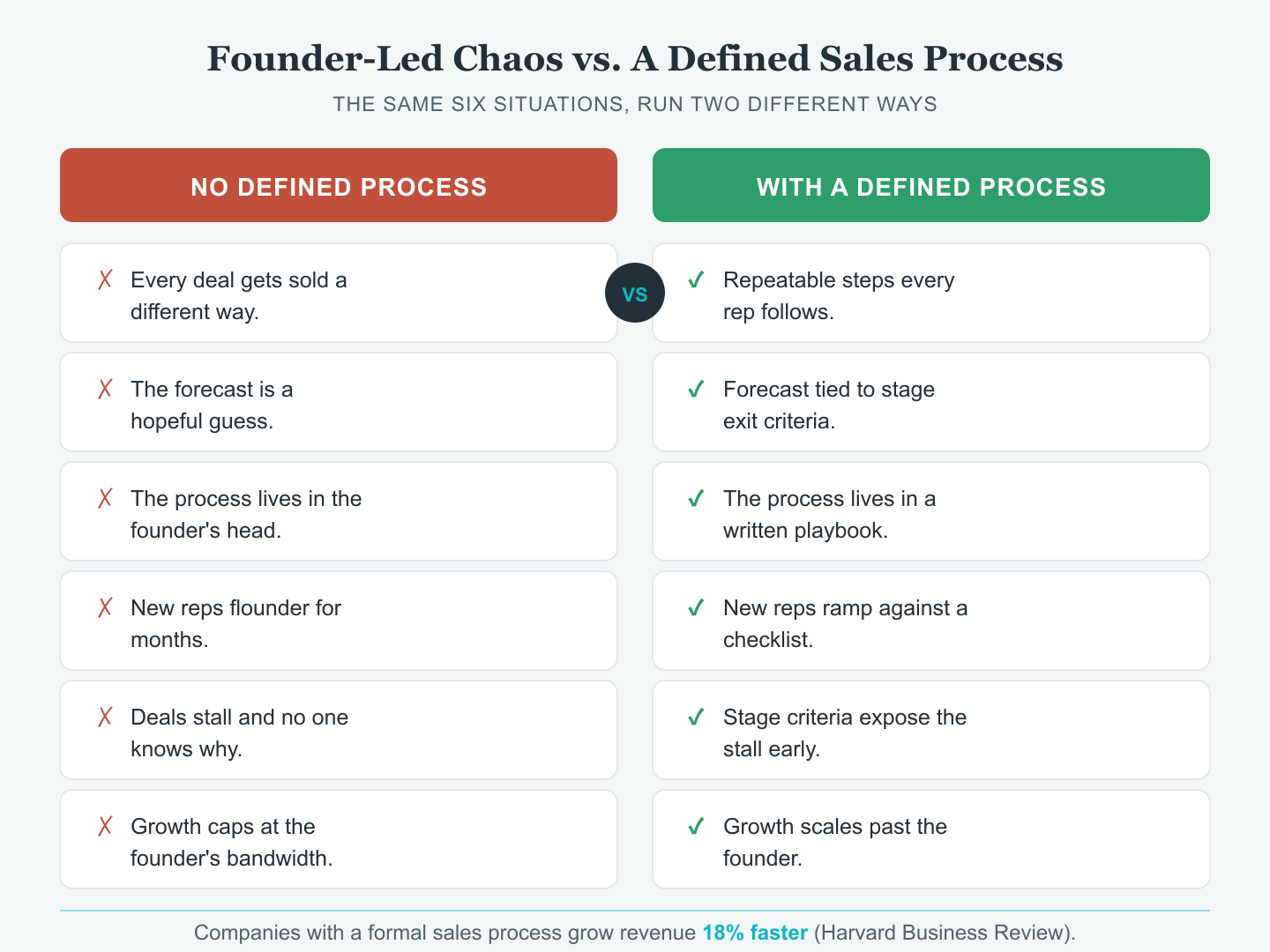
The column on the left is where most $1M to $10M founders live. It works, right up until it doesn't. It works until you hire your second rep and realize you can't clone yourself. It works until an investor asks for a forecast you can actually defend. A defined process is how you move to the right-hand column, and fewer than half of sales organizations have made that move (CSO Insights). Which means this is also your fastest edge on the competition.
A process you can't hand to someone else isn't a process. It's just you, working harder.
When a Fractional Sales Leader Can't Help You
I told you I'd be straight about this, so here it is. There's a common worry among founders with nothing in place: "I have no systems, no process, no CRM discipline at all. Am I too early, too much of a mess, to bring someone in?"
No. Starting from zero is not the problem. A blank slate is often the easiest founder to help, because there are no broken habits to unwind first. If you have real customers who buy from you, you have a process worth defining, even if it's living entirely in your head today. Building the infrastructure from scratch is the core of the work, not a reason to wait.
Here's where I genuinely can't help you:
- You want someone to be your sales team, permanently. My job is to build the process and hand it to people who run it. If what you actually want is to outsource selling forever and never build the muscle internally, that's a different service, and it won't get you a company that grows without you.
- You haven't found product-market fit yet. If deals close only when you discount hard, and no two customers buy for the same reason, there's no repeatable pattern to systematize yet. Defining a process on top of "we're still figuring out what we sell" is premature. Nail the offer first.
- Nobody has the time to execute what we build. A process only works if someone runs it. If you won't allocate any time or any person, yourself included, to actually use the system, no leader can install discipline into an empty room.
Outside of those three, if you're a founder doing real revenue and stuck being the whole sales department, defining your process is exactly what a Fractional Sales Leader is for.
Frequently Asked Questions
Q: How long does it take a Fractional Sales Leader to define my sales process?
The first working version is usually in place within the first 30 days: a written ICP, qualifying criteria, and pipeline stages with exit criteria configured in your CRM. From there it gets refined over the next couple of months as real deals run through it. A process isn't a one-time document. It's a living system that gets sharper the more you use it. But you'll feel the difference in how your pipeline reviews run almost immediately.
Q: I already have a CRM. Isn't that my sales process?
No, and this trips up a lot of founders. A CRM is a filing cabinet. Your sales process is what you file and why. Most CRMs I open are full of stages named "Interested" and "Hot" that mean nothing, with deals that have sat untouched for months. The tool isn't the process. The process is the definition of what each stage means and the exit criteria that let a deal move. Once that's defined, the CRM finally becomes useful.
Q: Can't I just buy a sales methodology like MEDDIC or Sandler and use that?
A methodology is a useful lens, but it's not your process. MEDDIC tells you what to qualify. It doesn't tell you who your ideal customer is, what your stages are, or how a deal moves through your specific business. I'll happily use the parts of any methodology that fit, but the process has to be built from your deals, your market, and your customers. A framework you bought off the shelf and never customized is the reason so many methodologies get abandoned within a year.
Q: What if my product or market keeps changing? Won't the process just go stale?
A good process is built to be updated. That's the whole point of writing it down. When your market shifts, you change one document and your whole team is aligned again the same day. Compare that to an undocumented process, where a market shift means every rep quietly reinvents their own approach and your results get noisier. The faster you're changing, the more you need a written process, not less.
Q: I'm the only one selling right now. Do I even need a defined process yet?
That's exactly when you need it, because you're the bottleneck and you don't have a document to hand the next person. Defining the process while you're still the only seller is far easier than trying to reconstruct it after you've hired two reps who are each doing it differently. If your plan is to ever step back from selling, the process is the bridge that gets you there. Waiting until you're overwhelmed just makes the build harder.
Q: How is this different from hiring a full-time VP of Sales to do it?
A full-time VP of Sales costs $250K or more all-in, and at $1M to $10M ARR most founders aren't ready to carry that or to keep a senior leader fully occupied. A Fractional Sales Leader gives you the same process-building experience for a fraction of the cost and time, focused specifically on defining the system and coaching your people to run it. You get the infrastructure without betting a quarter-million dollars on a hire you may not be ready for.
Right now, your sales process is you.
In 12 weeks, we can turn what's in your head into a system your team runs without you. One hour a week with a 50-year sales leader. See exactly how it works inside The Founder's Corner™.
See How The Founder's Corner™ WorksPrefer to talk it through first? Book a free 30-minute call.
About the Author
Louie Bernstein
Fractional Sales Leader with 50 years of sales experience helping $1M–$10M ARR companies build scalable, repeatable sales systems. Founder of MindIQ (INC 500). LinkedIn Top Voice in Sales Management, Sales Operations, and Sales Coaching.