How do you keep five stages without making buyers repeat work?
Buyers can skip a scheduled sales meeting when the work that meeting would accomplish is already complete and verified. Keep the five stages: Target, Engage, Qualify, Validate, Close. Let buyers satisfy the requirements through a useful conversation, written answers, or existing evidence. For a B2B founder at $1M to $10M ARR, the rule is simple: shorten the work that repeats what you know, while checking every fact needed for the buying decision.
Key Takeaways
- Buyers can move through your sales process faster when they supply verified evidence. A request for a proposal alone doesn't establish qualification.
- Keep Target, Engage, Qualify, Validate, and Close as the five stages. Change the meetings required for a particular buyer when the evidence supports the change.
- Gartner reported in March 2026 that 67% of 646 surveyed B2B buyers preferred a rep-free experience. Buyer preference is a reason to remove needless meetings, not proof that every deal should be self-service.
- Put the reason for a shorter path and the supporting evidence in the CRM so a sales leader can review the decision.
- This week, review five deals where someone wanted to skip a meeting. Check whether the buyer had completed the work or the rep had simply stopped asking.
Your buyer asks for a price. Your rep sends a link to book a discovery call.
Sometimes that call is needed. Sometimes your buyer has already sent a detailed brief, named the decision-maker, and explained the deadline. Asking the same questions again makes the buyer do your administration.
I think small companies need enough discipline to know when a meeting has done its job before it starts.
Keep the buying requirements. Earn the next meeting.
What can a buyer skip in a five-stage sales process?
A buyer can skip a standard activity when reliable evidence already satisfies its purpose. Your five-stage sales process still checks account fit, the business problem, purchase readiness, solution fit, and the agreement. The rep chooses the work needed to establish those facts instead of requiring every buyer to attend the same meetings.
The stages stay the same
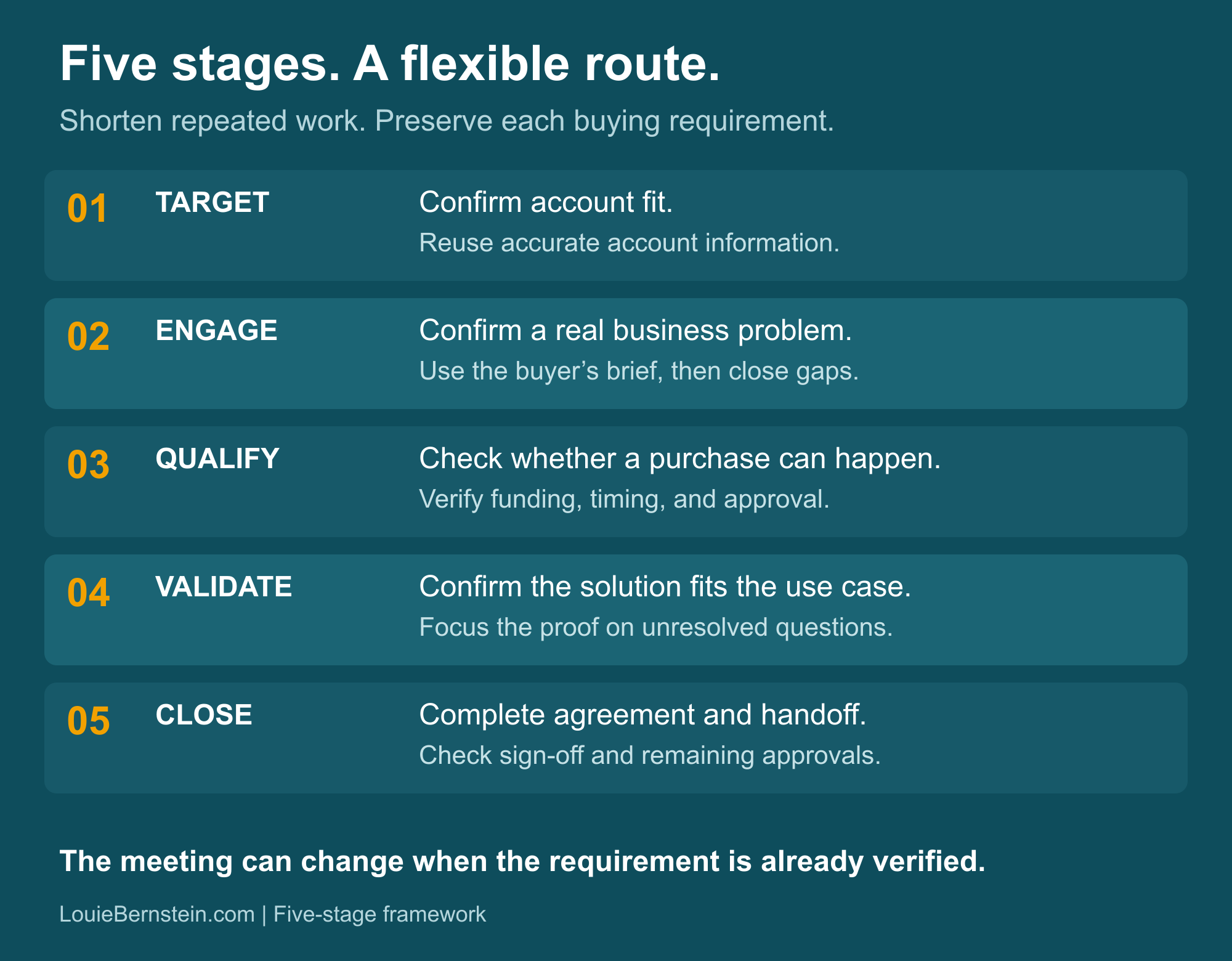
My small-company sales process uses five stages. Target checks whether the account belongs. Engage establishes a real conversation about a real problem. Qualify establishes whether a purchase can happen. Validate establishes whether your solution fits. Close completes the agreement and handoff.
Those are five different jobs. They don't require five separate calls. A prepared buyer may establish fit and explain the problem in one exchange. Another buyer may need several conversations to understand the cost of leaving the problem alone.
Skip repeated work, then record what you know
Suppose an inbound buyer sends requirements, a budget range, the evaluation team, and a proposed start date. Your rep should review the brief and confirm what's still uncertain. Running a full discovery script from question one would ignore useful work the buyer has already done.
The opposite mistake is treating a referral as proof. A trusted customer introduced the prospect, so the rep assumes budget and authority exist. An introduction establishes a reason to talk. The rep still has to find out whether the new company can buy.
If your CRM allows a jump between stages, preserve the evidence for the requirements passed along the way. If your CRM requires each transition, record those transitions honestly. Don't invent past meetings or dates to make the report look tidy.
Why do informed buyers still need qualification?
Informed buyers still need qualification because product knowledge doesn't establish a company's ability or willingness to purchase. A buyer may understand your features and still lack funding, internal agreement, or a reason to act. Your rep should acknowledge the research, then ask focused questions about the purchase conditions that remain unknown.
Buyer preferences have changed
Gartner's March 2026 release reports that 67% of 646 B2B buyers surveyed in August and September 2025 preferred a rep-free experience. The same survey found that 45% had used AI during a recent purchase (Gartner, 2026).
Those findings support giving buyers useful information before a call. They don't tell you whether your prospect has a budget. A founder selling a complex service still has to understand scope before making a responsible commitment.
In its global 2025 study of more than 4,000 buyers, 6sense reported that 94% of buying groups ranked preferred vendors before first contact. The report's release also says buyers selected the preliminary favorite 77% of the time, rounded to about 80% in its summary (6sense, 2025).
Those results describe the surveyed market, not your company's odds. The useful lesson is narrower: a first conversation may happen well after the buyer started evaluating. Find out what the buyer has established before deciding what to cover.
Ask permission to close the gaps
Try: “You've done the product research. Before I recommend the next step, can we check who needs to approve this and what has to happen before your start date?”
That question respects preparation and protects the deal. If the buyer can't answer, help identify the right person. Don't turn an unanswered question into an assumed yes because the buyer sounds confident.
How should a rep handle a buyer who wants to jump ahead?
A rep should respond to the buyer's immediate request, explain any limit, and verify the missing purchase facts before committing resources or advancing the forecast. Give useful information where possible. Choose a short confirmation, written exchange, or focused meeting based on the uncertainty that remains, rather than forcing the standard appointment sequence.
When the buyer wants pricing first
Provide a usable price or range when your offer supports one. State the assumptions. If scope drives price, explain which scope questions affect the number. “We need a call” is less helpful than explaining that user count and implementation work determine the quote.
Sharing pricing isn't the same as issuing a final proposal. Your rep can help the buyer judge affordability while keeping unconfirmed requirements open. The buyer shouldn't have to pretend to be fully qualified to learn whether you're remotely in budget.
When the buyer says the demo isn't necessary
Ask what evidence established solution fit. A previous deployment of the same product may answer some questions. A video of a different workflow may answer very few. Confirm the use case, the people affected, and any material difference from what the buyer has seen.
If a technical review is required, explain the specific risk it addresses. Don't schedule a general presentation to satisfy the playbook. Give the technical team a narrow question to answer and a clear stopping point.
When the buyer wants the contract
Make it easy to review terms, but check who can sign and what approval remains. A buyer may need your standard agreement to begin legal review. Sending that document doesn't prove that the commercial decision has been made.
Keep the CRM stage tied to the evidence. Otherwise the contract request becomes a late-stage opportunity, and the founder spends Friday trying to close a purchase the buyer hasn't approved.
How do you give reps flexibility without taking over?
Give reps flexibility by documenting which facts they must confirm, which activities they may replace, and when they need approval. A founder at $1M to $10M ARR shouldn't have to authorize every shorter meeting. Review the reasoning during coaching and reserve escalation for commitments outside the rep's written authority.
What my second-call mistake taught me
In my article on running the second sales call, I describe a meeting where we thought discovery was complete. My rep asked the decision-maker for the business. Another participant raised an unresolved support request, and the conversation went sideways. We won the sale, but took an avoidable detour.
The lesson applies here. Evidence has a date. A buyer may have agreed on the problem last week, then brought someone new to today's call. A short confirmation protects you from selling against an understanding that no longer holds.
Before you shorten the meeting, confirm that the buying facts still hold.
Write an exception note a manager can review
Have the rep record the activity being replaced, the evidence already supplied, the person who confirmed it, and any unanswered question. Add the next buyer-owned action. Keep the note brief enough to use on a real selling day.
For example: “No general demo. Operations lead confirmed the required workflow using the recorded walkthrough. Integration behavior remains unverified. Technical review Thursday with their systems owner. No promise of compatibility made.” That note supports a decision without pretending every requirement is resolved.
Role play the judgment. Give the rep a prepared buyer, an enthusiastic buyer with no approval path, and a returning buyer with a different use case. Ask what can be shortened and what must be checked. Coach the answer before the rep faces the live situation.
How do you measure whether a shorter sales path works?
Measure a shorter sales path by buying progress, completed purchases, selling time, and problems discovered after commitment. Compare similar opportunities and keep unresolved deals separate from completed ones. Fewer meetings can be useful, but a founder needs to know whether the saved time came with weaker qualification or promises the company can't deliver.
Separate the routes through the same process
Tag opportunities that used an approved shorter path. Record why: prior product experience, a complete requirements brief, or evidence supplied before contact. Compare them with similar buyers using the usual route, including company size, source, offer, and use case.
A warm referral and a cold outbound lead may behave differently regardless of meeting count. A small sample can reveal questions worth investigating; it cannot establish that skipping a meeting caused better results. Wait for the relevant sales cycle before judging win rates.
Make the time calculation explicit
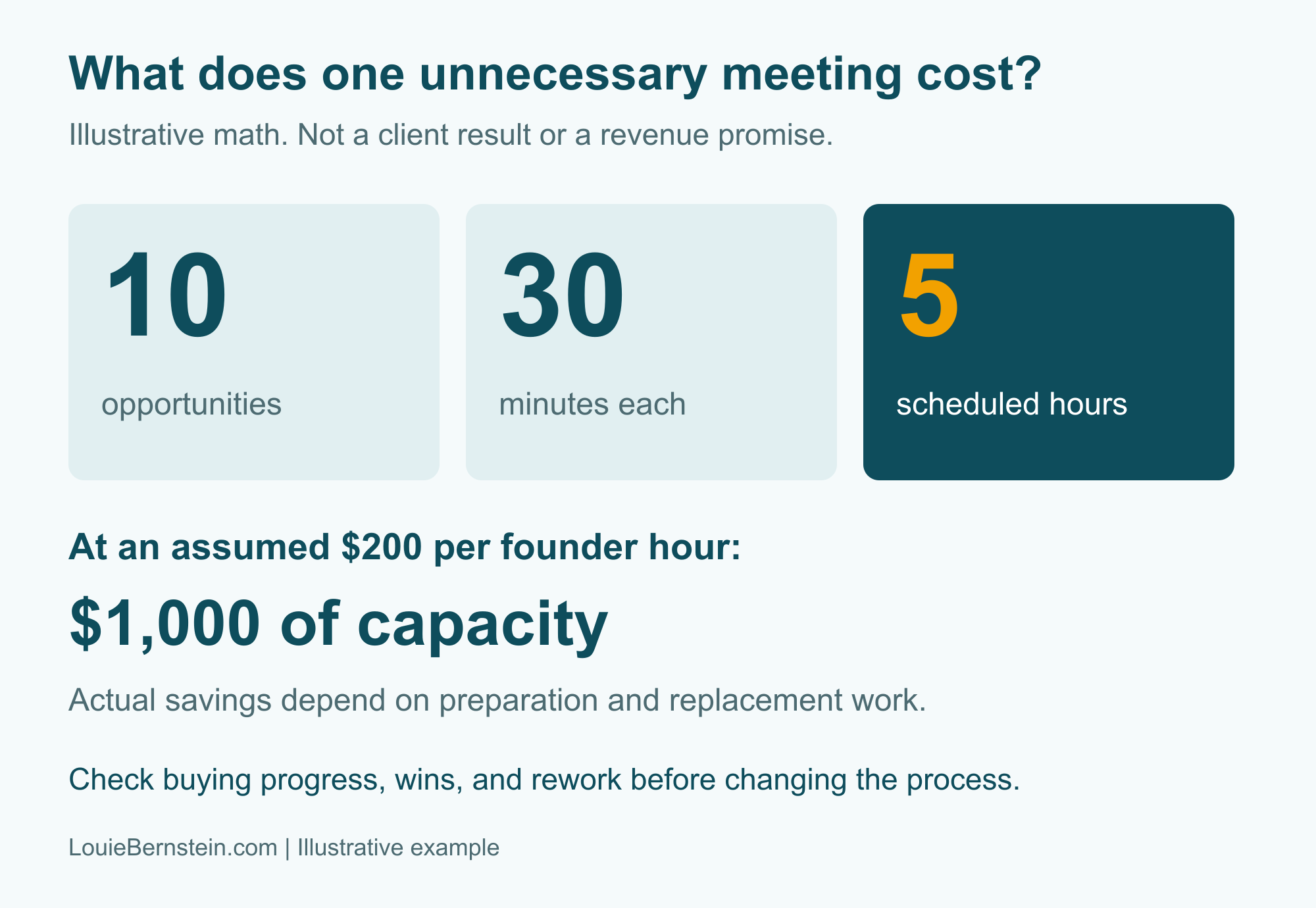
Here is illustrative math, not a client result: removing one unnecessary 30-minute meeting from each of 10 opportunities saves five scheduled hours. At a $200 hourly founder opportunity cost, that's $1,000 of capacity. It isn't booked revenue or guaranteed profit. Preparation, follow-up, and replacement work change the real saving.
Check what happened afterward. Did buyers complete the next action? Did a missing stakeholder appear at signature? Did implementation discover a requirement sales hadn't verified? A faster route that creates rework deserves repair.
Start with five recent deals where someone asked to skip a meeting. Write down what was already known, what was assumed, and what happened next. Use the findings to improve the Sales Playbook. If your team has no shared stages yet, establish those first. Flexible execution needs a common standard.
Frequently Asked Questions
Should an existing customer repeat qualification for another purchase?
Confirm what changed: the use case, funding, decision-maker, scope, and approval path. Reuse accurate account information. A new department or legal entity can introduce requirements that the first purchase never addressed.
Can procurement start before validation is complete?
Procurement can review standard terms while technical work continues if both sides understand what remains unresolved. Keep dependencies visible and avoid making commitments that assume a successful evaluation. Parallel work doesn't mean every approval is complete.
Should reps use separate pipelines for shorter paths?
Use the same pipeline when the buying requirements and stage meanings stay the same. Add a route field for reporting. Consider a separate pipeline when the commercial motion genuinely differs, such as a simple renewal compared with a new implementation.
What if the buyer refuses to identify the decision-maker?
Explain why the approval path affects the recommendation and timing. Offer help the buyer can share internally. Keep the unknown visible, and don't represent the opportunity as ready to close without evidence of how approval will happen.
Can AI decide which meetings a buyer should skip?
AI can summarize supplied information and flag missing facts. A rep should check the underlying material before advancing a deal or making a commitment. A generated summary can sound complete while combining assumptions with actual buyer statements.
Build a process your reps can use with judgment
If every exception brings you back into the deal, your team needs clearer rules and coaching. As a Fractional Sales Leader, I help B2B founders at $1M to $10M ARR build Sales Playbooks and teach reps to move deals forward.
Schedule a 30-minute conversationAbout the Author

Louie Bernstein Fractional Sales Leadership
Louie Bernstein is a Fractional Sales Leader with 50 years of sales experience and has worked as a Fractional Sales Leader since 2017. He built and ran MindIQ for 22 years. He helps B2B founders at $1M to $10M ARR build repeatable sales systems so selling doesn't depend on the founder.