Key Takeaways:
- One hour a week works because the skill you're building, running your own sales, sticks through reinforcement, not through a one-time bootcamp. You forget 84% of what a one-time sales workshop teaches within 90 days if nothing reinforces it, and the forgetting curve doesn't spare founders (Sales Performance International).
- A weekly cadence is the reinforcement, and in this model you're the one being coached, not a rep. Consistent coaching lifts close rates by as much as 70% over one-and-done training because the mechanism is repetition, not intensity.
- The hour is for building the system, not for me to close your deals. The work between sessions is where the results come from.
- It won't work if you're in full crisis needing daily hands-on management, if you won't do the homework, or if you have no product-market fit to systematize yet.
- No sales system in place is fine. That's the point. No willingness to build one is the actual disqualifier.
Let me start with the objection I hear most, because it's a fair one.
"One hour a week? That's it? How is one hour going to fix a sales problem it took me three years to create?"
I understand the skepticism. A full-time VP of Sales is in your business forty hours a week. One coaching session is $350. On the surface, the math looks like you're getting a sliver of what a real sales leader would give you. And if you think of that hour as the whole job, you're right to be skeptical.
But that's not how the hour works. The hour isn't the job. The hour is where we decide what the job is that week, and then you and your team go do it. What you're really buying isn't sixty minutes. You're buying a system that gets built one week at a time, and a cadence that makes sure the work actually gets done instead of dying in your inbox.
So can it work one hour a week? Yes. But only if it's done a specific way. Here's the honest case on both sides, and the research that settles it.
The Honest Case Against One Hour a Week
I'm going to argue the other side first, because if I don't, you won't trust me when I argue mine.
One hour a week is not enough time to run your sales team for you. It's not enough to sit in on every deal, manage every rep, or catch every mistake in the moment. If what you need is a person to take the wheel and drive your revenue day to day, one hour a week won't do it. A fractional model that's mostly coaching relies on you and your team to execute between sessions. If there's nobody capable of executing, the plan just sits there.
It also doesn't work in a crisis. If you're going to miss payroll, if your one salesperson just quit and took the pipeline with them, if you need someone hands-on today, coaching is the wrong tool. That's a triage situation, and triage needs presence, not a weekly appointment.
And here's the one that stops most people: coaching only works on people who do the reps. If you show up to the hour, nod at everything, and then let the week swallow the homework, you'll get nothing. I've watched smart founders waste months this way. The session felt productive. Nothing changed. The hour is only as valuable as the six days that follow it.
If you want someone to close your deals for you, don't hire a coach. That's not coaching. That's just moving the founder trap onto someone else's desk.
So that's the case against. It's real, and I won't pretend it isn't. Now let me show you why, for the right founder, one hour a week beats the forty-hour alternative you think you need.
The Case For It: What the Research Actually Says
Before I go further, let me be clear about who this section is for. It's for you, the founder. Not your reps. The research below is about what happens when you take coaching, because in The Founder's Corner you're the one in the chair.
Here's the thing about any skill worth having, including the skill of building a sales system that runs without you. It doesn't stick from a single big event. It sticks from repetition over time. And there's a mountain of research proving it.
Sales Performance International found that 84% of what's taught in sales training is forgotten within 90 days if nothing reinforces it. Eighty-four percent. And before you file that under "rep problem," don't. It's a human one. Think about your own version of it: the sales book you highlighted, the two-day seminar you flew to, the webinar you swore you'd act on. Most of it was gone before the next quarter started. That's not a discipline flaw. It's how learning works without reinforcement. A founder learning to build a sales system is no more immune to the forgetting curve than anyone else, and adding reinforcement raises retention by about 60% over the one-and-done event.
Now the same mechanism in reverse, on the upside. When the person being coached gets a steady, structured cadence instead of a one-time download, performance climbs. Consistent coaching is tied to gains of roughly 25% in revenue and as much as 70% in close rate, a formal coaching approach hits 91% of quota versus 85% for winging it, and the International Coach Federation, in a study with PricewaterhouseCoopers, measured an average return of seven times the coaching investment. Here's the part that's easy to miss: in The Founder's Corner, the person getting that weekly cadence is you. Not a rep. You're the one whose qualifying instinct, judgment, and process we sharpen and write down, because you're the one the whole operation runs through today.
Read those two facts back to back. A bootcamp you sit through gets forgotten. A steady hour a week, with you in the chair, gets retained and compounds into a system. One hour a week is not a smaller version of the bootcamp. It's the delivery method the research says actually changes behavior, aimed at the one person who can change how the whole company sells. You.
The problem was never that you didn't know enough about sales. The problem is that nothing in your week forces the knowledge to turn into a system. That's what the hour is for.
This matters more for a founder at $1M to $10M ARR than for anyone else. You're not failing at sales. You built the whole company on your own selling. The gap isn't skill. It's that your process lives in your head, and a weekly rhythm is what pulls it out of your head and onto paper your team can run. Founder-led sales almost never plateaus because the market ran out. It plateaus because the commercial model hit the ceiling of one person's calendar.
What One Hour a Week Actually Builds
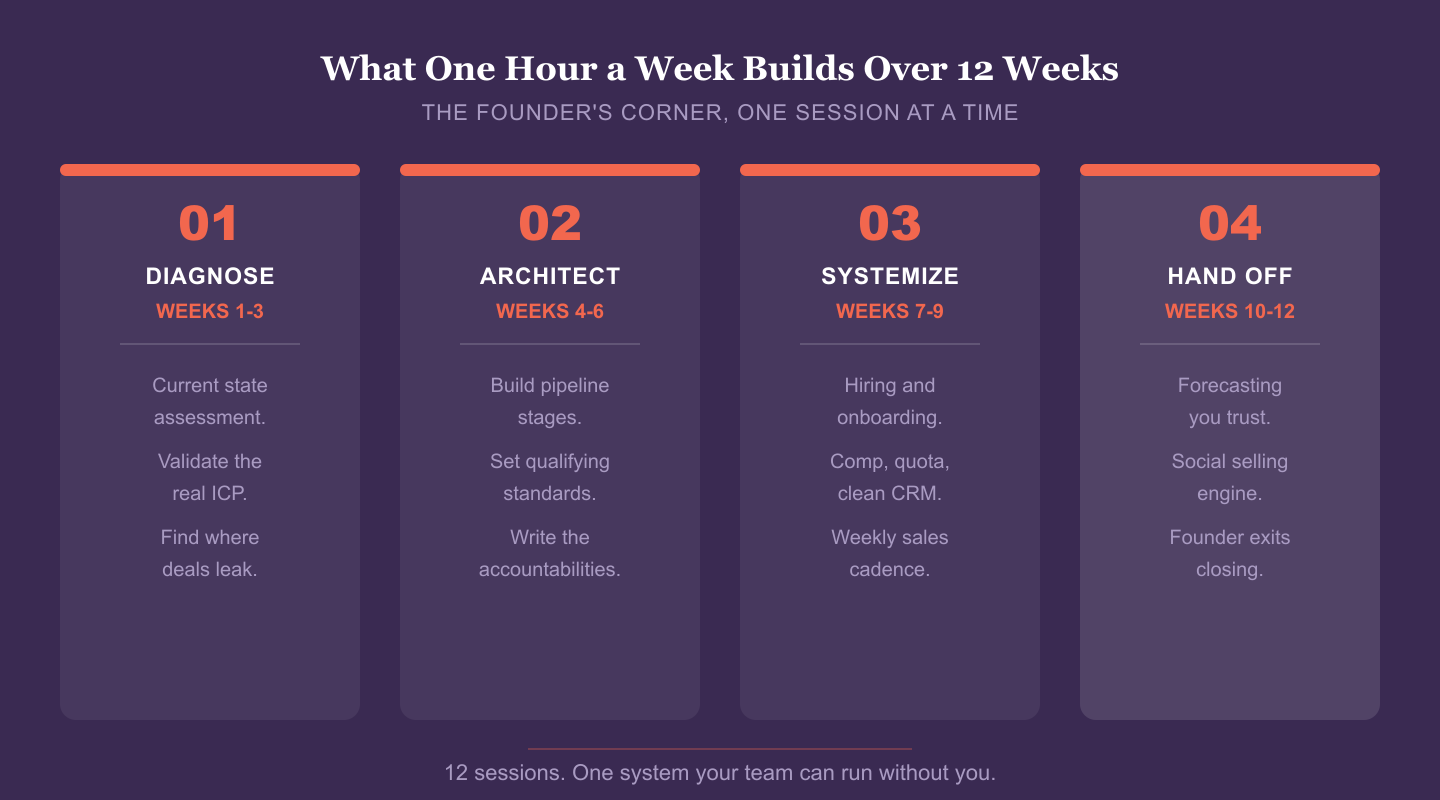
Skepticism usually comes from not being able to picture it. So let me show you exactly what gets built. This is the structure I use inside The Founder's Corner, my 12-week founder coaching program. One session a week, one block of the system at a time.
Weeks 1-3: Diagnose
We start by looking at what's actually happening, not what you assume is happening. Current state assessment. We validate your real Ideal Customer Profile, because most founders are selling to three or four different buyers and calling it one. Then we find where deals leak. You can't fix a pipeline you haven't measured.
Weeks 4-6: Architect
Now we build the skeleton. Real pipeline stages with real entry and exit criteria. Qualifying standards, so your team stops chasing deals that were never going to close. And an Accountability Document for every sales role, so everyone knows exactly what they own. This is the paperwork that makes a business sellable and a team hireable.
Weeks 7-9: Systemize
This is where it starts running without you. Hiring and onboarding systems so your next rep ramps in weeks, not quarters. Compensation and quota frameworks that pay for the behavior you actually want. A clean CRM, and a weekly sales cadence that inspects the work. Remember the 84% that gets forgotten? The weekly cadence is the reinforcement that keeps it from disappearing.
Weeks 10-12: Hand Off
The last stretch is about you stepping back. Forecasting you can actually trust. A social selling engine on LinkedIn and YouTube so leads come to you. And the real goal of the whole thing: the founder exits the closing seat, and revenue keeps coming anyway.
The One Variable That Decides Everything
If you take one thing from this article, take this. Whether one hour a week works has almost nothing to do with the hour. It has everything to do with what you do with the other six days.
Coaching is not doing. In our session, we decide the move. Write the qualifying criteria. Rebuild the discovery script. Sit down with your rep and set their quota. Then you go execute it, and you bring the result back next week so we can sharpen it. That loop, decide, do, review, decide again, is the entire mechanism. It's why the research on reinforcement is so strong, and it's why the founders who do the reps see 61% sales increases while the founders who just attend the meeting see nothing.
A full-time VP would do a lot of that work for you. And that sounds better until you remember the cost, both in dollars and in what you lose. When someone else builds and owns your entire sales function, you never learn how it works. The founders I coach come out the other side actually understanding their own sales machine. That's leverage a hire doesn't give you.
The math is not subtle either. The Founder's Corner is $1,400 a month. A full-time VP of Sales runs $250,000 to $400,000 all in, and their average tenure has dropped to about 17 to 19 months, often shorter than the sales cycle they were hired to shorten. One hour a week that teaches you to run your own sales, versus a six-figure bet that leaves in a year and a half. For a founder between $1M and $10M who isn't ready for that gamble, the cheaper option is also the better one.
When One Hour a Week Won't Work
I'd rather tell you not to hire me than take your money for something that won't help. So here's the honest map of who this fits and who it doesn't.
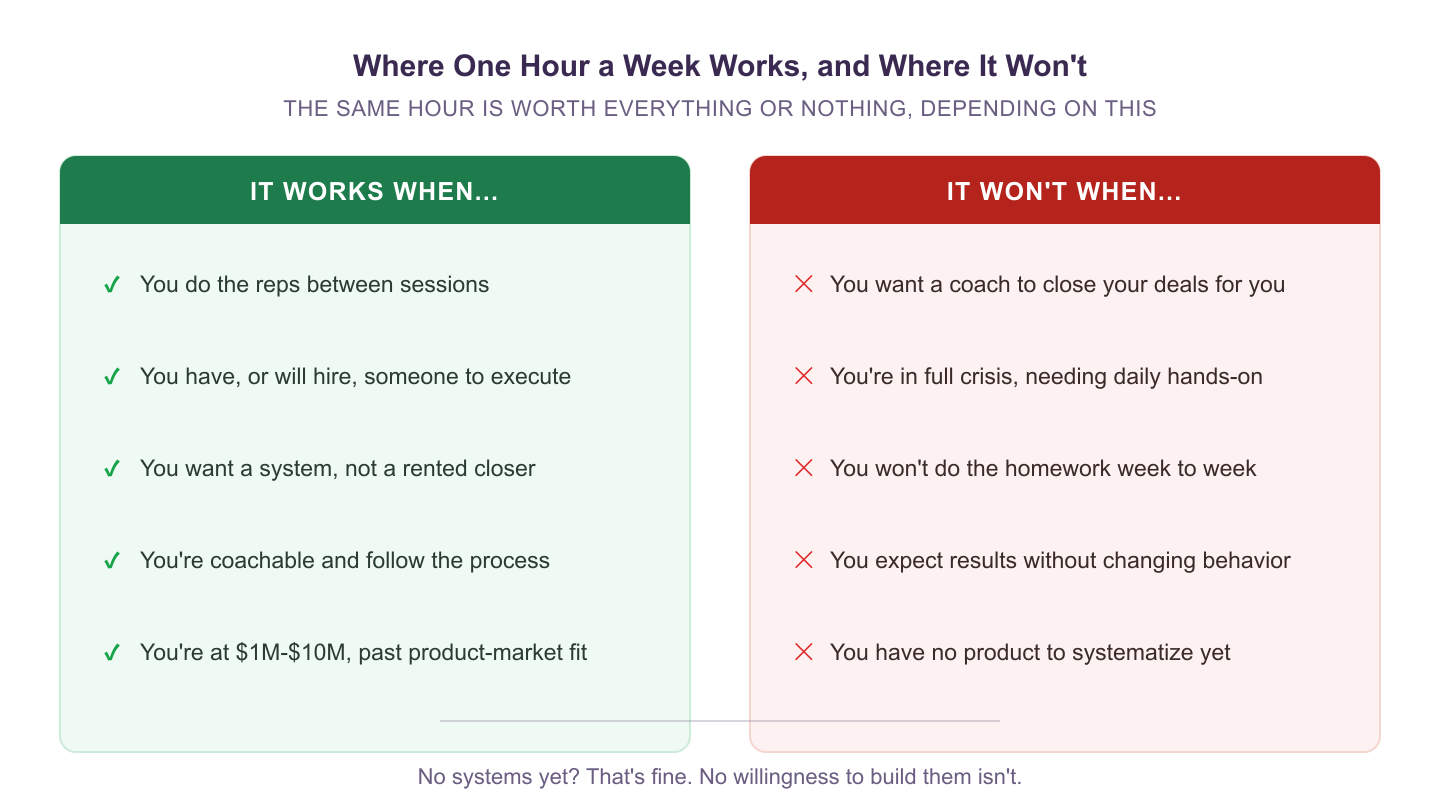
Notice the last red row, because founders get this backwards. People assume that if they have no sales system, no documented process, no pipeline stages, coaching is too advanced for them. The opposite is true. Having no system is exactly the starting condition The Founder's Corner is built for. Week one is a current-state assessment precisely because most founders walk in with nothing written down. We build the system from zero. That's the work.
The real disqualifier isn't the absence of a system. It's the absence of two things: a product that's already found its market, and a founder willing to do the reps. If you haven't nailed product-market fit yet, there's nothing to systematize, and no amount of sales structure fixes a product problem. And if you won't do the homework between sessions, the best coaching on earth is wasted on you. Be honest with yourself about both before you start.
No system yet? Perfect. That's what we build. No product-market fit, or no intention of doing the work? Save your money. I'll tell you that on the first call.
Frequently Asked Questions
Q: Can one hour a week of sales coaching really replace a VP of Sales?
It doesn't replace the day-to-day management a VP does. It replaces the reason you thought you needed one. A weekly coaching cadence builds the documented sales system, the pipeline stages, the hiring playbook, and the operating rhythm that a good VP would build, except you keep the knowledge instead of it walking out the door. For a founder at $1M to $10M ARR who isn't ready for a six-figure hire, that's usually the smarter move. You're paying $1,400 a month to learn to run your own sales instead of $200,000-plus to rent someone who leaves in 17 months on average.
Q: Why does a weekly cadence work better than an intensive workshop?
Because skills fade fast without reinforcement. About 84% of what's taught in sales training is forgotten within 90 days when there's no follow-up, according to Sales Performance International, and that forgetting curve applies to a founder in a seminar just as much as a rep in a workshop. A one-time bootcamp is mostly gone before you've used it. A weekly session is spaced repetition, the exact mechanism that makes learning stick, which is why consistently coached people outperform on quota, revenue, and close rate. The cadence isn't a compromise on the workshop. It's the better delivery method, and in The Founder's Corner you're the one getting it.
Q: What do I actually do between coaching sessions?
You execute the week's move. That might be writing your qualifying criteria, rebuilding a discovery script, cleaning up your CRM stages, running your first structured pipeline review, or sitting down with a rep to set quota. The session is where we decide the move and sharpen the last one. The week is where the work gets done. If you don't do the work between sessions, the coaching won't produce results, and I'll be honest with you about that early.
Q: I don't have any sales process at all. Am I too early for this?
No. Having no system is the normal starting point, not a disqualifier. Most founders who start The Founder's Corner have their entire sales process living in their own head with nothing written down. Week one is a current-state assessment for exactly that reason. We build the system from scratch, in order, one block a week. The only real too-early signal is not having product-market fit yet. If the product hasn't found its buyer, fix that first, because sales structure can't fix a product gap.
Q: How fast will I see results?
Some things move in the first month, like tighter qualifying and a cleaner pipeline, because they're quick to implement and immediately stop wasted effort. The bigger outcomes, hiring that sticks, a forecast you trust, revenue that holds when you step back, build over the full 12 weeks and beyond. One founder I worked with grew sales 61% and turned their first profit in years within a year. That's the compounding effect of doing the reps week after week, not a first-session miracle.
Q: When is fractional coaching the wrong choice?
When you need daily hands-on management right now. If you're in full crisis, if there's no one on your team capable of executing the plan, or if you genuinely need someone to run the sales floor every day, coaching isn't the right tool and I'll say so. Coaching also fails on anyone looking for a shortcut, someone who wants a coach to close their deals for them instead of learning to build the system. That's just relocating the founder trap. If that's what you want, we're not a fit, and I'd rather tell you now.
One hour a week could be the difference between owning your business and being owned by it.
The Founder's Corner is a 12-week program that turns founder-led sales into a system your team can run without you. $1,400 a month. One session a week. See exactly how it works and whether it fits your situation.
See The Founder's Corner →Or book a 30-minute call and I'll tell you honestly whether one hour a week can help you.
About the Author
Louie Bernstein
Fractional Sales Leader with 50 years of sales experience helping $1M–$10M ARR companies build scalable, repeatable sales systems. Founder of MindIQ (INC 500). LinkedIn Top Voice in Sales Management, Sales Operations, and Sales Coaching.