Key Takeaways:
- Yes, founders need sales coaching, and they need it more than the reps they're trying to hire. You're the one person in the building nobody coaches, running the one function you were never trained for.
- The coaching gap has a cost. Half of CEOs report loneliness at the top, and 61% say it hurts their performance (RHR International / Harvard Business Review). You're making your highest-stakes sales decisions with no one to pressure-test them.
- Coaching pays, and it pays most at the top. Formal sales coaching lifts win rates about 28% (CSO Insights), sales training returns $4.53 on the dollar (ATD), and mentored owners grow revenue 83% versus 16% without (SCORE).
- Sales coaching takes priority over every other kind, because in recurring revenue your bad habits don't just cost this quarter's deal. They compound into next year's churn.
- A Fractional Sales Leader is the coach for the person at the top: someone who's built and run sales teams, reviews your calls, pressure-tests your instincts, and turns what's in your head into a system the whole team can run.
Founders usually ask me this as a challenge, not a question. "I've been selling for fifteen years and I built this company to $4M. Do I really need sales coaching?" Yes. And you need it more than the reps you're thinking about hiring to take sales off your plate.
I say that with some scar tissue. In 2008 I had a company that made the INC 500, decades of selling behind me, and I still ran myself straight into the ground. Not because I wasn't good at sales. Because I was the only one carrying it, and there was nobody above me checking my blind spots, my pace, or the story I kept telling myself that everything was fine.
Here's the thing nobody says out loud. In your company, every single person gets coached except one. The rep gets coached by the manager. The manager gets coached by the VP. You, the founder running sales, report to a board deck and a spouse who's tired of hearing about the pipeline. The person making the highest-stakes revenue decisions is the least coached person in the org chart.
So let's answer the question properly. Not "is coaching nice to have," but why the founder is the one who needs it most, why sales coaching specifically jumps the line, and what it actually looks like when it's done right.
The One Person in the Building Nobody Coaches
Everyone under you gets developed. You get a status update.
Think about how skill actually improves in a sales org. Someone senior listens to your calls, tells you what you missed, and holds you to fixing it next week. That's the whole mechanism. It's why teams invest in managers at all. Now look at your own week. Who does that for you? Nobody. You're the top of the funnel and the top of the org chart at the same time, which means your selling has been on autopilot for years with no one in the passenger seat. Your reps get better on a schedule. You get better by accident, if at all.
You never trained for the job you're actually doing
Most B2B founders didn't come up through sales. You built a product, solved a problem you understood cold, and sold it because you had to, not because anyone taught you how. You got to $1M, $3M, $5M on conviction, product knowledge, and being genuinely good in a room. That's real, and it's also a ceiling. Conviction closes early adopters. It does not build a repeatable process, qualify out the wrong deals, or teach the next person to sell without you. You've been improvising a role that most people spend a career learning, and improvising it alone.
The founder is the least-coached person in the company and the one whose decisions matter most. That's not a small gap. That's the gap.
What the Research Says About Coaching the Person at the Top
I like to argue this with numbers, because "trust me, you need a coach" is exactly what you'd expect a coach to say. The data does the work better than I can.
Coaching pays, and it compounds at the top
The return on coaching is not subtle. CSO Insights found that teams with a formal coaching process post win rates roughly 28% higher than teams that coach randomly or not at all. The Association for Talent Development pegged the return on sales training at about $4.53 for every dollar spent. And SCORE's work on mentorship found that owners who get outside guidance grew revenue by 83% on average, compared to 16% for those who didn't. Now apply that leverage to the person whose selling touches every big deal in the company. Coaching a rep improves one seat. Coaching the founder improves the whole revenue engine, because everything still runs through you.
The loneliness tax is a performance tax
This part gets waved off as soft, and it isn't. A study by RHR International, reported in Harvard Business Review, found that half of CEOs experience loneliness in the role, and of those, 61% believe it's hurting their performance. That's not about feelings. It's about decision quality. When there's no one to pressure-test the deal you're about to discount, the hire you're about to make, or the forecast you're about to promise the board, you make those calls in an echo chamber. Founders are also 50% more likely to report a mental-health condition than a comparison group, per Dr. Michael Freeman's research at UCSF. Isolation at the top isn't a personality quirk. It's a structural risk to the business, and coaching is the most direct fix for it.
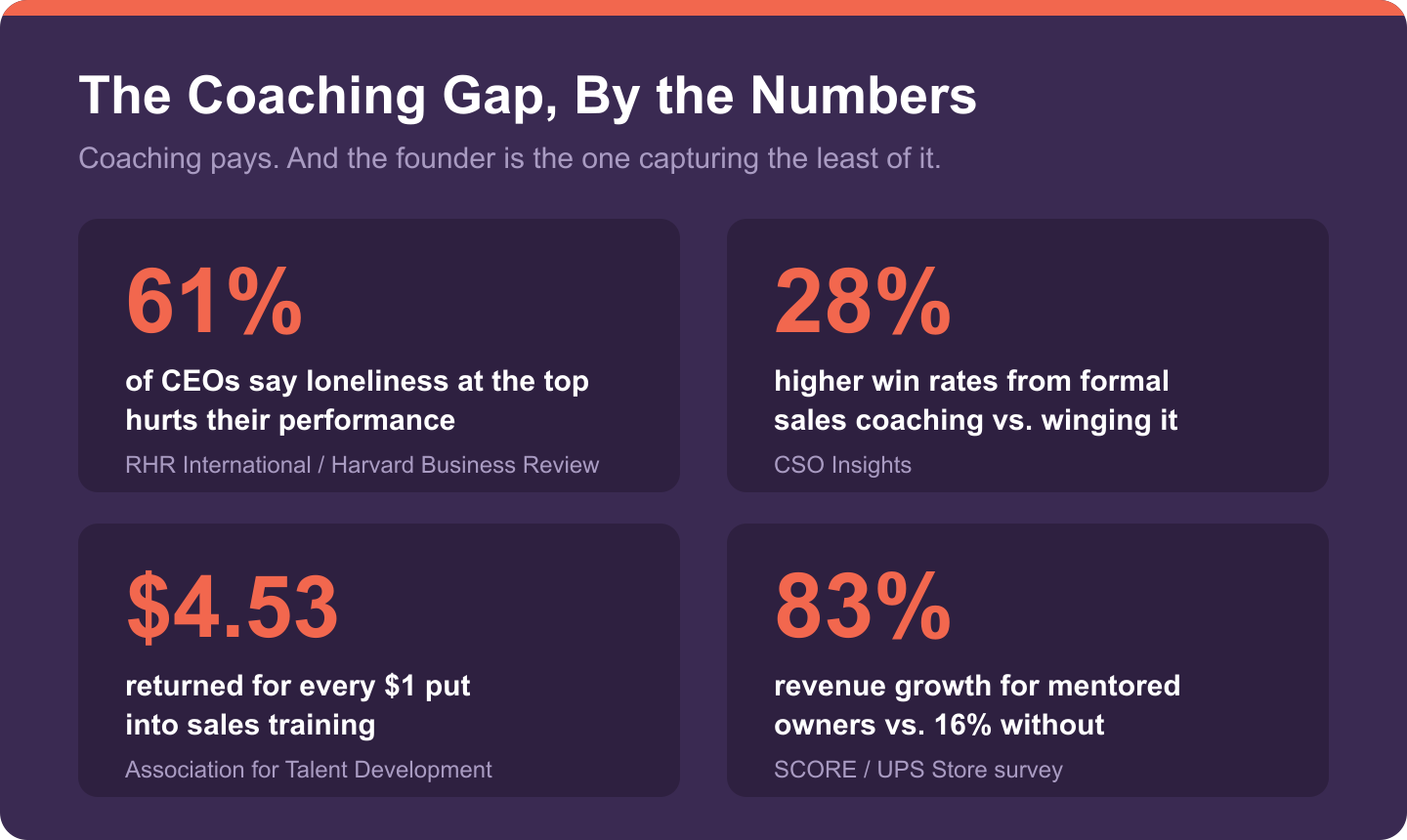
Coaching a rep upgrades one seat. Coaching the founder upgrades every deal in the building, because you're still the one they all route through.
Why Sales Coaching Takes Priority Over Every Other Kind
There's no shortage of coaches offering to help founders. Leadership coaches, mindset coaches, executive coaches. They're not wrong, and some are excellent. But for a founder between $1M and $10M ARR still stuck in founder-led sales, sales coaching jumps the line. Here's why.
Sales is the constraint on everything else
Mindset matters. But mindset doesn't fill the pipeline, and it doesn't get you out of the room on every deal. Sales is the function that's capping your growth right now, eating your calendar, and keeping your brain running at 11pm. Coach the constraint first. A general executive coach can help you feel steadier while you're still the bottleneck. A sales coach removes the bottleneck. One treats the symptom, the other treats the cause, and at your stage the cause is that revenue can't happen without you personally in it.
In recurring revenue, the coaching you skip becomes the churn you inherit
This is the part founders underrate. In a one-time-sale business, a sloppy deal is one bad transaction. In SaaS or any recurring model, a deal sold to the wrong customer, or on the wrong promise, doesn't just book badly. It churns in eight months, drags your net revenue retention down, and shows up as a scar on your metrics right when you're trying to raise. Uncoached selling habits, the ones nobody's ever corrected because nobody coaches you, get baked into how the whole team sells. Fix them at the source and you're not just closing more. You're closing the right deals, the ones that stay.
Sales is the function that never sleeps and never lets you rest. It's the first thing to coach, not the last, because it's the thing that's actually running you into the ground.
What Coaching a Founder Actually Looks Like
When founders picture sales coaching, they picture a motivational speaker or a course. That's not it, and if that's what's on offer, keep your money.
It's not therapy and it's not a pep talk
Real sales coaching for a founder is specific and unglamorous. Someone who's built and run sales teams sits in on your calls and tells you where you talked past the buying signal. They look at your pipeline and call the three deals that are dead but you're still forecasting. They watch you give away margin on a discount you didn't need to give, and they make you feel it. It's the same call review you'd give a rep, except the rep is you, and you've never had it before. That's uncomfortable the first few times. It's also the fastest way anyone's selling has ever gotten better, yours included.
Coach the founder first, then build the system that coaches the team
Here's where sales coaching for a founder is different from coaching a rep, and better. When someone coaches you, the goal isn't just to make you a sharper closer. It's to extract what you do well, the questions you ask, the way you frame the problem, the objections you handle in your sleep, and turn it into a documented process the rest of the team can run. Your instincts become the playbook. Then that same person builds the hiring and coaching system so your reps get developed on a schedule instead of by accident. Coaching the founder is the on-ramp. A sales org that runs without you is the destination.
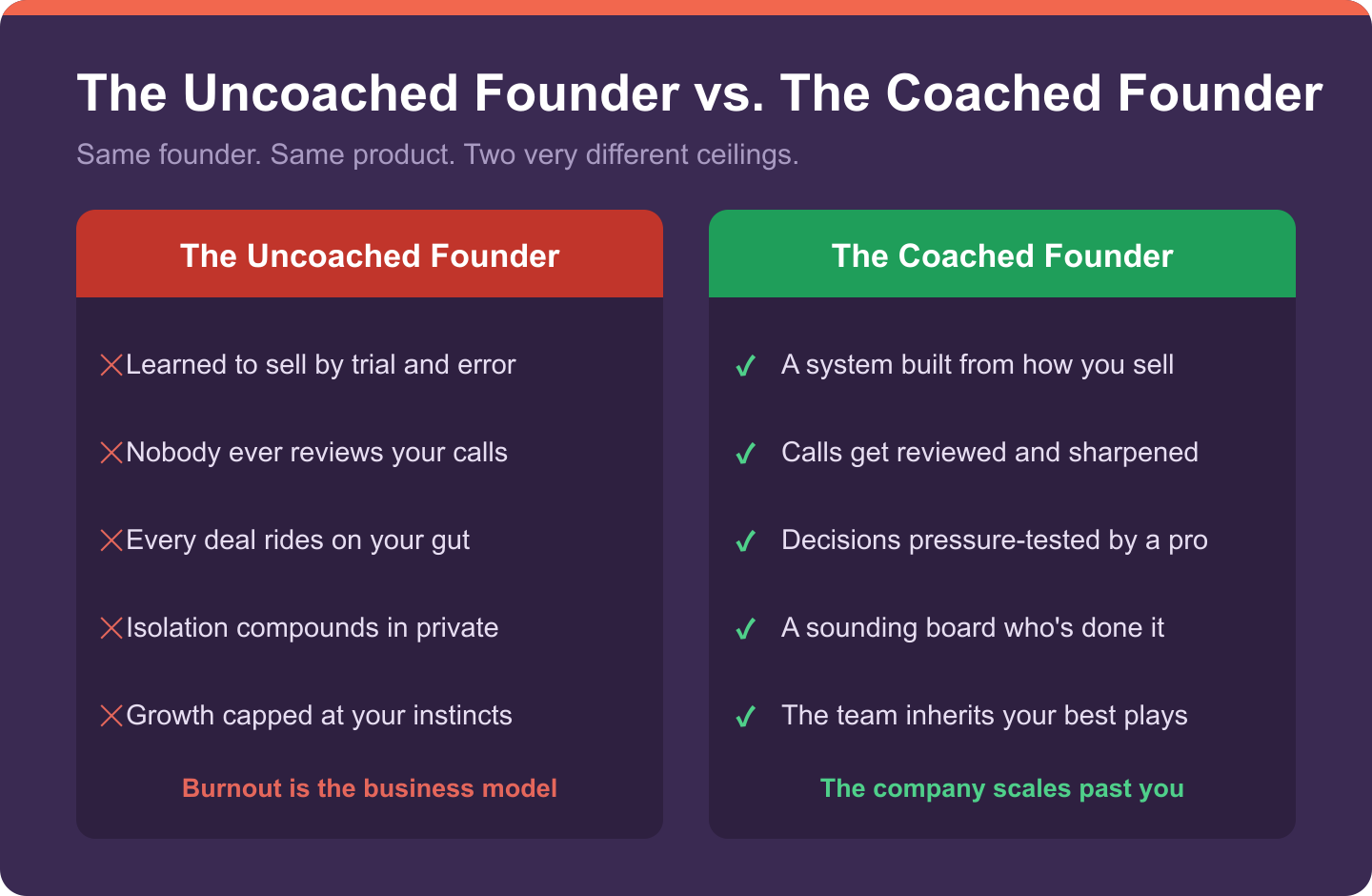
Why This Stops Being Optional at $1M ARR
Below $1M, being the coach-less founder-closer is survivable. You're small enough to hold it all in your head. Somewhere past $1M, that stops being true, and the cracks start showing up as founder burnout, missed forecasts, and a first sales hire that doesn't work out because there was no system to drop them into. The uncoached habits you got away with at $500K become the ceiling you can't break through at $4M.
The reflex answer is to hire a full-time VP of Sales and hope they coach you and fix everything. At $1M–$10M ARR, that's a $300K-plus bet, and it's the wrong sequence, because you're hiring someone to run a system that doesn't exist yet. That's the gap a Fractional Sales Leader fills. You get senior sales leadership, the person who's built teams before, coaching you directly and building the process, the Accountability Document, and the hiring plan, for a fraction of the cost and none of the long-term lock-in. It's coaching for the person at the top, paired with the system that finally gets you out of every deal.
You coach every rep you hire. It's strange that the one person you never think to coach is the one every deal depends on. Start there.
What sales coaching cadence actually improves rep performance in 90 days?
A protected 30-minute weekly one-on-one — not a monthly marathon — is the cadence that moves rep performance inside a quarter, because the short feedback loop lets reps practice, adjust, and repeat every week.
- Structure each session in thirds: 10 minutes reviewing one real call or deal, 10 minutes on skill roleplay, and 10 minutes on a single micro-goal you inspect the following week.
- Consistency beats intensity: teams running a formal, dynamic coaching process hit roughly 91% of quota versus about 85% for ad-hoc coaching (CSO Insights).
- Never mix coaching with pipeline review — blending the two is the most common reason coaching programs stall in the first 90 days.
Frequently Asked Questions
Q: Do founders really need sales coaching if they've been selling for years?
Yes, and often more than newer sellers, because founders have had the most reps with the least feedback. Experience without coaching just hardens your habits, good and bad, and nobody's ever told you which is which. You built the company on conviction and product knowledge, which closes early customers but doesn't build a repeatable process or teach anyone else to sell. Coaching turns what's worked into something transferable, and catches the blind spots years of selling alone quietly created.
Q: What's the difference between sales coaching and a general executive coach for a founder?
An executive coach works on how you lead and how you think. A sales coach works on how you sell and how your revenue engine runs. Both have value, but for a founder still stuck in founder-led sales, the sales side is the constraint on everything else. Sales is what's capping growth, eating your calendar, and keeping you up at night. Coach the constraint first. Executive coaching helps you carry the load more steadily. Sales coaching takes the load off.
Q: Does sales coaching actually produce a return, or is it a soft investment?
It's one of the better-documented returns in business. CSO Insights found formal coaching lifts win rates about 28% over random or no coaching. The Association for Talent Development put the return on sales training at roughly $4.53 per dollar. And SCORE found mentored owners grew revenue 83% on average versus 16% for those without guidance. The catch is that most coaching is informal and wasted. The return comes from a structured process with a real practitioner, not a course or a pep talk.
Q: Isn't isolation just part of being a founder?
Pressure is part of it. Making every high-stakes call with no one to pressure-test you isn't something to accept, it's a risk to fix. Half of CEOs report loneliness in the role, and 61% say it hurts their performance, according to RHR International's work with Harvard Business Review. That's decision quality, not feelings. A good coach is the person you can think out loud with before you discount the deal, make the hire, or commit to the forecast. That single relationship is often the highest-leverage thing a founder adds.
Q: Can't I just hire a VP of Sales to coach me and the team?
You can, but at $1M–$10M ARR it's usually the wrong sequence and a $300K-plus risk. You'd be hiring someone to run a system that doesn't exist yet, and most of those hires roll off inside a year having built nothing you can keep. A Fractional Sales Leader gives you the same senior coaching and experience without the fixed cost or the commitment. They coach you, build the process and the Accountability Document, then hire and develop the reps inside the system they've built. Leadership sized to where your company actually is.
Q: How fast does coaching a founder show results?
Faster than most founders expect on the calls, slower on the system. Once someone starts reviewing your calls and pipeline, the sharpening shows up within the first few weeks, tighter discovery, fewer dead deals in the forecast, less margin given away. Building the full engine, the documented process, the hires, the coaching rhythm that holds without you, is a quarter or two of focused work. But the shift in how you sell, and how much lighter the load feels once you're not deciding everything alone, tends to land early.
You coach everyone but yourself. Let's fix that.
If you're a $1M–$10M founder still carrying sales on your own back with no one reviewing your calls or pressure-testing your deals, let's talk. Thirty minutes. We'll look at how you're selling right now, find the habits nobody's ever corrected, and map out what to coach first, whether you work with me or not.
Schedule a 30-Minute CallAbout the Author
Louie Bernstein
Fractional Sales Leader with 50 years of sales experience helping $1M–$10M ARR companies build scalable, repeatable sales systems. Founder of MindIQ (INC 500). LinkedIn Top Voice in Sales Management, Sales Operations, and Sales Coaching.