Key Takeaways:
- The first-year churn trap starts when a signed contract gets treated as a finished job. The customer still needs to see a useful result.
- Early losses can consume the selling and onboarding effort before the relationship has time to earn it back.
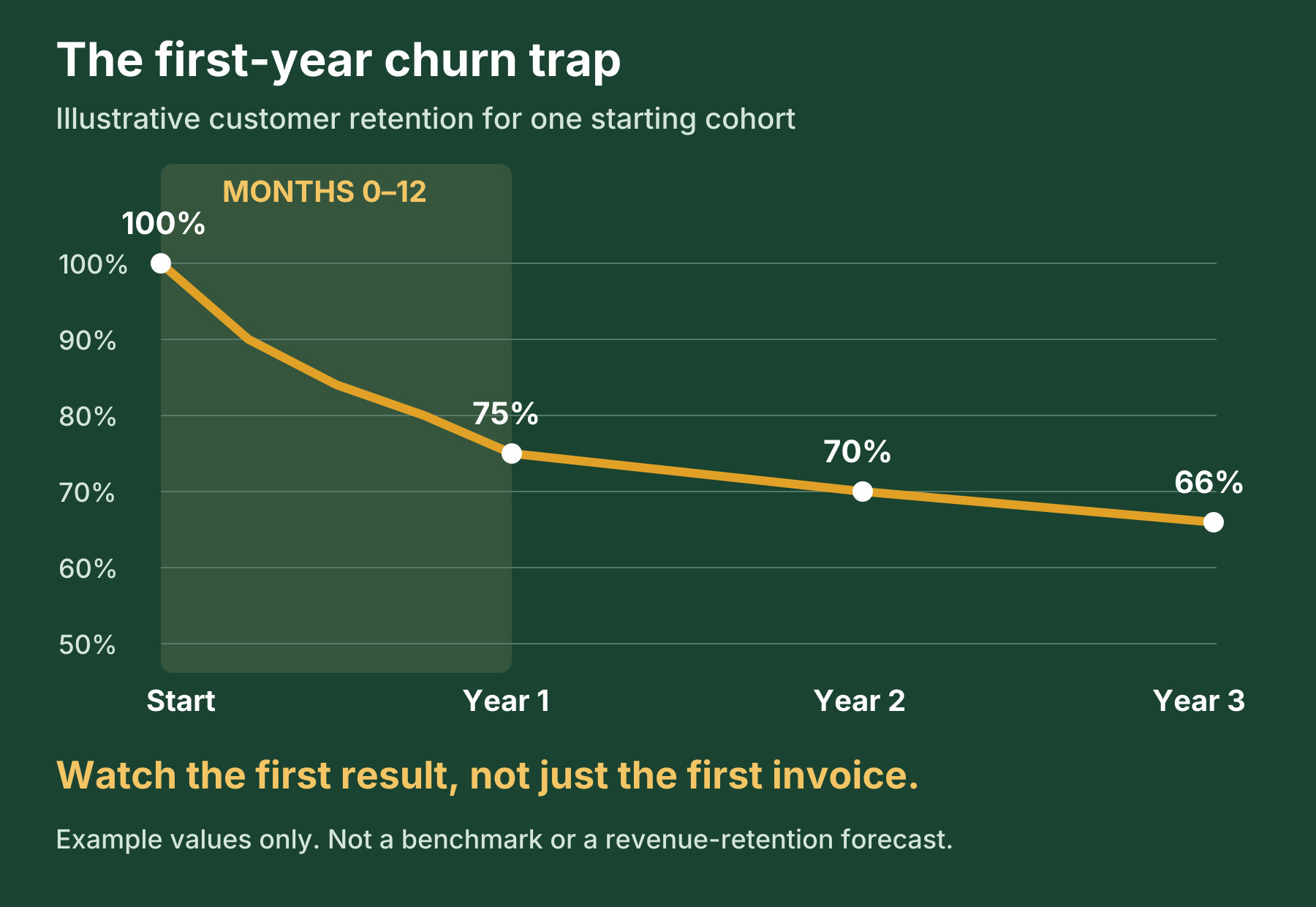
- Compare customers at the same age. A healthy overall retention number can hide trouble in your newest accounts.
- Use 30/60/90-day checks to confirm value, not just completed training. Adapt the dates to your delivery cycle.
- Give each account one owner, a customer-agreed next step, and a review date. The founder should not have to rescue every handoff.
You worked for months to win the account. You handled the objections, got the agreement signed, and handed the customer to your team. Then you went back to selling. That is what a founder is supposed to do, right?
Six months later, the customer asks what they are getting for the money. Your team points to training sessions, support calls, and completed tasks. The customer wanted a business problem solved. Those are different answers.
For a B2B founder at $1M to $10M ARR, this is an expensive gap. You can spend your best selling hours bringing in customers who leave before the relationship becomes durable. Then you have to sell the replacement revenue yourself.
First-year churn is the loss of customers during their first twelve months. It is not always worse than churn in later years. But when expectations, onboarding, and ownership break down early, the first year can do more damage than you see in your bookings report.
A signed contract proves the customer believed your promise. The first year has to prove you can deliver it.
1. Understand What Makes an Early Loss Expensive
You paid the selling cost before the customer stayed
Winning a new customer takes prospecting, discovery, proposals, and follow-up. Delivery then spends time getting the customer started. If the relationship ends early, you have fewer months of contribution to cover that work.
Here is an illustrative example. Assume an account produces $2,000 a month in recurring revenue and $1,400 after direct delivery costs. Assume selling and onboarding cost $8,400. It takes six months of that contribution to cover the upfront cost. A departure after three months leaves $4,200 uncovered.
Those are example assumptions, not industry averages. Use your own costs. The point is to see whether early departures leave you rebuilding revenue before the cost of winning it has been recovered. Do not count the same onboarding cost twice in your calculation.
Revenue churn and customer churn are different
Losing five small accounts and losing one large account can have different effects on revenue. Track both the number of customers leaving and the recurring revenue lost. A customer-retention curve alone cannot prove which year costs you the most dollars.
There is evidence for watching the opening months. ChartMogul's 2023 SaaS Retention Report found early customer losses and another drop around annual renewals. It also cautions that selling motions vary. Its 2024 report describes rising churn in year two in its discussion of net revenue retention. Neither finding makes year one the worst year for every business.
Your job is to locate your own weak point. If that point is the first year, spending all your attention on mature accounts will not fix it.
2. Find the Gap Between the Sale and the First Result
The promise gets lost in the handoff
The founder knows why the customer bought. The salesperson knows what was said on the last call. The delivery team gets a contract and a start date. Nobody receives the full picture.
Before an account leaves sales, record the customer's problem, starting point, intended result, deadline, and key people. Include promises and limits. Have the person responsible for delivery review those commitments before kickoff. If the promise cannot be delivered, address it while there is still time to reset expectations.
Do not make the customer explain their business from scratch to every new person. Use the kickoff to confirm what you learned in discovery and agree on the work ahead.
Activity gets mistaken for progress
Training attendance is useful. A completed setup checklist is useful. Neither proves the customer can do the thing they bought your offer to do.
Suppose a customer buys a service to reduce the time needed to prepare proposals. Three training sessions are an activity measure. A customer-approved proposal completed in less time is evidence of progress. Use that distinction when you define the first result.
Ask the customer what they will be able to do differently when the work is paying off. Then agree on how you will check. A small, verified result beats a long list of tasks with no connection to the original problem.
Nobody owns the next step
Sales thinks onboarding is handling it. Onboarding is waiting for customer information. The customer is waiting for instructions. Two weeks disappear while everybody thinks somebody else has the ball.
Assign one account owner to coordinate the work. That person does not have to perform every task. They need to know what is blocked, who can unblock it, and when the customer will hear from them.
3. Compare Customers at the Same Age
Build a simple cohort view
A cohort is a group of customers who started in the same period. For a small customer base, group accounts by starting quarter. Track what happens to that same group at months three, six, twelve, twenty-four, and thirty-six as the data becomes available.
For customer retention, divide the number still active by the number that started. Keep new customers out of that original group. ChartMogul's cohort-analysis guide explains this approach to comparing customers by subscription age.
Do not compare a group that has reached month twelve with one that has only reached month four. The newer group has not had the same opportunity to leave. Show blanks for periods it has not reached, rather than treating them as perfect retention.
Separate the cause from the timing
Annual contracts can delay when churn becomes visible. The customer may stop using the service in month four but remain contracted until month twelve. Record when progress stopped as well as when revenue ended.
Add a reason to each loss: poor fit, missed expectations, delivery failure, budget change, or another specific cause. Separate payment failures from a deliberate decision to leave. With a small sample, review the accounts behind the percentages before declaring a trend.
Look at dollars too. Gross revenue retention excludes expansion, so it helps show lost and reduced recurring revenue. Net revenue retention includes expansion. A large upsell can improve the net number while several new accounts disappear.
The first renewal can reveal a problem that your first-month review should have found.
4. Use a First-Year Save Plan Before an Account Needs Saving
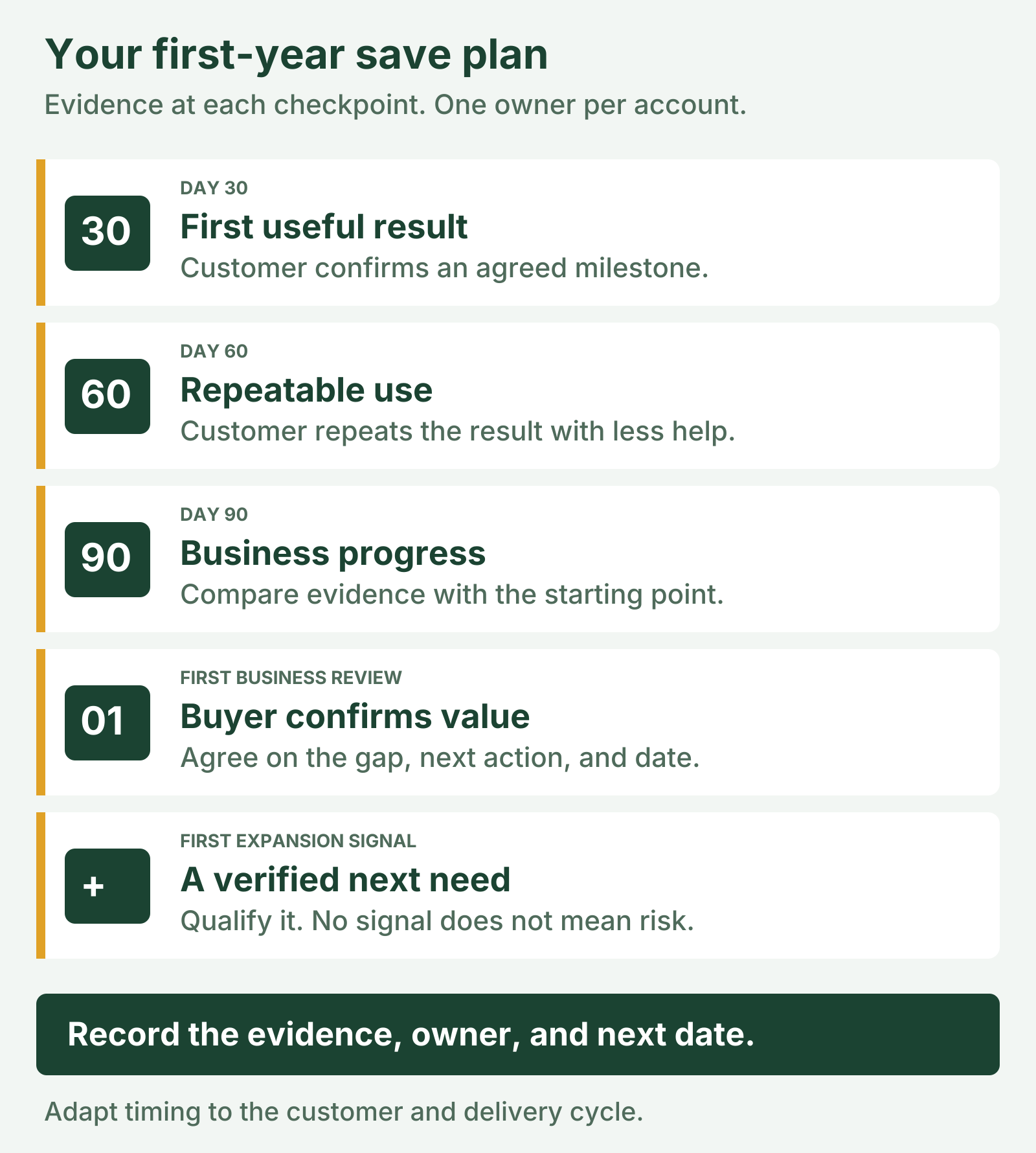
Set 30/60/90-day value checks
Treat these dates as starting points for your process, not promises every customer must meet. A complex implementation may need longer. Agree on realistic milestones before the work begins and make delays visible.
Day 30: Prove the first useful result. The customer can complete one important task or confirm an agreed milestone. Record the evidence, who confirmed it, and what remains blocked. If setup takes longer, confirm a meaningful implementation result and the next proof date.
Day 60: Prove they can repeat it. Check whether the result depends on your team doing the work for them. Can the customer's team use what you delivered? Review repeated usage or another result that fits your service. Identify the training or process gap holding them back.
Day 90: Prove the business connection. Compare progress with the starting point and the reason for buying. Ask the customer what has improved and what has not. Avoid claiming financial savings that the customer has not measured or accepted.
Hold the first business review while you can still change the outcome
Put this meeting on the calendar during onboarding. Invite the people who use the work and the person who can judge its business value. Schedule it around the first meaningful results and ahead of the customer's budget or renewal decision.
Use three questions: What did we agree to improve? What evidence do we have? What needs to happen next? Leave with a written action, an owner on each side, and a date. A slide deck is optional. Those answers are not.
Notice expansion without forcing it
An expansion signal might be another team asking to use the service or a customer describing the next problem they want help with. Record it. Confirm the need, fit, and decision process before putting extra revenue in the forecast.
No expansion signal does not mean the account is unhealthy. The original purchase may solve the whole problem. Do not turn a value review into an upsell pitch when the customer is still waiting for the first promise to be met.
5. Make the Process Work Without Founder Rescue
Review exceptions every week
Start with a short meeting on first-year accounts that missed a milestone, lost a key contact, or have an overdue action. The account owner brings the evidence and a proposed response. You decide what needs help, not who can produce the longest update.
Put the responsibilities in an Accountabilities Document. Include handoff completeness, agreed milestone dates, evidence of progress, and escalation rules. Keep the record in the CRM so the next person can act without tracking you down.
Coach the conversation instead of taking the account back
If the owner struggles to discuss a missed result, role-play it. Have them state the gap, ask what is blocking progress, and agree on the next step. Teach them to run the conversation before you decide you must run it yourself.
Join when your authority is needed to resolve a commitment or remove an internal obstacle. Keep the owner responsible for follow-up. Otherwise, a retention process can become another way to route every difficult decision back to the founder.
Fix the source of the loss
If early departures share the same unrealistic promise, fix discovery and qualification. If customers fit but cannot get started, fix onboarding. If the result arrives and then fades, examine ongoing usage, service quality, and changing priorities.
You do not need to hire a full-time VP of Sales to start this work. You need a clear process, people who know their responsibilities, and someone checking that it happens. Systems before people means defining the work before hiring someone to absorb the confusion.
Start this week with the customers you signed in the last ninety days. Find the promised result, its evidence, and its owner. Where one is missing, schedule a useful conversation. That is how you begin protecting the revenue you already worked to win.
Frequently Asked Questions
Q: Is first-year churn always higher than later-year churn?
No. Contract length, customer fit, pricing, and delivery all affect when customers leave. Compare groups at the same customer age and measure both accounts lost and recurring revenue lost. Treat the first year as a period to manage, not an assumed worst-case statistic.
Q: What is the difference between onboarding completion and value proof?
Onboarding completion means the planned setup or training happened. Value proof means the customer can show progress toward the reason they bought. You need both. A finished checklist should lead to a useful result, not replace it.
Q: What should I do when a customer misses the day-30 milestone?
Find the cause with the customer. It might be missing information, an access problem, a poor handoff, or an unrealistic promise. Name the next action and owner, then agree on a new date. Do not hide the missed milestone by marking onboarding complete.
Q: How do annual contracts change the way I track churn?
They can separate disengagement from the date revenue ends. Track customer progress during the contract and record cancellation notice deadlines. An account that is still paying may already have stopped getting value or decided against renewal.
Q: Do I need customer-success software to build this plan?
Start with the CRM and reporting tools you have. Track the promised result, milestone, evidence, owner, and next action. Consider more software when the volume or complexity makes the process hard to run, rather than buying it before responsibilities are clear.
Q: Should every first-year customer expand?
No. A customer can get full value and renew at the same size. Look for a real additional need after the original purchase is working. Treat expansion as a qualified opportunity, not a required box on every customer's scorecard.
Build a handoff your customers can count on.
If first-year customers keep pulling you back into rescue calls, Fractional Sales Leadership can help connect your sales promises, CRM discipline, and team accountabilities. See how I work at LouieBernstein.com, then bring one recent handoff to our conversation.
Schedule a 30-Minute CallAbout the Author
Louie Bernstein
Louie Bernstein is a Fractional Sales Leader with 50 years of sales experience helping $1M–$10M ARR companies build repeatable sales systems. He is the founder of MindIQ (INC 500).