Key Takeaways:
- SaaS sales breaks differently than other businesses. Recurring revenue means a weak sales motion compounds against you at every renewal, not just at the first sale.
- A Fractional Sales Leader installs the system SaaS founders skip: a defined ICP, a qualification standard, pipeline stages that live in the CRM, comp and quotas, a forecast you can trust, and a hiring and onboarding playbook.
- Expect roughly 90 days to a working system, not an overnight fix. The first month diagnoses and defines. The next two build and hand off.
- The median new SaaS rep takes 5.7 months to ramp, and the median account executive hits just 51% of quota. A system is what closes that gap.
- This works when you've already closed deals yourself. If you have no paying customers and no proof anyone will buy, you need product-market fit first, not a sales leader.
- You keep the founder magic. You lose the bottleneck.
You built the product. You found the first customers. You closed most of them yourself, on the phone, on Zoom, over coffee. That's how nearly every good SaaS company starts. Founder-led sales is a feature, not a bug, in the early days.
Then you cross $1M ARR, and the thing that got you here quietly becomes the thing holding you back. You're on every deal. Your pipeline lives in your head. Your forecast is a feeling. And the two reps you hired to take selling off your plate are still asking you to jump on the "important" calls.
You know you need sales leadership. You also know a full-time VP of Sales at $250K base plus equity is a bet you're not ready to make on someone you met three weeks ago.
That's the exact gap a Fractional Sales Leader fills. Here's what to expect when you bring one into a SaaS startup, what they'll actually build, the numbers they'll hold you to, and the one situation where they can't help you yet.
Why SaaS Sales Breaks Differently Than Everything Else
I've spent 50 years in sales, and SaaS is its own animal. In most businesses, you make the sale and you're done. In SaaS, the sale is the beginning of a relationship you have to keep earning. That changes everything about how you build a sales motion.
The recurring-revenue trap
When you sell the wrong customer a one-time product, you lose one deal. When you sell the wrong customer a SaaS subscription, you lose them at renewal, you inflate your churn, and you drag down the one number investors care about most: net revenue retention. Top SaaS performers run NRR around 104% to 106%, meaning they grow revenue from customers they already have. A sloppy, unqualified sales motion is how you end up below 100% and paying to acquire customers who leave.
The costs stack up on the front end too. The median SaaS company now takes 16 months to pay back the cost of acquiring a customer. If your reps are chasing bad-fit deals, that payback stretches out and your burn goes with it. Founder-led selling hides this problem because you, the founder, instinctively qualify hard. You know a bad fit when you hear one. Your reps don't, unless you teach them, and teaching them a repeatable standard is exactly the work most founders never get to.
The metrics that expose it
Here's the uncomfortable part. The average B2B SaaS sales cycle runs about 84 days, and a new SaaS rep takes a median of 5.7 months to fully ramp, up from 4.3 months in 2020. So a bad first hire doesn't cost you a bad month. It costs you the better part of a year before you even know it didn't work. Meanwhile the median account executive hits only 51% of quota, according to The Bridge Group. Half of quota is the middle of the market, not the bottom. That's what "normal" looks like without a system underneath it.
In SaaS, a weak sales motion doesn't cost you one deal. It compounds against you every single renewal.
What a Fractional Sales Leader Actually Builds
"Fractional Sales Leader" sounds like a part-time closer. It isn't. I'm not there to run your deals for you. I'm there to build the machine that runs your deals without you, then hand you the keys. For a SaaS startup between $1M and $10M ARR, that machine has a specific set of parts.
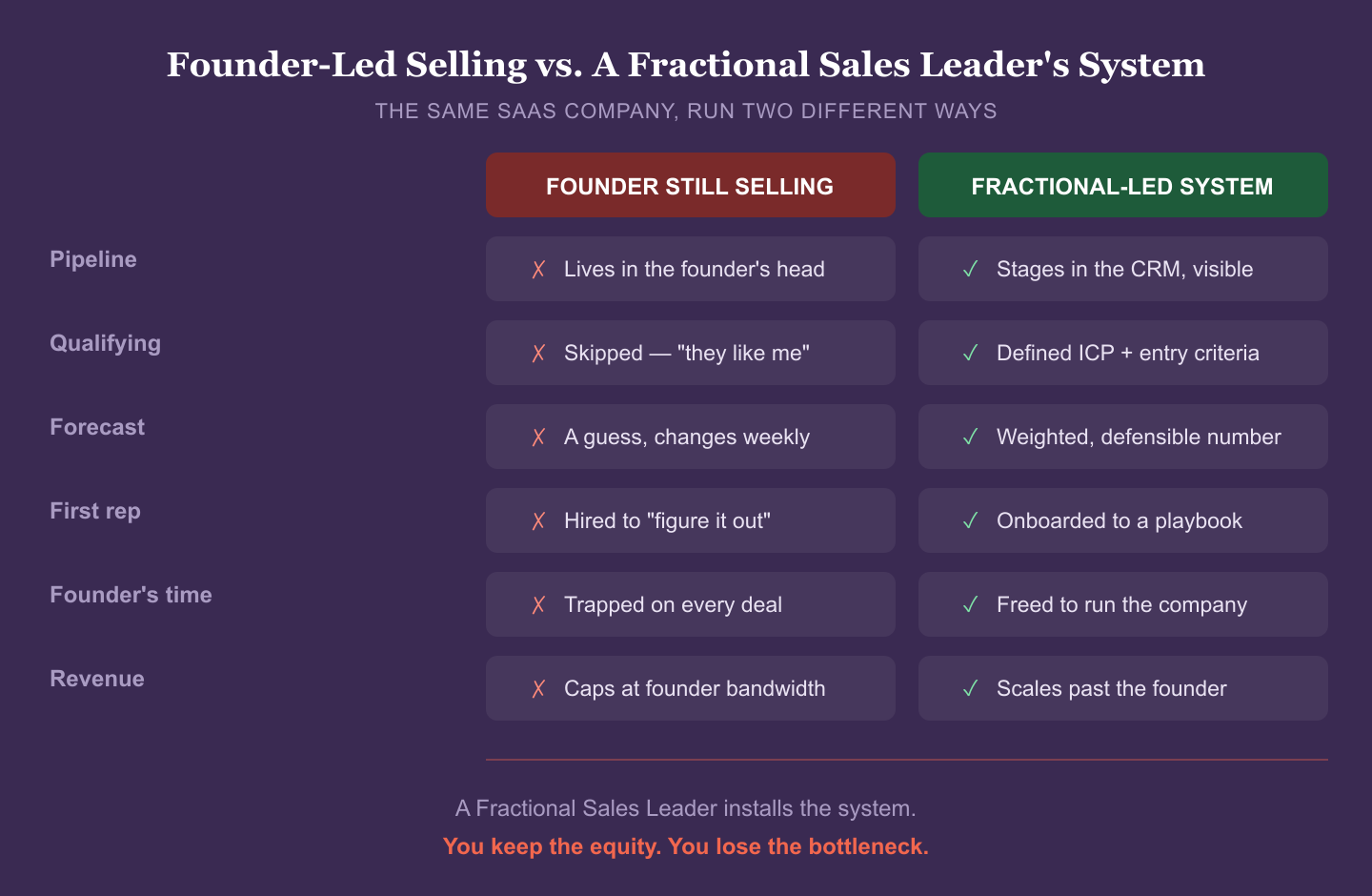
Here's what gets built, roughly in the order it needs to happen:
- A validated ICP. Not the customer you wish you had. The customer who buys fast, stays, and expands. Everything downstream depends on getting this right.
- A qualification standard. Clear entry criteria for what counts as a real opportunity, so your reps stop clogging the pipeline with deals that were never going to close.
- Pipeline stages in the CRM. Defined stages with exit criteria, so the pipeline lives in the system and not in your head. If it's not in the CRM, it didn't happen.
- Comp and quotas that drive the right behavior. A plan that pays reps for closing good-fit SaaS customers who stick, not for booking logos that churn in six months.
- A hiring and onboarding playbook. An Accountability Document for every role and a ramp plan that gets new reps productive in weeks, not the industry-standard half a year.
- A forecast you can defend. A weighted, evidence-based number you can put in front of a board, instead of a gut feeling that changes every Friday.
- A weekly sales rhythm. Pipeline reviews and one-on-ones that catch problems while they're still small, so nothing surfaces at the worst possible moment.
Notice what's not on that list: me being on your calls forever. The whole point is to make yourself, and eventually me, unnecessary to the day-to-day. That's the founder exit done right.
What to Expect in the First 90 Days
A good Fractional Sales Leader doesn't walk in on day one and start rearranging your comp plan. That's how you break what's working. The first job is to understand what you've already got, then build from there. Here's the arc I run.
Weeks 1–4: Diagnose and define
I listen first. I sit in on calls, read your closed-won and closed-lost deals, and talk to your reps and your customers. Then we define the foundation: your real ICP, your qualification criteria, and your pipeline stages. By the end of the first month, you have a shared language for what a good deal actually looks like, which most SaaS startups have never written down.
Weeks 5–8: Build the system
Now we build. Inbound and outbound motions, comp and quotas, the CRM configured to your new stages, and Accountabilities Document for each seat on the team. This is where the pipeline stops being a mystery and starts being a machine. If you need to hire, we build the scorecard and the onboarding plan before anyone signs an offer, not after.
Weeks 9–12: Install the rhythm and hand off
The last stretch makes it stick. We stand up the weekly rhythm, the forecast, and the reporting, and I coach your team to run it without me. The goal by day 90 is a sales operation that produces a number you trust and doesn't depend on you being in the room. This is the exact structure of my 12-week program for founders, and you can see the full week-by-week build on the Fractional Sales Leadership Program page.
Ninety days isn't a magic number. It's how long it takes to build a system, prove it works, and get it out of my hands and into yours.
The SaaS Benchmarks You'll Be Measured Against
You can't manage what you don't measure, and you can't tell if you're winning without knowing what the field looks like. Here are the numbers I put in front of every SaaS founder I work with, so we're both honest about where you stand.
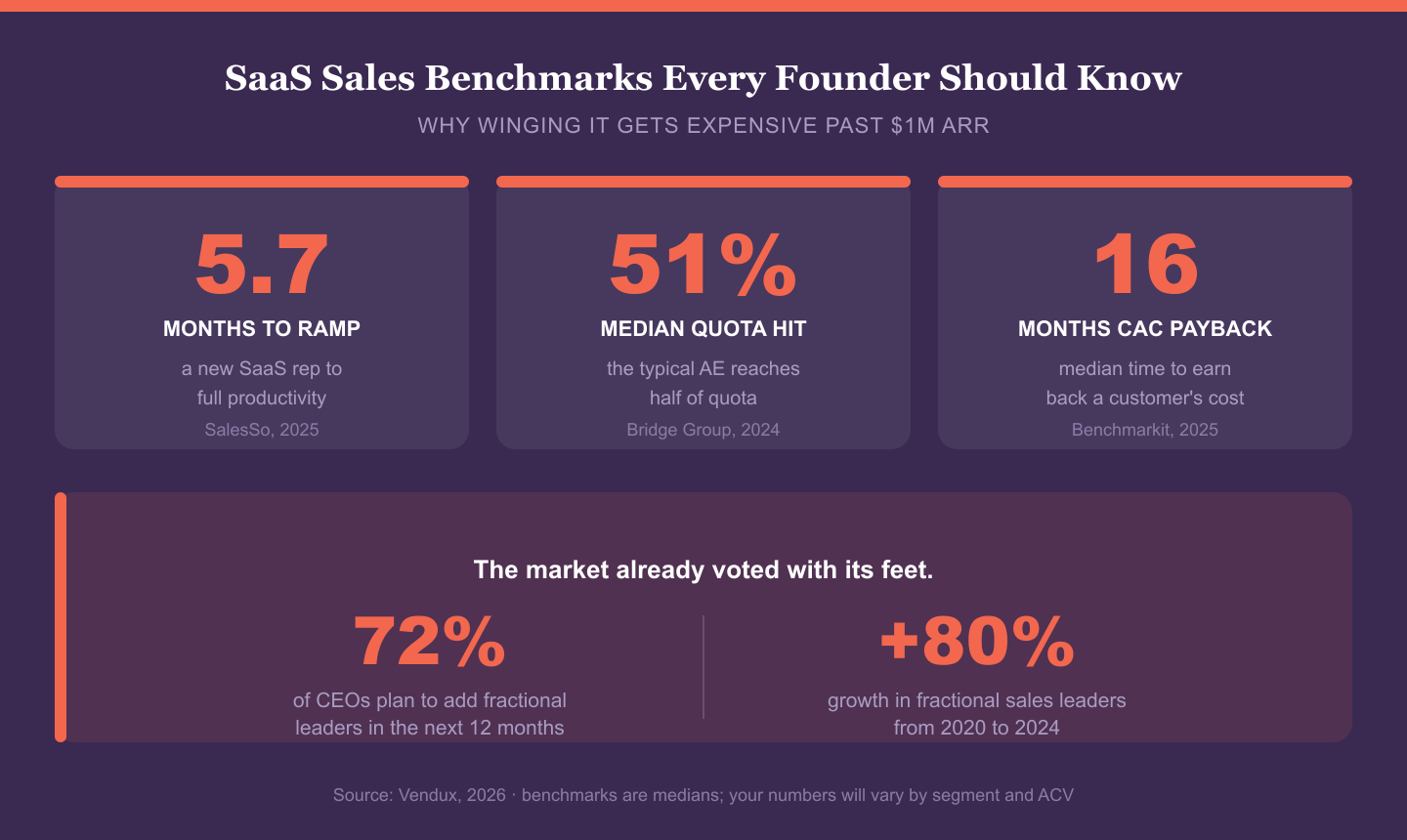
A few things to notice. First, these are medians. Half the market is below them. Second, the fractional model has stopped being a novelty and become a normal part of how companies scale. The number of fractional sales leaders grew roughly 80% between 2020 and 2024, and 72% of CEOs plan to increase their use of fractional executives in the next 12 months, according to Vendux. Gartner projects that more than 30% of midsize enterprises will have at least one fractional executive on retainer by 2027.
The reason is simple math. You get senior sales leadership without a senior full-time salary, and you get it now instead of after a six-month executive search. For a SaaS startup watching its burn, that's not a compromise. That's the smart move.
When a Fractional Sales Leader Won't Help You Yet
I'll tell you the truth even when it costs me the engagement. A Fractional Sales Leader is not a fix for a company that hasn't proven anyone will buy.
If you have zero paying customers, if you've never closed a deal yourself, if you don't yet know why the customers you do have said yes, then you don't have a sales problem. You have a product-market fit problem. No system, no process, and no leader I could give you will fix that. Building sales infrastructure on top of an unproven product just helps you burn cash faster and more efficiently. That's not what I do to founders.
Here's the distinction that matters. Having no sales system is not a disqualifier. It's the whole reason I exist. Most founders I work with have never written down an ICP, never defined a pipeline stage, never built a comp plan. That's normal, and it's fixable. What you do need is the raw proof underneath it: you've closed real customers, at a real price, and you can point to why they bought. If you've got that, you're exactly who a Fractional Sales Leader is built for. My 12-week program is designed specifically to take a founder from "it lives in my head" to "it runs without me."
No sales system is a starting point, not a disqualifier. No proof anyone will buy is a different problem, and a sales leader can't solve it for you.
Is fractional sales leadership right for a SaaS startup?
Fractional sales leadership gives a SaaS startup a senior sales executive part-time — installing process, forecasting, coaching, and CRM discipline — for materially less than a full-time hire, while you keep ownership of execution.
- When it fits best: Seed to Series B, where the gap between the expertise you need and the headcount you can afford is widest — especially when the team is talented but rudderless.
- What it moves: reps operating from a documented process, a forecast you can trust, and clearer KPIs — without adding a permanent executive salary.
- The honest caveat: a fractional leader spread too thin can't go deep, so scope the engagement to building the system — not permanently running your sales floor.
Frequently Asked Questions
Q: What's the difference between a Fractional Sales Leader and a full-time VP of Sales for a SaaS startup?
A full-time VP of Sales is a permanent hire at a senior salary, usually $200K to $250K base plus equity, and a search that can take months. A Fractional Sales Leader gives you the same senior experience on a part-time basis, starting in days, for a fraction of the cost. For a SaaS company between $1M and $10M ARR, you often don't have enough scale yet to keep a full-time VP busy or justify the burn. The fractional model lets you build the system first and hire the full-timer later, once there's a machine for them to run.
Q: How is fractional sales leadership different for SaaS than for other industries?
SaaS lives and dies on recurring revenue, so the sales motion has to protect retention, not just win the first deal. That means tighter qualification, a comp plan that rewards good-fit customers over churn-prone logos, and a forecast tied to net revenue retention and CAC payback, not just bookings. A Fractional Sales Leader who understands SaaS builds the motion with renewals and expansion in mind from day one.
Q: How much does a Fractional Sales Leader cost?
Pricing varies with scope and time commitment, but the model is designed to cost a fraction of a full-time VP of Sales. You're paying for senior leadership on the days you need it, not a full executive salary plus benefits plus equity. For most SaaS startups in the $1M to $10M ARR range, that's the difference between getting real sales leadership now and waiting a year until you can afford a full-timer.
Q: Will a Fractional Sales Leader take over my customer relationships?
No. Your relationships and your founder credibility are assets, not problems to solve. My job is to build the system around you so those relationships scale past your personal bandwidth, not to insert myself between you and your customers. Founder magic is real. The goal is to keep it and remove the bottleneck it creates.
Q: How soon will I see results?
You'll feel the difference in the first few weeks as the pipeline gets honest and the noise drops out. A working system, with a forecast you trust and a team that can run without you, is a roughly 90-day build. Compounding results follow from there. Remember that a new rep takes a median of 5.7 months to ramp, so part of what a Fractional Sales Leader does is compress that curve with a real onboarding playbook.
Q: I only have one or two reps. Is it too early for fractional sales leadership?
That's often the perfect time. The earlier you build the system, the less bad habit you have to unwind later. Bringing in a Fractional Sales Leader when you have one or two reps means they ramp on a real playbook instead of guessing, and every hire after them inherits the same standard. The expensive mistake is waiting until you've hired five people who all sell differently.
Ready to get sales out of your head and into a system?
If you're a SaaS founder between $1M and $10M ARR who has proven customers will buy but hasn't built the machine to scale it, my Fractional Sales Leadership Program was built for you. See the full 12-week, week-by-week plan and how it can help your company.
See the Fractional Sales Leadership ProgramPrefer to talk it through first? Book a 30-minute call.
About the Author
Louie Bernstein
Fractional Sales Leader with 50 years of sales experience helping $1M–$10M ARR companies build scalable, repeatable sales systems. Founder of MindIQ (INC 500). LinkedIn Top Voice in Sales Management, Sales Operations, and Sales Coaching.