Key Takeaways:
- A Fractional Sales Leader for B2B SaaS should be responsible for outcomes, not hours: a documented sales process, a hiring system, a weekly coaching rhythm, pipeline truth, comp and quota math, and accountability in writing.
- They are not responsible for being your quota-carrying rep, running your marketing, or fixing product-market fit. If revenue only happens when they personally sell, you rented a salesperson, not a leader.
- The stakes are real. Roughly 70% of first-time VPs of Sales don't make it 12 months (SaaStr), and average VP of Sales tenure has dropped from 26 months to about 19 (Gong).
- The system is the job. Companies with a formal sales process show 18% higher revenue growth (Harvard Business Review), and formal coaching lifts win rates 28% (CSO Insights).
- Hold it all together with an Accountability Document: every number, every owner, reviewed weekly. Including their numbers.
The Job Description Nobody Writes Down
Somewhere around $1M ARR, every SaaS founder has the same argument with themselves. You can't keep being the CEO, the VP of Sales, and the top rep at the same time. But a full-time VP of Sales costs $250K or more, and you've heard how those stories end. So you start looking at fractional sales leadership, and you run straight into the question nobody answers clearly: what exactly should this person be responsible for?
I've seen the role defined as everything from "closes deals for me" to "gives me advice on Zoom once a week." Both are wrong. And both will cost you a year you don't have.
So here's the direct answer. A Fractional Sales Leader for B2B SaaS should be responsible for building and running your sales system: one documented sales process, a hiring system, a weekly coaching rhythm, pipeline truth, compensation and quota math, and accountability in writing. They should not be responsible for being your quota-carrying rep, generating your leads, or fixing your product.
That's the whole article in two sentences. The rest is the evidence, the specifics, and the line you should draw in writing before you sign anything.
The Short Answer: They Own the System, Not the Selling
Outcomes, not hours
Fractional means part-time hours, usually 10 to 15 a week. What makes it work isn't the hours. It's that the engagement is defined by outcomes. A rep is responsible for a quota. A consultant is responsible for a report. A Fractional Sales Leader is responsible for a sales organization that runs without you in it. That's the deliverable. Everything on the list below is just that deliverable broken into parts.
Why the system beats a super-closer
Founders love the idea of hiring a closer, because closing is the part you can see. But the research points the other way. Harvard Business Review reported an 18% difference in revenue growth between companies with a formal sales process and companies without one. A super-closer takes their magic with them when they leave. A documented process is still there Monday morning. In a recurring-revenue business, where this year's sloppy deals become next year's churn, the process is worth more than any individual seller. Including you.
If your revenue depends on one person's talent, you don't have a sales organization. You have a key-person risk with a CRM login.
The Six Responsibilities That Belong in Writing
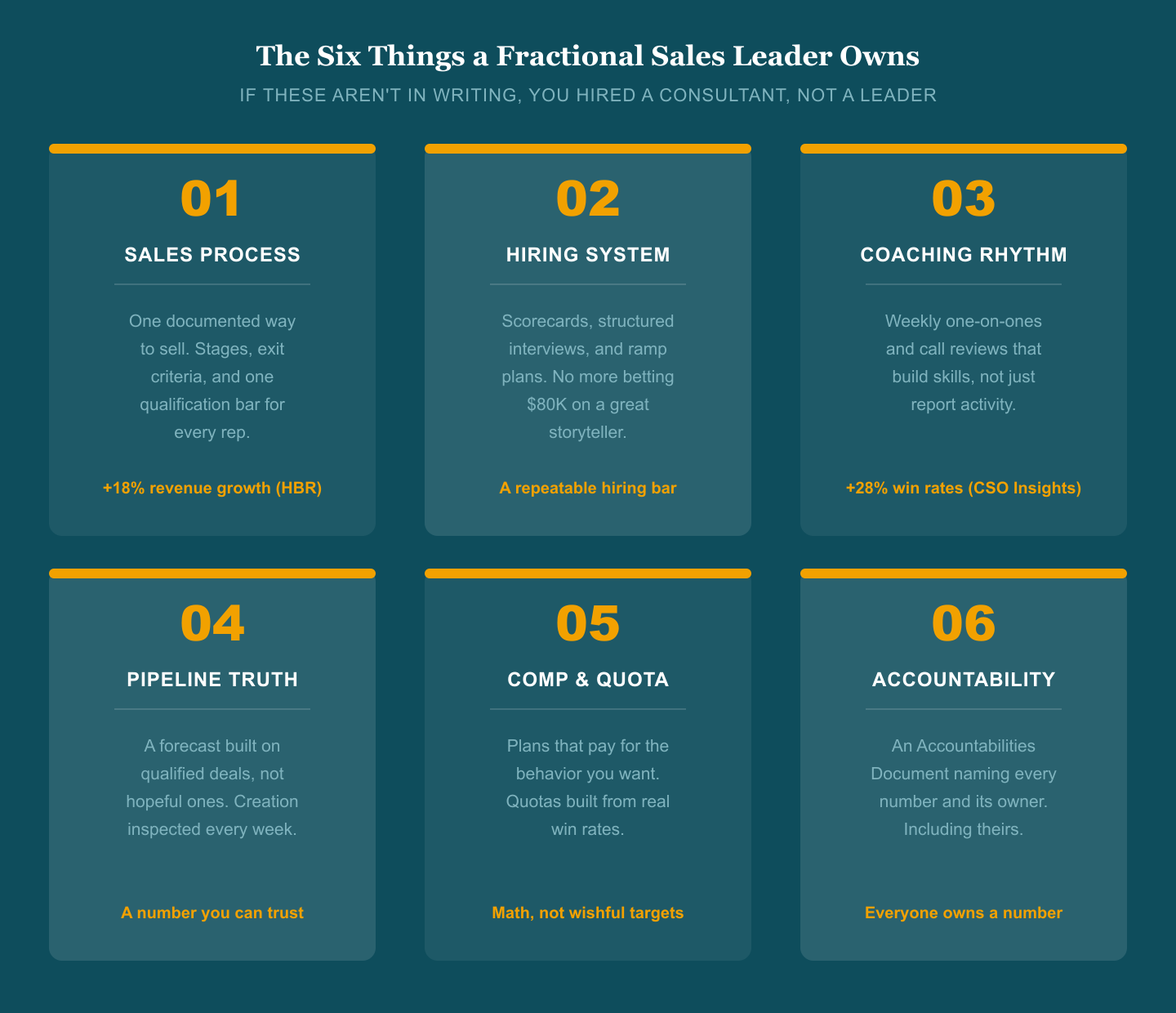
When I take on a B2B SaaS client, these six things go into the engagement in writing. If a fractional candidate won't commit to them on paper, keep interviewing.
1. Sales process
One documented way to sell. Defined stages, exit criteria for each stage, and a qualification bar every rep applies the same way. Right now your process lives in your head, which is why nobody else can run it. Getting it out of your head and onto paper is job one.
2. Hiring system
Scorecards, structured interviews, and a ramp plan that exists before the offer letter does. Your Fractional Sales Leader should run the searches, the interviews, and the onboarding, so you stop betting $80K of salary and six months of runway on whoever tells the best stories in the interview.
3. Coaching rhythm
Weekly one-on-ones and call reviews that build skill instead of just collecting activity reports. This one has the best-documented payoff of the whole list: CSO Insights found teams with a formal coaching process post 28% higher win rates than teams that coach randomly or not at all. Random coaching is what founders do between board prep and product fires. That's not an insult. It's a schedule problem, and it's exactly what you're buying your way out of.
4. Pipeline truth
A forecast built on qualified deals instead of hopeful ones, with new pipeline creation inspected every week before anyone talks about closing. Founder-led pipelines are famously flattering. Somebody has to be responsible for making the number honest, and it can't be the person whose company valuation depends on it.
5. Comp and quota math
Compensation plans that pay for the behavior you actually want, and quotas reverse-engineered from your real win rates and deal sizes. The Bridge Group's 2026 report found just 48% of AEs hit annual quota. That's not a lazy-rep epidemic. That's an industry setting targets by wish. Your Fractional Sales Leader owns the math that keeps you out of that statistic.
6. Accountability
An Accountability Document that names every number and the one person who owns it. Reps own their numbers. You own yours. And the Fractional Sales Leader's own deliverables sit in the same document, reviewed at the same weekly meeting. No hiding, in either direction.
What Are They Not Responsible For?
This half of the question matters just as much, because most fractional engagements don't fail on effort. They fail on scope. Here's where the line sits.
They're not your quota-carrying rep
A good Fractional Sales Leader will absolutely get on deals: joining calls, coaching live, helping structure the big ones. But if every closed deal has their fingerprints on it as the seller, you haven't left founder-led sales. You've outsourced it. The dependency just changed names, and it got more expensive. The job is to make your reps able to close, not to close instead of them.
They're not your marketing department
They should give marketing a precise ICP, tight qualification feedback, and a clear definition of a sales-ready lead. What they shouldn't own is demand generation itself: ads, content, SEO, brand. When one fractional person owns both sales and marketing at your stage, both get half an owner, and you can't tell which half is failing when the pipeline goes quiet.
They're not a rescue mission for product-market fit
A sales system amplifies what's true. If customers buy, it helps them buy faster and more predictably. If customers fundamentally don't want the product, no sales leader on earth, fractional or full-time, fixes that. An honest one will show you the evidence in your win-loss data and say so to your face. That conversation is worth the whole engagement fee. But the fix belongs to you and your product team.
And they're not permanent
The engagement should have a built-in ending: a sales organization strong enough to justify a full-time leader, promoted from within or hired with the scorecards they left behind. A Fractional Sales Leader who needs to stay forever is telling you the system never got built.
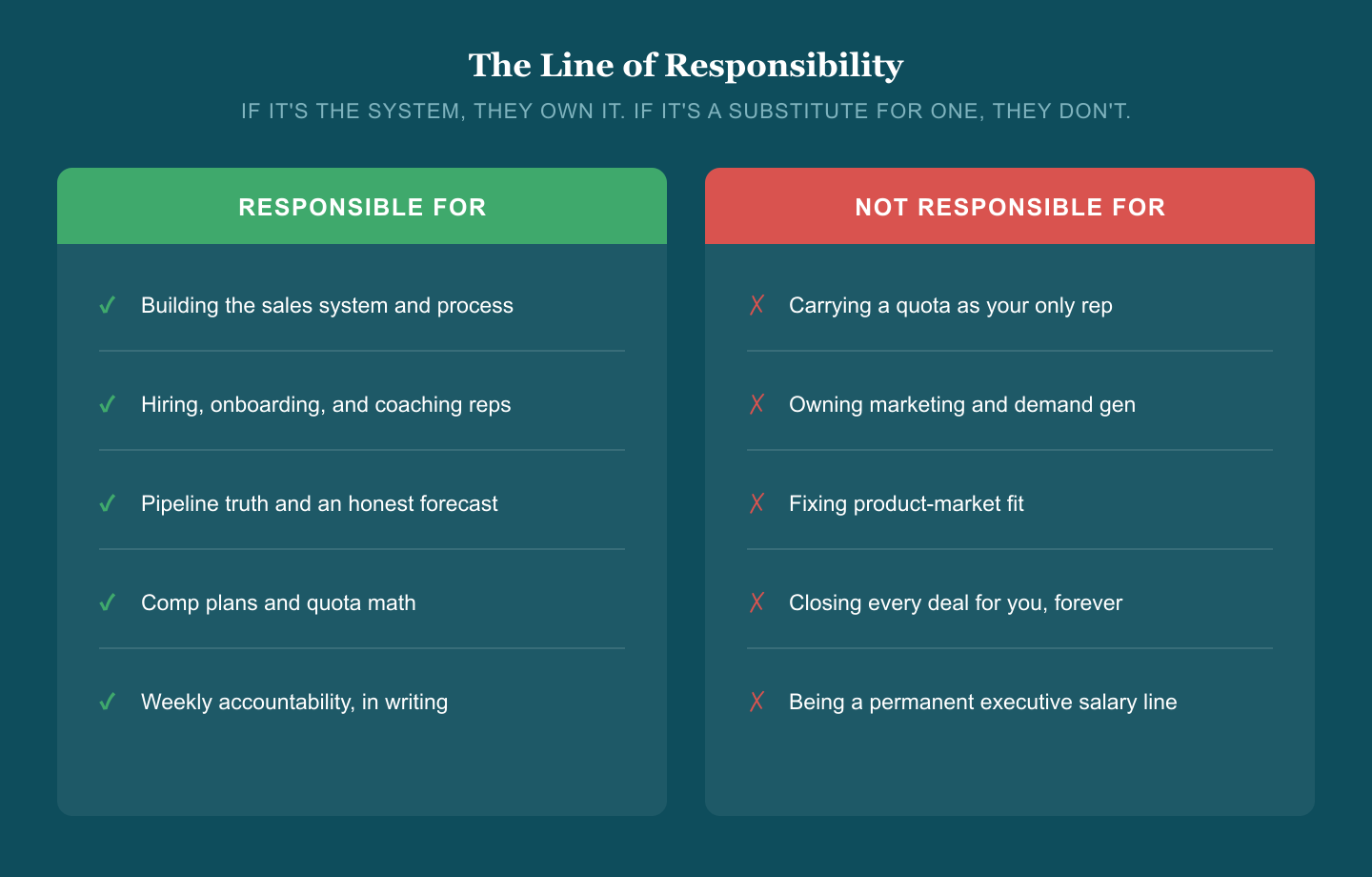
The test is one question: if this person disappeared tomorrow, what's left? If the answer is "a process, a team, and a forecast I trust," you scoped it right.
Why This Question Matters More in B2B SaaS
The alternative to getting this scope right is the one you've been avoiding: hiring a full-time VP of Sales and hoping. The data on that bet is ugly. Jason Lemkin at SaaStr has said for years that around 70% of first-time VPs of Sales don't make it 12 months. Gong's analysis puts average VP of Sales tenure at about 19 months, down from 26. At a $250K-plus package, a miss doesn't just burn cash. It burns the year of pipeline that nobody was building while the wrong person reorganized your CRM.
SaaS makes the miss even more expensive, because recurring revenue punishes bad selling twice. A mis-sold deal in a services business is one bad project. A mis-sold deal in SaaS is churn, a damaged logo, and a worse net revenue retention number when you raise. Between $1M and $10M ARR, you need senior sales leadership before you can justify the full-time price tag for it. That's precisely the gap fractional leadership exists to fill, and precisely why the responsibilities have to be written down. You're buying a fraction of someone's time. You can't afford a fraction of their accountability.
How to Hold a Fractional Sales Leader Accountable
Put it in an Accountability Document
Before the engagement starts, both of you sign an Accountability Document. Theirs should name the system deliverables: documented process by day 30, qualification bar and pipeline scrub by day 45, hiring scorecards and comp math by day 60, coaching rhythm running by day 90. Dates, not vibes.
Then inspect the numbers weekly
After the first 90 days, you judge them on the system's output: qualified pipeline created per week, win rate trend, rep ramp time, and forecast accuracy. Those four numbers tell you whether the machine is getting built or whether you're paying for expensive company. And notice what's not on that list: their personal closed-won. The moment you grade a Fractional Sales Leader like a rep, they'll act like a rep, and you'll be right back where you started. The founder who does everything, plus an invoice.
Scope the role around the system and you'll know within 90 days if it's working. Scope it around heroics and you'll find out in a year, the expensive way.
Frequently Asked Questions
Q: What is a fractional sales leader responsible for?
A Fractional Sales Leader is responsible for building and running your sales system: a documented sales process with stages and exit criteria, a hiring system with scorecards and ramp plans, a weekly coaching rhythm, an honest pipeline and forecast, compensation and quota math built from real win rates, and written accountability for every number. The deliverable is a sales organization that produces revenue without depending on the founder.
Q: What is a fractional sales leader not responsible for?
They're not responsible for carrying a quota as your primary rep, owning marketing and demand generation, fixing product-market fit, or staying forever. They'll join deals to coach and help structure them, and they'll feed marketing a sharp ICP and lead definition. But if the engagement is scoped around them personally closing your deals, you've replaced founder-led sales with rented-closer sales, and the dependency problem survives.
Q: Should a fractional sales leader carry a quota?
No, not a personal one. Grade them on the system's output instead: qualified pipeline created per week, win rate trend, rep ramp time, and forecast accuracy. A personal quota pushes them to sell instead of build, which feels great for a quarter and leaves you with nothing when they roll off. The team's revenue target is the scoreboard; their job is making the team able to hit it.
Q: How many hours a week does a fractional sales leader work?
Most engagements run 10 to 15 hours a week, and the range across the industry is roughly 5 to 25. But hours are the wrong unit to buy. Scope the engagement around deliverables with dates: process documented by day 30, hiring system by day 60, coaching rhythm live by day 90. A leader who hits those in 12 hours a week is worth more than one who logs 25 and delivers slideware.
Q: How is a fractional sales leader different from a sales consultant?
A consultant hands you a recommendation and leaves the execution to you. A Fractional Sales Leader executes: they run the pipeline meetings, do the hiring, coach the reps, and own numbers inside your business, on your team, every week. If the engagement ends with a deck instead of a working sales system and a trained team, you bought consulting with a fancier title.
Q: When should a B2B SaaS founder hire a fractional sales leader instead of a VP of Sales?
Between roughly $1M and $10M ARR, when sales still runs through the founder and the budget can't absorb a $250K-plus VP of Sales mistake. The failure data is brutal: about 70% of first-time VPs of Sales don't last a year (SaaStr), and average VP tenure is around 19 months (Gong). A Fractional Sales Leader builds the process, team, and metrics first, so when you do hire full-time, that person inherits a working system instead of a blank page.
Want this scoped for your company?
If you're a $1M–$10M B2B SaaS founder still carrying the sales org on your back, let's talk. Thirty minutes. We'll walk through the six responsibilities, figure out which ones are currently living in your head, and you'll leave with a clear picture of what to put in writing, whether you hire me or not.
Schedule a 30-Minute CallAbout the Author
Louie Bernstein
Fractional Sales Leader with 50 years of sales experience helping $1M–$10M ARR companies build scalable, repeatable sales systems. Founder of MindIQ (INC 500). LinkedIn Top Voice in Sales Management, Sales Operations, and Sales Coaching.