Key Takeaways:
- Build your sales process around decisions the buyer must make, with evidence required before a deal advances.
- Start with one customer type and one sales motion. Test the process on real opportunities before expanding it.
- A Fractional Sales Leader owns selling standards and coaching. Sales Operations makes the supporting workflows and reporting reliable.
- Your first test: can a rep explain the deal, choose the next action, and update the forecast without asking you?
You build a sales process by defining who you sell to, mapping the buyer's decisions, setting stage exit criteria, documenting how reps do the work, and coaching them through live deals. Then you measure what happens and adjust. The CRM should reflect those decisions.
If you're running a B2B company between $1M and $10M ARR, you've probably already got a process. It lives in your head. You know when a prospect is serious, when to push back, and when a proposal is premature. Your reps keep coming back because they don't have those rules.
The job is to make your judgment teachable. Here's how I'd build a process your team can actually use, including where a Fractional Sales Leader helps and where a Sales Operations person belongs.
What are the steps to make sure the sales process works?
1. Choose one sales motion to fix first
Start with a specific buyer, problem, and offer. Selling an annual software subscription to an owner isn't the same as selling a services engagement through procurement. Combining both into one detailed process can create steps that make sense to nobody.
Write your Ideal Customer Profile in plain English: company type, buyer role, problem you solve, trigger for buying, and reasons to walk away. Include who you can't serve well. A rep needs permission to disqualify a poor fit before you spend three calls proving it.
2. Reconstruct what buyers actually did
Review a small sample of recent wins, losses, and stalled opportunities. Ten is a manageable starting point, not a research benchmark. Read the notes, listen to available calls, and ask customers what almost stopped the purchase.
Capture the original problem, people involved, questions raised, approvals needed, and reason for the final decision. Separate something you observed from something your rep assumed. “They need this by October” is different from “I put October in the CRM.”
3. Work through the build in order
- Map the decisions buyers must make before committing.
- Define the evidence required to leave each sales stage.
- Write a short Sales Playbook page for each stage.
- Configure only the CRM fields needed to support those rules.
- Practice the conversations, then pilot the process on live deals.
- Review adoption and results before rolling it out further.
Assign one person to approve the selling standards. Reps should contribute what they're hearing, but they shouldn't each invent a different definition of a qualified opportunity. You can't compare results when everybody is measuring a different thing.
What should each sales stage require?
Use a buyer question and a clear exit rule
A sales stage describes where an opportunity stands. An exit criterion is the evidence required to move it forward. An activity is work the rep performs. Keep those separate. Sending a proposal is an activity; it doesn't prove the buyer agreed on scope.
Here's a starting model for a founder selling a considered B2B purchase. Adapt it to your customers' buying process:
- Problem confirmed: The buyer describes a relevant problem, its business impact, and why it deserves attention.
- Evaluation agreed: You know the success criteria, relevant participants, and next evaluation step the buyer has accepted.
- Solution validated: The buyer confirms the proposed approach addresses the agreed requirements; unresolved gaps are documented.
- Purchase path confirmed: The approval steps, commercial issues, and target timing are understood and supported by buyer evidence.
- Closed won or lost: Record the actual outcome. For a win, confirm the required agreement and handoff information.
Keep unqualified leads outside the opportunity pipeline. Give stalled deals a clear disposition: active with a real next step, nurture with a reason to revisit, or closed lost. Buyers can revisit earlier questions. Your process needs to allow that without hiding the change.
Give buyers useful work between calls
Gartner's June 2025 release reported that 73% of surveyed B2B buyers avoid suppliers sending irrelevant outreach, and 69% encounter inconsistencies between websites and sellers. The survey covered 632 buyers in August and September 2024 (Gartner).
My practical takeaway: make every follow-up help with a decision. Send an agreed requirements summary, an implementation outline, or answers to an approver's questions. Check that pricing explanations and product claims match what your website says. Don't make the buyer reconcile your own materials.
How do you turn the process into daily selling?
Make the Sales Playbook usable during a call
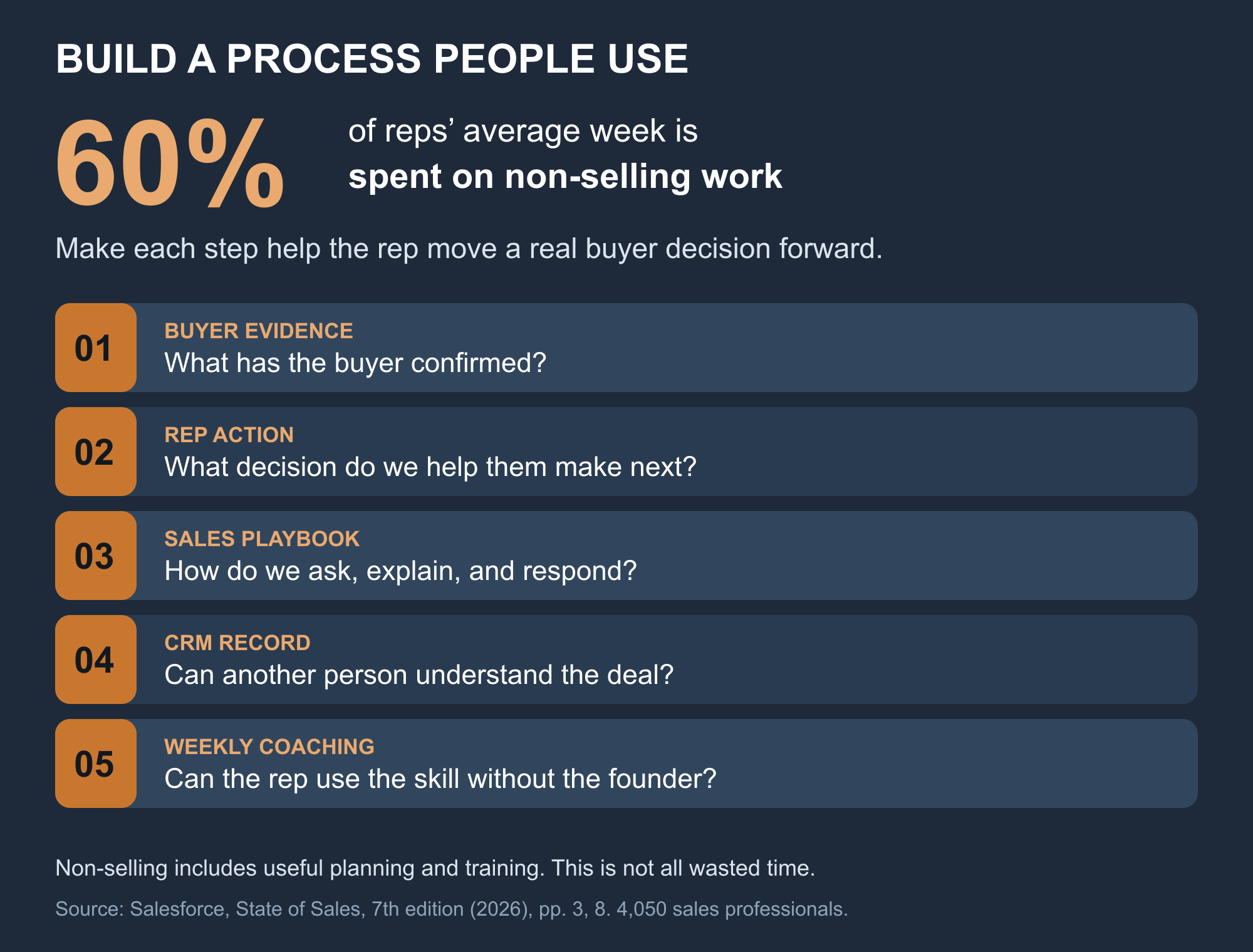
For each stage, write the goal, questions to ask, evidence to capture, common objections, and next action. Add one example of a strong answer and one weak answer. A new rep should be able to find what they need without calling you.
For example, “They want better reporting” is weak discovery. “The operations manager spends six hours reconciling reports every Friday, and the CFO wants that reduced before year-end” gives your rep something to investigate. Those details are illustrative, not a client result. The rep still needs to verify impact and priority.
Put the minimum useful information in the CRM
Start with the business problem, stage evidence, people involved, next action and date, amount, and basis for the expected close date. Add approval or implementation details when the sale needs them. Don't require a rep to fill in late-stage facts they couldn't reasonably know yet.
Salesforce's 2026 State of Sales report says reps spend 60% of an average workweek on non-selling work. Its survey covered 4,050 sales professionals across 22 countries, fielded in August and September 2025 (Salesforce, pp. 3, 8). That's broad context, not a benchmark for your company. Non-selling includes useful planning and training.
Before adding a required field, ask which decision it improves. Before automating a task, watch someone do it correctly. Automating a bad qualification rule just spreads the mistake faster.
Teach the skill before judging the result
Role-play one stage at a time. Let the rep try, give specific feedback, and have them try again. Review a real call afterward. If they missed the buying process, coach how to ask about it. Don't take over every conversation and call that training.
Use the same standards in hiring and onboarding. Give candidates an anonymized scenario, ask them to run discovery, and see how they respond to feedback. Put the expected behaviors and outcomes in an Accountabilities Document. New hires should learn your process through practice, not just reading.
If the rep needs you to decide what happens next on every deal, the process still lives in your head.
Should you hire a Fractional Sales Leader or a Sales Operations person?
Match the role to the missing work
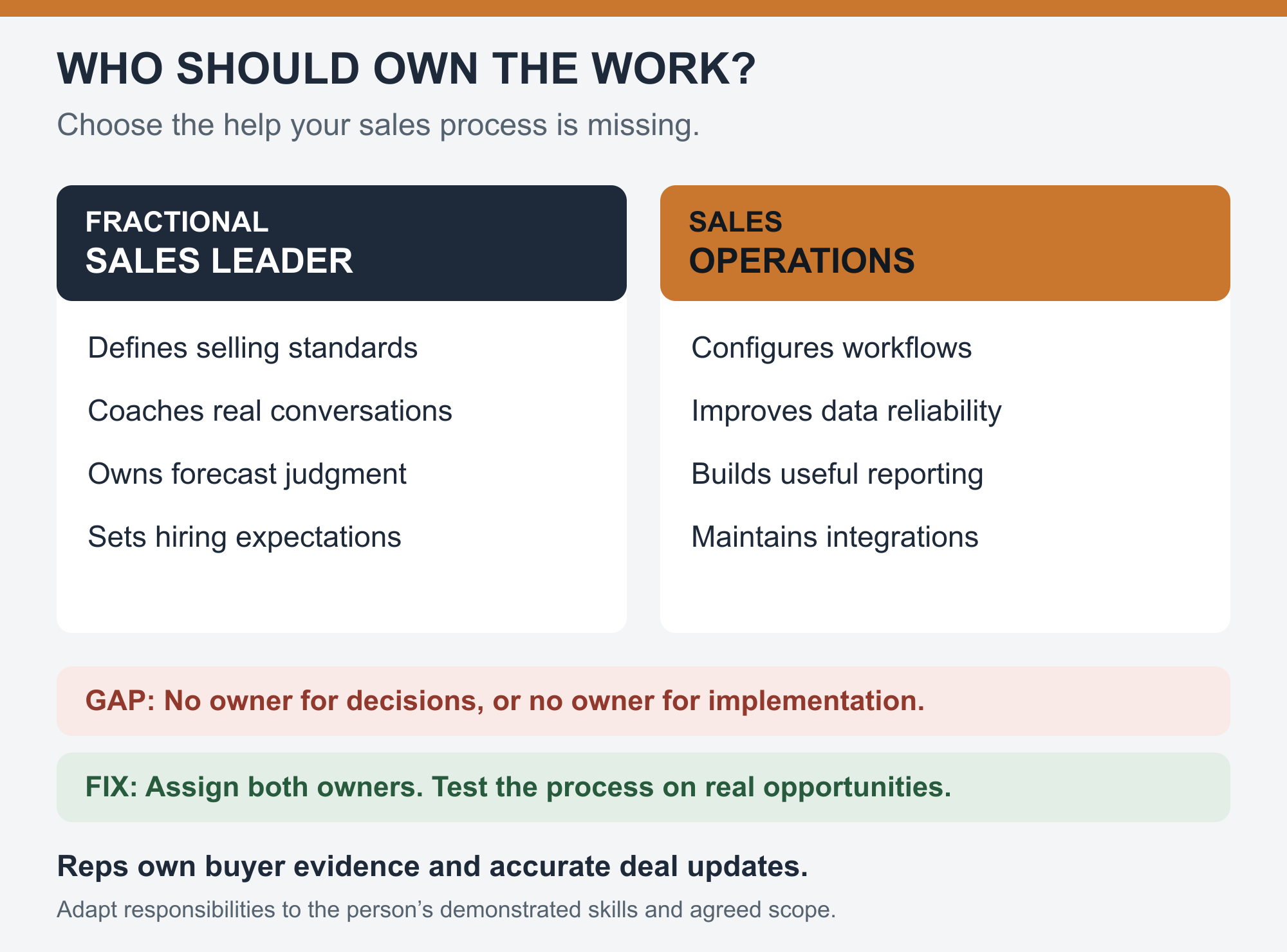
Choose a Fractional Sales Leader when nobody owns qualification standards, coaching, hiring decisions, and forecast judgment. That's often the founder's problem: the team has tools, but you still supply the decisions.
Choose a Sales Operations person when sales leadership is working and the friction comes from routing, integrations, data quality, or reporting. Experienced operations people can shape strategy, too. The important distinction is what the person is accountable for in your business.
If you need both, assign a business owner and an implementation owner. The leader approves what qualifies a deal. Operations turns that rule into a usable workflow and accurate report. The rep gathers and records the evidence. Nobody should assume a job title covers all three jobs.
Ask for proof of the work you need
Ask a leadership candidate to coach a weak discovery call. Ask an operations candidate to trace a reporting error back to its cause. For a combined role, test both capabilities and agree on time allocation. Ask references what the team could run independently after the engagement.
You don't need existing systems for Fractional Sales Leadership to help. Building them can be the assignment. But if you haven't found a repeatable customer problem, or you won't give the leader access and authority, installing stages won't solve the underlying issue. Validate demand and agree on decision rights first.
How do you prove the sales process works without you?
Run a pilot with explicit pass conditions
Use one rep or a small group of similar opportunities. Before starting, record how often you intervene, whether next steps are buyer-confirmed, and where deals stall. Keep the pilot narrow enough that you can see what changed.
Here's what I'd require before calling the process ready:
- The rep can explain why an opportunity belongs in its stage.
- Another person can read the record and understand the next action.
- A coached skill shows up in an actual sales conversation.
- The forecast separates supported commitments from unresolved possibilities.
- The delivery team receives the buyer's goals and promises made.
In the weekly pipeline review, inspect exceptions: missing evidence, missed next steps, and changed close dates. Handle skill development in a separate coaching conversation. That keeps your forecast meeting from turning into an hour of stories.
Measure improvement without fooling yourself
Compare similar opportunities over a period long enough for them to progress. If 20 opportunities entered evaluation and eight eventually reached solution validation, that cohort's conversion is 40%. That's an arithmetic example, not a target. Don't divide today's deals in one stage by today's deals in another and call it conversion.
Track stage conversion, time in stage, no-decision losses, founder intervention, and forecast error using a consistent revenue definition. Preserve forecast snapshots so you can compare what you expected with what actually closed. Small samples need caution; one large deal can move the numbers sharply.
Three useful additions to a process-building engagement are a check that buyer-facing materials agree, a record of rule changes, and a handoff rehearsal. Have someone else run the pipeline review from the documentation. Gaps become obvious when the founder stops translating.
You can test adoption before a full sales cycle finishes. Revenue improvement takes longer to assess. Don't promise a 30-day revenue result for a business whose customers take six months to buy.
Frequently Asked Questions
What's the first step in building a sales process?
Choose one customer type and offer, then study recent wins, losses, and stalled deals. Identify the decisions buyers made and where they struggled. Build your first version around that evidence.
How many sales stages should I use?
Use enough to distinguish meaningful buyer progress without adding unnecessary administration. The five-stage example above is a starting model, not a universal rule. Every stage needs a distinct purpose and clear exit evidence.
What's the difference between a sales process and a Sales Playbook?
The process defines the stages and requirements for progress. The Sales Playbook explains how to do the work: questions, examples, objection responses, and next actions. Your CRM records what happened.
Can Sales Operations build my sales process?
An experienced operations person can help design it and implement the workflows. Still assign someone to own selling standards, coaching, and team performance. Hire against those responsibilities instead of assuming they're included.
Can a Fractional Sales Leader help if I have no sales systems?
Yes, if the engagement includes building the foundation and developing the team. You need a real customer problem to solve, access to your deals, and willingness to transfer decisions. A process can't create demand by itself.
How will I know it's working?
Start with observable behavior: consistent stage decisions, useful records, better conversations, and fewer founder rescues. Then assess conversion, cycle time, and forecast reliability over comparable opportunities and complete sales cycles.
Build a sales process your team can run.
If you're still supplying every sales decision, I'll help you identify what's missing and whether Fractional Sales Leadership is the right next step. Visit LouieBernstein.com to see how I help founders build their sales systems.
Schedule a 30-Minute CallAbout the Author
Louie Bernstein is a Fractional Sales Leader who helps B2B founders build Sales Playbooks, improve sales processes, and develop teams that can sell without the founder in every deal.