Who Owns the Customer When Both Sales and a Partner Are Involved?
Prevent channel partner sales conflicts by agreeing on deal ownership, customer communication, and compensation before either side starts selling. Assign one person to lead each opportunity, record the partner's contribution, and protect qualified registered deals for a defined period. Separate sales credit from responsibility for the customer. Your rep and partner can both earn recognition while the buyer gets one coordinated sales process and a clear point of contact.
Key Takeaways
- Prevent channel partner sales conflicts with written rules for specific opportunities, rather than promises that someone owns an entire customer forever.
- Separate who sourced the deal, who leads the sale, who contracts, and who handles the customer after purchase.
- Give your rep a reason to help partner deals. Partner fees, rep commission, quota credit, and company revenue are separate decisions.
- Require evidence of a qualified opportunity before granting protection. A company name in a spreadsheet isn't enough.
- Audit your next five shared deals for one lead seller, one next action, and one agreed compensation treatment.
A partner introduces you to a prospect. Your salesperson says, "That's my account. I've been emailing them for months." The partner says, "They took the meeting because of me." Both statements might be true.
Now the founder becomes the referee. The buyer gets two follow-ups, two explanations of the offer, and possibly two prices. A useful relationship has become another task on your calendar.
Don't make the customer sort out a disagreement you should have settled before the introduction.
For a B2B company at $1M to $10M ARR, the answer doesn't require a large channel department. You need a few written decisions that your team and partners can apply without calling you.
Who Owns the Customer When Both Sales and a Partner Are Involved?
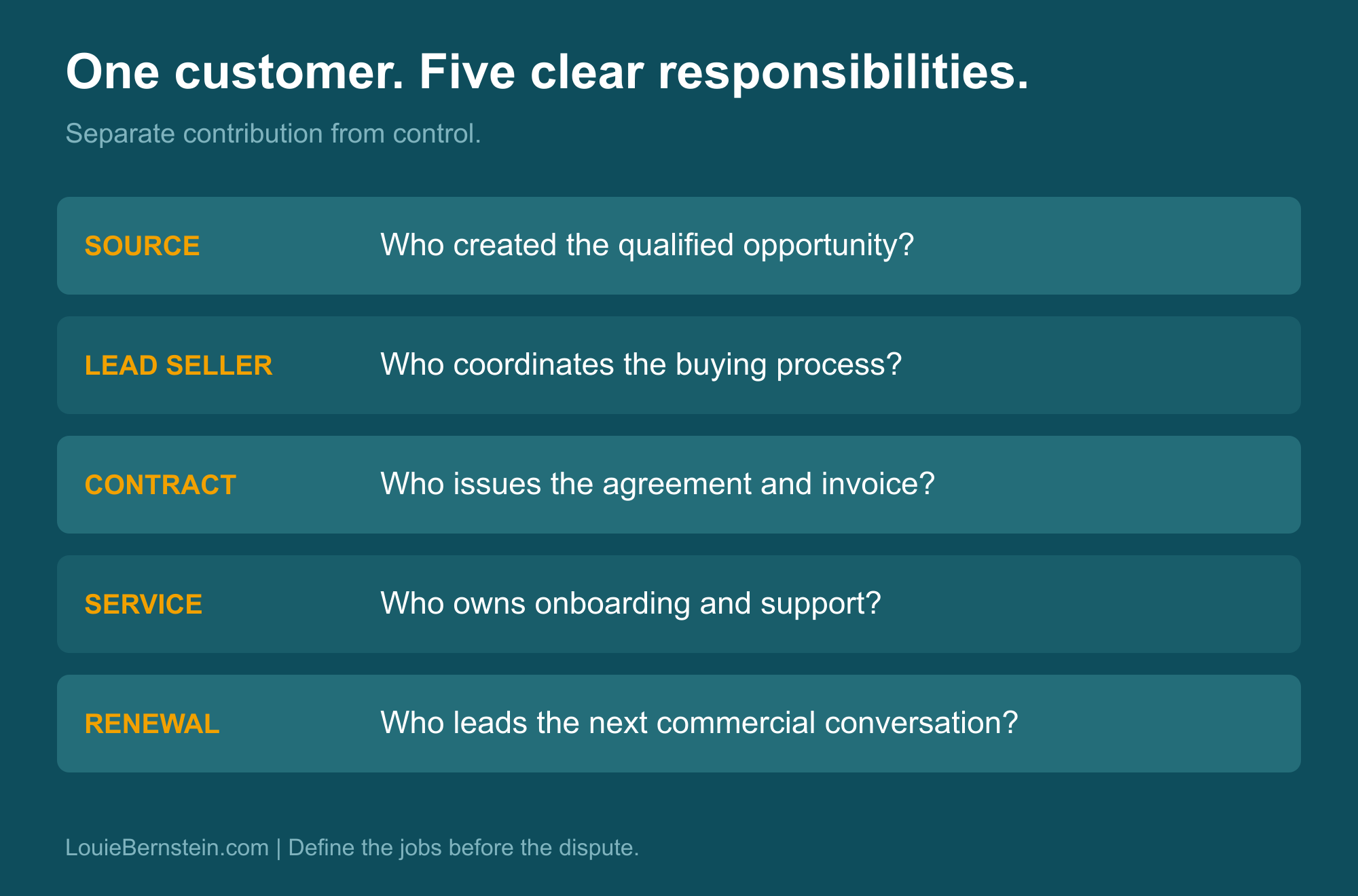
No seller owns the customer's freedom to choose. Your company and partner need defined responsibilities for a particular opportunity, consistent with their agreements and the buyer's preferences. Name the lead seller, contracting party, service owner, and source of the introduction separately. One account record cannot explain all four jobs.
Replace ownership language with specific responsibilities
A referral partner may open the door while your rep qualifies, demonstrates, and closes. A reseller may contract with the buyer while your team supplies technical support. An implementation partner may stay involved after the sale without leading commercial negotiations. Those arrangements need different handoffs.
| Decision | What to record |
|---|---|
| Source | Who created the qualified opportunity, with evidence |
| Lead seller | Who coordinates the buying process and next action |
| Contracting party | Who issues the contract and invoice under the agreement |
| Service owner | Who handles onboarding, support, and escalation |
| Renewal owner | Who leads renewal and expansion conversations |
Keep one internal person accountable for coordination even when the partner leads the sale. Your company still needs someone to verify promises, manage approvals, and make sure the handoff happens. Put those duties in an Accountabilities Document.
Ask the buyer how they want to work
If a buyer wants the trusted adviser in every meeting, respect that preference. If the buyer asks to deal directly with your company, explain the change to the partner and apply the agreed fee rules. A communication preference shouldn't become an excuse to erase a partner's earned compensation.
Send a short joint introduction: "Maria will coordinate the evaluation. James will advise on implementation. Pricing approvals come from our company." The buyer should know whom to call without learning your internal territory structure.
What Rules Keep Reps and Partners From Chasing the Same Deal?
Written rules of engagement keep reps and partners from chasing the same deal by defining qualification, registration, protection, and exceptions before outreach overlaps. Protect a specific buying opportunity for a stated period, subject to real progress. Don't award permanent control of a whole company because someone uploaded its name first.
Register evidence, not a list of logos
Require the customer entity, buyer contact, problem, product or project, evidence of engagement, and agreed next step. Record submission and approval separately. A timestamp helps settle a dispute, but the earliest empty record shouldn't defeat a later qualified introduction.
Spell out existing-opportunity exceptions. An active evaluation with documented buyer meetings is different from an old contact or unanswered email sequence. State what qualifies as active, who checks duplicates, and who approves protection. Tell the partner why a request was declined and allow a review.
Large programs make these boundaries explicit. Dell's current deal-registration guidance says Dell won't proactively pursue direct sales for an approved registered resale opportunity. That is a defined commitment about an opportunity, not a promise that partners own every future purchase by that account.
Give protection an expiration and a renewal test
For a small team, an illustrative starting policy could require a registration decision within two business days, 60 days of protection, and a progress review before extension. Those are proposed operating rules, not industry benchmarks. Adjust the window to your actual sales cycle and partner agreement.
Require buyer evidence for extensions: a scheduled evaluation, procurement milestone, or agreed technical review. Don't let registration become a way to park accounts. Also don't expire a productive partner simply because procurement takes longer than expected.
Microsoft's co-sell documentation, checked in October 2026, gives Microsoft sellers 14 days to decide whether to participate in a help request. Incoming opportunities can expire after 14 days without a response. That is Microsoft's workflow, not a recommended response standard for your small company. The useful lesson is to attach a clock and an outcome to acceptance.
How Should You Pay Reps Who Help a Partner Close?
Pay reps for the work and outcomes you expect on partner deals, with commission and quota rules written before the opportunity starts. A partner fee doesn't automatically replace rep compensation. If helping a partner makes a rep worse off than pursuing the same buyer alone, your incentive plan encourages competition.
Separate revenue, quota credit, and commission
The company books a sale once. Management may give more than one person performance credit, but that doesn't create more company revenue. Decide whether a rep receives full, partial, or no quota credit for each partner motion, then separately calculate the commission payment and partner fee.
Use contribution, workload, and margin to choose the treatment. A rep doing full discovery and closing after a referral has a different job from a rep answering one product question for a reseller. Don't call both situations "partner assisted" and pay them identically without checking the work.
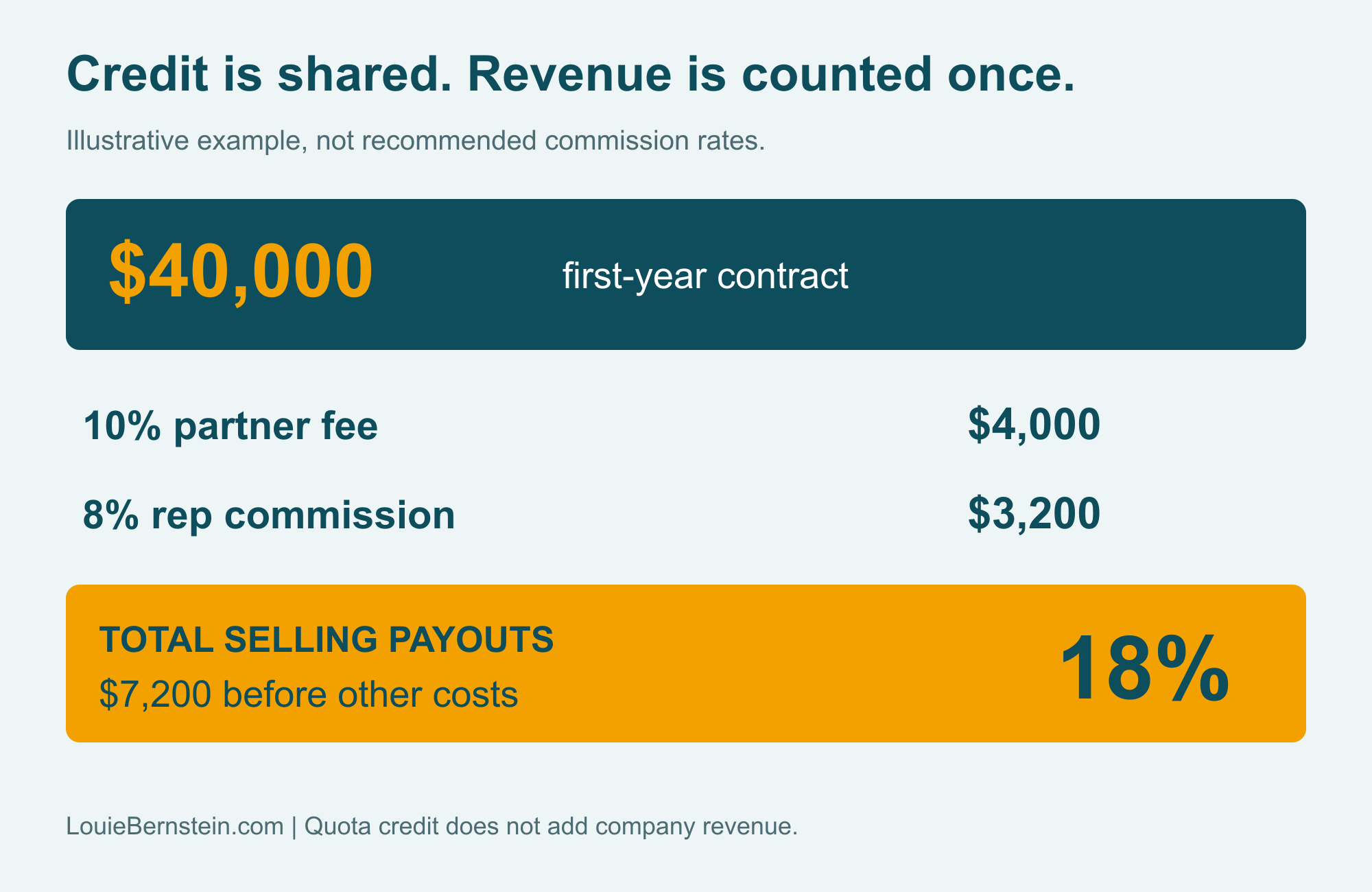
Consider an illustrative $40,000 first-year contract. A 10% partner referral fee is $4,000. A separate 8% rep commission is $3,200. Total selling payouts are $7,200, or 18% of contract value, before other sales and delivery costs. These are sample rates, not recommendations or market averages.
If you give the rep full $40,000 quota credit, the company still sold $40,000. It didn't sell $80,000 because the partner also gets attribution. Forecast one opportunity; tag the contributions. Check the full acquisition cost before deciding whether the arrangement works.
Fix the incentive before asking for teamwork
A rep who loses commission whenever a partner appears has a financial reason to hide an opportunity. A partner whose introduction gets relabeled direct has a reason to stop sharing. A speech about collaboration won't repair either rule.
Use the Sales Playbook to show examples: referral only, joint sale, reseller led, and partner added to an existing deal. Put the actual pay terms in the compensation plan and partner agreement. Change future rules openly rather than rewriting the treatment of a deal already underway.
How Do You Settle a Channel Conflict Without Losing Trust?
Settle a channel conflict with one decision maker, written evidence, and a private review while the agreed seller keeps the buyer moving. Compare the dispute with the rules in place when the opportunity began. Publish the decision to both parties and explain how customer communication and compensation will work.
Use a short review sequence
- Ask both sides for the timeline, buyer evidence, registration decision, and promised next action.
- Check the existing agreement, active-opportunity exception, and buyer preference.
- Assign a temporary customer contact so neither side sends competing offers.
- Have the designated sales leader decide responsibility and credit, recording the reason.
- Update the shared plan and use any policy gap to improve future rules.
Don't promise a response deadline your decision maker can't meet. A two-business-day target may work for a small team, but write an escalation path for cases needing more evidence. Tell both parties when they'll hear back instead of letting silence become the decision.
Where founders usually get this wrong
My work as a Fractional Sales Leader centers on getting the sales process out of the founder's head and into a system the team can run. Apply that same discipline here. If every ownership decision requires your personal memory of a conversation, the partner channel has become another form of founder-led sales.
The useful test isn't whether you can settle today's disagreement. It's whether your sales manager could settle the next similar disagreement using the written rules. Ask the manager to explain the decision. Coach the reasoning instead of taking the problem back.
A fair exception can save a deal. An unwritten exception can create the next five arguments.
When the old rule is unclear, acknowledge the gap. Make a documented one-time decision without pretending a policy existed. Then define the future treatment with your team and partners before the next opportunity arrives.
What Should You Check Before the Next Shared Sales Call?
Before the next shared sales call, check that the rep and partner agree on the buyer's problem, meeting leader, responsibilities, commercial boundaries, and next step. Put the plan on the opportunity record. For a founder-led company, a brief shared plan is more useful than a lengthy policy nobody applies.
Run the five-deal audit
Review your next five partner-involved opportunities. For each, name the source, lead seller, partner role, protection end date, compensation treatment, renewal owner, and next buyer action. Mark unknown fields honestly. A complete CRM record should show a decision, not merely a filled box.
Look for conflicting promises. Has anyone offered a discount without approval? Has the partner promised implementation your team can't deliver? Does the buyer know which company invoices? Resolve those points before another proposal goes out.
Measure friction without punishing good disclosure
Track duplicate outreach incidents, disputed opportunities, time to resolve disputes, and exceptions to the rules. Review win rate, cycle length, and margin separately for comparable partner motions. A rise in reported disputes after introducing a reporting process may mean better visibility rather than worse behavior.
Compare like with like. A reseller-led enterprise deal and a small referral deal won't need the same effort. Review where the process failed, then change the rule or coach the behavior. More partner software won't decide a responsibility that management hasn't defined.
Related Reading
How Much Should You Pay a B2B Referral or Channel Partner? →
Frequently Asked Questions
Q: What if two partners refer the same buyer?
Apply your duplicate-referral rule using qualified opportunity evidence and the scope of each referral. Don't assume the first submitted company name wins. If both contributed, a documented shared arrangement may be appropriate, provided the agreements allow it and the economics work.
Q: Can a partner claim every subsidiary of one customer?
Only grant the scope you've expressly approved in the agreement and registration. Define the legal entity, business unit, geography, and project where relevant. A relationship at a parent company doesn't automatically demonstrate access to every subsidiary's buying team.
Q: Should partners see our entire CRM?
Share only the information the partner needs and is authorized to receive. A shared opportunity summary can show stage, owner, and next action without exposing unrelated accounts, confidential notes, or other partners' commercial terms. Agree on access and customer information handling before sharing records.
Q: What happens when a partner stops responding?
Use the inactivity and expiration process in the agreement. Notify the partner, request a progress update, and state the review deadline. Reassign work when necessary to protect the customer, while honoring any fees already earned under the agreed terms.
Q: Does a referral fee include future upsells?
A referral fee includes future upsells only if the agreement says so. Define products, entities, time limits, and required ongoing contribution. Assign renewal and expansion duties separately so a service handoff doesn't accidentally become a promise of permanent commission.
Build a channel your team can run without a referee.
If partner disagreements keep landing on your desk, a Fractional Sales Leader can help you define responsibilities, align incentives, and coach your team to apply the rules. Start with the deals you're already trying to close.
Schedule a 30-Minute CallAbout the Author
Louie Bernstein
Louie Bernstein is a Fractional Sales Leader with 50 years of sales experience and has provided Fractional Sales Leadership since 2017. He helps B2B founders build repeatable sales systems so their teams can sell without depending on the founder.