Should Partner Compensation Be Based on Leads, Revenue or Recurring Revenue?
Pay a B2B referral or channel partner for the work the partner actually does. A partner who makes an introduction and steps away should earn a one-time fee on first-year revenue you've collected, and 20% is the common market reference point. A partner who implements, supports or co-sells can earn recurring revenue share, capped at 12 to 36 months. Don't pay per lead. Lead fees reward volume, not buyers.
Key Takeaways
- A B2B partner should be paid on revenue, not leads: a one-time fee for an introduction, and capped recurring revenue share only for partners who keep working after the sale.
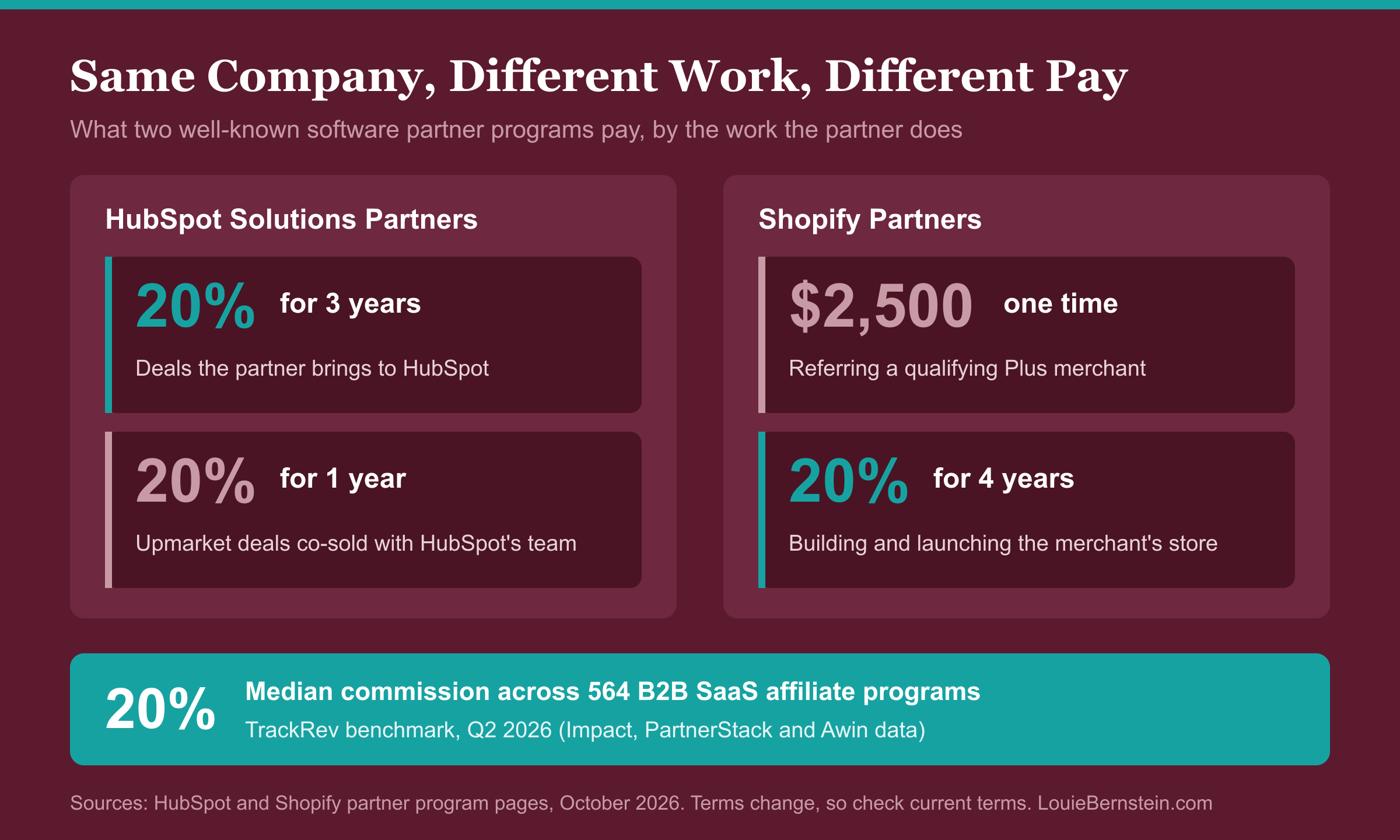
- 20% is the market reference point. TrackRev's Q2 2026 benchmark of 564 B2B SaaS affiliate programs puts the median commission at 20%, and HubSpot pays solutions partners 20% for 3 years on deals they bring.
- The same rate can cost very different amounts. On a $30,000 deal that renews twice, 20% one time costs $6,000, while 20% for 3 years costs $18,000.
- Before you offer a partner any number, write down what you'd pay to win that customer yourself, then set the partner fee below it.
- Put the rules in writing before the first deal: what counts as a qualified referral, when the fee is paid, how long it lasts and what happens if the customer cancels.
The first partner call goes great. The partner knows your buyer. They've got a dozen clients who need what you sell. Then comes the question: "So what's in it for us?"
Most founders at $1M to $10M ARR answer on the spot. The number sounds generous, so it lands at 20% or 25%, sometimes "for the life of the customer." Nobody writes down what counts as a referral. Nobody checks the margins. Two years later, you're paying a partner every month for a customer your own team has been serving since the first week.
A partner commission isn't a thank-you note. It's a price you're paying for specific work, and you should know what the work is before you set the price.
The good news: partner pay is a design problem, and it's a smaller one than a sales comp plan. You need three decisions. What do you pay on? How much? For how long?
Should You Pay Partners Per Lead, Per Deal or on Recurring Revenue?
Pay B2B partners per closed deal or on recurring revenue, not per lead. Per-lead pay rewards the partner for sending names, whether or not those people buy. Per-deal and recurring pay reward the partner only when a customer pays you. Choose between the two based on whether the partner keeps working after the sale.
The three models side by side
| Pay model | What it rewards | When it fits | Main risk |
|---|---|---|---|
| Per lead | Volume of names | Paid lead-generation vendors, not partners | You pay for people who never buy |
| One-time fee on the deal | An introduction that closes | Referral partners who introduce and step away | Low. Paid once, on cash collected |
| Recurring revenue share | Customers who stay and grow | Partners who implement, support or resell | Paying for work the partner stopped doing |
Why per-lead pay is the wrong default
A per-lead fee tells the partner that names matter. So you get names. Some will be good. Many will be the partner's clients who were never going to buy, sent because sending them costs nothing and pays something. Your salespeople then spend their week qualifying people out, which is the most expensive way to say no.
Pay on a closed, paid deal and the incentive changes. The partner now only makes money when they introduce someone who's a real fit. That's the behavior you want. A partner who's confident in the fit will gladly take that deal.
What Percentage Do Software Companies Actually Pay Partners?
Software companies commonly pay partners around 20% of revenue, but the duration changes with the partner's work. TrackRev's Q2 2026 benchmark puts the median B2B SaaS affiliate commission at 20%. HubSpot and Shopify both pay more, or for longer, when the partner does more than make an introduction.
Look at the length of the payment, not just the rate
HubSpot's Solutions Partner program pays 20% for 3 years on deals partners bring to HubSpot. On certain upmarket deals that HubSpot's own sales team originated and the partner co-sells, it pays 20% for 1 year. Same rate. One-third the duration. HubSpot pays for who did the sourcing work.
Shopify's partner earnings page draws the line even more sharply. Referring a qualifying Shopify Plus merchant earns a one-time $2,500 payment. Building and launching a merchant's store earns 20% of the monthly platform fee, plus a small share of sales volume, for 4 years. The introduction gets paid once. The ongoing work gets paid over time.
Use benchmarks as a ceiling check, not a target
The TrackRev benchmark draws on Impact, PartnerStack and Awin data. Across all the programs it tracks, fixed-term recurring plans of 3 to 12 months are the most common structure, used by 39% of programs at a 20% median. One-time payouts are used by 33% at a 25% median. Lifetime recurring plans run a 30% median and are used by 18%.
Two cautions. Those programs are mostly self-serve software sold through affiliates, with gross margins a services-heavy business may not have. And HubSpot and Shopify have pricing power and partner ecosystems you don't. Treat 20% as the number your partner has probably heard, then do your own math.
How Do You Set a Partner Commission That Fits Your Margins?
Set a partner commission by starting with what it costs you to win the same customer without the partner, then pricing the partner below that. The partner fee is a cost of acquiring a customer. If it's higher than your own cost of sale, the partner channel loses money on every deal it closes.
Five steps to a number you can defend
- Price your own cost of sale. Add your salesperson's commission, the share of their salary spent on a typical deal and the founder hours a deal usually takes. That's the customer acquisition cost the partner is replacing.
- Check gross margin. A 20% fee on a 75% gross margin product leaves room. The same fee on a 35% margin services contract eats more than half of year one's gross profit.
- Pay on cash collected, not bookings. The partner gets paid when the customer pays you. That protects you from deals that sign and never pay.
- Cap the term. Pick 12, 24 or 36 months. "For the life of the customer" means you're still paying long after the partner's work is done.
- Add a clawback window. If the customer cancels inside the first 90 days, the fee comes back or isn't paid. Partners who send real buyers rarely object.
This is the same discipline I use when I help founders build a sales compensation plan for their own reps. Define the behavior you want, then pay for it. The math is simpler for partners, because you're paying for one outcome.
Run the three-year math before you sign
Take an illustrative $30,000 first-year deal that renews at the same price for 2 more years. A one-time fee of 20% of year one costs $6,000. Recurring share of 10% for 3 years costs $9,000. Recurring share of 20% for 3 years costs $18,000. That's 3 times the one-time fee at the same rate.
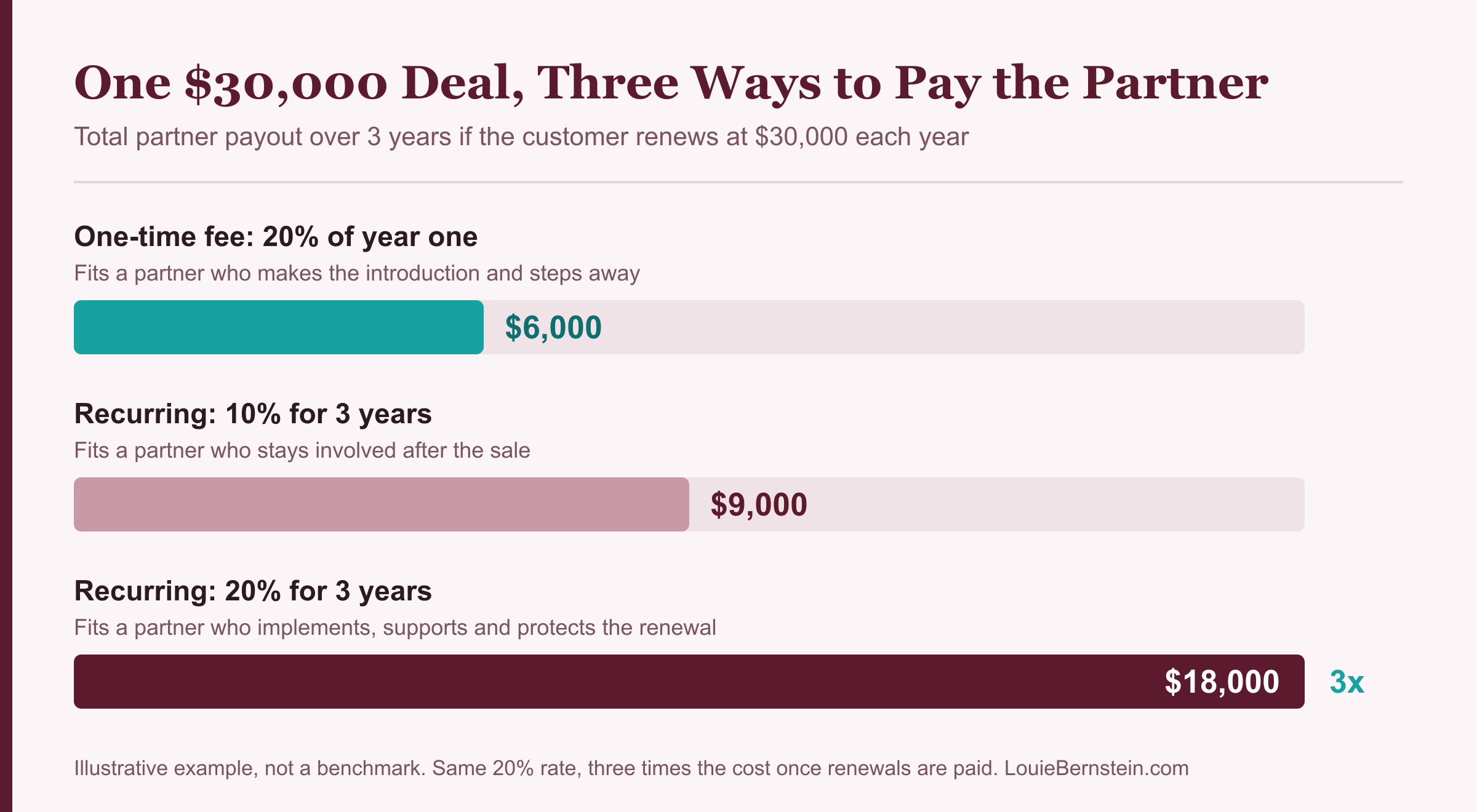
None of those numbers is wrong. Each one fits a different partner. The mistake is offering the $18,000 version to a partner who'll do $6,000 worth of work.
When Should a Partner Get Recurring Revenue Share?
A partner should get recurring revenue share only when the partner keeps doing work that protects or grows the customer after the sale. Implementation, training, support, account reviews and reselling all qualify. A single introduction doesn't. Recurring pay should match recurring work, and it should end when the work ends.
Questions that decide it
- Who does the onboarding? If the partner implements, the partner affects whether the customer renews.
- Who does the customer call with a problem? If it's the partner, the partner is carrying service cost you'd otherwise carry.
- Who owns the expansion conversation? If the partner brings you upsell opportunities, recurring share on the account makes sense.
- Does the partner invoice the customer? A reseller who carries the billing and collection risk earns a margin, usually set as a discount off your price, rather than a commission.
If every answer is "us," pay a one-time fee. Be generous with it. A clean, fast one-time payment often motivates a referral partner more than a small monthly check they'll forget about.
Where Do Founders Usually Get Partner Pay Wrong?
Founders usually get partner pay wrong by setting the number in the first conversation, before defining what the partner will do. The rate gets set by what sounds generous, not by margins or work. Then the founder is stuck with it, because cutting a partner's pay later damages the relationship.
What I see when I review a founder's partner deals
I've designed dozens of comp plans for $1M to $10M ARR founders, and partner deals break the same way sales comp plans do. A candidate asks what the comp plan looks like, the founder makes something up, and it sounds generous. A partner asks what's in it for them, and the same thing happens. The plan was built in a hurry to close a conversation, not to drive behavior.
Three patterns show up again and again:
- Lifetime terms on a handshake. The partner introduced a customer four years ago and hasn't spoken to them since. The check still goes out every month.
- Partners paid more than your own salesperson for less work. Your rep runs discovery, demo and negotiation and earns, say, 10%. The partner sent an email and earns 20%. Your rep notices.
- No rule for deals already in the CRM. A partner "refers" a company your team has been working for 6 months. Without a written rule, you pay twice or you fight with a partner.
A good comp plan isn't the engine of a sales team. It's the steering wheel. Partner pay works the same way.
Write it down once, then lock it
Put partner terms in a one-page document, and add the partner section to your Sales Playbook so your team knows how a partner deal is registered and handled. Cover what counts as a qualified referral, how a deal gets registered, the existing-account rule, the rate, the term, when payment happens and the clawback. Then don't change it mid-year when a quarter looks short. Partners, like reps, stop trusting a program whose rules keep moving.
If you don't have partners yet, start with finding partners who actually reach your buyer. The right pay plan won't rescue the wrong partner.
Related Reading
Why Do Most B2B Partner Programs Fail to Produce Revenue? →
Frequently Asked Questions
Q: Should I pay a partner more than I pay my own salesperson?
Pay a partner more than your salesperson only when the partner does more of the selling. If the partner makes an introduction and your rep runs the whole sale, the partner's fee should usually be at or below your rep's commission on that deal. Otherwise your own team learns that partner deals are the ones that don't pay.
Q: Does the partner fee come out of my rep's commission?
No. Keep your rep's commission intact on partner deals. If the rep loses money when a partner is involved, the rep will quietly avoid partner deals. Budget the partner fee as a separate cost of acquiring the customer.
Q: Should I pay a referral fee to a customer who refers another customer?
A customer referral usually works better with a thank-you that fits the relationship, like a service credit or a discount on renewal, than with cash. Check the referring customer's own policies first, because many companies don't allow employees to accept vendor payments.
Q: What if a partner asks for a monthly retainer instead of a commission?
A retainer pays a partner for effort, not results, so treat it like hiring a contractor. Agree on specific deliverables, such as co-hosted events or a set number of introductions, and a short review date. If the partner won't commit to deliverables, stick with a commission.
Q: Do partner referral fees need to be disclosed to the customer?
In some industries, yes. Financial services, healthcare and government buyers often have rules about referral payments and conflicts of interest. If you sell into a regulated market, have an attorney review the partner agreement before you pay the first fee.
Get your partner pay right the first time.
If you're a B2B founder at $1M to $10M ARR, a Fractional Sales Leader can help you price partner deals, write the rules and connect partner revenue to the rest of your sales system. Learn how I work at LouieBernstein.com.
Schedule a 30-Minute CallAbout the Author
Louie Bernstein
Louie Bernstein is a Fractional Sales Leader with 50 years of sales experience and has provided Fractional Sales Leadership since 2017. He helps B2B founders build repeatable sales systems so their teams can sell without depending on the founder.