What Makes a Company a Good Sales Partner Instead of Just a Good Logo?
Find B2B partners who bring you customers by starting with your own customers, not with famous brands. Ask your best customers who they trusted before they bought from you, then score those firms on five tests: same buyer, early view of the buying trigger, earned trust, a reason to want your customer to succeed, and one named person who makes introductions. A partner that fails those tests is a logo, not a sales channel.
Key Takeaways
- The best B2B sales partners serve your exact buyer, hear about the buying trigger before you do, and have advice the buyer acts on. Brand size doesn't predict any of those.
- Find candidates by asking your last 10 to 20 customers which advisers, vendors and consultants they trusted before they bought from you.
- Buyers trust people over vendors: 73% of U.S. business decision-makers trust peer insights, while 55% trust vendor websites (SurveyMonkey and Reddit, 2026).
- Score every candidate 1 to 5 on buyer overlap, trigger timing, earned trust, mutual motive and a named champion. Pilot only with partners scoring 20 or more out of 25.
- A good logo looks great on your website and produces no introductions. Judge partners by qualified introductions per quarter, not by the agreement you signed.
A founder shows me a slide with a dozen partner logos on it. Big names. Impressive company. Then I ask a simple question: how many qualified opportunities did each of those partners bring you last year?
The room usually gets quiet. A few partners sent one deal. Most sent nothing. Nobody had tracked it, because the partnership was celebrated when the agreement was signed, not when a customer showed up.
A partner earns the name when a customer shows up. Until then, it's a logo.
If you're a founder at $1M to $10M ARR and you're still the person closing most deals, partners look like a shortcut. The right ones can be. The wrong ones cost you months of meetings, co-marketing plans and enablement decks that never turn into pipeline.
What Makes a Company a Good Sales Partner Instead of Just a Good Logo?
A company is a good B2B sales partner when it already serves your exact buyer, sees that buyer's problem early, and has advice the buyer acts on. A good logo has brand recognition but no reason or opportunity to introduce you. For a founder, the difference shows up in one place: qualified introductions.
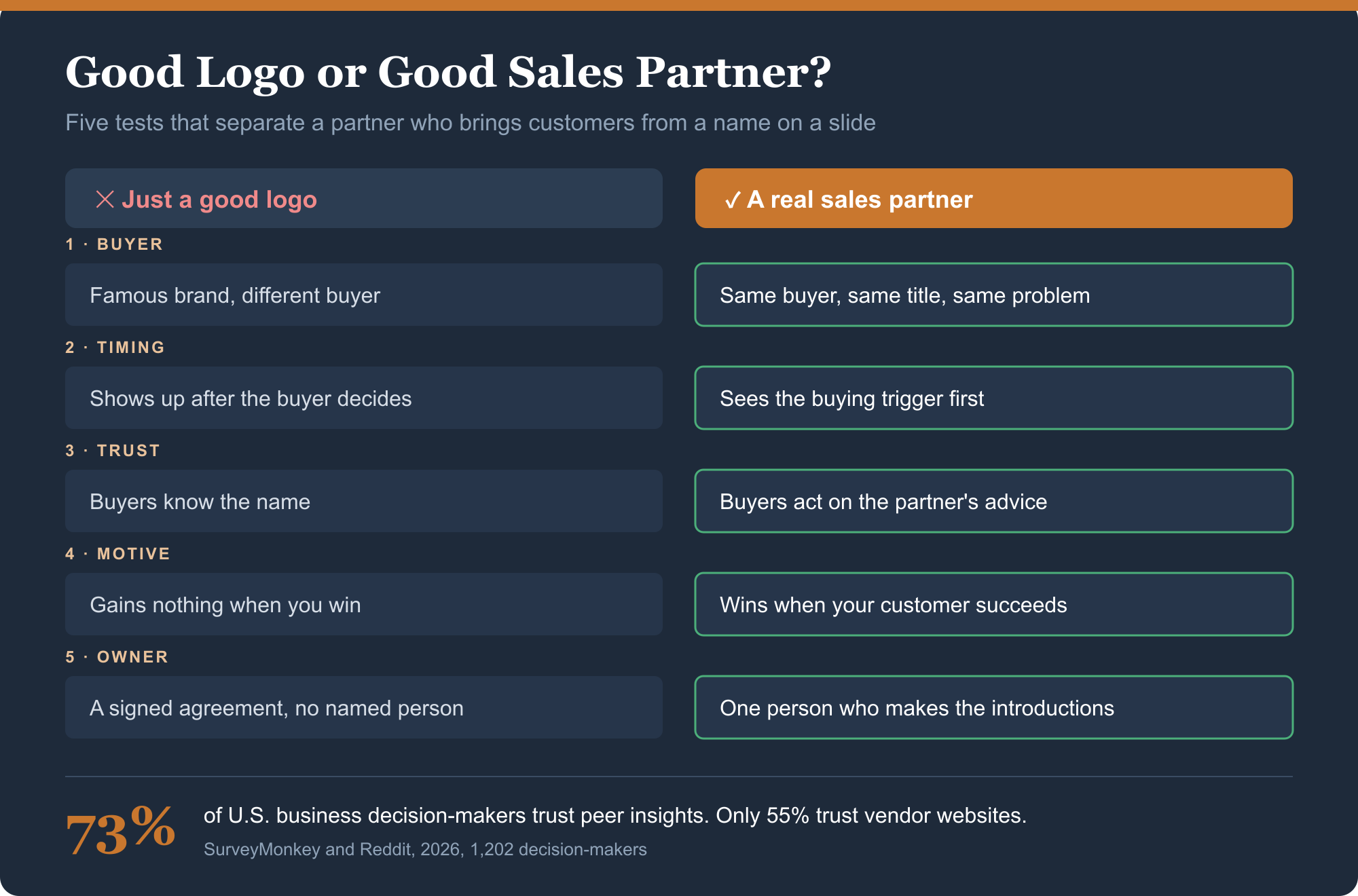
The five tests that separate a sales partner from a logo
- Same buyer. The partner sells to the same title, in the same type of company, with the same problem you solve. A famous brand that sells to IT when you sell to the CFO isn't a partner for you.
- Trigger timing. The partner hears about the buying trigger before you do. An accountant who sees a client's growth problems in the year-end numbers is early. A vendor who shows up after the buyer chose a solution is late.
- Earned trust. The buyer acts on the partner's advice. Name recognition and trust aren't the same thing.
- Mutual motive. The partner gains when your customer succeeds. That might be referral income, but it's often something better: a happier client, more implementation work, or a stronger service offering.
- Named champion. One person inside the partner firm owns the relationship and makes introductions. A partnership agreement with no named person is a document, not a channel.
Why trust matters more than brand size
B2B buyers trust people they know more than they trust vendors. In a 2026 SurveyMonkey and Reddit study of 1,202 U.S. business decision-makers, 73% said they trust peer insights, compared with 55% for vendor websites and 46% for review sites. The same study found 55% struggle to know which sources to trust at all.
That's the real value a sales partner brings: borrowed trust at the moment a buyer is confused. A big brand doesn't automatically carry that trust into your deal. A small consulting firm whose clients call them first when something breaks often does.
Where Do You Find B2B Partners Who Already Reach Your Buyers?
You find B2B partners who already reach your buyers by asking your current customers who they trusted before they bought from you. Your customers already walked the path. The advisers, consultants and adjacent vendors they relied on are the people most likely to see your next buyer first.
Start with your last 10 to 20 customers
Ask each customer three questions on your next check-in call:
- Who did you talk to about this problem before you talked to us?
- What other vendors or advisers do you rely on in this part of your business?
- If a peer had the same problem, who would they call first?
Write the answers in one list. Names that show up two or three times are your first candidates. They've proven they reach your buyer, because they reached your customers. That's better research than any partner directory.
Look in four places your buyer already trusts
- Advisers. Accountants, fractional CFOs, attorneys and consultants who serve your buyer and see problems early.
- Adjacent vendors. Companies that sell a different product to the same buyer, often just before or just after you in the buying sequence.
- Implementers. Agencies and service firms that set up or run the systems your product connects to.
- Communities. Associations, peer groups and event organizers where your buyers compare notes.
Your existing customer referral engine is a natural place to start this list. Customers who refer peers will usually tell you which outside advisers they trust, too.
How Do You Vet a Potential Partner Before Signing Anything?
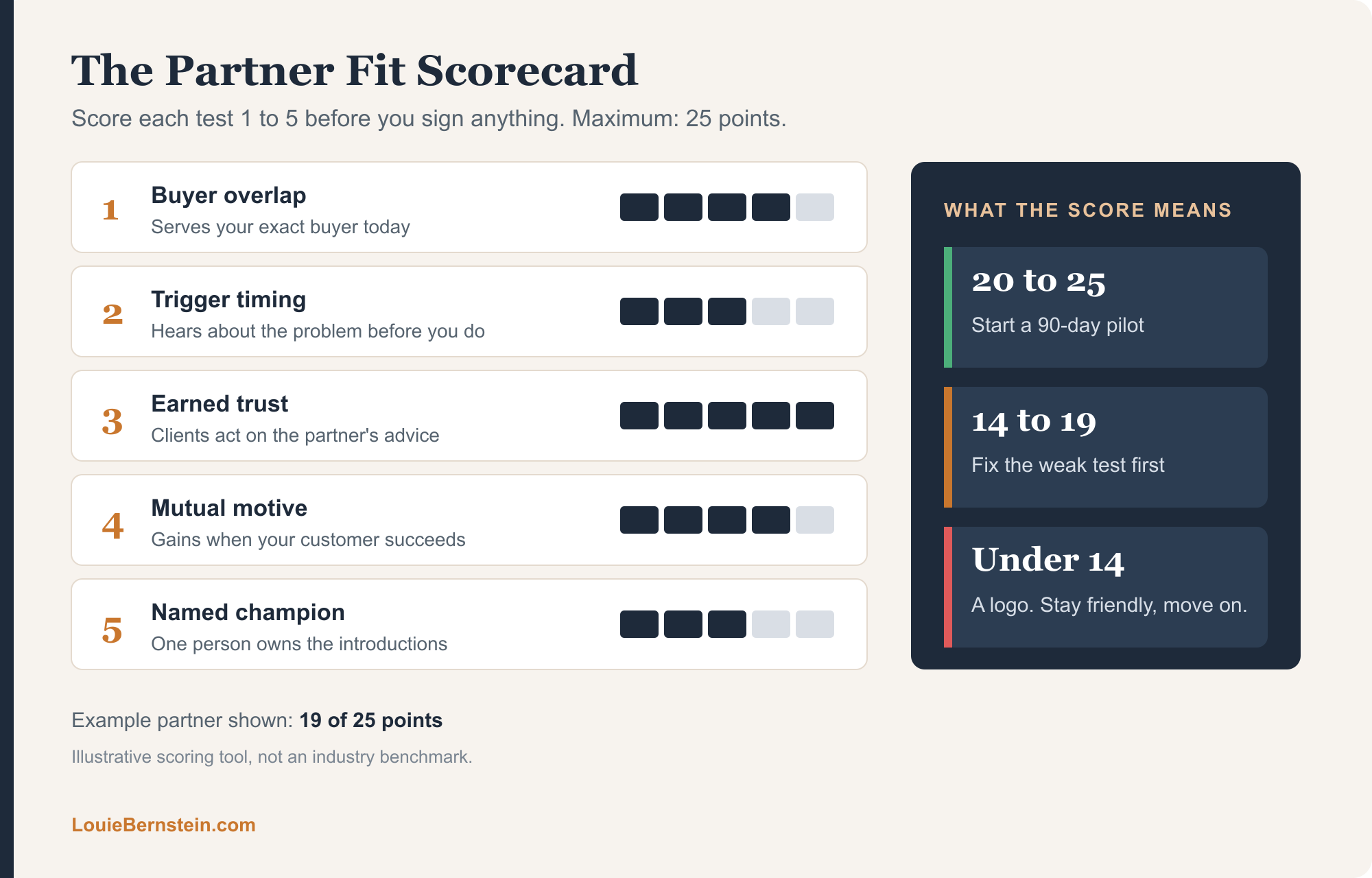
Vet a potential B2B partner by scoring it 1 to 5 on the five tests before you sign an agreement. A total of 20 or more out of 25 justifies a small pilot. A score of 14 to 19 means one weak test needs fixing first. Below 14, the company is a logo, however impressive it looks.
Use the Partner Fit Scorecard
The scorecard below is a simple decision tool, not an industry benchmark. Its value comes from forcing you to score each test separately instead of reacting to the brand. The example partner scores 19: strong trust, decent buyer overlap, but nobody inside the firm owns the introductions yet.
Ask questions that reveal real access
A partner's enthusiasm in the first meeting tells you very little. Ask questions that make them describe real buyers:
- Describe a client you worked with last quarter who had the problem we solve. What triggered it?
- Who at that client would take a meeting with us if you suggested it?
- What do you get when your client buys the right solution?
- Who on your team will make the introductions, and how much time can they give this?
If the answers are vague, such as "we know a lot of people in that space," keep looking. Access means a credible path to a specific conversation, not a big contact list.
Make the economics clear on both sides
A partner spends reputation every time they introduce you. Find out what that partner earns and what they risk. Partners already carry a lot of revenue for B2B companies: nearly 60% of respondents in Forrester's State of B2B Partner Ecosystems, 2026 survey said more than 40% of their organization's revenue is attributable to partners and indirect routes to market. Those partners have choices. Give them a reason to pick you that fits their business, not just a commission rate.
Where Do Founders Usually Get Partner Selection Wrong?
Founders usually get partner selection wrong by choosing for brand and agreement size instead of buyer access and a named owner. A signed agreement with a famous company feels like progress. Without someone inside that company making introductions, the partnership produces meetings about the partnership and no customers.
What I see when I audit sales teams
When I audit a founder's sales system as a Fractional Sales Leader, the partner list is one of the first things I look at. The pattern repeats. Founders sign with the biggest name that will return their call, then wonder why nothing comes in. Meanwhile, a small firm that sent two good customers last year gets no attention, because it doesn't look impressive on a slide.
The second mistake is signing too many partners at once. Every partner needs training, follow-up and someone answering their introductions quickly. A founder who's still closing every deal doesn't have that time. Ten partners that each get a little attention usually produce less than three that get real attention.
The third mistake is skipping the sales system. A partner can open a door. Somebody still has to qualify the buyer, run discovery and close. If those steps live only in the founder's head, every partner introduction lands back on the founder's calendar. Put the basics in a short Sales Playbook first: ideal buyer, disqualifiers, the problem in the buyer's words, and what happens after an introduction.
Pick the partner whose clients call them first, not the partner whose logo looks best on your website.
Logo vs. sales partner at a glance
| Question | ✕ Good logo | ✓ Good sales partner |
|---|---|---|
| Who do they sell to? | A related market | Your exact buyer |
| When do they show up? | After the decision | At the buying trigger |
| Why would buyers listen? | Brand recognition | A history of good advice |
| What do they gain? | Co-marketing exposure | Happier clients and real income |
| Who owns it? | A partnership manager | One person who introduces you |
| How do you measure it? | Agreement signed | Qualified introductions per quarter |
How Do You Know a New B2B Partner Is Actually Working?
A new B2B partner is working when it produces qualified introductions that move through your sales process within one sales cycle. Count introductions accepted, opportunities created and deals closed, separately for each partner. Activity, meetings and co-marketing plans don't count. Customers do.
Measure partners like any other sales channel
Partner-involved deals can win more often, but the effect isn't automatic. Crossbeam's network data from October 2024 showed an average 11.7% lift in win rate when partners were involved in deals. The lift varied by company and partner count, and one group, enterprise companies with 5 to 10 connected partners, actually saw a 1% drop. Crossbeam is a vendor that sells partner software, so treat the figure as directional.
Track three numbers per partner every quarter: qualified introductions, opportunities created and closed revenue. Add the time your team spends supporting each partner. Then compare the cost to your other channels, using the same channel cost comparison you'd use for outbound or events.
Start with three partners and a 90-day review
- Pick three. Choose the three highest-scoring partners who serve the same buyer.
- Name owners. One person at each partner, one person on your team.
- Train in one session. Cover the ideal buyer, the trigger, disqualifiers and how to make the introduction.
- Respond fast. Answer every introduction within one business day. A slow reply burns the partner's reputation and your relationship.
- Review at 90 days. Keep the partners producing qualified introductions, fix the handoff where it stalls, and politely end the rest.
Forrester's 2026 survey found 50% of respondents named a lack of resources as a top challenge to partner ecosystem success. That's large companies with partner teams. A founder-led company has even less time, which is why three focused partners beat a long list.
Related ReadingShould You Build a Partner Channel Before Hiring? →
Frequently Asked Questions
Q: Should I approach big-name companies or small firms first?
Approach small firms first when they serve your exact buyer and their clients call them early. A big company may have a strong brand, but your product is one of hundreds it could recommend. A smaller firm often has more reason to introduce you and more trust with each client.
Q: How do I pitch a potential partner who has never heard of me?
Pitch the value to the partner's clients, not your product. Show how your solution makes their clients more successful and makes the partner look good for recommending it. Bring one customer story from their market. Ask for a single introduction, not a formal partnership.
Q: Should I pay partners a referral fee?
Pay a referral fee when the partner's main contribution is the introduction and the fee fits your margins. Many advisers care more about client outcomes than fees, and some can't accept them. Ask what the partner wants before you offer money. Put the terms in writing before the first deal.
Q: How long before a new partner sends a real opportunity?
Expect the first qualified introduction within 90 days if the partner scored well and was trained. Closed revenue takes at least one full sales cycle after that. If a well-trained partner hasn't sent one introduction in 90 days, the fit or the motive is probably wrong.
Q: Who should manage partners if I'm still the main closer?
Give one person on your team ownership of partner follow-up, even if you still run the final sales calls. That person answers introductions, tracks results and keeps partners informed. If no one but the founder can do it, fix that before adding partners, or the channel becomes more founder-led sales.
Find partners who bring customers, not logos.
If you're a B2B founder at $1M to $10M ARR, a Fractional Sales Leader can help you pick the right partners and build the sales process that turns their introductions into revenue. Let's talk about where your next customers should come from.
Schedule a 30-Minute CallAbout the Author
Louie Bernstein
Louie Bernstein is a Fractional Sales Leader with 50 years of sales experience and has provided Fractional Sales Leadership since 2017. He helps B2B founders build repeatable sales systems so their teams can sell without depending on the founder.