When Can Partners Produce Growth More Efficiently Than Another Sales Rep?
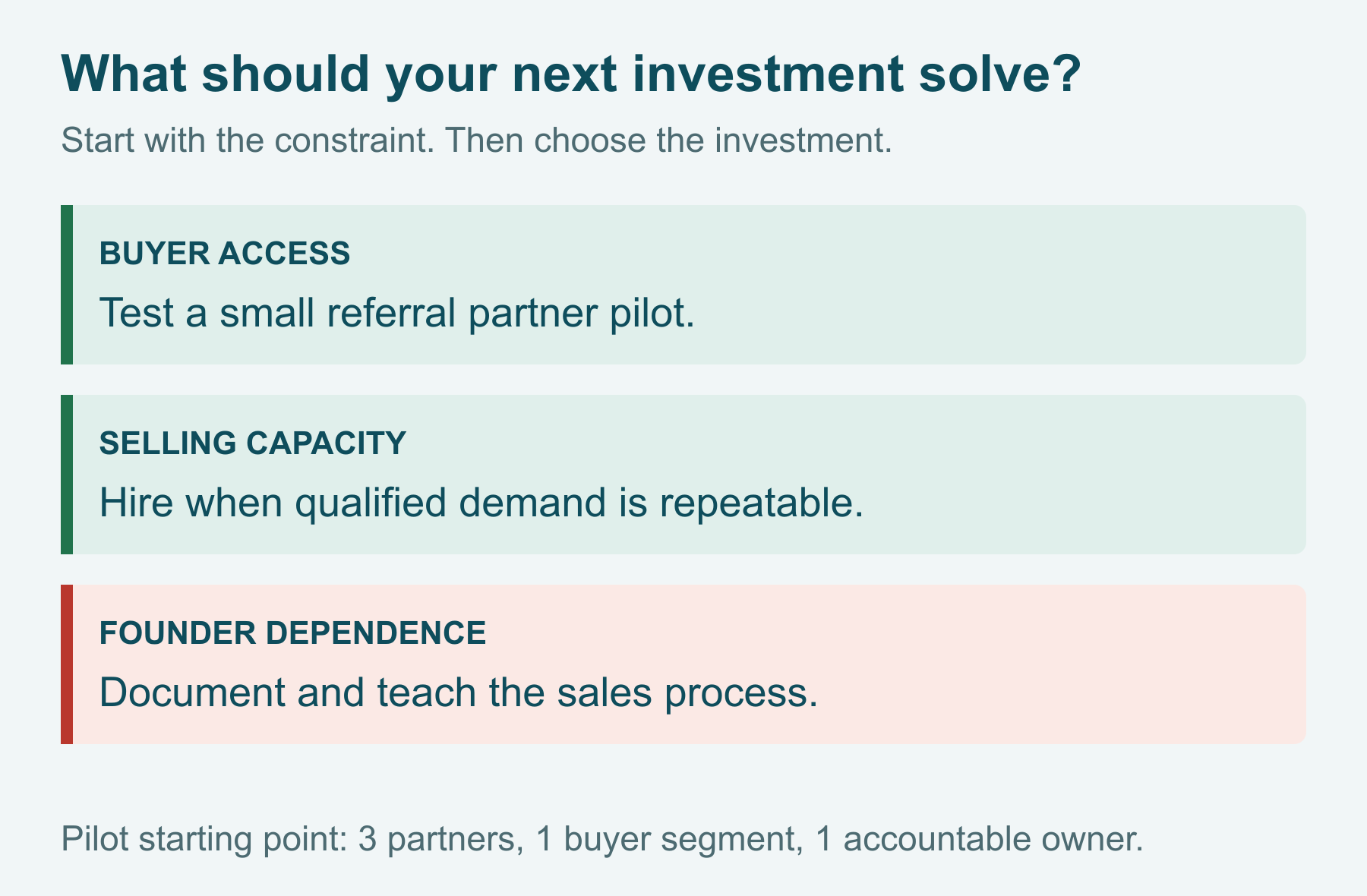
Build a partner channel before hiring more salespeople when partners already reach your ideal buyers, have a clear reason to introduce you, and can produce profitable business through your existing sales process. Start with a small referral pilot. Hire a rep first when qualified opportunities already exceed your team's capacity. If nobody can sell without the founder, fix the sales system before expanding either route.
Key Takeaways
- Test a partner channel before another sales hire when buyer access is the constraint and your team can handle the resulting opportunities.
- A referral partner opens a door; a reseller takes on more of the sale. Don't budget for one and expect the other.
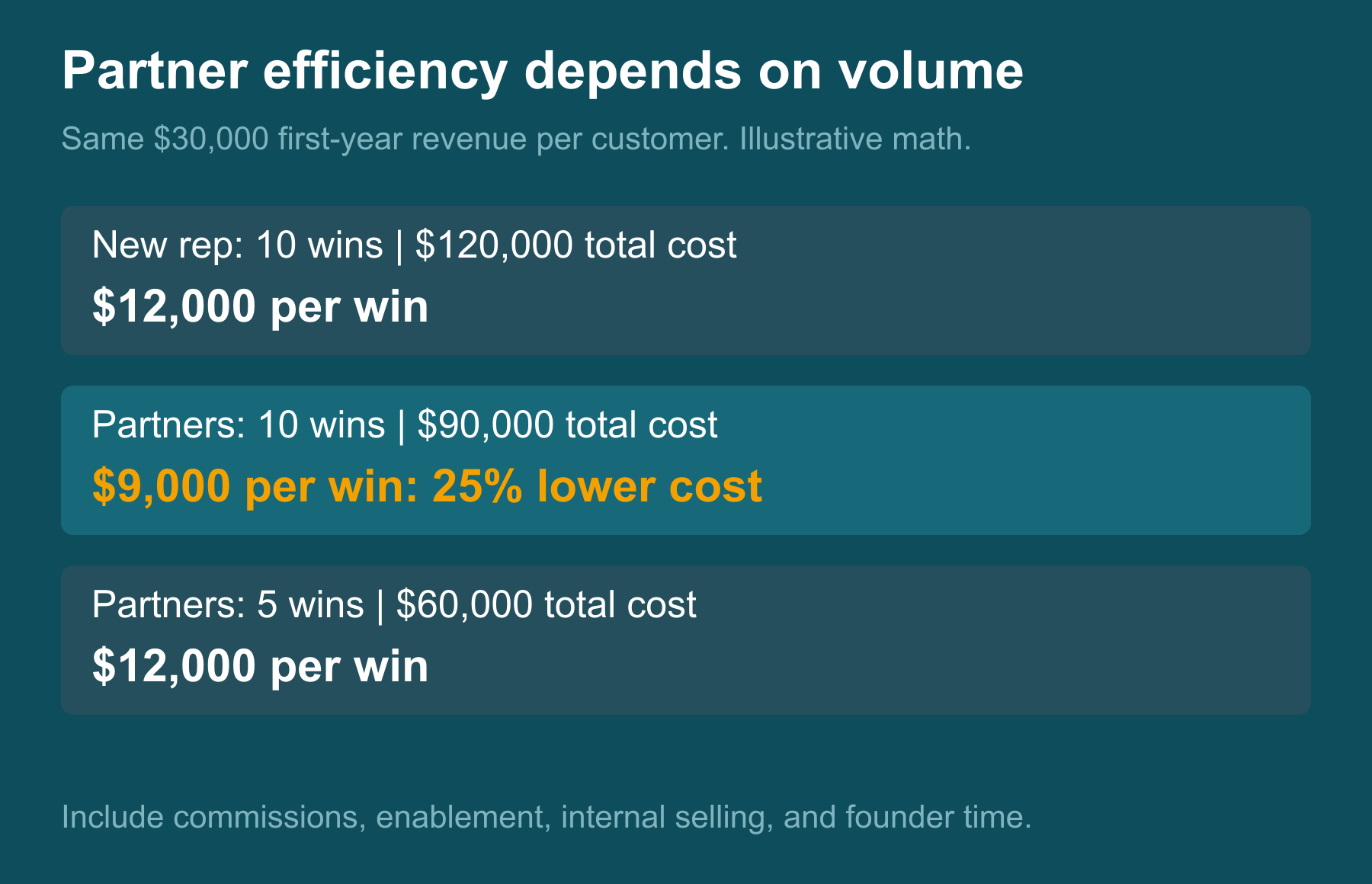
- In the illustrative comparison, partner acquisition costs $9,000 per customer versus $12,000 for a new rep, but the advantage disappears if partner wins fall from ten to five.
- Start with three carefully chosen partners and one buyer segment. Treat the pilot size as a management choice, not an industry benchmark.
- Count commissions, enablement, internal selling time, and founder hours before calling partner revenue efficient.
A founder gets two proposals in the same week. A sales candidate wants a salary and a commission plan. A consultant who knows the market offers introductions in exchange for a share of the business.
The introductions sound safer. You pay when revenue arrives. But someone still has to qualify the buyer, run discovery, write the proposal, and follow up. If every task lands on you, the partner hasn't replaced a salesperson.
A partner can bring you a buyer. You still need a business that knows how to sell to that buyer.
When Can Partners Outperform Another Sales Rep?
Partners can outperform another sales rep when they provide trusted access to buyers your team struggles to reach, while your team has capacity to close those buyers. For a $1M to $10M ARR founder, the advantage comes from solving a specific access problem without adding more coordination cost than the business can carry.
Find the constraint before choosing the channel
Look at the last ten serious opportunities. Did you lose time getting a meeting, or did you lose time after the meeting? A partner may help with the first problem. An additional rep may help with the second, provided your sales process works and the rep can learn it.
Consider a software company selling to accounting firms. An adviser who already helps those firms change systems may recognize a buying trigger before your outbound team does. The adviser can explain why a meeting matters. That's a useful advantage. A company with a large mailing list but no buyer trust offers something different.
Ask the potential partner to describe a specific customer problem, who owns that problem, and when the customer seeks help. If the answer is only 'we know lots of people,' keep looking. Access means a credible path to a relevant conversation, not a spreadsheet of names.
Make the partner economics work on both sides
Partners need a reason to spend their reputation on an introduction. The reason could be referral income, implementation work, better customer outcomes, or a stronger service offering. Ask what the partner earns and what the partner risks. A commission won't rescue a recommendation that makes their client relationship harder.
Established programs make the exchange explicit. HubSpot publicly describes 20% commission for three years on deals partners bring, subject to program terms. That is an example of a defined incentive, not a recommended rate for your business. Your margins, responsibilities, and renewal obligations should determine your offer.
Which Kind of Partner Should You Start With?
Start with a referral partner when your company needs introductions and can still own the sale. Choose a reseller or delivery partner only when the buyer needs responsibilities those partners can actually perform. A founder should define the work first, because different partner models require different training, margins, support, and control.
| Model | Partner owns | Your company still owns |
|---|---|---|
| Referral | A relevant introduction | Qualification, selling, contracting, delivery |
| Co-selling | Agreed buying tasks alongside your team | A named owner and coordinated next steps |
| Reseller | Resale and agreed customer responsibilities | Product support and contractual obligations |
| Implementation | Defined setup or service work | Product success and agreed support boundaries |
Begin with one narrow buyer problem
For a first pilot, I'd choose three partners serving the same buyer segment with the same buying trigger. Three isn't a proven magic number. It's a manageable starting point that lets you compare behavior without creating a second full-time job for yourself. One reliable partner is worth more than a directory full of inactive logos.
Before signing, ask each partner for a working session on a few appropriate accounts, with customer permission where needed. Can the partner recognize the problem? Can they explain the introduction honestly? Will they agree to a next step? Those answers reveal more than enthusiasm during a kickoff call.
Give the partner a short version of your Sales Playbook: ideal buyer, disqualifiers, problem language, proof, introduction format, and handoff. A referral partner shouldn't need your whole product manual to recognize a good fit.
How Do You Compare Partner Costs With a New Sales Hire?
Compare partners and a new sales hire using the same period, the same customer definition, and fully loaded costs. Include internal selling work in the partner route and ramp costs in the rep route. Then compare gross profit after acquisition costs, cash timing, and founder hours. Revenue alone won't tell you which investment works.
Use a complete example, not a commission comparison
Here's illustrative planning math, not a compensation benchmark or forecast. Assume each route wins ten incremental customers with $30,000 of first-year revenue each. At an 80% gross margin before acquisition costs, both routes produce $240,000 of first-year gross profit. Assume no revenue overlap and that the same delivery costs apply.
The new-rep route costs $120,000 over the comparison period, including salary, commissions, benefits, recruiting, tools, ramp, and allocated management time. That's $12,000 per customer. The partner route costs $60,000 in commissions plus $30,000 in enablement, tools, internal selling, and allocated founder time. That's $90,000 total, or $9,000 per customer.
The partner route costs 25% less per customer in this example and leaves $150,000 after acquisition costs, versus $120,000 for the rep route. The $30,000 difference matters only if the assumed wins, margins, and work are real. If commissions continue into later years, include those payments in a longer-term comparison too.
Stress-test the volume before committing
Now cut partner wins to five while keeping the $30,000 support allocation fixed. Revenue falls to $150,000, commissions fall to $30,000, and total acquisition cost becomes $60,000. Cost per customer rises to $12,000. Gross profit before acquisition is $120,000, leaving $60,000 after acquisition. The apparent cost advantage has disappeared.
Separate cash expenses from allocated founder time so you can judge both runway and economic cost. Don't count a founder hour twice. Don't treat collected annual cash and monthly revenue recognition as interchangeable. Compare expected cash receipts with actual payment obligations before deciding the partner route is easier to fund.
Use your existing channel cost and gross profit comparison to keep the definitions consistent. Run a lower-volume case for the rep too. Both investments can disappoint. Neither deserves an optimistic forecast just because you prefer it.
What Must Be in Place Before the First Partner Introduction?
Before the first partner introduction, define qualification, account ownership, response expectations, compensation eligibility, and customer support responsibilities. A founder needs one accountable internal owner for each opportunity. Without those rules, partners create disputed credit and extra follow-up work instead of a dependable route to customers. Write the rules before a valuable deal arrives.
Where founders usually get this wrong
My work as a Fractional Sales Leader starts with a question: can someone else run the sale, or does the founder still carry the judgment in their head? The same test belongs in a partner program. Adding an outside relationship doesn't make unwritten discovery questions or vague qualification rules easier to teach.
I don't want the founder rescuing every introduction. I want the team to know which buyer problem qualifies, what proof the buyer needs, and what must happen before the opportunity moves forward. That's the same discipline I use when helping a founder hand sales responsibility to an employee. The partner changes the source of the conversation, not the need for a system.
Write the operating rules on one page
Use an Accountabilities Document for the internal owner. Define a qualified introduction, a response window your team can meet, deal registration, existing-account exclusions, commission timing, and who approves exceptions. Make one person responsible for resolving ownership questions.
Track partner-sourced and partner-assisted opportunities separately. Sourced means the partner created a new opportunity under your written rules. Assisted means the partner helped an opportunity that already existed. Assistance may be valuable, but counting the same deal as new business from two channels makes your investment decision unreliable.
If every partner introduction needs the founder to make it sellable, you've expanded founder-led sales.
How Do You Test a Partner Channel Before Scaling It?
Test a partner channel with a capped budget, a small group of partners, and a review window tied to your real sales cycle. Measure qualified introductions and customer outcomes before expanding recruitment. A 90-day pilot can test partner activity, but a six-month sale needs more time before you judge closed revenue or repeatability.
Run a pilot with clear decisions
- Define the test. Choose one segment, one partner model, three partners, and a maximum cash and time budget.
- Agree on the work. Train partners on buyer problems, practice introductions, and name the internal opportunity owner.
- Review weekly. Inspect accepted introductions, qualification, next steps, stalled deals, and founder hours.
- Judge completed cohorts. Compare wins, losses, acquisition cost, gross profit, payment timing, and early customer health.
- Choose the next investment. Expand the partners producing repeatable value, change the handoff where evidence supports it, or stop the test.
Set your go and stop rules before launch. For example, require partners to complete training and agree to specific account activity by an agreed date. Set an acceptable cost per customer based on your own margins and cash position. Don't borrow a universal activation rate from a large software ecosystem and call it your forecast.
Hire when capacity becomes the constraint
Hire the next salesperson when qualified demand is repeatable and a trained person can own more of the sale profitably. Successful partners may create that need rather than remove it. A rep can close partner-sourced opportunities while partners keep supplying access. Partner growth and sales hiring can become complementary investments.
If the pilot creates more founder work without reliable customer progress, pause recruitment. Fix qualification, ownership, or the partner proposition. A Fractional Sales Leader can help you make that diagnosis and build the process before you add another commitment. The next investment should remove the constraint you can see in the evidence.
Related ReadingAre You Ready to Step Back From Sales? →
Frequently Asked Questions
Q: Should I give a new partner exclusivity?
Avoid broad exclusivity during an unproven pilot. If exclusivity is necessary, define its scope, performance requirements, review date, and exit terms with appropriate legal advice. Don't block other routes to buyers in exchange for an informal promise.
Q: Do I need partner management software to start?
A CRM with clear partner fields and a simple commission record can support a small referral pilot. Add dedicated software when reporting, payments, or coordination become hard to manage reliably. Software won't create a reason for partners to introduce you.
Q: Can competitors share the same referral partner?
Yes, if the partner can recommend the right fit honestly and confidentiality is protected. Ask how recommendations are made and how conflicts are handled. Buyer trust matters more than a promise that your product will always be recommended.
Q: Should I pay commissions on renewals?
Pay renewal commissions only when the economics and agreed partner responsibilities justify them. A one-time introduction and ongoing account work are different contributions. State the duration and conditions clearly before anyone brings a deal.
Q: What if one partner brings most of the business?
Treat partner concentration as a planning risk. Track how much pipeline and revenue depend on that relationship, maintain direct customer knowledge, and build other routes gradually. Strong performance from one partner doesn't prove that recruiting ten more will reproduce the result.
Choose your next growth investment with evidence.
If you're a B2B founder at $1M to $10M ARR, Fractional Sales Leadership can help you define the sales process, ownership, and economics before you add partners or headcount. Learn more at LouieBernstein.com.
Schedule a 30-Minute CallAbout the Author
Louie Bernstein
Louie Bernstein is a Fractional Sales Leader with 50 years of sales experience and has provided Fractional Sales Leadership since 2017. He helps B2B founders build repeatable sales systems so their teams can sell without depending on the founder.