The B2B sales channel that's making you money is the one that returns the most first-year gross profit for every fully loaded dollar it costs, and can keep doing that without you. Count the cash spend and your own selling hours. Compare channels over a window at least as long as your sales cycle. Referrals usually look free until founder time goes into the math, and then they look like what they are: founder-led sales.
Key Takeaways
- Rank B2B sales channels by first-year gross profit returned per fully loaded dollar, not by leads, meetings, or revenue booked.
- Fully loaded channel cost includes cash spend, salaries, tools, and the founder's selling hours priced at a realistic rate.
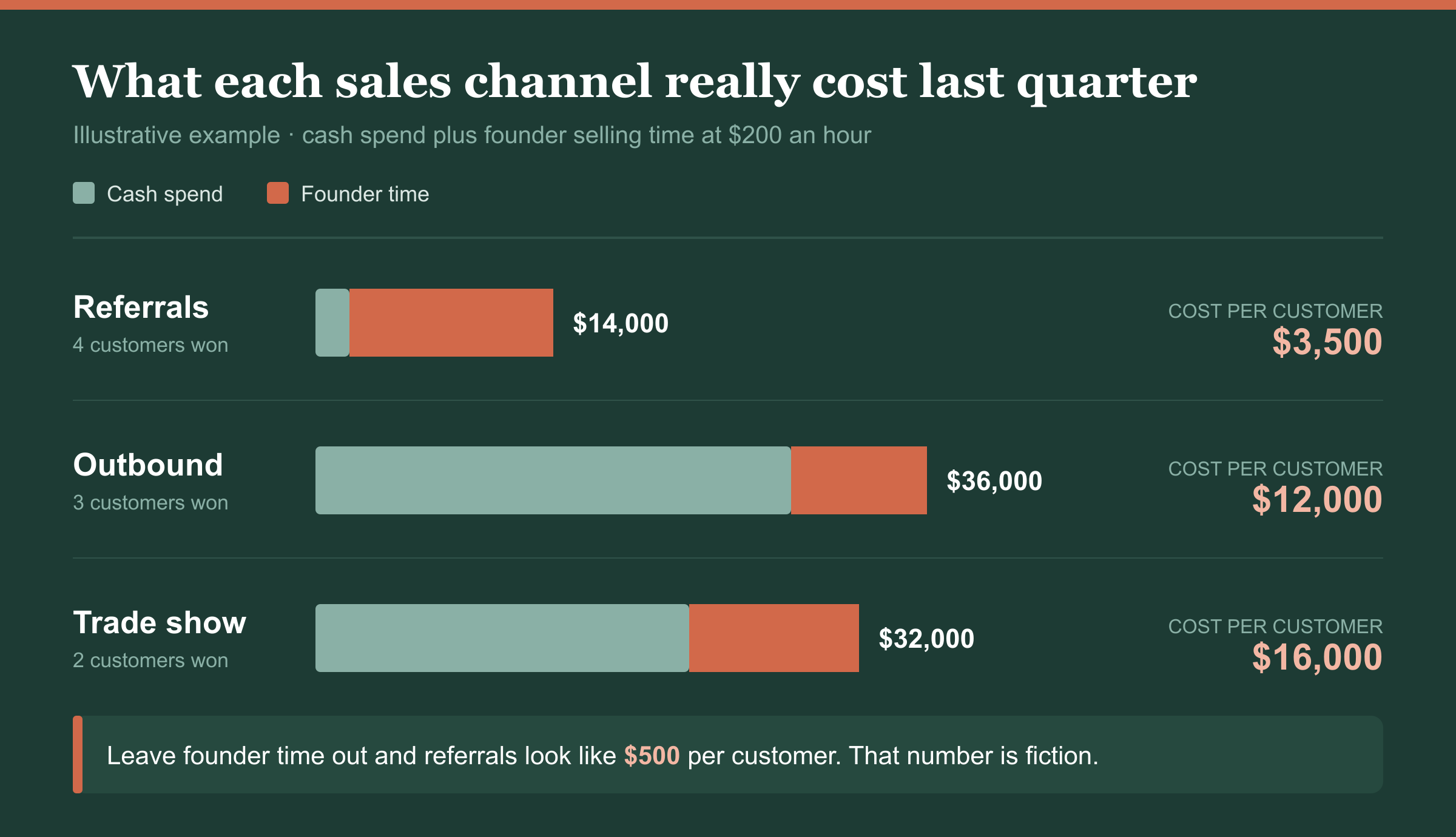
- In the illustrative example, referrals cost $500 per customer in cash but $3,500 per customer once 60 founder hours are counted.
- Buyers first contacted sellers about 61% of the way through their purchase in 2025 (6sense, nearly 4,000 buyers), so "last touch" CRM data often credits the wrong channel.
- Make Lead Source a mandatory CRM field this week and ask every new prospect, "How did you first hear about us?"
- A channel that only works when the founder is in the room isn't ready to scale, no matter how good its return looks.
Ask a founder where their best customers come from and you'll get a confident answer. Ask to see the numbers behind it and the room gets quiet.
Most $1M to $10M ARR companies run three to five sales channels at once. Referrals. Some outbound. A trade show or two. A partner who sends a deal now and then. Content that may or may not be doing anything. Budget gets set by habit, and the founder's gut decides which channel gets credit.
That gut is usually wrong in one specific way. It counts the money and ignores the founder.
How Do You Figure Out Which Sales Channel Is Actually Making You Money?
To find the sales channel that's actually making you money, divide each channel's first-year gross profit by its fully loaded cost over the same window. The ratio shows how many dollars of gross profit each dollar of channel spending returned. Leads and meetings don't belong in this test, because they cost money long before they earn any.
Use one number per channel
Here's the calculation for each channel:
- Fully loaded cost: everything spent to win customers through the channel during the window, including people and founder time.
- Customers won: new customers whose first meaningful contact came through the channel.
- First-year gross profit: first-year contract value multiplied by your gross margin.
- Return per dollar: first-year gross profit divided by fully loaded cost.
A return of 1.0x means the channel earned back its cost in year one. Below 1.0x, you're financing those customers and waiting for renewals to make the money back. Above 3.0x, you've probably found something worth protecting.
Pick the right window
Measure each channel over at least one full sales cycle, and longer when deal counts are small. If your deals take five months to close, a one-quarter view will make outbound look terrible, because the meetings booked this quarter haven't closed yet. Two to four rolling quarters is a safer view for most companies in this range.
What Costs Should You Include When Comparing Sales Channels?
When comparing sales channels, include every cost the channel needs to produce a customer: cash spend, salaries and commissions, tools, travel, and the founder's selling hours. Founder time is the cost most companies leave out, and leaving it out makes founder-heavy channels like referrals and networking look far cheaper than they are.
Put a price on your hours
Your time isn't free. It's the scarcest resource in the company. Track the hours you spend on each channel for one month, then price them. In this article's example, I use $200 an hour. Twenty hours a week of founder selling at that rate is about $200,000 a year of executive time.
Here's an illustrative quarter for a company selling at 75% gross margin. Every number is made up to show the method, not a benchmark.
| Channel (one quarter) | Cash spend | Founder time | Fully loaded cost | Customers won | Cost per customer |
|---|---|---|---|---|---|
| Referrals | $2,000 | 60 hrs = $12,000 | $14,000 | 4 | $3,500 |
| Outbound (one SDR plus tools) | $28,000 | 40 hrs = $8,000 | $36,000 | 3 | $12,000 |
| Trade show | $22,000 | 50 hrs = $10,000 | $32,000 | 2 | $16,000 |
Watch the referral illusion
Without founder time, referrals cost $500 per customer in this example. With founder time, they cost $3,500. Referrals are still the cheapest channel here. They're just seven times more expensive than the spreadsheet said.
That gap matters when you plan your next hire. A salesperson can't inherit your network. If referrals carry the company, the true cost of that channel is you.
How Do You Compare the Real Cost and Return of Each Sales Channel?
Compare the real cost and return of each sales channel by putting fully loaded cost, customers won, first-year gross profit, and founder hours side by side for the same window. Return per dollar shows which channel earns the most. Founder hours show which channel can grow without you. You need both numbers to make a sound decision.
Run the return calculation
Continue the illustrative example. Referral customers average $30,000 in first-year contract value, outbound customers $24,000, and trade show customers $36,000. At 75% gross margin:
| Channel | First-year gross profit | Fully loaded cost | Return per $1 | Founder hours per customer |
|---|---|---|---|---|
| Referrals | $90,000 | $14,000 | 6.4x | 15 |
| Trade show | $54,000 | $32,000 | 1.7x | 25 |
| Outbound | $54,000 | $36,000 | 1.5x | 13 |
Referrals win on return. Outbound uses the fewest founder hours per customer and has a salesperson doing most of the work, so outbound is the channel most likely to scale. The trade show has the biggest deals and the most founder hours per customer. A revenue report wouldn't show you any of that.
Adjust for what happens after year one
First-year return is the starting point, not the final word. Customers from different channels can stay for different lengths of time. A study of a German bank found referred customers had a 16% to 25% higher customer lifetime value than customers acquired other ways (Journal of Marketing Research, 2018). That was consumer banking, not B2B software, so check your own renewal rates by channel before you assume the same.
A channel that returns 6x but only when the founder shows up is a great business for the founder. It isn't yet a sales system.
Why Does Your CRM Give Credit to the Wrong Sales Channel?
Your CRM often gives credit to the wrong sales channel because it records the last touch before a deal, while most B2B buyers do their research long before they talk to anyone. If the first touch never gets recorded, the channel that created the demand gets no credit, and the channel that happened to catch it gets all of it.
Buyers decide before they call
In 6sense's 2025 Buyer Experience Report, buyers first contacted sellers about 61% of the way through their buying journey, based on nearly 4,000 B2B buyers. In the same survey, 77% said their first vendor conversation was with the vendor they ultimately chose. Gartner's survey of 646 B2B buyers, run in late 2025 and published in March 2026, found 67% prefer a rep-free buying experience, and 45% used AI during a recent purchase.
Put those together and the problem is clear. By the time a prospect fills out your demo form, something else already put you on the shortlist. A podcast, a LinkedIn post, a customer who mentioned you at dinner. If your CRM says "website," it's crediting the front door instead of the reason the buyer walked through it.
Ask the question nobody asks
The cheapest attribution tool is a question. On every discovery call, ask: "How did you first hear about us?" Then record the answer in a mandatory Lead Source field. Don't let a deal move to the next stage with that field blank.
That's one of the first things I change when I come into a company. When Lead Source is optional, it gets skipped. And when it gets skipped, the founder's memory becomes the attribution model.
When Should You Cut, Keep, or Double Down on a Sales Channel?
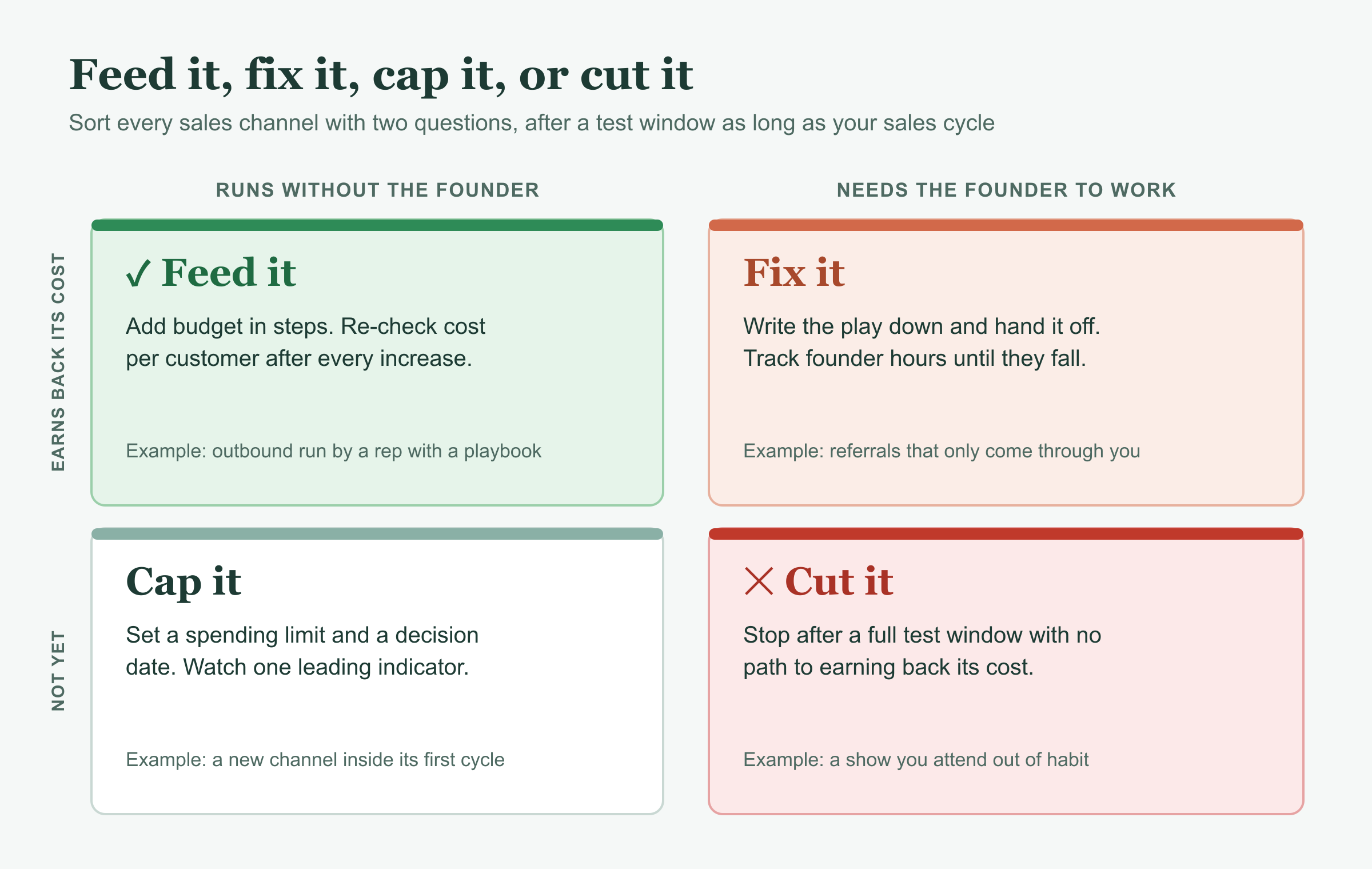
Double down on a sales channel when it earns back its fully loaded cost and runs without the founder. Fix it when it earns money but depends on you. Cap a new channel's spending until it completes a full test window. Cut a channel that finishes that window with no realistic path to earning back what it costs.
Give slow channels a fair test, with a limit
Some channels take longer to pay off. Research from the Ehrenberg-Bass Institute, published by LinkedIn's B2B Institute in 2021, estimates that only about 5% of B2B buyers are in the market at any given time. Content, events, and partnerships often work on that other 95%, so judging them after six weeks is unfair. Judging them never is worse. Set a spending cap, a decision date, and one leading indicator, such as qualified first conversations sourced by the channel.
What I see when I audit sales teams
I've been in sales for 50 years and a Fractional Sales Leader since 2017, and the same pattern keeps showing up. The founder's favorite channel is the one the founder personally runs. Usually that's referrals or networking. It feels free, it closes well, and it's the most expensive sales channel in the company once the founder sends themselves an invoice.
Most of my own business comes from referrals, so I'm not against them. I'm against pretending they're a system. A referral channel becomes a system when there's a written process for asking, a person other than the founder who owns follow-up, and a number on a dashboard every month. Until then, it's founder-led sales with a nicer name.
The fix isn't to stop doing referrals. Write down how you ask for them, who you ask, and when. Put it in the Sales Playbook. Hand the follow-up to someone else. Then track your hours per referral customer and watch that number drop.
Frequently Asked Questions
How many customers do I need before channel comparisons mean anything?
Channel comparisons get unreliable when a channel has only one or two wins in the window, because a single large deal can swing the result. Use a longer rolling window, show the customer count next to every ratio, and treat small samples as direction, not proof.
What hourly rate should I use for founder time?
Use a rate that reflects what your time is worth to the business, such as what it would cost to hire someone to do your other work. Pick one rate, use it for every channel, and keep it the same over time. Consistency matters more than precision.
Should paid ads be compared the same way as referrals and outbound?
Yes. Paid ads, referrals, outbound, events, and partners should all go through the same calculation: fully loaded cost, customers won, first-year gross profit, and founder hours. Include agency fees and the time someone spends managing campaigns, not just the ad spend.
What if a customer touched three channels before buying?
Record the first channel the customer names when asked how they first heard about you, and note the others in the opportunity record. First-touch answers from the buyer are imperfect, but they're more honest than crediting whatever form the buyer filled out last.
Can I compare channels if I don't know my gross margin?
You can compare cost per customer without gross margin, but you can't compare return. Ask your accountant for a gross margin estimate that includes delivery, support, and hosting costs. Even a rough margin is better than comparing revenue, which overstates every channel's return.
When should I bring in outside help to fix channel economics?
Bring in outside help when the founder is still the main source of new revenue and nobody else in the company can run a channel end to end. A Fractional Sales Leader can build the measurement, write the playbook, and hand the founder-dependent channels to the team.
Find out which channel is really paying the bills.
If your $1M to $10M ARR B2B company still depends on you to bring in and close most deals, Fractional Sales Leadership can help you measure every channel, build the Sales Playbook, and hand the work to a team that sells without you. Learn more at LouieBernstein.com.
Schedule a 30-Minute CallAbout the Author
Louie Bernstein is a Fractional Sales Leader and founder of MindIQ. He helps B2B founders build Sales Playbooks, defined sales processes, and teams that can sell without constant founder involvement.