Acquiring a B2B customer costs the full sales and marketing effort required to win new business, divided by the number of new customers won. Include people, campaigns, commissions, tools, and unsuccessful deals. Track founder selling time separately when payroll doesn't reflect its value. For a founder-led business, the useful number is what acquisition costs today and what the same work will cost when someone else must do it.
Key Takeaways
- True B2B customer acquisition cost includes the work spent on lost deals, not just the expenses attached to wins.
- Keep cash CAC and founder-adjusted CAC separate. An assumed value for founder time isn't an additional cash expense.
- In the illustrative example below, $1,000 of advertising per customer becomes $7,000 cash CAC and $8,000 founder-adjusted CAC.
- Calculate payback using gross profit, not revenue. Delivery costs consume part of every customer payment.
- Audit ten working days of founder selling time and review acquisition costs by customer segment before increasing spending.
You spend $20,000 on marketing and win 20 customers. The spreadsheet says acquisition costs $1,000 a customer. That looks like a business you can scale.
Then you hire a salesperson. The same customers need discovery calls, proposals, technical answers, and your help getting the deal closed. The ad bill was only the part you could see.
If you're building a B2B company at $1M to $10M ARR, a cheap-looking acquisition number can lead to an expensive hiring decision. Before buying more leads, find out what turning those leads into paying customers actually requires.
What Should Be Included in Your True Customer Acquisition Cost?
True customer acquisition cost should include the sales and marketing resources used to acquire new customers: compensation, campaigns, commissions, software, outside help, and relevant shared costs. Include effort spent on prospects who never buy. For founder-led companies, also show a separate time adjustment when the founder's acquisition work is underpriced or unpaid.
Start with people, not the advertising invoice
Include salaries, employer payroll costs, benefits, and commissions for the people acquiring customers. A rep's preparation, internal meetings, and follow-up still cost money even when the rep isn't talking to a buyer.
Salesforce's 2026 State of Sales report, based on 4,050 sales professionals surveyed across 22 countries in August and September 2025, reports that sellers spend 40% of their time selling and 60% on other work (Salesforce, pp. 3 and 8). That's a broad survey, not a benchmark for your company. It explains why counting only customer-facing hours misses paid acquisition work.
Include acquisition-related management, coaching, sales operations, and technical support. If an employee splits time between new sales and existing accounts, allocate the cost using a reasonable estimate. Don't assign the whole salary to both activities.
Include the resources that help people win
Count advertising, content, events, agencies, prospect data, CRM, outreach tools, travel, and referral fees. Stripe's July 2025 CAC guide includes sales and marketing salaries, commissions, acquisition tools, and agency fees in the calculation (Stripe).
Pre-sale security reviews, legal work, and proof-of-concept support belong in the acquisition discussion when they help win the contract. Shared tools and overhead need a documented allocation, not a guess that changes whenever the number looks bad.
Keep routine post-sale delivery and support in cost of service rather than quietly adding them to CAC. Onboarding sits near the boundary in some businesses. State your policy and apply it consistently. Whatever label you choose, don't make the cost disappear from the customer's economics.
Lost deals belong in the numerator
If your team works 40 opportunities and wins ten, the other 30 still consumed paid time. Customer acquisition cost spreads the relevant acquisition effort across the customers won. Dividing only the winning deals' expenses by ten leaves out the cost of finding those winners.
Define a new customer clearly, too. Free trials, meetings, and opportunities aren't paying customers. Count a business buying for the first time once, not each seat or each invoice. Keep renewals and expansion separate from new-customer wins.
How Do You Calculate CAC Without Hiding Founder Time?
Calculate cash CAC by dividing acquisition spending by new customers won, then add a clearly labeled founder-time adjustment for a second management view. Use a conservative hourly assumption and subtract any founder compensation already allocated to acquisition. The two views answer different questions: cash required and the economic effort needed to win.
Build a calculation you can explain
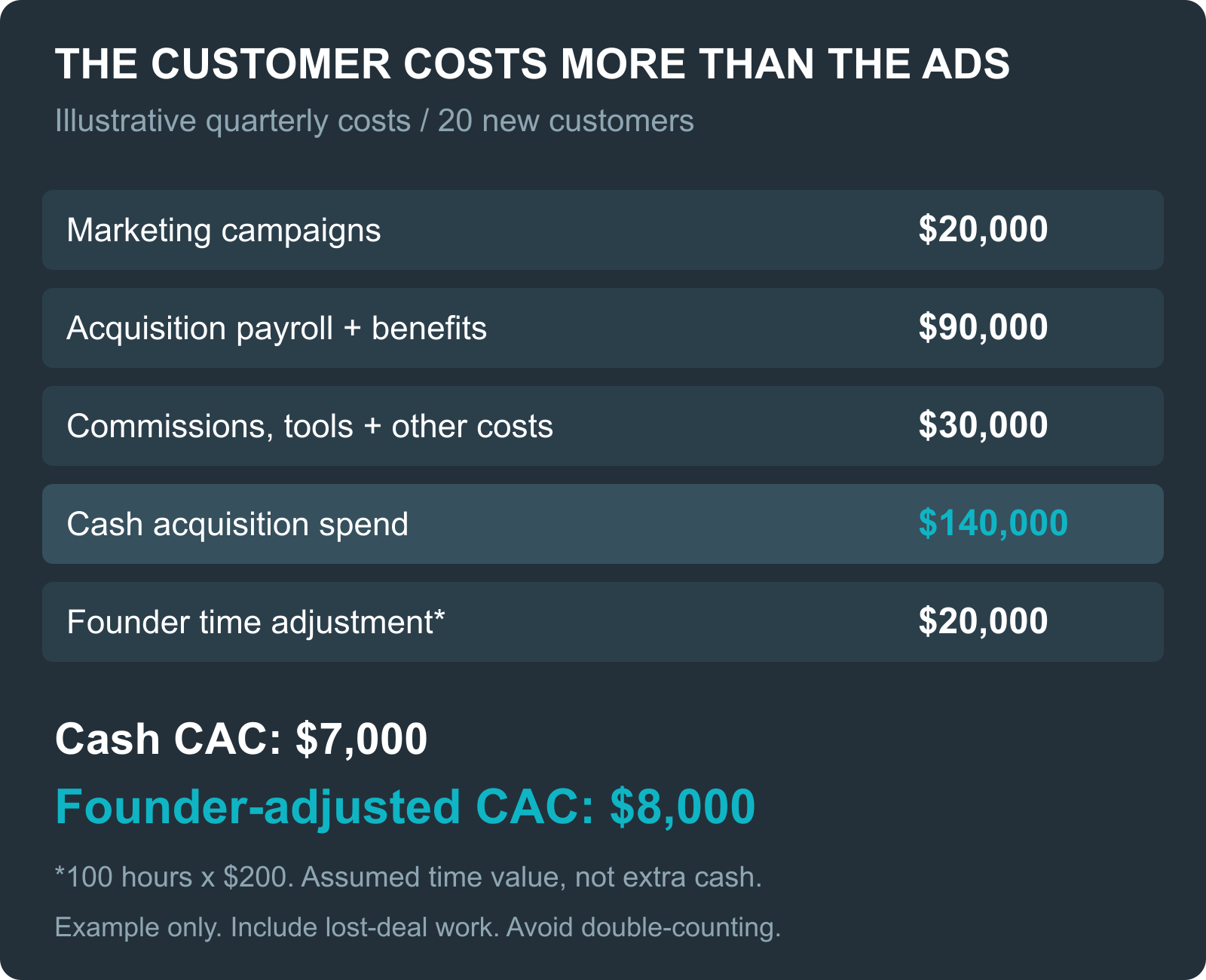
Consider this illustrative quarter, not a client result or an industry average:
| Acquisition cost | Amount |
|---|---|
| Marketing campaigns | $20,000 |
| Acquisition payroll and benefits | $90,000 |
| Commissions, tools, and other acquisition costs | $30,000 |
| Total cash acquisition spend | $140,000 |
With 20 new customers, cash CAC is $7,000. Marketing alone was $1,000 per customer, but that wasn't the cost of the complete acquisition effort.
Now assume the founder contributed 100 acquisition hours valued at $200 an hour, with none of that time reflected in the allocated payroll. The time adjustment is $20,000. Founder-adjusted acquisition cost becomes $160,000 divided by 20, or $8,000 per customer.
Value the work without inventing cash savings
Your hourly assumption might reflect replacement cost or the value of your next-best use of time. Label which one you chose. Don't use ARR divided by your working hours. Company revenue isn't your personal hourly rate.
If founder compensation already covers part of the acquisition work, adjust only the difference needed for the management view. Don't add the same hours twice. Keep speculative missed revenue out of the CAC numerator; discuss opportunity cost separately.
A founder-adjusted number isn't a standardized accounting measure. It's a decision tool. Your bookkeeper's expense report, commission accounting, and management CAC analysis may use different timing. Reconcile them rather than treating every number as interchangeable.
Which Customers and Time Periods Should You Compare?
Compare customer acquisition costs across similar customer segments and periods that reflect your sales cycle. A same-quarter calculation is a useful starting point, but long buying cycles can separate spending from wins. Track spending, new customers, and sales-cycle timing together so a slow close doesn't look like a failed acquisition strategy.
Respect the delay between spending and winning
A campaign launched in January may produce a customer in June. Dividing January's spending by January's wins can mix unrelated work. A quarter with several delayed contracts may look unusually efficient because much of the work happened earlier.
Start with a rolling view that covers several typical sales cycles. Then inspect groups of opportunities created in the same period and follow them through the buying process. Some costs won't map neatly to one deal. Document the limits instead of claiming perfect attribution.
Don't shift spending backward or forward just to improve CAC. Use the same policy each period, keep the simpler period report, and add the sales-cycle explanation alongside it.
Separate customer segments before cutting a channel
A small account and an enterprise account can require very different selling effort. Report customer-count CAC by segment alongside contract value, gross margin, and selling time. An overall average can hide an expensive segment inside an otherwise healthy business.
Separate founder referrals from rep-generated pipeline when enough data exists. A trusted introduction may close quickly because you've spent years building the relationship. Hiring another rep doesn't automatically reproduce that source of trust.
Keep channel CAC and blended CAC distinct. Channel views help you compare acquisition routes. The blended view shows the total acquisition effort across the business. Allocate shared costs consistently and resist giving every channel full credit for the same customer.
How Do You Know Whether Your CAC Is Affordable?
Customer acquisition cost is affordable when customer gross profit can repay the acquisition investment within your cash limits, with enough room for churn, overhead, and profit. Compare CAC with gross profit and actual collection timing. A large contract doesn't solve the problem if delivery consumes the margin or customers leave before payback.
Use gross profit to calculate payback
Assume a recurring customer pays $2,000 a month and has a 75% gross margin. Monthly gross profit is $1,500. With the illustrative $7,000 cash CAC, simple payback is about 4.7 months: $7,000 divided by $1,500.
The $8,000 founder-adjusted view produces about 5.3 months. Keep those measures labeled. The time adjustment doesn't create an extra invoice your bank account must pay.
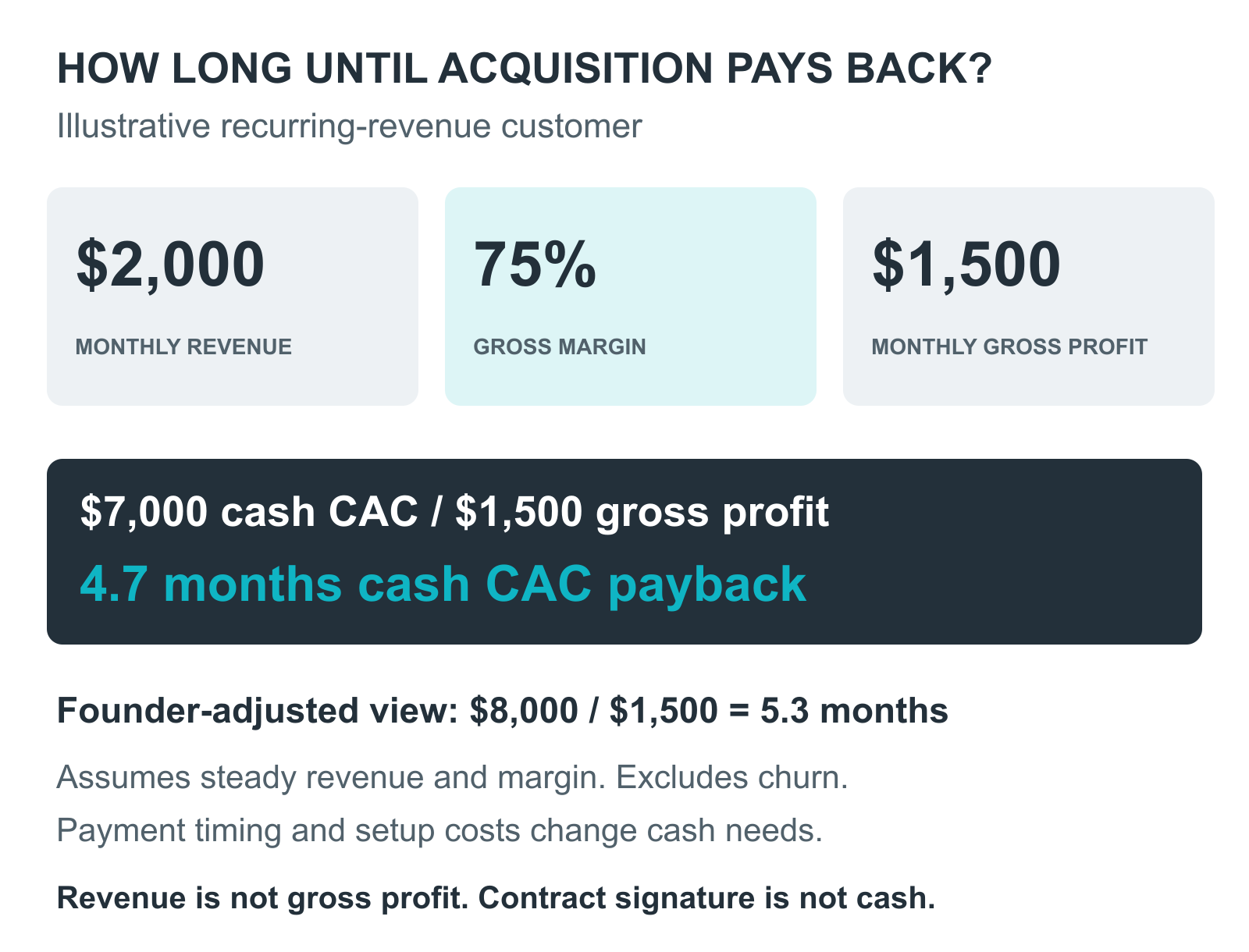
The simple payback calculation assumes stable revenue and margin. Setup work, delayed collections, expansion, contraction, and churn change the result. For project-based businesses, use the contribution from the actual work and payment schedule rather than a recurring-revenue formula.
Test cash needs before celebrating the ratio
An annual prepayment helps cash arrive earlier. It doesn't turn the whole payment into profit, because the company still owes delivery. Monthly billing may leave you funding acquisition and service before enough cash comes back.
Ask what happens if the customer pays late, delivery costs more than planned, or the customer leaves early. Use your own retention history. A lifetime-value estimate based on years of retention you haven't observed can make almost any CAC look attractive.
There's no single good dollar CAC for every B2B company. A $7,000 acquisition cost means something different for a $6,000 annual customer than for a $60,000 customer. Even that comparison needs margin, retention, and cash timing to support a decision.
How Can You Lower CAC Without Becoming the Closer Again?
Lower customer acquisition cost by reducing wasted selling effort and improving the team's ability to win suitable customers without constant founder intervention. Tighten qualification, document sales stages, and coach specific skills before buying more leads. Track acquisition cost alongside founder hours, customer quality, and margin so apparent savings don't create a new dependency.
What I've learned about teaching salespeople
At MindIQ, I was the sales engine before I learned how limiting that role could become. I've written about the transition from being the person on every important deal to building a team that can handle the work. That experience shapes how I look at acquisition cost: your involvement can make a sale possible while hiding what the business needs to repeat it.
Applied to CAC, the distinction matters. You can make a rep's results look better by rewriting every proposal and taking over every difficult conversation. But the acquisition process still requires your time. The business hasn't learned to win without you.
A deal you rescue can produce revenue. A skill you teach can help the next deal close without you.
Track founder interventions and their causes. Does the rep need better discovery questions? A clear qualification standard? Practice discussing price? Coach the skill, then let the rep own the next buyer conversation. Keep founder approval for real exceptions.
Run a practical acquisition audit
- List acquisition spending. Give each cost an owner and document how shared costs are allocated.
- Track ten working days of founder time. Include preparation, interruptions, proposals, and deal rescue.
- Define the customer count. Reconcile new paying accounts with CRM wins and billing records.
- Inspect one segment. Compare win rate, sales-cycle length, margin, and founder involvement for similar customers.
- Fix one expensive failure. Add an exit criterion, qualification question, or coaching exercise, then review the effect over a suitable sales cycle.
If poorly qualified deals consume hours of proposals, improve qualification before increasing activity. If buyers stall after demos, examine the agreed next step and buying process. The Sales Playbook should tell reps what evidence moves a deal forward.
A Fractional Sales Leader can help install those habits without requiring a full-time VP of Sales. The goal is a repeatable process your team can run. Measure progress with fewer avoidable sales hours and better customer economics, not a promised percentage reduction in CAC.
What Else Should Founders Know About Customer Acquisition Cost?
Founders should distinguish acquisition cost from lead cost, track acquisition investment during hiring, and avoid claiming precision from a handful of wins. CAC helps guide spending when the definitions stay consistent. The following answers address common reporting decisions that can change the number without changing the underlying quality of the sales business.
Is cost per lead the same as CAC?
No. Cost per lead measures the cost of generating a lead. CAC measures the acquisition effort per new customer won. Cheap leads can create expensive customers if they need heavy follow-up or rarely buy.
What if we don't win any customers during the period?
CAC is undefined when the customer count is zero. Report the spending and zero wins, then inspect a longer period and the open pipeline. Don't report zero CAC or replace the denominator with meetings.
Do sales hiring and ramp costs count?
Acquisition-related recruiting, training, and ramp spending should be visible in your management analysis. Show major one-time investments separately as well as within a clearly defined total. Removing them entirely understates what building acquisition capacity requires.
Should renewals and upsells reduce new-customer CAC?
No. Keep existing-customer growth separate from the new-customer count. Allocate account-management costs to the work they support. Adding renewal or upsell transactions to the denominator can make new-customer acquisition look cheaper without winning another customer.
Can a customer referral have zero CAC?
A referral can have zero direct advertising cost while still requiring paid sales work. Include discovery, proposals, commissions, and other acquisition resources. If referral fees apply, include those too.
How often should I review CAC with a small customer count?
Review spending and wins monthly, but interpret CAC over a period long enough to contain meaningful wins and typical sales cycles. Show the actual customer count beside the ratio. One delayed contract can move a small company's average substantially.
Build a sales process you can afford to repeat.
If you're at $1M to $10M ARR and every win still needs your help, let's look at the work behind your acquisition cost. Fractional Sales Leadership can help your team qualify, sell, and manage the pipeline with less founder dependence. Learn more at LouieBernstein.com.
Schedule a 30-Minute CallAbout the Author
Louie Bernstein is a Fractional Sales Leader and founder of MindIQ. He helps B2B founders build Sales Playbooks, defined sales processes, and teams that can sell without constant founder involvement.