Key Takeaways:
- Referrals are the highest-trust, shortest, cheapest deals you will ever close. Most founders leave them to luck.
- You do not get more referrals because you never ask, you ask at the wrong time, or you ask so vaguely nobody can help.
- A referral ask lands when your customer's good feeling is highest: after a win, at renewal, after you saved them.
- The specific ask beats the general one. "Who do you know at a Series B SaaS with this exact problem" beats "know anyone?"
- Make it easy. Write the intro for them. The less work the ask takes, the more often you get a yes.
- If it isn't in the CRM, it never happened. Track every ask and every source, or you are running on hope, not a system.
A referral lands in your inbox. A warm intro from a happy customer to someone who has the exact problem you solve. That deal closes faster than any other in your pipeline. The trust is already there. The price rarely gets argued. You did almost nothing to earn it, and you would take a hundred more.
So here is the question that should bother you. If referrals are your best deals, why do you have no idea where the next one is coming from?
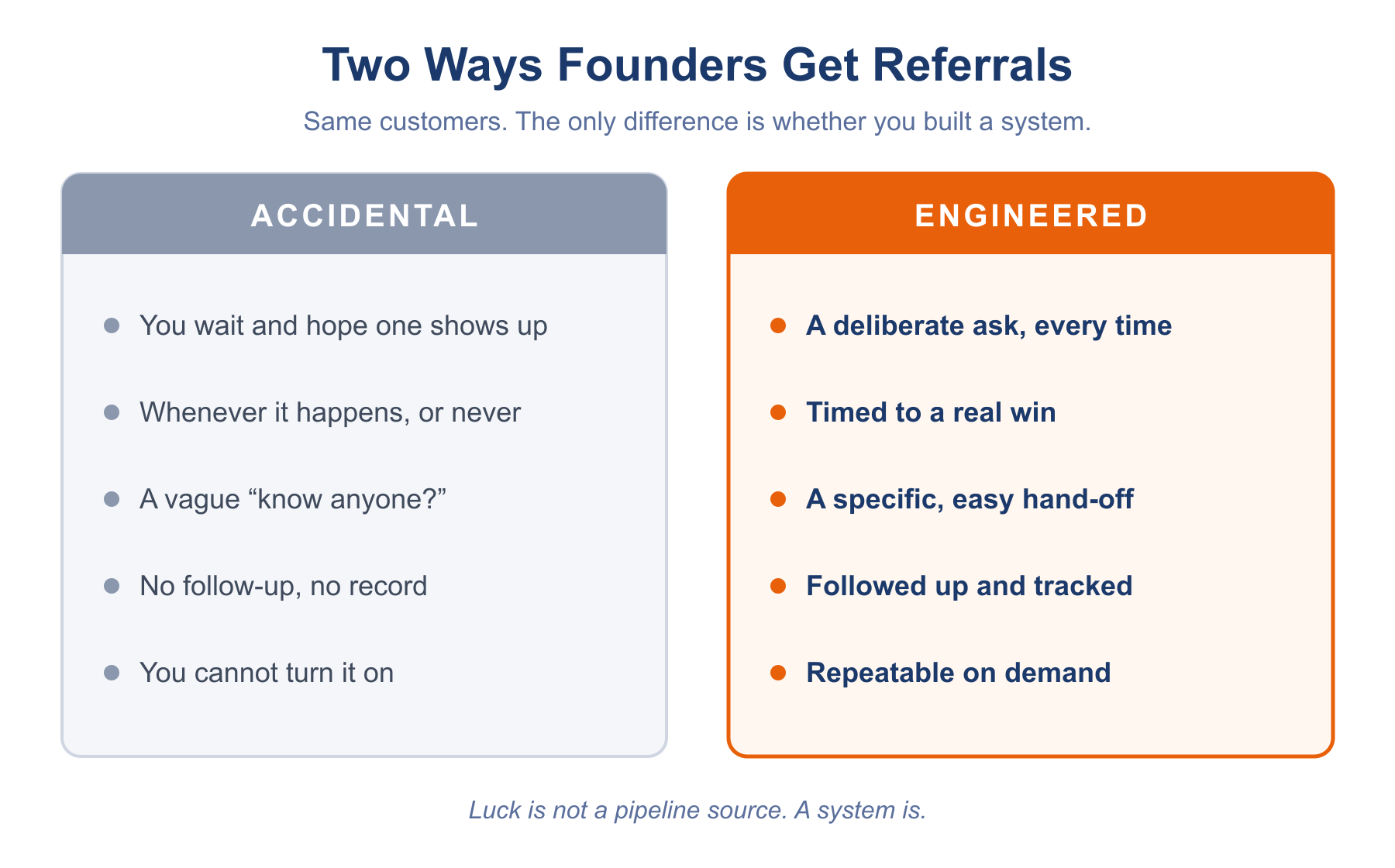
I have been in sales for over 50 years, and this is the pattern I see in almost every founder I work with at $1M to $10M ARR. They love referrals. They will tell you referrals are how they got half their customers. And they have no system to produce a single one. They wait. They hope. When a referral shows up, they treat it like weather, something that happens to them, not something they made happen.
That is the gap. Your happiest customers would refer you. Most of them never do, and it is not because they do not like you. It is because you never asked, or you asked at a moment they were not thinking about it, or you asked in a way that gave them nothing to act on. The referral was there. You just never went and got it.
A referral engine is not a fancy program with rewards and portals. It is a habit. A deliberate ask, made at the right moment, in a way that is easy to say yes to, and written down so you can do it again. That is it. And it is the cheapest pipeline a founder will ever build.
“Referrals are not luck. Luck is what you call a system you never bothered to build.”
Let me show you the difference between the referrals you get by accident and the ones you can get on purpose. Then I will show you how to build the second kind.
Why Referrals Are the Best Pipeline a Founder Owns
Before you build the engine, you need to know why it is worth the effort. A referral is not just another lead. It arrives with things every other pipeline source has to earn from scratch. Understand what makes it different and you will stop treating it like a nice surprise and start treating it like the asset it is.
Trust arrives before you do
A cold prospect spends the first half of the call deciding whether to believe you. A referred prospect walks in already believing, because someone they trust vouched for you. That vouch does work no amount of your own marketing can. You did not tell them you are good. Their peer did. The whole trust-building phase, the part that makes cold selling slow and painful, is already done before you say a word.
The sale is shorter and the price holds
Referred deals move faster because the buyer is not shopping. They came to you on a recommendation, not off a list of five vendors. They are not running you against three competitors to shave the price. When trust is high and comparison is low, the deal closes sooner and the discount conversation mostly disappears. Your best margins live in your referral pipeline, and most founders never notice.
It is the cheapest pipeline you will build
Every other source costs. Ads cost money. Outbound costs a list and the hours to work it. Content costs months before it pays. A referral costs one well-timed question to a customer you already have. There is no cheaper lead in your business than the one a happy client hands you. That is exactly why leaving it to chance is such an expensive habit.
Why the Referrals You Get Are Accidental
If referrals are this good, why do you get so few? Not because your customers are ungrateful. In almost every case, the problem is on your side, and it comes down to three habits. Fix these and the same customers who never sent you anyone start sending you people.
You never actually ask
Most founders think a good product earns referrals on its own. It does not. Your customers are busy running their own companies. They are not sitting around thinking about who to send your way. They will refer you when it crosses their mind, and it rarely crosses their mind unless you put it there. The number one reason you do not get more referrals is the simplest one. You do not ask.
You ask at the wrong moment
Timing decides the answer. Ask a customer for a referral in a flat month, when nothing much has happened, and you get a polite "sure, I'll think about it." That is a no. Ask the same person the week after you delivered a result they can feel, and they will name two people on the spot. The referral was always in there. You just reached for it when their good feeling was low instead of high.
You ask in a way nobody can act on
"Do you know anyone who could use us?" is the worst referral question there is. It sounds easy, but it makes the customer do all the work. They have to scan their whole network, guess who fits, and figure out what to say. That is too much, so they say "I'll keep you in mind" and forget by lunch. A vague ask feels polite. It is actually a way to get nothing while feeling like you tried.
“A happy customer who never refers you is not a loyalty problem. It is a system problem. You never gave them an easy way to say yes.”
When to Ask So the Answer Is Yes
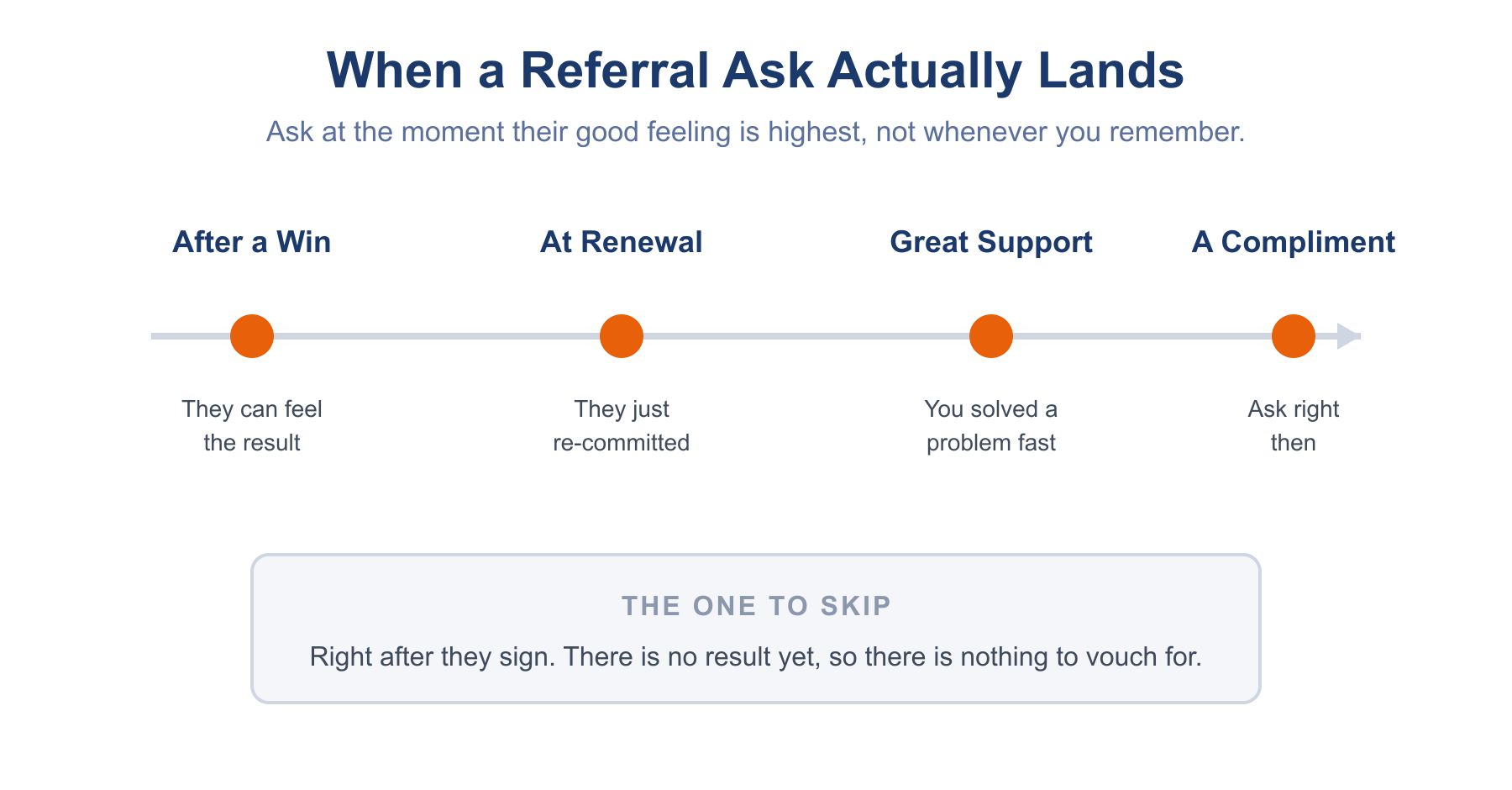
The single biggest lever on referrals is timing. You are not trying to trick anyone. You are asking when the customer is most aware of the value you brought, because that is when your name is easy to pass along. There are a few moments in every customer relationship when the good feeling peaks. Learn to spot them, and ask right then.
Right after a win they can feel
The best moment is when you have just delivered a result the customer can point to. They hit a number. You fixed the thing that was costing them. A project they care about landed. Right then, the value you bring is not a memory, it is fresh. That is when a customer says "you have to talk to my friend, she has the same problem." Watch for the win, and ask while it is still warm.
At renewal and after you save them
Renewal is a moment most founders waste. When a customer re-signs, they just told you with their wallet that you are worth it. That is the perfect time to ask who else should be getting this. The same goes for a great support moment. When you solve a problem fast and take stress off their plate, gratitude is high. Gratitude is the fuel a referral runs on. Ask while the tank is full.
The one moment to skip
Do not ask the day they sign. It feels natural, but it is too early. They have not seen a result yet. They bought on a promise, not a proof, so they have nothing real to vouch for. Ask now and the referral is weak, because your customer is really just repeating your pitch. Wait until you have delivered something they felt. A referral built on a result carries weight. One built on a hope does not.
“Ask when their good feeling is highest, not whenever you happen to remember. Timing is most of the yes.”
How to Ask So You Actually Get One
Good timing gets you halfway. The other half is the ask itself. Most founders make it hard by accident, then wonder why nothing comes back. The goal is to take all the work off the customer's plate. Do that and a yes becomes the easy answer instead of a chore.
Be specific, not general
Do not ask if they know "anyone." Ask for exactly who you want. "Who do you know running sales at a Series B software company, still doing most of the selling themselves?" Now the customer is not searching their whole network. They are matching one clear picture, and a name pops up. The narrower and more specific the ask, the easier it is to answer. Give them a target, not a blank page.
Make the hand-off effortless
Once they name someone, do not leave them to figure out the intro. Offer to write it for them. Send a short, forwardable note they can pass along with one line of their own. Two sentences on who you are and why you are reaching out, easy to forward, nothing for them to compose. The less work the ask takes, the more often it happens. You are not being pushy. You are removing the friction between a willing customer and a warm introduction.
Close the loop and write it down
When a referral comes in, two things have to happen. Thank the person who sent it, and tell them how it went. A customer who hears "that intro turned into a great conversation, thank you" will send you more. The second thing is to log it. Where did it come from, who referred it, what stage is it in. If it isn't in the CRM, it never happened. The record is what turns a lucky streak into a source you can measure and trust.
Build it so you can hand it off
You will not chase every referral yourself forever. The point of a system is that it does not depend on you. Write down the moments to ask, the exact words that work, and the intro template. Systems before people. Once the motion is on paper and it works, a rep or a customer success hire can run it, asking at renewal and after every win without you in the room. A referral habit that lives only in your head is not an engine. It is one more thing that stops the day you get busy.
“Make the ask specific, make the intro effortless, and write down what worked. That is the whole engine.”
Frequently Asked Questions
Q: Doesn't asking for referrals make me look needy?
Only if you ask badly, at the wrong time, from a customer you have not helped yet. Ask a happy customer right after you delivered a real result, and it does not read as needy at all. It reads as confident. You are telling them you are ready to help more people like them. Good customers are usually glad to point you to a peer who is struggling with the same thing. Neediness comes from desperation. A well-timed ask from a position of proven value is the opposite of desperate.
Q: Should I pay customers for referrals?
Usually no, at least not at your stage. Most B2B founders find that a cash reward can actually cheapen the gesture, turning a genuine recommendation into a transaction. Your customers refer you because you helped them and they trust you, not for a check. What works better is closing the loop well, thanking them, and telling them the outcome. If you want to give back, a thoughtful thank-you or a credit on their account is plenty. Save the formal reward program for later, when volume justifies the machinery.
Q: What if I ask and they say they can't think of anyone?
That usually means your ask was too broad. "Know anyone?" gets a blank stare. Come back with a specific picture. Name the exact type of company, role, and problem you help with. Often the customer says "oh, in that case, yes, you should talk to so-and-so." If they still cannot name someone, no harm done. Thank them, and ask again in a few months after the next win. A no today is not a no forever. It is often just a sign the moment or the ask was not sharp enough.
Q: How often can I ask the same customer?
More than once, as long as you tie each ask to a real moment and never turn it into nagging. A good rhythm is to ask after a clear win, again at renewal, and again after any standout support moment. That could be two or three times a year for an active, happy account. The key is that every ask is anchored to something that just went well, so it never feels like you are pestering them. If you are only asking when something good happened, you will not wear out your welcome.
Q: Can this really be handed off, or does it only work when the founder asks?
It can be handed off, and it should be. The reason it feels founder-only is that most founders never write it down. Once you document the moments to ask, the exact wording, and the intro template, a rep or a customer success person can run the same motion. Systems before people. The relationship warmth helps, but the mechanics do the heavy lifting, and the mechanics travel. A referral engine that only works when you personally ask is not an engine yet. It is a habit you have not turned into a system.
Q: How do I know if my referral engine is actually working?
You track it, the same way you track any other pipeline source. Log every referral, who sent it, when you asked, and whether it closed. After a few months you will see the pattern. Which customers refer, which moments produce the best intros, and what a referred deal is worth compared to a cold one. If it isn't in the CRM, it never happened, and you are back to guessing. The record is what tells you the engine runs, instead of hoping it does.
Your happiest customers are pipeline. Let's put them to work.
You already have customers who would refer you. Let's spend 30 minutes building the asks, the timing, and the tracking that turn word of mouth into a source you can count on.
Schedule a 30-Minute CallAbout the Author
Louie Bernstein
Fractional Sales Leader with 50 years of sales experience helping $1M–$10M ARR companies build scalable, repeatable sales systems. Founder of MindIQ (INC 500). LinkedIn Top Voice in Sales Management, Sales Operations, and Sales Coaching.