Key Takeaways:
- The knowledge you use to close deals is your cheapest pipeline source. You already paid for it. Most founders never spend it twice.
- Inbound is not a personality contest. It is your expertise, written down where the right buyers can find it before they are ready to talk.
- You do not need to be a writer. You need to answer, in public, the same questions you answer on every sales call.
- A realistic cadence beats a heroic one. Three hours a week you keep will out-produce a content plan you abandon in a month.
- Inbound is slow to start and hard to stop. Outbound goes quiet the day you stop sending. Published expertise keeps working while you sleep.
- Track where inbound conversations come from, or you cannot tell what content is worth your time.
You get on a sales call and the prospect already trusts you. They have read something you wrote. They quote a point back to you. They are not asking whether you know the problem. They are asking when you can start. That call is easier, faster, and closes at a higher price than any cold lead you chased. And it cost you almost nothing to create.
That is inbound, and it is the most underused pipeline source a founder owns. I have been in sales for over 50 years, and the founders I work with at $1M to $10M ARR almost all have the same blind spot. They are sitting on decades of hard-won knowledge, the kind buyers pay for, and they treat it like it only exists to be spent one call at a time.
Here is what I mean. Every week you explain the same things. Why the cheap option costs more later. What separates a real solution from a demo. The mistake buyers make right before they call you. You say these things to one person, that person buys or does not, and the knowledge evaporates. You paid for it once and spent it once.
Published in public, that same answer works for years. It reaches people who are not ready to buy yet, the ones who will be ready in six months, the ones who will send you a referral. It does the first half of the sales call before the call ever happens. That is not marketing fluff. That is your expertise, doing the job it already does, at scale.
“You already paid for the knowledge. Inbound is just the decision to spend it more than once.”
This is not about becoming an influencer. It is about turning what is already in your head into a system that brings the right buyers to you. Here is how that actually works.
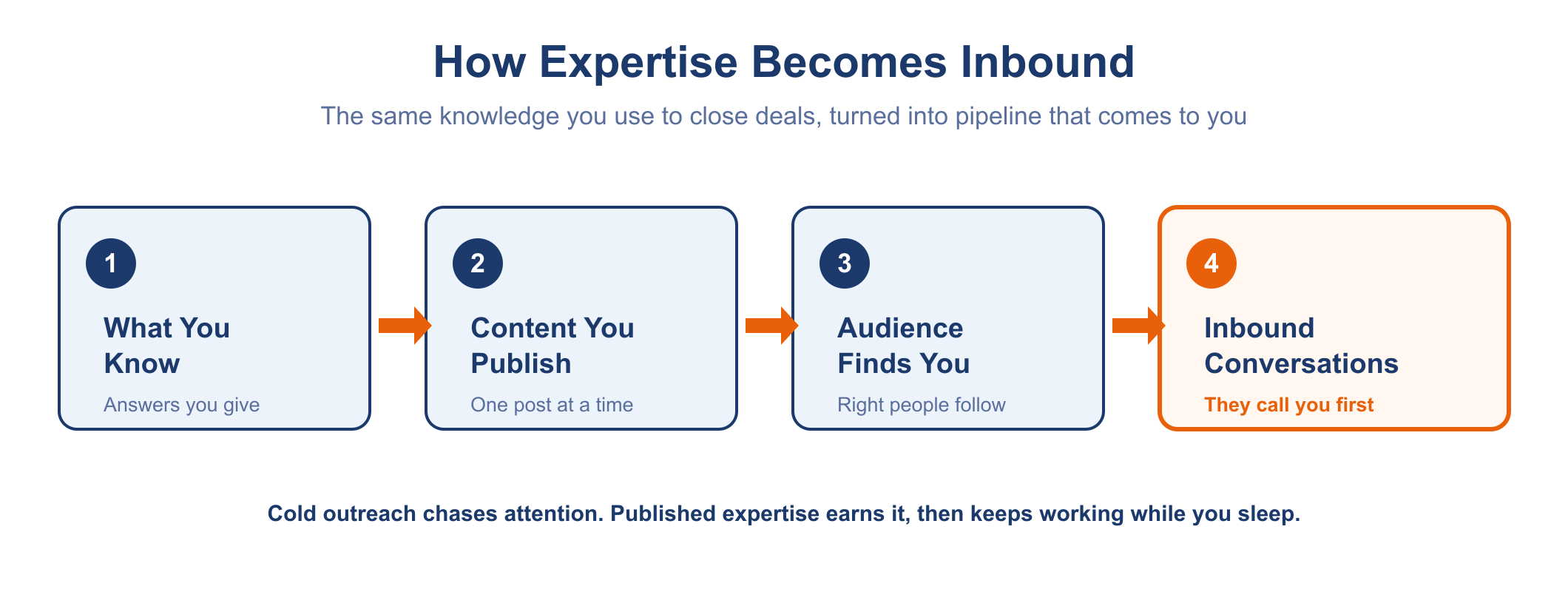
Why Your Expertise Is the Cheapest, Most Earned, Pipeline You Have
Every pipeline source has a cost. Ads cost money. Outbound costs time and a list you have to build and rebuild. Referrals cost you nothing but you cannot turn them on when you need them. Your expertise is different. The expensive part, learning the thing, is already done. All that is left is writing it down. That is the cheapest pipeline you will ever build, and it is the one most founders skip.
Buyers decide before they call you
By the time a prospect books a call, they have already done most of their research. They have read, watched, and asked around. They have a shortlist, and often a favorite, before they ever talk to a salesperson. If your expertise is nowhere they looked, you are not on that list. Inbound is how you get into the research phase, where the real decision happens, instead of showing up after it is over. This is why buyers pick a favorite before they call you, and it is the whole reason to publish.
Trust arrives before you do
A cold prospect spends the first half of the call deciding whether to trust you. An inbound prospect already has. They found you, read you, and reached out anyway. That is a different conversation. You are not proving you understand the problem. You proved that in the post they read last month. Now you are talking about their situation and what to do about it. The sale is shorter because the trust was built before the meeting.
It compounds instead of resetting
Outbound resets every morning. Stop sending and the pipeline goes quiet the same day. Content does the opposite. A post you wrote in March gets found in September. Ten posts pull harder than one. A year of them becomes a body of work that keeps producing conversations with no new effort. Outbound is a faucet you hold open. Inbound is a well you dig once. You want both, but only one of them keeps working while you sleep.
What to Publish When You Are Not a Writer
The most common reason founders never start is that they think content means writing, and they do not think of themselves as writers. Good news. Nobody wants your writing. They want your answers. You do not need to be clever. You need to be useful, and you already are, several times a week, on the phone.
Mine your own sales calls
The best content you will ever publish is already coming out of your mouth. Every question a prospect asks is a post. Every objection you handle is a post. Every time you explain why the obvious choice is the wrong one, that is a post. Keep a running note. After each call, write down the one thing you had to explain. In a month you will have twenty ideas and never face a blank page again.
Answer the question, do not sell
The instinct is to end every post with a pitch. Resist it. The post that earns trust is the one that helps whether or not the reader ever buys from you. Give away the answer. Tell them how you would solve it, even the part they could do without you. That generosity is the point. A reader who got real value from you once assumes there is more where that came from, and that is who calls you.
“Nobody wants your writing. They want your answers. You give them away all week for free on the phone. Write them down.”
Write to one person, not an audience
The moment you try to write for everyone, your voice goes flat and corporate. So do not. Picture the last good prospect you talked to and write the post to them. Use the words they used. Name the problem the way they named it. Content that sounds like a real person helping one real person beats a polished article every time, because it reads like the conversation your buyers already wish they were having.
How to Start Without Blowing Up Your Week
Here is where most founder content dies. Not from a lack of ideas, but from a plan that was never survivable. You decide to post every day, keep it up for two weeks, fall behind, feel guilty, and quit. The fix is not more discipline. It is a smaller plan you can actually keep. Systems before people, and in this case, systems before ambition.
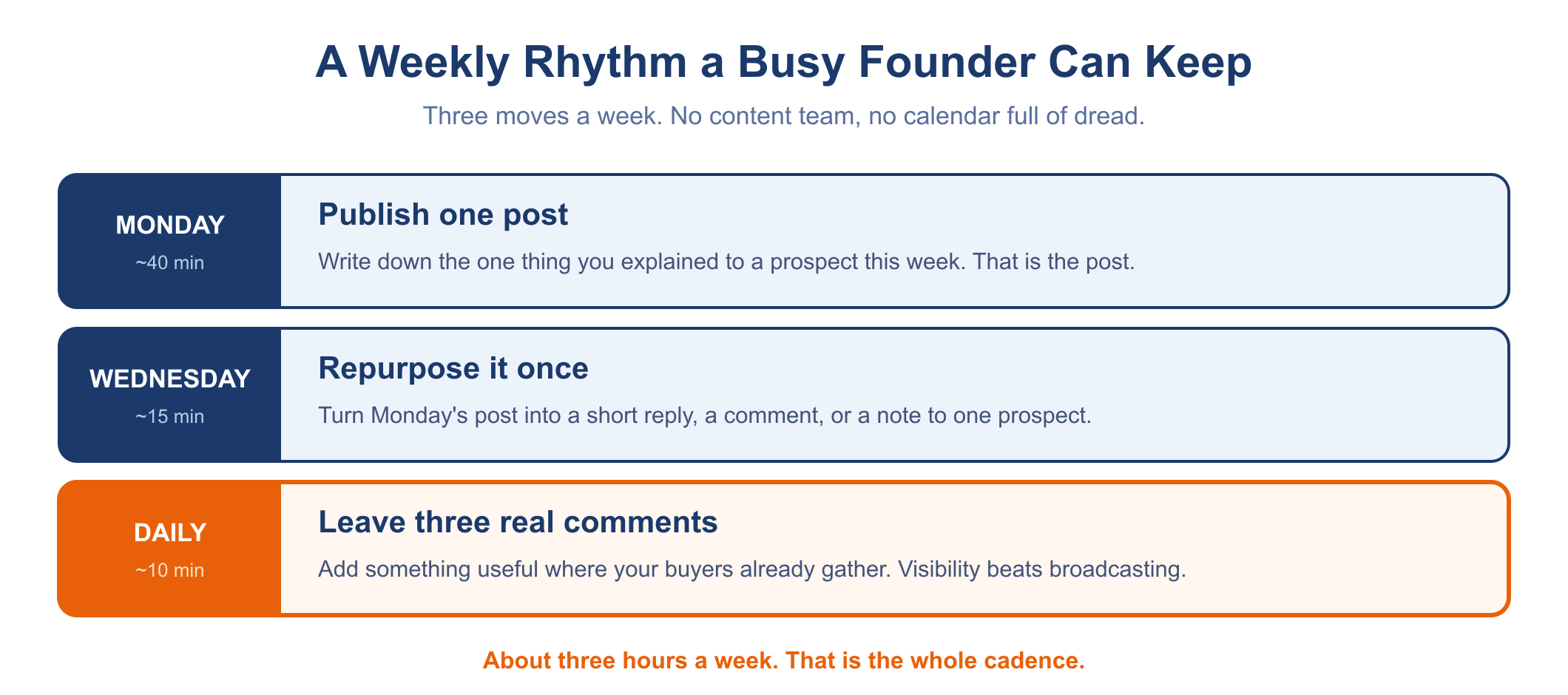
One post a week, not one a day
Start with one post a week. That is it. Take one idea from your sales-call notes and write it up in forty minutes. One good post a week is fifty a year, which is more expertise than most of your competitors will ever publish. Consistency you can sustain beats a burst you cannot. The founder who posts once a week for a year wins against the one who posts daily for three weeks and stops.
Repurpose before you create more
You do not need more ideas. You need to use each one more than once. Monday's post becomes a comment on someone else's thread. It becomes a short note to a prospect who has that exact problem. It becomes a talking point in your next call. One idea, worked three ways, does the job of three ideas at a third of the effort. Creating from scratch every time is the fast road to burnout.
Be visible where broadcasting is not enough
Posting is only half of it. The other half is showing up in the comments where your buyers already gather. Ten minutes a day leaving something useful on other people's posts builds more relationships than an hour shouting into your own feed. Visibility beats broadcasting. People trust the person who is helpful in the room, not the one giving out never-done-it-myself advice.
“Three hours a week you keep beats ten hours a week you quit. Pick a cadence you can defend on your worst week.”
Turning Readers Into Conversations
Content that nobody acts on is a hobby, not a pipeline source. The last step is turning the people who find you into conversations you can track and close. This is where founders either build a real motion or let good attention leak away. It does not take much, but it takes intent.
Give a reason to reach out
Most readers will never comment or message you on their own, even the ones who need you. So give them an easy next step. A specific offer to answer a question. A short guide they can ask for. A simple line at the end of a post that says who it is for and what to do. You are not being pushy. You are removing the friction between a reader who trusts you and a conversation that helps you both.
Track where inbound comes from
When someone reaches out, write down how they found you and what they had read. If it isn't in the CRM, it never happened. Do this for a few months and the pattern shows up. Certain posts pull. Certain topics bring buyers, others bring browsers. That is how you learn what to write more of, and how you prove to yourself that the three hours a week are paying for themselves. Without the record, you are guessing.
Build the motion so you can hand it off
You will not do this forever. The goal is a repeatable motion, not a personal hobby that dies the day you get busy. Prove it works with your own expertise first. Document what to publish, where, and how often, and which topics convert. Then a hire can run the engine while you feed it the expert answers only you can give. Systems before people. A content motion you can hand off is an asset. One that lives only in your head is a liability waiting for your next busy month.
Frequently Asked Questions
Q: I am not a writer. Can this still work for me?
Yes, because this is not writing in the way you are dreading it. It is answering. You already explain your expertise several times a week on sales calls in plain, clear language. Publishing is taking one of those answers and typing it out instead of saying it. Do not try to sound like an author. Sound like you sound on a good call. The founders who win at this are not the best writers. They are the most useful, and you are already useful.
Q: How long before inbound actually produces leads?
Longer than you want and sooner than you fear. The compounding takes months, so do not expect a flood in week three. But the first conversations often come faster, because your existing network sees you show up with something useful and remembers you have a problem to solve for them. Treat the first ninety days as building the well, not drawing from it. If you quit at week six because it is slow, you never reach the part where it pays. I posted for five months with nothing coming in. Then, in one week three requests came in and I took accepted two contracts.
Q: Won't I give away the answers people should pay me for?
This worry stops more founders than any other, and it is backward. Buyers do not pay you for the answer. They pay you to implement it, to do it faster, and to avoid the mistakes they would make alone. Giving away the what proves you own the how. The reader who tries it themselves and gets stuck calls you. The one who reads it and knows they do not want to do it alone calls you sooner. Generosity is the proof of expertise, not the loss of it.
Q: Where should I publish? Do I need a blog?
Start where your buyers already are, which for most B2B founders is LinkedIn. It needs no setup, and the audience is already there. A blog on your site is worth building over time because you own it and it helps you get found in search, but it is the second step, not the first. Do not let the question of where stall you for a month. Post the answer where your buyers scroll, then repost it on your site later. One place done beats five places planned.
Q: How is this different from outbound?
Outbound is you reaching out to buyers. Inbound is buyers reaching out to you. Outbound works the day you do it and stops the day you stop. Inbound is slow to start and hard to kill, because published expertise keeps getting found long after you wrote it. They are not rivals. Outbound fills the pipeline now while inbound builds the well that fills it later. A founder who does only outbound is always starting from zero. One who adds inbound is building something that carries its own weight.
Q: I tried posting and nothing happened. What went wrong?
Usually one of three things. You quit too early, before the months of consistency that make it work. You wrote for everyone, so it read like a brochure instead of a real answer. Or you posted and vanished, never showing up in the comments where relationships get built. Pick one narrow topic you know cold, write to one specific buyer, post once a week without fail, and spend ten minutes a day being useful on other people's posts. Do that for a quarter before you decide it does not work.
Your expertise is pipeline. Let's put it to work.
You already have the knowledge that closes deals. Let's spend 30 minutes turning it into a content motion that brings the right buyers to you, and one you can eventually hand off.
Schedule a 30-Minute CallAbout the Author
Louie Bernstein
Fractional Sales Leader with 50 years of sales experience helping $1M–$10M ARR companies build scalable, repeatable sales systems. Founder of MindIQ (INC 500). LinkedIn Top Voice in Sales Management, Sales Operations, and Sales Coaching.