Key Takeaways:
- 95% of the time, the winning vendor was already on the buyer's Day-One shortlist (6sense). The decision set forms before you know the buyer exists.
- The vendor a buyer prefers before talking to sales goes on to win 80% of deals (6sense). By the time your phone rings, you're usually being confirmed, not chosen.
- Buyers now do the deciding themselves: 94% research with generative AI (Forrester) and 60% use AI to build their vendor list (Google). They spend just 17% of buying time with any supplier (Gartner).
- Your real job moved upstream. Winning now means getting into the consideration set early, being findable and legible to both humans and AI, long before the demo.
- The founder is still the best closer and the best source of the point of view that gets you named. But you can't build the upstream engine and close every deal alone. That's the gap a Fractional Sales Leader fills.
Here's a number that should stop you cold. 95% of the time, the vendor who wins a B2B deal was already on the buyer's shortlist on Day One of their buying journey (6sense). Not added late after a great demo. There from the very start.
And it gets worse for the way most founders still sell. The vendor a buyer prefers before they ever speak to a salesperson goes on to win the deal 80% of the time (6sense). By the time your phone rings, the race is mostly run. You're not competing. You're being confirmed, or you're being used to make someone else's choice look reasonable.
If you're a founder between $1M and $10M in ARR and you're still running sales yourself, this changes where your job actually is. The deal isn't won in the demo anymore. It's won weeks earlier, in a room you're not in, by a buyer talking to peers, reading, and increasingly, asking an AI who the best options are. Let me show you what's really happening, and exactly what to do about it.
The Shortlist Now Forms Before You Know the Buyer Exists
Your buyer starts educating themselves long before they'd ever fill out your contact form. And they've got new tools for it. 94% of B2B buyers now use generative AI in their research (Forrester), up from 89% the year before, and 60% use those tools specifically to build or augment their vendor list (Google). They ask ChatGPT or Perplexity "who are the best vendors for a company like mine," they read reviews, and they ask peers in a Slack group. Then they draw up a list.
On Day One of a buying journey, buyers already evaluate about 5.1 vendors and fill roughly 3.6 spots on their shortlist (6sense). Read that again. The shortlist isn't the finish line of their research. It's the starting line. It's assembled early, from whatever the buyer can find and whoever their sources name, and then the rest of the process is mostly narrowing that list down.
Which means your first "contact" is never actually first contact. The buyer has already met a version of you, stitched together from your website, your content, third-party reviews, and whatever an AI model happens to say about you when asked. You didn't get a vote on that version. It got built without you. And it either earned you a spot on the list or it didn't.
70–80% of the Decision Happens Before First Contact
Gartner's research is blunt about how little of the journey you actually get. B2B buyers spend just 17% of their total buying time meeting with potential suppliers, and when they're comparing several vendors, that drops to 5% or 6% with any one sales rep (Gartner). Put the other way around: roughly 80% of the buying journey now happens with no salesperson in the room at all.
6sense found the same thing from the buyer's side. Buyers don't engage a seller until they're about two-thirds of the way through their journey. By the time they raise a hand, they've already set their requirements and ranked their shortlist in order of preference. The conversation you think of as "the start of the sale" is, for them, closer to the end of the decision.
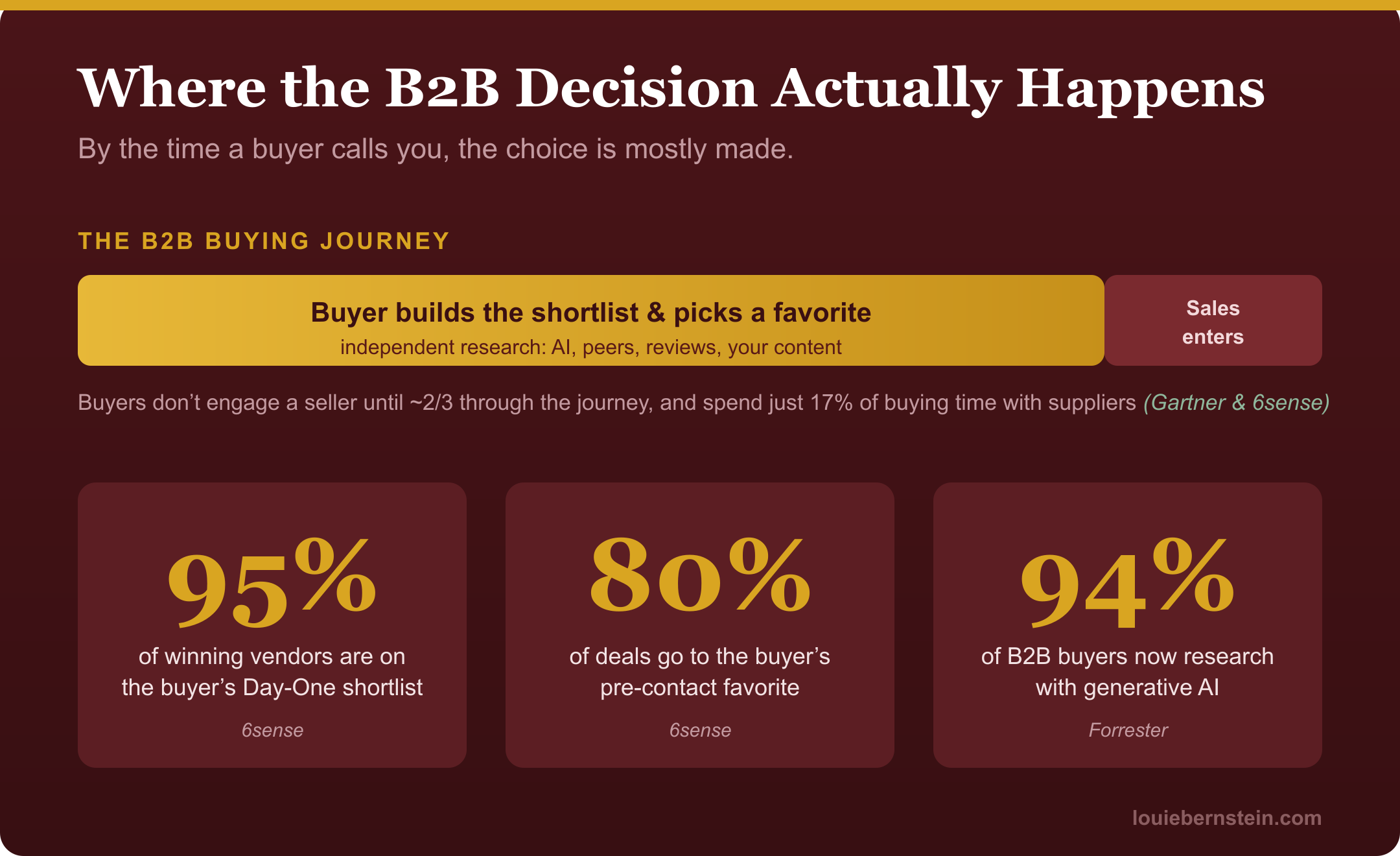
So here's the trap. The founder who believes selling starts at the demo is showing up for the last 20% of a decision that's already 80% made. You can run the best discovery call of your life and still be too late, because you're trying to win a race that was decided before you knew it had started.
Why the Day-One Favorite Wins Almost Every Time
Why does the pre-contact favorite win 80% of the time? Because a first-formed preference becomes the reference point, and every other vendor gets judged against it. The buyer isn't shopping with an open mind at that point. They're looking to confirm they were right about the option they already liked. You're not the story. You're the comparison that makes the favorite look good.
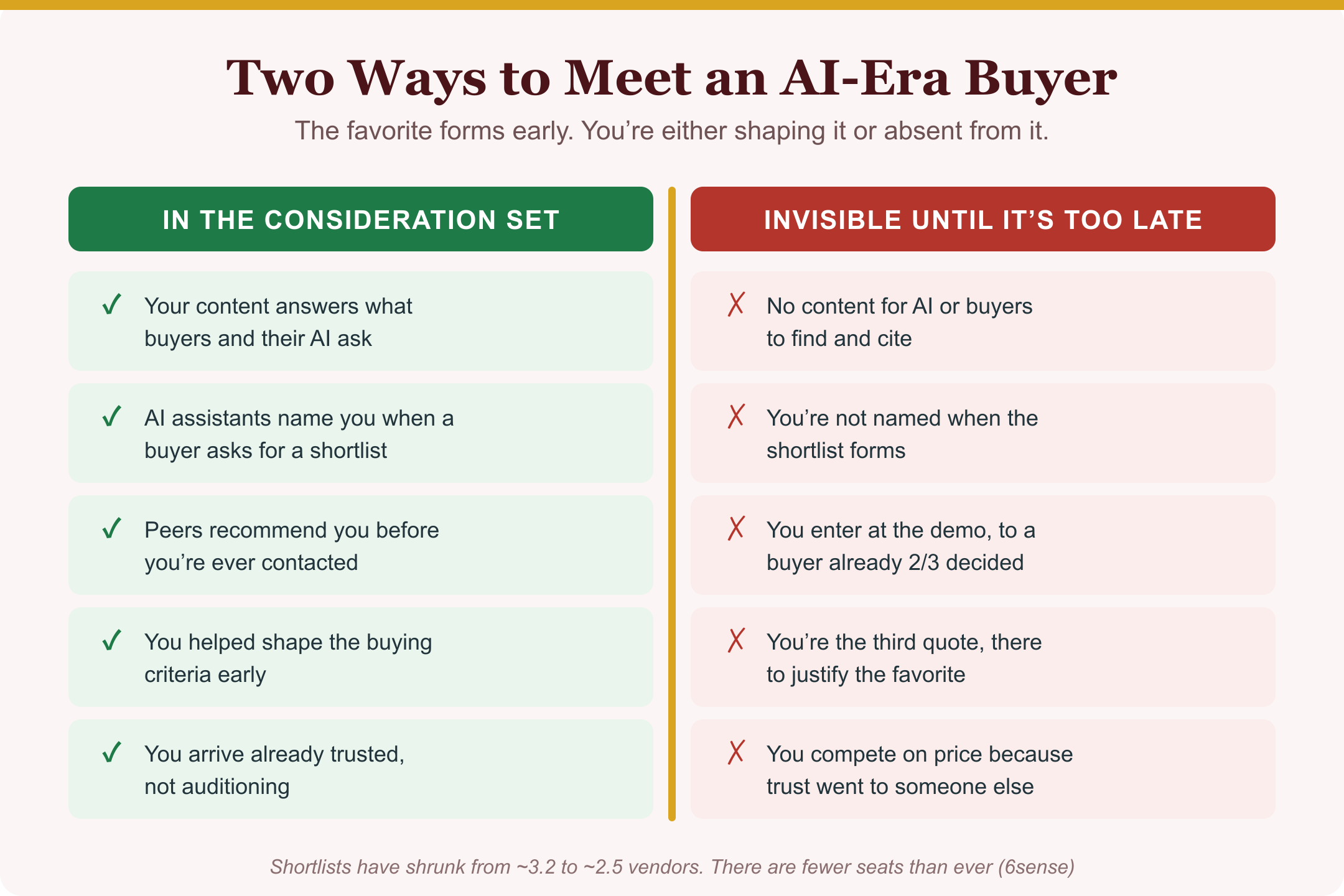
It's getting harder, not easier. The average final shortlist has shrunk from about 3.2 vendors a few years ago to roughly 2.5 today (6sense). Fewer seats, more competition for each one. If you're not the favorite, there's a real chance you're what salespeople call column fodder: invited into the process to make the buyer's preferred choice look justified. You do the work, you sharpen their questions, and then you lose to the vendor they'd picked before you ever spoke.
"By the time a buyer agrees to a call, you're not auditioning for the part. You're confirming a casting decision that's mostly already made."
What This Means for a Founder Still Selling the Old Way
The old founder motion was simple. Wait for the lead, run a great demo, out-charm the competition, close. That worked when the demo was where a buyer actually learned about you. It isn't anymore. The learning now happens upstream, without you, and the demo just confirms what the buyer already decided.
So your real job moved upstream too. Winning now means getting into the consideration set before the buyer is even a buyer. That means being findable and legible, to both humans and the AI tools they now lean on. It means content that answers the specific questions buyers ask at each stage, not a feature list. It means third-party proof, reviews and case studies an AI and a human can both cite. And it means one clear, repeatable point of view on the problem you solve, so you're the name that comes up.
This isn't "go do more marketing." It's making sure the version of you a buyer meets before they meet you is accurate, specific, and hard to ignore. The same things that make you legible to a model, clear answers to real questions, make you more persuasive to the human on the other side. I broke down the seller's side of this shift in how a founder should actually use AI in sales.
The Uncomfortable Question: Are You Even in the Consideration Set?
Stop guessing and go check. Here's a five-minute audit you can run today, before you spend another dollar on outbound:
- Ask the AI your buyer would ask. Open ChatGPT or Perplexity and type the real question: "best [your category] for [your ideal customer]." Are you named? If not, you're invisible at the exact moment shortlists form.
- Read your own site as a buyer. Does it answer the specific questions a buyer asks at each stage, or is it a wall of features? Buyers and models both reward clear answers, not adjectives.
- Count your third-party proof. Reviews, case studies, named results. If an AI can't find anything credible to cite about you, it won't recommend you.
- State your point of view in one sentence. If you can't, neither can a buyer explaining to their boss why they picked you.
- Ask your last five closed-won buyers how they first heard of you. The pattern tells you where the set actually forms for your market.
If the honest answer is "we're not really showing up," that is not a sales problem you can charm your way out of at the demo. It's an upstream problem, and no amount of closing skill fixes it downstream. The good news: it's fixable, and most of your competitors haven't figured it out yet.
Where This Leaves Founder-Led Sales at $1M–$10M
Don't read any of this as "the founder doesn't matter anymore." The opposite is true. You're still the best closer in the building, and you're also the single best source of the point of view that gets you named in the first place. Your take on the problem, the thing you understand that your competitors don't, is the raw material for everything upstream. No one can manufacture that but you.
The problem is capacity, not ability. You can't build the content engine, fix the pipeline and forecast, and close every deal at the same time. Something breaks, and it's almost always the upstream work, because closing is urgent and being-found is important but never urgent. That's exactly the gap a Fractional Sales Leader fills: installing the system that gets you into the consideration set and moves an already-informed buyer to a decision, without the cost or risk of a $400K VP of Sales. If unpredictable pipeline is already the symptom you feel most, I wrote a full playbook on fixing unpredictable revenue and pipeline visibility.
One honest caveat, because it matters. If you don't yet have a defined ideal customer, a repeatable motion, and real proof that your product wins, getting "AI-legible" won't save you. You'll just get found faster for something that doesn't work yet. If that's you, go close more deals yourself first, learn the pattern, then systematize it. But if you're a founder between $1M and $10M in ARR, you almost certainly have a motion worth making visible. The buyers have already changed how they decide. The only question is whether you're in the room where it happens.
Related Reading
Frequently Asked Questions
Q: Do B2B buyers really decide before they contact a salesperson?
Largely, yes. 95% of the time the winning vendor was already on the buyer's Day-One shortlist, and the vendor buyers prefer before ever engaging sales goes on to win about 80% of deals (6sense). Buyers spend only 17% of their buying time meeting with suppliers (Gartner) and don't engage a seller until roughly two-thirds through their journey. The decision isn't made in your demo. It's mostly made before your demo, which is why getting into the consideration set early matters more than closing skill.
Q: How do buyers use AI like ChatGPT to build a vendor shortlist?
They ask it directly. 94% of B2B buyers now use generative AI in their research (Forrester), and 60% use these tools to build or augment their vendor list (Google). A buyer types "best [category] for a company like mine," gets a handful of named vendors, and that becomes the starting shortlist. If your content and third-party proof don't give the model something credible to cite, you won't be named, and you won't make the list you never saw being written.
Q: How do I get my company onto the Day-One shortlist?
Be findable and legible before the buyer is a buyer. That means content that answers the real questions buyers ask at each stage instead of listing features, third-party proof an AI and a human can both cite, and one clear point of view on the problem you solve so you're the name that comes up. The average shortlist has shrunk to about 2.5 vendors (6sense), so there are fewer seats than ever. You earn one by being useful upstream, not by having the best demo downstream.
Q: If the decision is made early, is founder-led selling pointless now?
No. It's more valuable, just earlier. The human conversation still decides the deal at the end, and a nervous buyer needs trust and judgment that no AI provides. More than that, the founder is the best source of the point of view that gets you named in the first place. The shift isn't "stop selling." It's move your selling upstream, so you're shaping the buyer's criteria while they're forming their shortlist, not showing up after it's set.
Q: How do I know if I'm already in the consideration set?
Run a quick audit. Ask ChatGPT or Perplexity the exact question your buyer would ask and see if you're named. Read your own site as a buyer and check whether it answers real questions or just lists features. Count your credible third-party proof. And ask your last five closed-won customers how they first heard of you. If you're not showing up where the set forms, that's an upstream problem no amount of demo polish will fix.
Q: I'm early with no real sales system. Should I worry about this yet?
Be honest with yourself first. If you don't yet have a defined ideal customer, a repeatable winning motion, and proof your product delivers, becoming "AI-legible" won't help. You'll just get found faster for something that isn't working. Go close more deals yourself, learn the pattern, then systematize it. But once you're between $1M and $10M in ARR with a motion that works, making it visible upstream is one of the highest-leverage moves you can make, and it's exactly the kind of system a Fractional Sales Leader installs.
Want to be the favorite before the buyer ever calls?
If you're a founder between $1M and $10M in ARR, I'll help you build the system that gets you into the consideration set early and moves an already-informed buyer to a decision, without a $400K VP of Sales. See how it works at louiebernstein.com.
Schedule a 30-Minute CallAbout the Author
Louie Bernstein
Fractional Sales Leader with 50 years of sales experience helping $1M–$10M ARR companies build scalable, repeatable sales systems. Founder of MindIQ (INC 500). LinkedIn Top Voice in Sales Management, Sales Operations, and Sales Coaching.