Key Takeaways:
- Don't start with the tool. Start with your bottleneck. AI is only valuable where it removes a real constraint on selling.
- The high-ROI zone is the repetitive 70% of a rep's time that isn't selling (Salesforce): research, follow-up drafts, CRM hygiene, and summaries. That's where AI pays for itself immediately.
- The danger zone is the conversations that decide deals, discovery, negotiation, and the close. Hand those to AI and you erode the trust that actually wins business.
- Protect pipeline quality: keep a human reviewing AI output, and never let automated volume replace real qualification. Fast garbage is still garbage.
- One rule cuts through every decision: automate the repetitive, own the judgment. If a task turns on a human's buying decision, a human owns it.
- Before you add a single AI tool, fix the fundamentals: a defined ICP, a documented playbook, and an enforced process. AI multiplies what's there. Make sure something's there.
The first two questions founders ask me about AI are "will it replace my reps" and "can I just buy tools instead of a leader." I've answered both. This one is the practical follow-up they ask once they're convinced: "Okay, Louie, I get it. So what should I actually do with AI right now, this quarter, without blowing up my pipeline?"
Good. That's the right question, and it deserves a real answer, not hype. AI is genuinely useful in sales today. Salesforce found teams using it are 1.3x more likely to grow revenue (Salesforce), and McKinsey pegs the productivity opportunity across marketing and sales at $0.8 to $1.2 trillion (McKinsey). The upside is real. But so is the downside if you aim it wrong.
So here's the practical playbook I give my clients. Where AI earns its keep, where it quietly does damage, and the one simple rule that keeps you on the right side of the line every time.
Start With the Bottleneck, Not the Tool
Most founders do AI backwards. They see a slick demo, buy the tool, and then go looking for a problem it can solve. That's how you end up with a stack of subscriptions and no measurable change in revenue. Start the other way around. Ask: where is my sales function actually stuck?
Maybe your reps are drowning in research and never get to enough conversations. Maybe follow-up is inconsistent and deals go cold. Maybe your CRM is a mess so your forecast is fiction. Maybe you personally are the bottleneck, still writing every proposal at midnight. Name the constraint first. Then, and only then, ask whether AI is the right tool to relieve it. Sometimes it is. Sometimes the answer is a process fix or a hire, and no tool will help.
This is the same discipline I bring as a Fractional Sales Leader: diagnose before you prescribe. AI applied to your real bottleneck is leverage. AI applied to a problem you don't actually have is just an expensive distraction.
The High-ROI Zone: Research, Follow-Up, CRM Hygiene, and Drafting
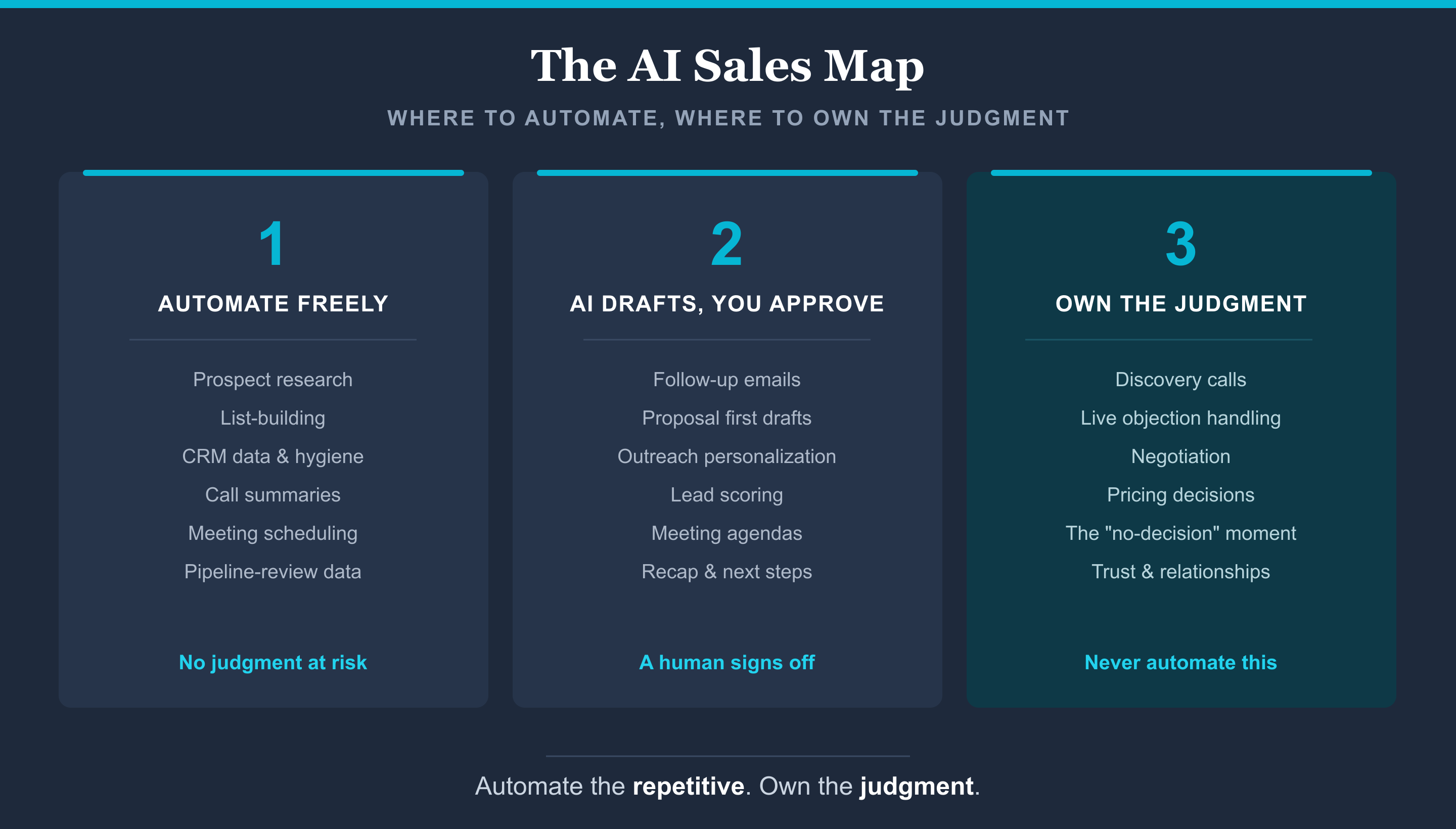
Here's where AI pays for itself fast, and where I want you to start. It's the repetitive, low-judgment work that eats the 70% of selling time that isn't selling (Salesforce). Hand this to AI today and your team gets hours back this week.
Account and prospect research that used to take twenty minutes now takes twenty seconds. CRM hygiene, logging activity, updating fields, cleaning duplicates, runs in the background instead of being the thing reps "forget" to do. Follow-up emails and proposal first drafts get written in seconds, so nothing falls through the cracks. Call summaries and next steps are captured automatically. None of this requires judgment about a specific deal, which is exactly why it's safe to automate. A human still reviews the output before it goes out, but the grunt work is gone.
"Start AI where it's boring. Research, hygiene, and drafts are pure upside and almost zero risk."
The Danger Zone: Handing AI the Conversations That Decide Deals
Now the part where founders get hurt. There's a growing temptation to let AI run the actual selling, AI voice agents doing discovery, AI chat closing deals, fully automated "conversations" with buyers. At your price point and complexity, don't. This is the danger zone, and crossing into it costs you the deals that matter most.
Remember the number from The JOLT Effect: 40% to 60% of qualified deals die from "no decision," the buyer's own fear of getting it wrong (Dixon & McKenna). Getting a nervous buyer over that fear takes empathy, credibility, and real-time judgment, reading the hesitation, addressing the unspoken worry, building enough trust that they'll commit. An AI can't do that, and when a buyer senses they're being handled by a bot on a decision this big, you don't look efficient. You look like you don't care enough to show up. Gartner found buyers already spend only about 17% of their time meeting with suppliers (Gartner). The little human time you get is precious. Don't automate it away.
Discovery, negotiation, objection handling in the moment, pricing conversations, the close, these are the high-judgment core of the job. This is the same line I drew in will AI replace my salespeople: AI takes the low-judgment half, humans own the half that closes. Cross that line and AI stops helping your pipeline and starts hollowing it out.
How to Keep AI From Eroding Your Pipeline Quality
Even in the safe zone, AI can quietly degrade your pipeline if you're not careful, and the failure mode is always the same: volume without quality. AI makes it trivial to send more outreach, generate more "leads," and book more meetings. But more isn't better if the meetings are with the wrong people or the leads were never qualified. You just fill your calendar and your CRM with noise, and your reps waste their scarce selling time on deals that were never real.
Two guardrails keep quality intact. First, keep a human in the loop on anything that reaches a buyer or affects a forecast. AI drafts; a person approves. That single habit catches the confident-but-wrong output before it does damage. Second, never let automated volume substitute for real qualification. An AI-booked meeting still has to clear your qualification bar before it counts as pipeline. Hold the standard. The goal of AI isn't more activity, it's more of your team's time spent on the right conversations. Measure it that way, or the tools will happily optimize for the wrong thing.
"AI makes it easy to do more. The whole discipline is making sure 'more' still means 'the right deals.'"
A Simple Rule: Automate the Repetitive, Own the Judgment
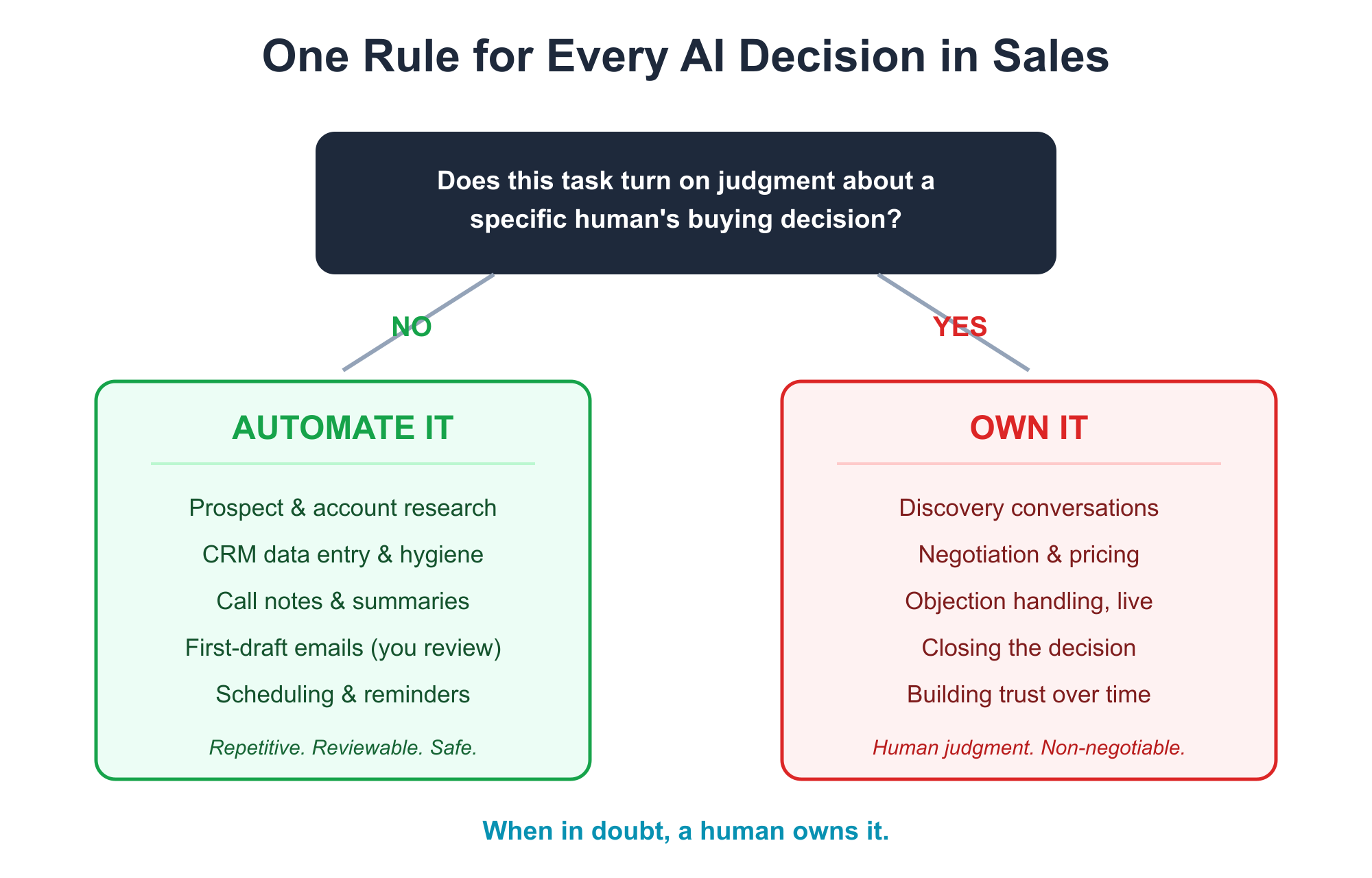
If you remember nothing else from this article, remember this. For any sales task, ask one question: does it turn on judgment about a specific human's buying decision? If the answer is no, automate it. If the answer is yes, own it. That single test sorts almost every AI decision you'll face.
Research? No judgment about a specific decision, automate it. A recap email? Reviewable, low-stakes, let AI draft it. A discovery call where you're trying to understand a buyer's real problem and earn their trust? Pure judgment, own it. Negotiating price with a nervous CFO? Own it. The rule isn't anti-AI, it's pro-clarity. It keeps you aggressive with automation exactly where it's safe and disciplined about the human touch exactly where it counts.
What to Fix Before You Add a Single AI Tool
Here's the part that isn't fun but is the most important, so I'll say it plainly. Before you buy any AI tool, you need three things in place: a clearly defined ICP, a documented playbook, and an enforced process. Without those, AI has nothing good to run on. It'll research the wrong accounts, draft off the wrong message, and automate a motion that doesn't work. You'll have spent money to do the wrong thing faster.
This is the whole reason sequence matters, and it's why I wrote a companion piece specifically on build-order, AI SDRs and sales automation: build the process first, or add the tools first? And if you're weighing whether tools alone could substitute for the leadership that builds those fundamentals, I answer that directly in can't I just use AI sales tools instead of hiring a Fractional Sales Leader?
And the honest caveat I give everyone: if you're pre-product-market fit or you personally haven't closed enough deals to know your winning motion, it's too early for any of this, tools included. Go win more first. But if you're a founder between $1M and $10M in ARR, you likely have the raw material. Get the fundamentals documented, apply the simple rule, and let AI multiply a system that already works. That's how you use AI in sales right now without regretting it later.
Related Reading: The AI in Sales Series
Frequently Asked Questions
Q: What's the best first use of AI in a small sales team?
Attack the repetitive, low-judgment work first: account research, CRM data entry and hygiene, call summaries, and first-draft follow-up emails. This is the roughly 70% of a rep's time that isn't actually selling, and automating it gives your team selling hours back this week with almost no risk. Keep a human reviewing anything that reaches a buyer. Once that's working and you've measured the time saved, expand carefully into drafting and personalization, always with human sign-off.
Q: Should I let AI handle discovery calls or close deals?
No, not for considered B2B deals at $1M–$10M ARR. Discovery and closing are where trust is built and where 40–60% of deals are won or lost to buyer indecision (The JOLT Effect). Those moments require empathy, credibility, and real-time judgment that AI can't provide, and buyers can tell when they're being handled by a bot on a big decision. Use AI to prep for and follow up on those conversations, but keep a human in the actual conversation. That's the line you don't cross.
Q: How do I stop AI from filling my pipeline with junk?
Two guardrails. First, keep a human approving anything that reaches a buyer or touches the forecast, AI drafts, a person signs off. Second, never let automated volume replace qualification. An AI-booked meeting only counts as pipeline once it clears your qualification bar, same as any other. AI makes it easy to generate more activity, but more activity with the wrong people just wastes your team's scarce selling time. Measure success by time spent on the right conversations, not by raw volume.
Q: What do I need in place before buying AI sales tools?
Three things: a clearly defined ICP, a documented playbook, and an enforced process. AI multiplies whatever it runs on, so without these it will research the wrong accounts, draft off the wrong message, and scale a motion that doesn't work. Get the fundamentals documented first, prove the motion works with humans, then add tools to execute the repetitive parts faster. If you can't clearly state who your ideal customer is and how you win, fix that before you spend a dollar on tooling.
Q: Is it too early for me to use AI in sales?
It might be. If you're pre-product-market fit, or you personally haven't closed enough deals to know your repeatable winning motion, it's too early, and that includes AI tools. You'd be automating noise. The honest move is to go win more deals yourself, learn the pattern, then systematize it. But if you're between $1M and $10M in ARR, you almost certainly have a motion worth documenting and multiplying. The question isn't whether to use AI, it's whether your fundamentals are ready for it to amplify.
Q: What's the one rule for deciding what to automate?
Automate the repetitive, own the judgment. For any task, ask whether it turns on judgment about a specific human's buying decision. If no, automate it, research, data entry, summaries, first drafts. If yes, own it, discovery, negotiation, pricing, closing, relationship-building. That single test keeps you aggressive with automation where it's safe and protective of the human touch where deals are actually decided. It's the whole strategy compressed into one sentence.
Want AI working for your pipeline instead of against it?
If you're a founder between $1M and $10M in ARR, I'll help you fix the fundamentals first, then put AI to work on the repetitive 70% so your team spends its time on the deals that actually close. See how it works at louiebernstein.com.
Schedule a 30-Minute CallAbout the Author
Louie Bernstein
Fractional Sales Leader with 50 years of sales experience helping $1M–$10M ARR companies build scalable, repeatable sales systems. Founder of MindIQ (INC 500). LinkedIn Top Voice in Sales Management, Sales Operations, and Sales Coaching.