Key Takeaways:
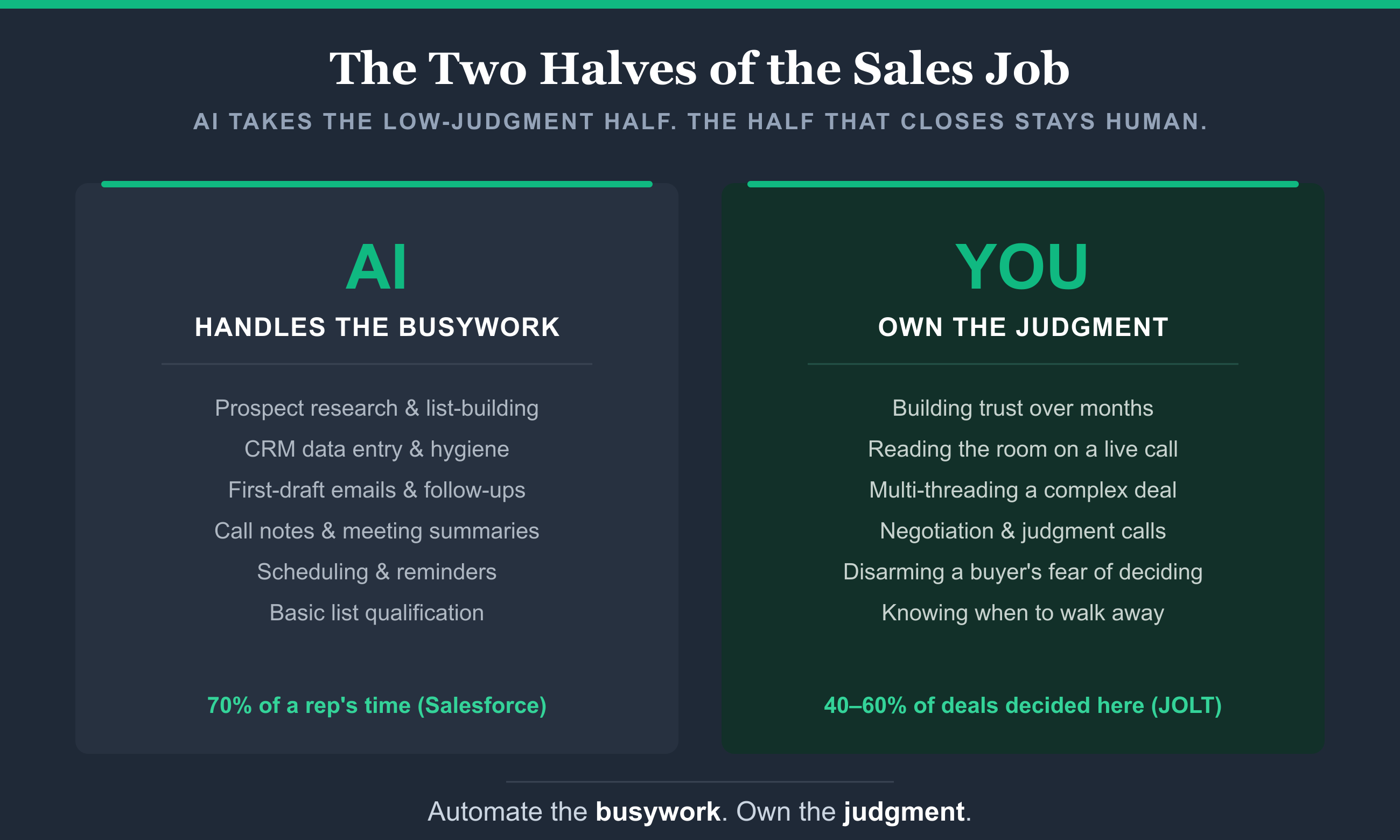
- The honest answer is no, AI won't replace your salespeople. But it will replace the half of the job that was never really selling: research, data entry, first drafts, and follow-up.
- Reps already spend about 70% of their time not selling (Salesforce, State of Sales). That's the half AI is coming for, and losing it is a gift, not a threat.
- What AI can't touch is judgment: trust built over months, reading a room, multi-threading a complex deal, and disarming a buyer's fear of getting it wrong.
- At $1M–$10M ARR the stakes are highest. You have the least slack, and AI aimed at the wrong buyers doesn't just waste money, it burns a small, finite market.
- The real risk isn't AI replacing people. It's bolting AI onto a sales function with no system for it to plug into. AI multiplies whatever it touches, including a mess.
- If you don't yet have a documented ICP, playbook, and process, adding AI tools now just helps you fail faster. Build the system first, then let AI multiply it.
Every founder I talk to in 2026 eventually asks some version of the same question: "If AI keeps getting this good, do I even need salespeople in a year or two?" It usually comes with a nervous half-laugh, because the fear underneath is real. You've watched AI write emails, summarize calls, research accounts, and draft proposals in seconds. If it can do all that, where does the human fit?
Let me give you the straight answer, because I've spent 50 years in sales and I've watched every "this changes everything" wave since the fax machine. AI is not going to replace your salespeople. But it is going to replace a large chunk of what your salespeople currently do, and if you don't understand exactly which chunk, you'll either panic and cut the wrong things or freeze and fall behind.
The job has two halves. One half is repetitive, low-judgment, and honestly a little soul-crushing. The other half is where deals are actually won and lost. AI is very good at the first half and nearly useless at the second. Once you see the split clearly, the question stops being scary and starts being strategic.
The Question Every Founder Is Asking in 2026 — and Why It's Framed Wrong
"Will AI replace my salespeople?" is the wrong question. It's binary, and sales isn't binary. The useful question is: "Which parts of the sales job is AI genuinely good at, and which parts still need a human being in the room?" Answer that and you get a plan instead of anxiety.
The "replacement" narrative got a lot of oxygen from a real trend. Back in 2020, Gartner predicted that by 2025, 80% of B2B sales interactions between suppliers and buyers would happen in digital channels, and that a third of buyers would prefer a seller-free experience entirely, rising to 44% among millennials (Gartner, Future of Sales). That prediction largely came true. Buyers do more research alone, talk to reps later, and want fewer meetings.
But here's the part the doomsayers missed. As AI floods every inbox with machine-written outreach and buyers drown in automated "personalization," the human conversation becomes more valuable, not less. When everyone can generate a slick email in three seconds, the scarce thing is a person who actually understands your problem and can be trusted with a six-figure decision. The framing "human versus AI" is wrong. The winning model is human plus AI, with each doing what it's actually good at.
What AI Actually Replaces: The Low-Judgment Half of the Job
Start with a number that should bother you as a founder. Salespeople spend roughly 70% of their time not selling (Salesforce, State of Sales). Prospect research, list-building, CRM data entry, writing follow-ups, logging notes, scheduling, pulling numbers for pipeline reviews. You're paying for a closer and getting a data-entry clerk three days out of five.
This is exactly the half AI is built to take. And the prize is enormous: McKinsey estimates generative AI could unlock an incremental $0.8 trillion to $1.2 trillion in productivity across marketing and sales (McKinsey). Not by replacing sellers, but by handing the tedious 70% to software so the human can spend more time in front of buyers. Salesforce found sales teams using AI are 1.3x more likely to report growing revenue (Salesforce, State of Sales). The lift comes from giving reps their selling hours back.
So when a founder asks "will AI replace my reps," the honest reframe is: AI will replace the part of the job your reps hate anyway, the part that was never the reason you hired them. That's not a threat to a good salesperson. It's a promotion.
"AI doesn't replace your salesperson. It replaces the clerk your salesperson was forced to become."
What It Can't Touch: Trust, Judgment, and the Deals That Close Over Months
Now the other half. In a B2B deal at your price point, the buyer isn't clicking "add to cart." They're making a decision they'll have to defend to their boss, their board, or their own budget for the next two years. That decision runs on trust, and trust is built by a human over weeks and months of showing up, understanding the problem, and not flinching when things get hard.
Here's the number that proves the point. Matt Dixon and Ted McKenna analyzed 2.5 million sales conversations for The JOLT Effect and found that 40% to 60% of qualified deals are lost not to a competitor but to "no decision," the buyer's own fear of getting it wrong (Dixon & McKenna). No AI closes that gap. Reassuring an anxious buyer, taking risk off the table, building a mutual path forward, knowing when to push and when to wait, that is pure judgment. It's the most human, least automatable work in the entire funnel.
AI can draft the recap email after that conversation. It cannot have the conversation. It can't read the pause on the line, catch the real objection hiding behind the stated one, or decide in the moment to change the whole approach because the CFO just walked into the room. That's the job. That's what you're actually paying a salesperson for, and it's exactly what the "70% not selling" problem has been starving.
Why This Matters More at $1M–$10M Than Anywhere Else
A company at $500M in revenue can run twenty AI experiments, kill nineteen, and never feel it. You can't. Between $1M and $10M in ARR you have less slack than you'll ever have again: a small team, a finite market, and deals big enough that losing a handful actually hurts. That changes the AI calculation completely.
When AI is pointed at the wrong buyers with the wrong message, it doesn't quietly waste budget the way it would at enterprise scale. It burns through your total addressable market. Every founder in your niche has a limited list of accounts that could ever buy. Blast them with mediocre automated outreach and you don't just lose the deal, you poison the name and lose the second chance too. At your size, reputation and referrals are the pipeline, and those are precisely the things careless automation destroys.
This is also the exact revenue band where the founder is usually still the best salesperson in the building, and the biggest bottleneck. Getting AI right here is less about tools and more about leadership, which is why I wrote a companion piece on how a $1M–$10M founder should actually use AI in sales right now. The short version: automate the repetitive, own the judgment.
The Real Risk Isn't AI — It's Not Having a System for It to Plug Into
Here's the thing that actually keeps me up at night on behalf of founders, and it isn't robots taking jobs. It's founders spending money on AI tools before they have anything for those tools to run. AI is a multiplier. Point it at a defined ICP, a documented playbook, and an enforced process, and it makes a good motion faster. Point it at chaos, and it makes chaos faster.
Think of it as simple math. A great AI stack is a multiplier of maybe ten. Ten times a strong system is real leverage. Ten times zero is still zero, except now you're paying for the privilege and doing damage at scale. An AI SDR that doesn't know who your ideal customer is will contact everyone. An AI email tool with no messaging strategy will send confident, well-written nonsense. The tool isn't the problem. The missing system is.
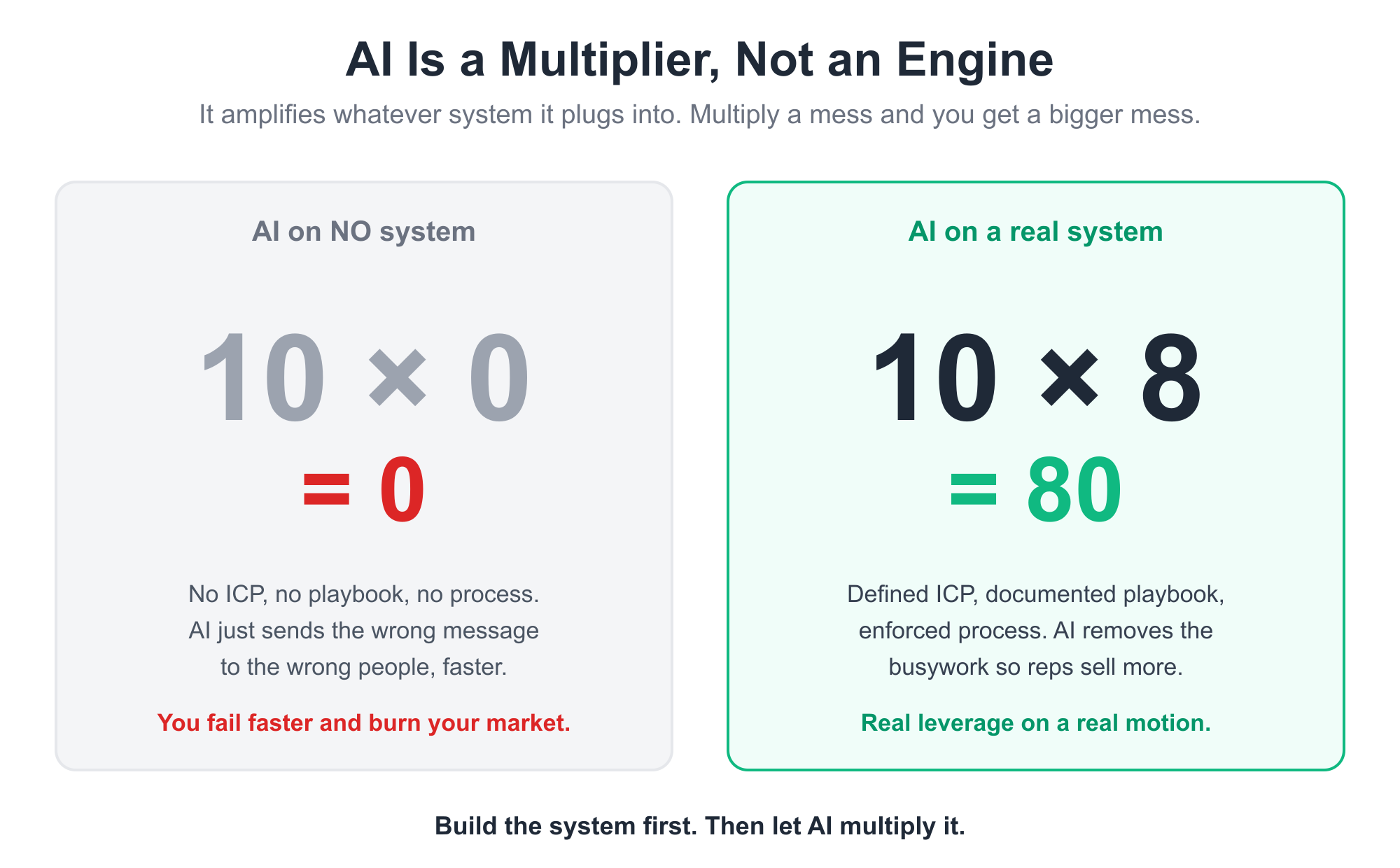
This is why the order of operations matters so much, and why I'm adamant about it. Before you add a single AI SDR or automation platform, you need the process underneath it. I walk through that exact sequence in AI SDRs and sales automation: build the process first, or add the tools first? Get the sequence backwards and the tools accelerate you straight off a cliff.
"AI multiplies whatever it plugs into. If you haven't built the system, all you're scaling is the mess."
Where a Fractional Sales Leader Fits in an AI-Assisted Sales Function
So if AI handles the busywork and your reps handle the judgment, who builds the system that makes both worth anything? That's the job I do. A Fractional Sales Leader is the person who defines the ICP, extracts and documents the winning playbook, builds the process, and only then decides which tasks to hand to AI and which to keep human.
That last decision is the whole game, and it's a leadership call, not a software setting. Which follow-ups should be automated and which need a personal touch? Where does an AI-drafted email help a rep and where does it quietly erode trust? What's the line between "automate the repetitive" and "own the judgment," for your business, your buyers, your deals? Answering that well is the difference between AI that grows your pipeline and AI that hollows it out.
And to be straight with you, as I always am: if you're pre-product-market fit, or you personally haven't closed enough deals to know your winning motion, it's too early for any of this. Go win more deals yourself first. But if you're a founder between $1M and $10M in ARR, you almost certainly have the raw material. You just need someone to turn your instinct into a system, and then let AI multiply it. That's the whole strategy in one sentence. Some founders wonder whether they can skip the leadership piece entirely and just buy the tools, which I tackle head-on in can't I just use AI sales tools instead of hiring a Fractional Sales Leader?
Related Reading: The AI in Sales Series
Frequently Asked Questions
Q: Will AI replace salespeople entirely in the next few years?
No. AI will replace tasks, not the role. It's already very good at the repetitive, low-judgment 70% of the job, research, data entry, drafting, and follow-up. It's nearly useless at the high-judgment work that actually closes B2B deals: building trust, reading a live conversation, negotiating, and helping an anxious buyer commit. The role that survives and thrives is a salesperson freed from busywork to spend more time on judgment. The role that disappears is the human being used as a data-entry clerk.
Q: If AI is this good, should I hold off on hiring salespeople?
Not if you're selling considered B2B deals at $1M–$10M ARR. AI can make each rep more productive, but it can't build the trust that closes a six-figure decision. The smarter move is to hire well and give each rep AI to remove the grunt work, so a smaller team sells more. What you should hold off on is buying a pile of AI tools before you've defined your ICP, playbook, and process. Tools without a system just help you fail faster.
Q: What sales tasks should I actually hand to AI first?
Start with the tasks that are repetitive and low-judgment: prospect and account research, CRM data entry and hygiene, first-draft emails and follow-ups, call summaries, and pulling data for pipeline reviews. These are safe because a human still reviews and owns the output. Keep AI away from the conversations that decide deals, discovery, negotiation, and the moments where trust is built or broken. A simple rule works: automate the repetitive, own the judgment.
Q: Can AI outreach hurt my business?
Yes, badly, especially at your size. When AI is pointed at the wrong buyers with a weak message, it doesn't quietly waste budget. It burns through a small, finite market and poisons your name with the exact accounts that could have bought later. At $1M–$10M ARR, referrals and reputation are your pipeline. Careless automated outreach damages both faster than any human could. That's why the message and the target, the system, have to be right before you scale outreach with AI.
Q: Doesn't AI make a Fractional Sales Leader unnecessary?
It's the opposite. AI makes leadership more valuable, because someone has to decide what the AI runs on and which tasks stay human. A Fractional Sales Leader defines your ICP, extracts and documents your winning playbook, builds the process, then decides where AI helps and where it hurts. The tools execute; leadership designs. Buying tools without that design is how founders end up with a fast, expensive, well-automated version of a broken sales motion.
Q: How do I know if I'm ready to add AI to my sales function?
Ask one question: do you have a documented, repeatable, winning motion? If you can say "buyers like this, with this pain, tend to buy for this reason, through these steps," you have a system AI can multiply. If your last ten deals closed for ten different reasons, you're not ready, and AI will only scale the confusion. Build the system first, prove it works with humans, then layer AI onto the parts that are repetitive and safe to automate.
AI won't build your sales system. Let's build it, then let AI multiply it.
If you're a founder between $1M and $10M in ARR trying to figure out where AI fits in your sales function, I'll help you build the system underneath it first, the ICP, the playbook, the process, so the tools actually make you money instead of noise. See how it works at louiebernstein.com.
Schedule a 30-Minute CallAbout the Author
Louie Bernstein
Fractional Sales Leader with 50 years of sales experience helping $1M–$10M ARR companies build scalable, repeatable sales systems. Founder of MindIQ (INC 500). LinkedIn Top Voice in Sales Management, Sales Operations, and Sales Coaching.