Key Takeaways:
- An AI SDR looks like a shortcut out of founder-led sales. It isn't. It's an accelerator, and accelerators only help when the car is pointed the right way.
- Automating an undefined process doesn't fix it, it multiplies the mess. You send the wrong message to the wrong people at machine scale, in your own company's name.
- "Build the process first" means a defined ICP, documented messaging, and a proven, repeatable motion, before you point automation at your market.
- AI SDRs earn their keep on a proven motion, following up warm leads, enriching accounts, reactivating dormant ones. They burn your market when they cold-blast with no system underneath.
- The right sequence is always the same: playbook, then pipeline, then automation. Prove it works with humans, then let AI scale it.
- At $1M–$10M ARR your market is small and finite. Bad automated outreach doesn't just waste money, it poisons the exact accounts you needed. Sequence matters more here than anywhere.
Every week another founder tells me they're about to buy an AI SDR. And I get why. You're exhausted from doing sales yourself, hiring a rep feels risky and slow, and here's a piece of software that promises to prospect, personalize, and book meetings around the clock for a few hundred bucks a month. It sounds like the escape hatch from founder-led sales you've been looking for.
So let me answer the question you're really asking, which is about order of operations: do I build the sales process first, or do I add the automation first and figure out the process as I go? I've watched founders try it both ways for decades, and the answer isn't close. Get the sequence wrong and the tools don't just fail to help, they actively hurt you.
This is the fourth piece in my series on AI in sales, and it's the most tactical. Here's exactly how to stage it so automation becomes leverage instead of a loaded gun pointed at your own market.
The Temptation to Automate Your Way Out of Founder-Led Sales
The pull is completely understandable. You've been the sales team since day one, and you're the bottleneck. Every deal still runs through you, and you can feel it capping the company's growth at the size of your own calendar. An AI SDR dangles the dream of stepping out of that role without the mess of hiring, onboarding, and managing a human.
And the timing feels right. Gartner predicted years ago that 80% of B2B sales interactions would move to digital channels, with a third of buyers preferring a seller-free experience (Gartner). If buyers want to self-serve and automate, why shouldn't sellers? So the founder reasons: let the AI do the outreach, and I'll get my life back.
Here's the trap in that logic. Founder-led sales isn't a task you can automate away, it's a body of knowledge you've never written down. The reason deals run through you is that the winning motion lives in your head. Point an AI SDR at your market before you've extracted that knowledge and you haven't escaped founder-led sales, you've just replaced your good instincts with a machine that has none. If the deeper goal is genuinely getting out of the founder's seat, I'd start with building the playbook that's trapped in your head, not with buying a bot.
Why Automating an Undefined Process Multiplies the Mess
Let's be precise about what goes wrong, because it's not subtle. Automation is a multiplier. Whatever you feed it, it does more of, faster. Feed it a sharp ICP and a proven message, and it multiplies your best work. Feed it a fuzzy target and an untested pitch, and it multiplies your worst, at a scale you could never reach by hand.
Picture an AI SDR with no defined ICP. It doesn't know who your ideal customer is, so it contacts everyone. It doesn't have a tested message, so it sends confident, generic, obviously-automated email in your company's name. Now multiply that by thousands of sends a week. You haven't built a pipeline. You've announced to your entire market that your company sends spam, and at $1M–$10M ARR that market is small enough that you'll actually run out of names. The very accounts you needed six months from now have already deleted and blocked you.
This is the same core lesson I hit in will AI replace my salespeople: AI multiplies whatever it plugs into, including chaos. Automating a broken process just lets you fail faster and louder. The mess doesn't get organized. It gets amplified.
"An AI SDR on an undefined process doesn't build a pipeline. It tells your whole market, at scale, that you send spam."
What "Build the Process First" Actually Means
"Build the process first" gets said a lot, so let me make it concrete. It doesn't mean a fat binder or six months of consulting. It means three things exist and actually work before any automation touches your market.
First, a defined ICP: you can name exactly who you win with and who to disqualify fast. Second, documented messaging: the specific pain you solve, in your buyer's language, in a form that's been tested on real prospects and gotten real replies. Third, a proven, repeatable motion: a sequence of steps that has actually converted strangers into customers more than once, so you know it's a pattern and not luck. That's the bar. It's why companies with a formal sales process see 18% more revenue growth than those winging it (HBR / Vantage Point). The process is the thing that produces the result. The automation just runs it faster.
If you can't yet check those three boxes, you don't have an automation problem, you have a system problem, and that's exactly the work I do as a Fractional Sales Leader: extract the motion from your head, document it, and prove it before we ever scale it.
Where AI SDRs Earn Their Keep — and Where They Burn Your Market
I want to be fair to the tools, because used right they're genuinely valuable. Once a real system sits underneath them, AI SDRs and automation earn their keep. They follow up on warm inbound leads within seconds, when speed-to-lead actually decides who wins. They research and enrich accounts so your reps walk in prepared. They quietly reactivate dormant leads that would otherwise rot. They personalize a proven message at a scale no human could match, and they hand your team back the repetitive 70% of the job so people can sell.
The same tool burns your market when there's no system underneath. Cold-blasting with no ICP. Mass generic email that reads like a robot wrote it, because one did. Fake personalization that buyers see through instantly. Letting automation replace real qualification, or worse, trying to run the actual close, where 40% to 60% of deals hinge on a human easing a buyer's fear of deciding (Dixon & McKenna). Same software, opposite outcomes. The only variable that changed is whether a real system was behind it.
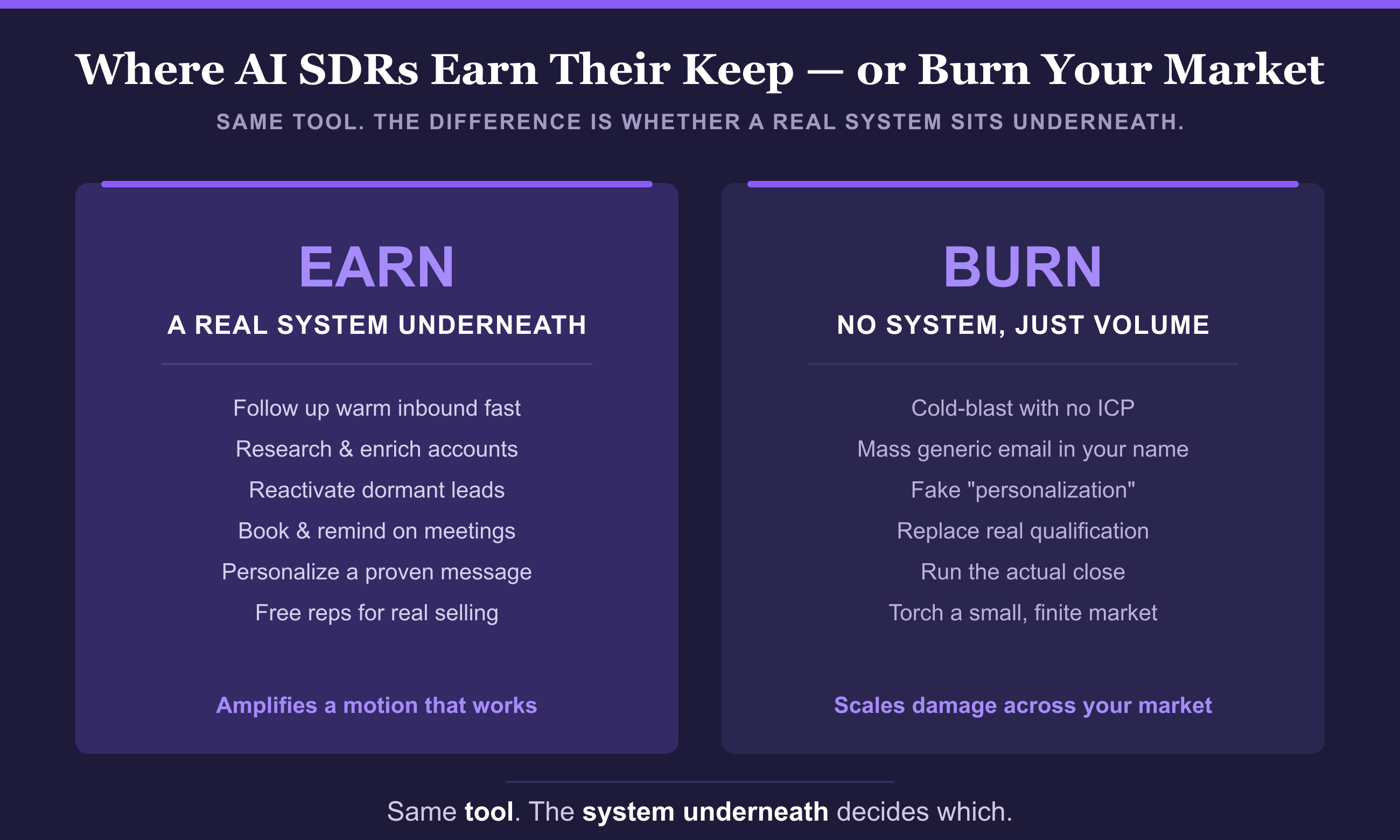
"The same AI SDR either amplifies a motion that works or scales the damage across every account you had. The system underneath decides which."
The Right Sequence: Playbook, Then Pipeline, Then Automation
Here's the order that works, and it never changes. Three stages, and you don't skip ahead.
Stage one is the playbook. Define the ICP, nail the messaging, map the process and stages, document how you actually win. This is the system on paper. Stage two is the pipeline. Run that motion with humans, prove it's repeatable, hit consistent wins, and fix whatever leaks. This is where you earn the right to scale, because you've shown the motion converts. Stage three is automation. Only now do you layer in AI SDRs and tools, to automate the repetitive parts and multiply a motion you've already proven works. Do it in this order and each stage makes the next one stronger.
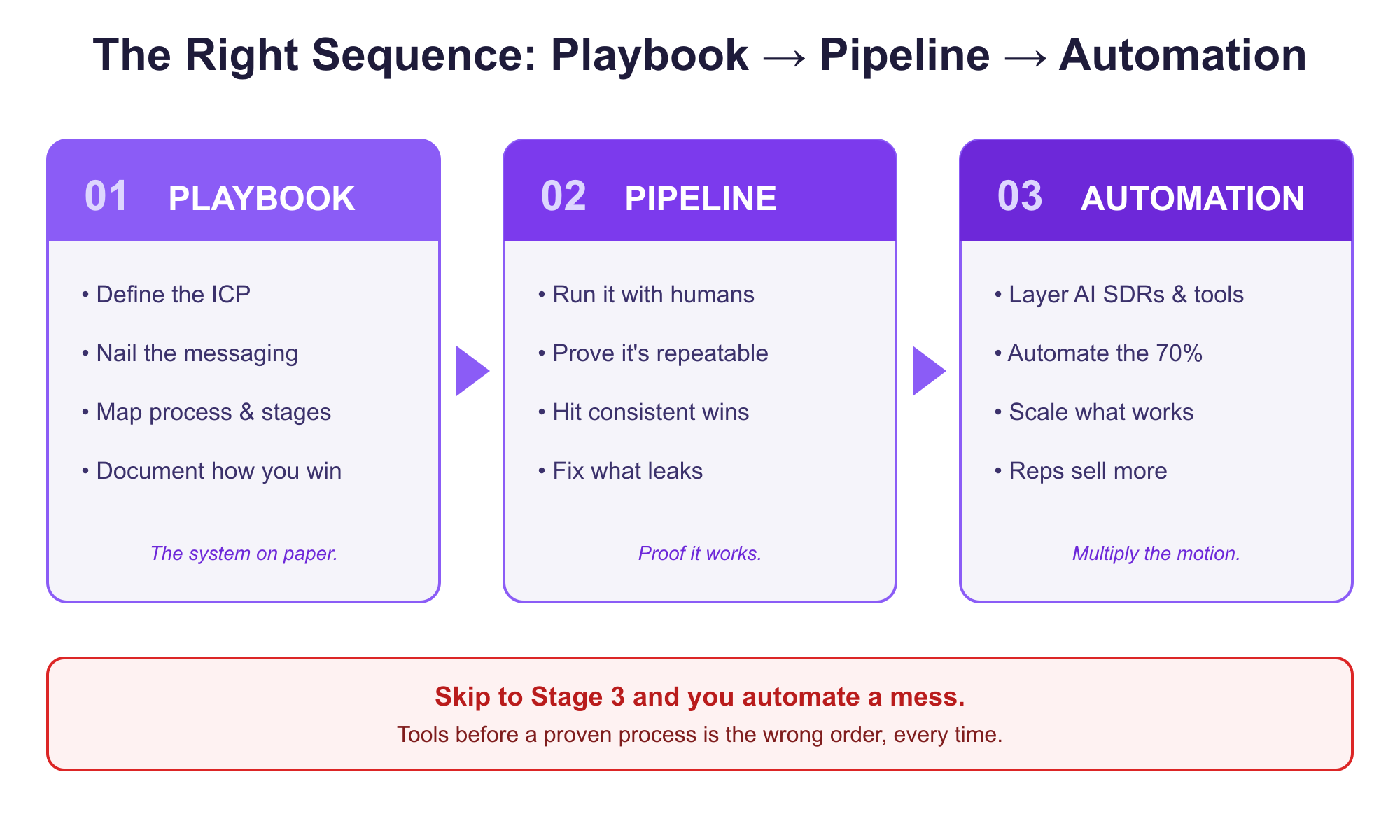
The mistake is starting at stage three because it's the shiny one. Buying the automation first is like installing a turbocharger before you've built the engine. For the full picture of which specific tasks are safe to automate at each stage, see how a $1M–$10M founder should actually use AI in sales right now.
How I'd Stage This for a Company at Your Revenue
If you're between $1M and $10M in ARR, here's how I'd actually stage it with you. First 30 days: extract and document the playbook, the ICP, the messaging, the winning motion that's currently locked in your head. Next 60 to 90 days: run it, with you and any reps executing the same documented motion, tightening it against real deals until the wins are repeatable and the forecast is believable. Only then, once the motion is proven, do we layer in automation, and even then we start in the safe zone: warm follow-up, research, enrichment, CRM hygiene, the repetitive work that frees your people to sell.
Notice what that sequence protects. Your finite market never gets sprayed with untested outreach. Your reputation stays intact. And when the automation does go live, it's multiplying a motion you know converts, so the leverage is real instead of imaginary. That's the difference between AI that grows your company and AI that quietly torches your pipeline. If you're still deciding whether you even need leadership to do this or whether tools alone could carry it, I tackle that in can't I just use AI sales tools instead of hiring a Fractional Sales Leader?
And the honest caveat, as always: if you're pre-product-market fit or you haven't personally closed enough to know your winning motion, it's too early for stage three entirely. Go win more deals first. But if you've got the pattern, the sequence above is how you finally get out of the founder's seat, without setting fire to the market on your way out.
Related Reading: The AI in Sales Series
Frequently Asked Questions
Q: Should I build my sales process first or add AI automation first?
Build the process first, always. Automation is a multiplier: it does more of whatever you feed it. Feed it a proven motion and it scales your best work; feed it an undefined process and it scales chaos to your entire market. The right sequence is playbook, then pipeline, then automation, prove the motion converts with humans before you let AI run it at volume. Adding tools first doesn't fix a broken process, it just helps you fail faster and more publicly.
Q: Can an AI SDR replace hiring a salesperson to get me out of founder-led sales?
Not on its own. Founder-led sales persists because the winning motion lives undocumented in your head, and an AI SDR has no instincts of its own. Point it at your market before you've extracted and proven that motion and you haven't escaped the founder trap, you've automated a version of sales with no judgment behind it. First document the playbook and prove it works. Then an AI SDR can genuinely take repetitive outreach off your plate, running a system you've already validated.
Q: What actually happens if I run an AI SDR without a defined process?
It contacts the wrong people with an untested message, in your company's name, thousands of times a week. Without a defined ICP it targets everyone; without proven messaging it sends generic, obviously-automated email. At $1M–$10M ARR your market is small and finite, so you don't just waste budget, you burn through the exact accounts you'll need later, and they remember you as spam. The damage to your reputation and referral base outlasts any short-term meetings you might book.
Q: When is an AI SDR actually a good investment?
Once you have a proven system underneath it. If your ICP is sharp, your messaging has earned real replies, and your motion converts repeatably, an AI SDR is excellent at scaling it, fast warm-lead follow-up, account research and enrichment, reactivating dormant leads, and personalizing a proven message at volume. That's the earn-their-keep zone. Keep it away from cold-blasting with no ICP, fake personalization, replacing qualification, or running the close. Same tool, opposite outcomes, and the system underneath is what decides which.
Q: What does "build the process first" actually require?
Three concrete things: a defined ICP you can name precisely, documented messaging that's been tested on real prospects and drawn real replies, and a repeatable motion that has converted strangers into customers more than once. It's not a giant binder or a six-month project, it's the winning pattern written down and proven. Companies with a formal process see 18% more revenue growth (HBR / Vantage Point) because the process, not the tooling, produces the result. If you can't check those three boxes yet, that's the work to do before any automation.
Q: How would you stage AI automation for a company at $1M–$10M ARR?
In three phases. First 30 days: extract and document the playbook, ICP, messaging, and winning motion. Next 60 to 90 days: run that motion with humans until the wins are repeatable and the forecast is believable. Only then layer in automation, starting in the safe zone, warm follow-up, research, enrichment, and CRM hygiene, before any outbound at scale. That order protects your finite market and your reputation, and it means automation multiplies a motion you've proven instead of scaling a guess. It's the difference between leverage and self-inflicted damage.
Get the sequence right: playbook, pipeline, then automation.
If you're a founder between $1M and $10M in ARR eyeing an AI SDR, I'll help you build and prove the motion first, then layer automation onto a system that actually works, so the tools scale your wins instead of your mistakes. See how it works at louiebernstein.com.
Schedule a 30-Minute CallAbout the Author
Louie Bernstein
Fractional Sales Leader with 50 years of sales experience helping $1M–$10M ARR companies build scalable, repeatable sales systems. Founder of MindIQ (INC 500). LinkedIn Top Voice in Sales Management, Sales Operations, and Sales Coaching.