What Separates Revenue-Producing Partners From Inactive Partners?
B2B partner programs fail to produce revenue when companies manage agreements instead of the work that creates customers. Revenue-producing partners recognize a buying problem, act on a clear reason to help, and trust your team to handle the introduction. Inactive partners stall somewhere along that path. Before recruiting more partners, find the missing action, assign an owner, and measure whether buyers move forward through your sales process.
Key Takeaways
- B2B partner programs fail when signing and training partners become substitutes for accepted introductions and customer progress.
- Readiness, activation, qualified pipeline, and closed revenue are separate results. Give each a definition and a review window.
- Four activated partners out of 20 eligible partners equals 20% activation. That illustrative rate says nothing about profit without opportunity and cost data.
- Audit the first stalled step for each partner before buying software, increasing commissions, or recruiting replacements.
- Give partners feedback on introductions and one agreed next action. Protect their customer relationships as carefully as your own.
The kickoff went well. Your partner likes the product. Your team sent the presentation, held training, and added a logo to the website. Then nothing happened.
For a founder at $1M to $10M ARR, the temptation is to recruit another partner. But adding relationships can multiply the same broken handoff. More agreements won't explain why the existing partners stopped calling.
A signed agreement is the starting line. The next buyer action tells you whether the partnership is moving.
No verified, market-wide failure rate establishes that most B2B partner programs fail. The useful question is why your program isn't producing the revenue you expected, and which part you can repair.
What Separates Revenue-Producing Partners From Inactive Partners?
Revenue-producing partners turn a relevant customer problem into an agreed action with your team. Inactive partners may understand your product but lack a reason, a moment, or the confidence to introduce you. For a founder, the practical distinction is observable buyer progress, rather than attendance at partner meetings or completion of training.
Make the first action small and useful
Give a referral partner one problem to listen for. For example, an accounting adviser hears a client say, "Our forecasts keep changing because nobody trusts the sales pipeline." The adviser doesn't need to demonstrate your whole product. They need to recognize the problem and ask whether the client wants an introduction.
Practice that conversation. Ask the partner to explain whom they'd introduce, why the meeting would help, and what the buyer should expect. If the answer sounds like a product brochure, simplify the message. Training should make the next customer conversation easier.
Separate being ready from doing the work
For a referral program, define readiness as completing the agreed setup and demonstrating the introduction. Define activation as making a first accepted introduction. A productive partner then creates qualified opportunities or other agreed customer outcomes. Use different definitions for resellers and implementation partners; their jobs are different.
Established programs also distinguish skills from results. Microsoft's Solutions Partner framework measures performance, skilling, and customer success separately. Qualification requires at least 70 of 100 points and more than zero in every metric. You don't need Microsoft's scoring system. You need the same refusal to treat training alone as proof of customer results.
Why Do Partners Stop Making Introductions?
Partners stop making introductions when the expected benefit no longer justifies the effort or the risk to their customer relationships. A confusing offer, slow response, weak customer fit, or poor feedback can each cause silence. A founder should diagnose the reason with a specific recent example before changing commissions or demanding more activity.
Look at the partner's working day
Your partner has a business to run. Recommending your company competes with serving clients, selling their own work, and recommending other vendors. Ask what makes your introduction useful during a conversation they already have. "Please remember us" adds a task. A clear buying trigger helps them serve a customer.
Then ask about risk. Does the partner know you won't pressure the buyer, ignore their context, or make promises delivery can't keep? Does the partner know when they'll hear back? The commission may be clear while the customer experience remains uncertain.
Inspect your side of the handoff
Review the last few introductions. Record when each arrived, who replied, whether the buyer agreed to meet, and what happened next. A partner who sends a good introduction into silence has learned something about your company. Another enablement webinar won't undo that lesson.
Set a response commitment your team can meet. One business day is a reasonable starting operating rule, not a proven universal benchmark. Acknowledge the introduction, name the internal owner, and explain the next step. If the buyer isn't a fit, tell the partner why without sharing confidential details.
Put these responsibilities in the internal owner's Accountabilities Document. A shared inbox doesn't own a relationship. A person does.
How Do You Find Where Partner Revenue Is Stalling?
Find the revenue stall by tracing each partner from readiness to accepted introduction, qualified opportunity, and customer won. Compare partners with similar roles and enough time to perform. For a founder, the first missing step identifies the next management action far more clearly than a single total for partner pipeline or registered deals.
Use a cohort with a clear clock
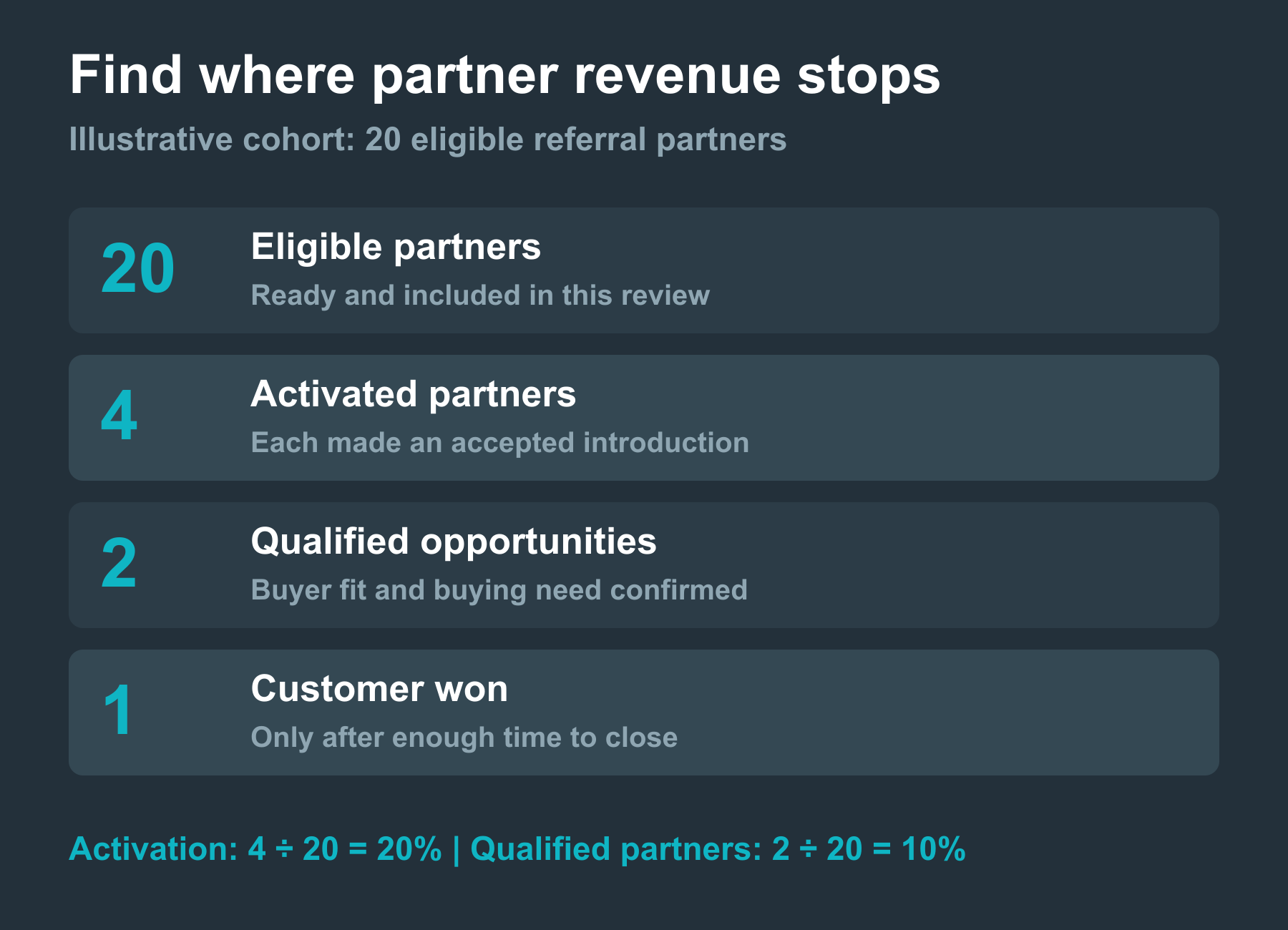
Consider an illustrative group of 20 eligible referral partners reviewed over the same period. Four each make one accepted introduction. Two of those introductions become qualified opportunities. One becomes a customer after enough time to close. Assume each result comes from a different partner so the partner counts remain clear.
Activation is 4 divided by 20, or 20%. Partners producing a qualified opportunity are 2 divided by 20, or 10%. Neither figure is an industry benchmark. Neither proves the program is profitable. They tell you that most partners in this example haven't reached the first customer-facing action.
Keep your denominators honest
Write down who is eligible and why. A partner signed yesterday hasn't had the same chance as a partner ready for six months. Keep new partners in a separate group until their agreed activation window has elapsed. Don't quietly remove inactive partners from the denominator to improve the dashboard.
Track partner counts and deal counts separately. One partner can send five opportunities. Five opportunities don't mean five active partners. Also separate partner-sourced business from assistance on opportunities already in your CRM. Credit useful assistance without counting the same revenue twice.
Keep the CRM record simple: partner name, readiness date, introduction date, acceptance decision, opportunity owner, buyer next step, outcome, and support hours. Add commission and delivery costs when reviewing economics. The records should explain a decision, not create another reporting job.
What Should You Fix Before Recruiting More Partners?
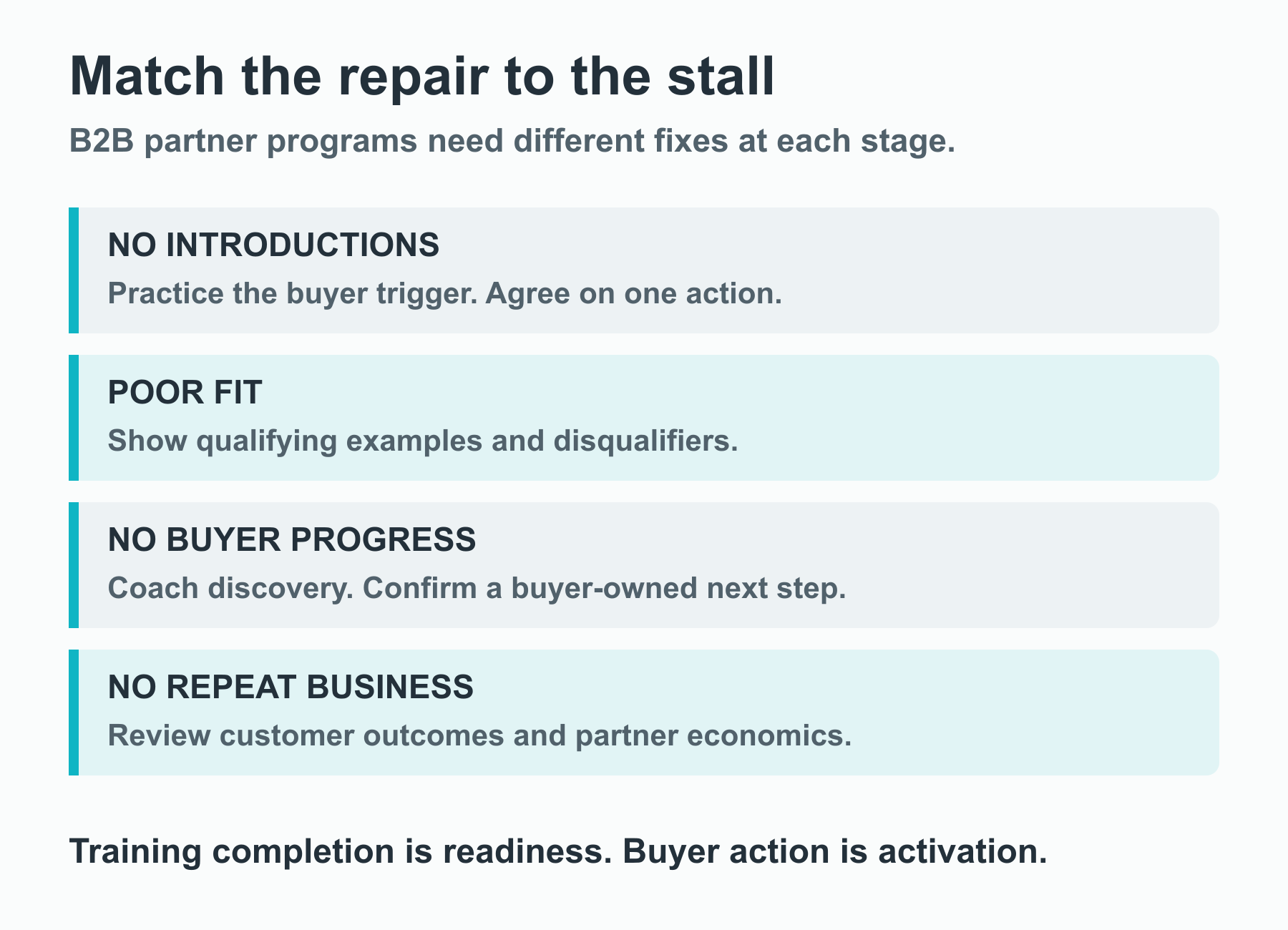
Fix the earliest repeated failure in the partner's path before recruiting more partners. No introductions calls for a different repair than introductions that never qualify or qualified buyers who never advance. A founder should choose one change, name the owner, and review the resulting customer behavior before expanding the program.
Where I start as a Fractional Sales Leader
My starting question is the same one I use when helping a founder hand selling to an employee: can another person explain the buyer problem and run the next step without you? A partner is another person who needs that clarity. Sending an outside firm a presentation doesn't transfer the judgment in the founder's head.
I'd rather role play one real introduction than add ten slides to a partner deck. Ask the partner to recognize a buying trigger. Ask your salesperson to handle the handoff. Then coach what was unclear. Teach both people to do the work instead of becoming the permanent translator between them.
A short partner section in your Sales Playbook should cover the trigger, disqualifiers, introduction wording, handoff, and ownership rules. Include a good example and a poor-fit example. Partners need to know when to leave you out, too.
Don't use a bigger commission to cover a broken process
Partners can produce substantial business. PartnerStack's 2026 network report says its GMV grew 52% in 2025 versus 2024, while paid customer signups grew 112%. Those are vendor-reported results from one software ecosystem, not expected growth rates for your company or evidence that incentives caused the growth.
The figures show that partner revenue is real. They don't tell you why your partners are inactive. Ask whether the problem is economics, confidence, qualification, or follow-through. Raise compensation when the work and margins justify it. Repair the customer experience when that's what broke.
When Should You Reactivate, Pause, or End a Partnership?
Reactivate a partner when the buyer fit remains strong and both sides will commit to a specific repair. Pause a relationship when timing or capacity prevents useful work. End the investment when fit is absent, trust is damaged, or agreed actions repeatedly don't happen. Judge revenue only after the relevant sales cycle has had time to finish.
Run one focused repair cycle
- Review the evidence together. Bring the last introduction or the missing first action, rather than a general complaint about engagement.
- Name the obstacle. Ask the partner what makes recommending you difficult. Check your own response and selling process.
- Agree on one action. Practice a trigger conversation, improve an introduction, or repair an overdue buyer follow-up.
- Choose a review date. A 30-day action review can be useful. It isn't a promise that a six-month sale should close in a month.
- Make the decision. Invest more when the agreed behavior changes. Reduce attention when neither side can identify a credible next step.
Put founder time in the decision
Count the hours spent in partner meetings, sales calls, enablement, and exceptions. A relationship can produce revenue while consuming more gross profit and founder attention than it returns. Compare customer quality, contribution after costs, and the capacity required to keep the relationship working.
Keep support for existing customers clear when you pause recruitment or end promotional activity. Then give your attention to partners whose customers progress and whose teams do the agreed work. The objective is a channel your business can operate, not another set of relationships only you can hold together.
Related Reading
How Do You Find B2B Partners Who Bring You Customers? →
Frequently Asked Questions
Q: Is there a standard partner activation rate I should target?
There isn't one useful target across referral, reseller, affiliate, and implementation programs. Define the action, eligible population, and time window first. Compare similar groups within your program before borrowing a vendor's benchmark.
Q: Can a partner be valuable without sourcing deals?
Yes. A partner may improve implementation, retention, or access to buying stakeholders. Agree on that role and measure its results separately. Don't label valuable delivery work as new pipeline simply to make a referral target look better.
Q: Should I pay for partner training attendance?
Pay for attendance only when training itself delivers a defined business benefit. Attendance alone doesn't show the partner can recognize or refer a suitable buyer. Avoid building a reward system that makes taking courses more attractive than helping customers.
Q: What happens when our partner champion leaves?
Reconfirm the relationship with a new owner before assuming activity will continue. Preserve the shared process and customer obligations, then repeat the readiness conversation. A company-level agreement doesn't automatically transfer one person's motivation or buyer relationships.
Q: Should partners see our entire CRM?
Give partners only the information needed for their agreed role and approved customer work. Share relevant status updates through a controlled process. Broad access isn't required to explain that an introduction was accepted or that a customer meeting happened.
Build a partner process your team can run.
If you're a B2B founder at $1M to $10M ARR, Fractional Sales Leadership can help you diagnose stalled handoffs, teach qualification, and assign clear ownership. Learn how I work at LouieBernstein.com.
Schedule a 30-Minute CallAbout the Author
Louie Bernstein
Louie Bernstein is a Fractional Sales Leader with 50 years of sales experience and has provided Fractional Sales Leadership since 2017. He helps B2B founders build repeatable sales systems so their teams can sell without depending on the founder.