Should You Grow Existing Accounts or Focus More on Winning New Customers?
Reduce customer concentration by growing revenue outside your largest accounts while keeping clear service commitments to those customers. Expand smaller accounts where you can solve a real problem, and protect time for winning new customers with different sources of risk. Give account care and new-customer selling separate owners and targets. The goal is to make your best customers a smaller share of a stronger business without giving them a worse experience.
Key Takeaways
- Reduce customer concentration by growing the rest of the business while protecting service for your best customers.
- Expansion inside your largest account can increase concentration even when company revenue rises.
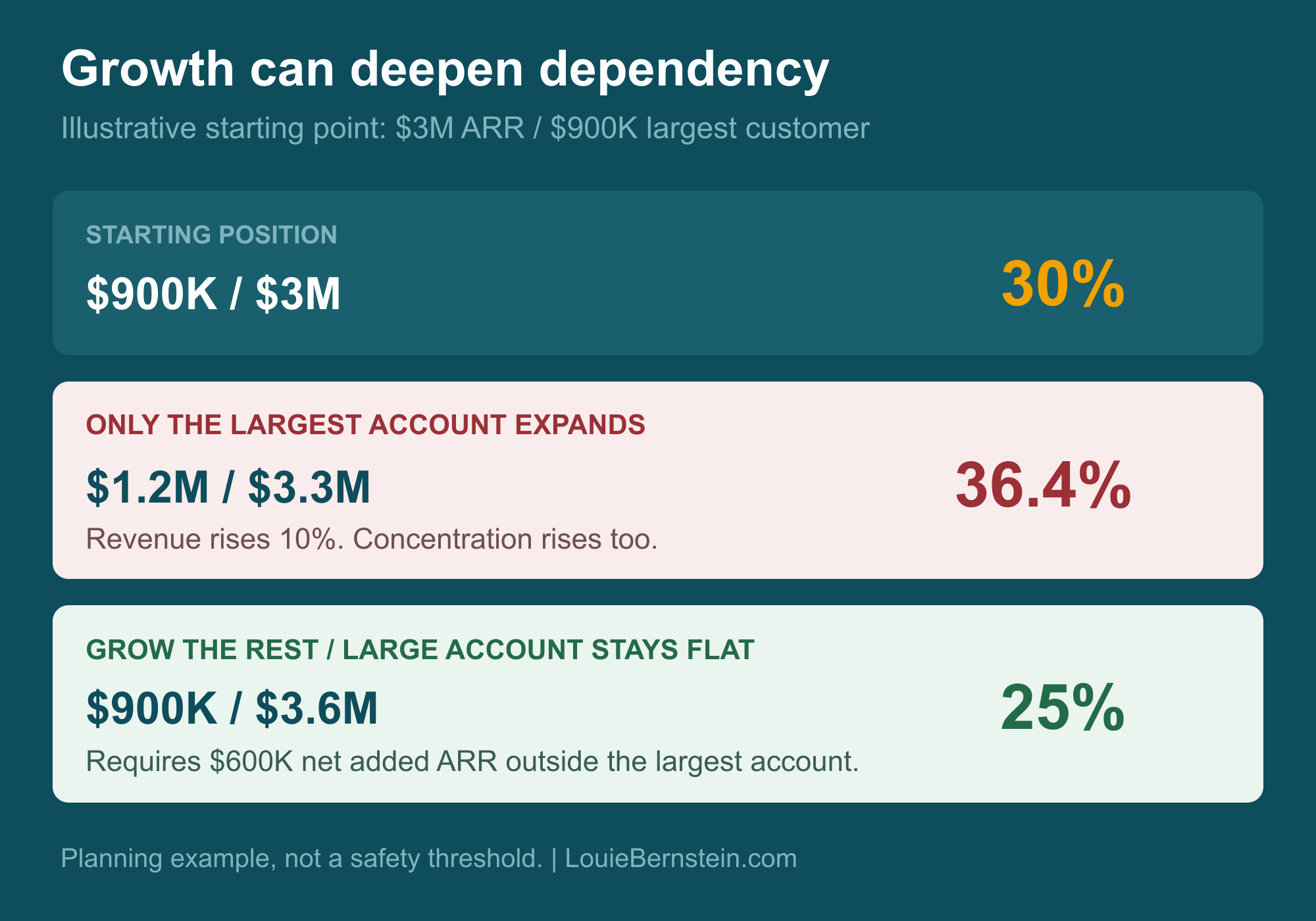
- In an illustrative $3M ARR company, growing a $900K customer to $1.2M raises its revenue share from 30% to 36.4% if everyone else stays flat.
- Give smaller-account expansion and new-customer sales separate pipeline targets, owners, and calendar time.
- Write an account coverage plan this week: service owner, backup, customer outcomes, review dates, and escalation rules.
Your biggest customer calls with another project. You know the people. They know your work. Closing the extra business feels easier than starting a conversation with a stranger.
Take enough of those calls, and you can have a good sales year while becoming more dependent on one buyer. For a founder at $1M to $10M ARR, revenue growth alone doesn't tell you whether the company is getting stronger.
Keep earning the big customer's business. Stop letting that customer consume the time needed to build everyone else's business.
You don't need to choose between loyalty and diversification. You need to decide who protects the relationship, who builds the next one, and how both jobs get done when the week gets busy.
Should You Expand Existing Accounts or Win New Customers?
Grow smaller existing accounts when they have a verified need, and keep new-customer selling active when concentration is the problem. Expansion in your largest account may produce attractive revenue but deepen dependency. For a B2B founder, the right mix depends on where growth lands, its margin, and the capacity required to win and serve it.
Separate three kinds of growth
Don't put all additional revenue in one bucket. Track expansion in your largest account or exposed customer group, expansion across other existing customers, and revenue from new customers. Those streams can produce the same dollars and very different exposure.
| Growth source | What makes it useful? | What should you check? |
|---|---|---|
| Largest-account expansion | More revenue from a proven relationship | Does dependency rise? Can delivery handle the work? |
| Smaller-account expansion | A wider revenue base using relationships you already have | Is the need real? Does the account share the same risks? |
| New customers | Additional buyers and sources of revenue | Do customers fit your offer and diversify exposure? |
Retention still deserves attention. ChartMogul's September 2024 report studied more than 2,500 SaaS businesses. For companies at $15M to $30M-plus ARR, expansion contributed about 40% of growth, compared with 30% in early 2021 (ChartMogul). Those companies are larger than the founder-led businesses I work with. The finding supports taking expansion seriously; it doesn't prescribe your sales mix or prove expansion reduces concentration.
Choose from actual opportunities
Review the next quarter's qualified opportunities by customer group. Compare likely gross profit, sales effort, delivery effort, decision timing, and the resulting account shares. A smaller customer's urgent, funded need may deserve attention before a cold prospect. A vague upsell inside your biggest customer shouldn't crowd out a qualified new buyer.
Use an account expansion playbook to qualify additional purchases. A friendly relationship isn't evidence of a new buying decision.
How Much Growth Do You Need Outside Your Biggest Account?
Calculate outside-account growth by dividing your largest account's expected ARR by the concentration share you're planning toward, then subtracting expected total ARR before diversification. Include likely expansion in the large account. For a subscription business, keeping that numerator current prevents a growth plan from understating the revenue needed elsewhere.
Run the flat-account and growing-account cases
Consider an illustrative company with $3M ARR. Its biggest customer contributes $900K, or 30%. The other customers contribute $2.1M. Suppose the founder chooses a 25% planning target. That target is an example, not a universal definition of safety.
- If the large account stays at $900K: $900K divided by 25% equals $3.6M total ARR. The rest of the company needs $600K of net added ARR.
- If the large account grows to $1.2M: $1.2M divided by 25% equals $4.8M total ARR. Other customers must reach $3.6M, adding $1.5M net to their starting $2.1M.
- If only the large account grows: $1.2M divided by $3.3M equals 36.4%. Company ARR rises 10%, but customer concentration increases.
Build the revenue bridge after losses
The $600K requirement is net growth outside the largest customer. If other accounts lose $150K through cancellations and downgrades, those accounts and new customers must produce $750K in gross additions to finish $600K ahead. Don't make the sales target look smaller by ignoring the revenue you expect to lose.
Keep recurring revenue separate from one-time projects. For a services business, use a consistent annual revenue period and account for project timing. Don't add a one-time implementation fee to ARR because it helps the diversification slide.
Model the largest customer and the largest exposed group separately. Several new customers controlled by one parent company can still leave you dependent on one budget decision.
How Do You Protect Your Best Customers While Diversifying?
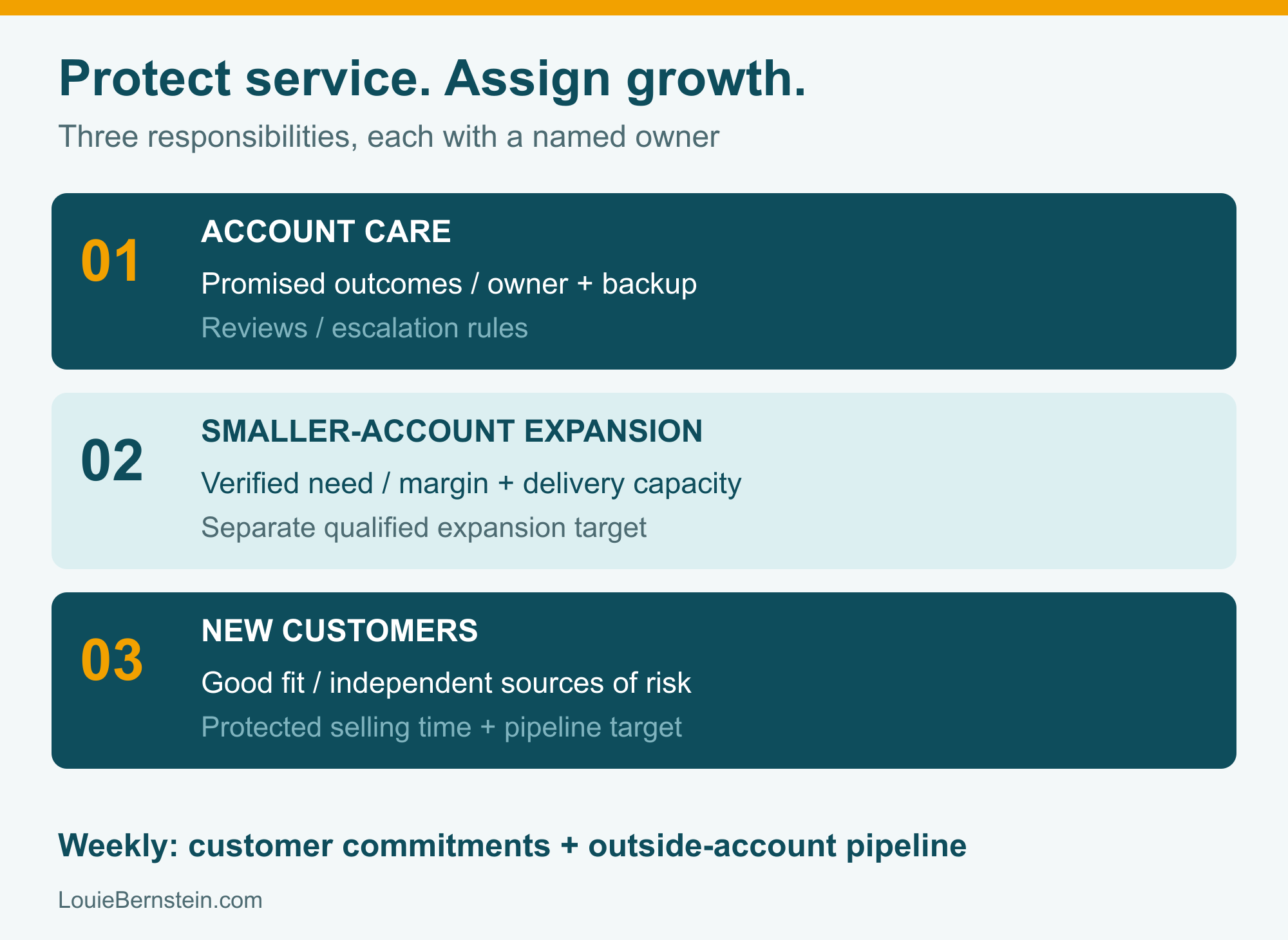
Protect your best customers with a written coverage plan before redirecting founder time toward growth elsewhere. Name an account owner and backup, document promised outcomes, and agree on review and escalation routines. Customers should experience dependable coverage as your team takes responsibility, rather than discovering that access disappeared without explanation.
Write the service floor before changing the calendar
List what each strategic account is entitled to receive under its agreement. Add the operating details: who responds, who follows through, when progress is reviewed, and which problems require executive attention. Don't promise a response time your team can't meet.
Distinguish contracted obligations from habits you've developed. A founder joining every status call may be a habit. An agreed implementation milestone is a commitment. Change the first deliberately; deliver the second.
Introduce the account owner while the relationship is healthy. Attend a customer review together. Have the new owner lead the next review and send the follow-up. Stay available for strategic decisions while allowing the owner to handle ordinary questions.
What I've seen in founder-led sales
I've written about the pattern where a founder runs the biggest account's reviews, takes the escalation calls, and becomes the relationship. Meanwhile, new-customer selling gets thinner. The account percentage and the founder's calendar tell the same story.
My advice is to teach the team to own the work. If a salesperson brings you a customer issue, ask what happened, what they've tried, and what they recommend. Coach the decision. Taking every problem back teaches the customer and the salesperson to wait for you.
Put responsibilities in an Accountabilities Document and record customer commitments in the CRM. A handoff isn't complete because you announced a new owner. It's complete when the customer gets reliable answers and the team follows through without your reminders.
How Do You Make Diversification Happen Every Week?
Make diversification happen by giving outside-account growth a named owner, a qualified pipeline target, and protected selling time. Review account health alongside growth so neither responsibility disappears. A small B2B team can assign both jobs without creating two departments, but each job needs a clear outcome and a visible weekly commitment.
Work backward from the outside-account target
Use the illustrative $600K net growth requirement. Suppose qualified smaller-account expansion can supply $240K net. New customers must supply the remaining $360K. At $60K ARR per new customer, that's six wins. At a historical 25% win rate on comparable qualified opportunities, six wins require 24 opportunities.
Those are planning assumptions, not benchmarks. Use your own deal sizes, stage definitions, sales cycle, and losses. Twenty-four opportunities won't solve a six-month deadline if comparable deals usually take nine months to close. Build the timeline around buyer decisions and your team's capacity.
Give the team a documented Sales Playbook so new-customer wins don't require your personal involvement in every meeting. Define qualification, discovery, next steps, and stage exit criteria. Then coach against the process.
Review outcomes, not just calendar activity
Once a week, review strategic-account commitments, qualified expansion outside the exposed group, new-customer opportunities, and the next buyer action on each important deal. If prospecting time was canceled for an account problem, identify the cause and reschedule the selling work.
Don't reward a rep for booking lots of small, poor-fit customers simply to improve the percentage. Check margin, onboarding capacity, and payment terms. Diversification that overwhelms delivery can damage both the new customers and the accounts paying today's bills.
How Will You Know Customer Concentration Is Actually Falling?
Track account concentration, retained revenue, gross profit, and customer service together to see whether diversification is working. A falling largest-customer percentage is useful only when the underlying business remains healthy. For a founder-led company, also measure whether routine account care and new-customer selling still require the founder to keep moving.
Keep a small monthly scorecard
- Largest account and exposed group's share of ARR, using the same snapshot date.
- Net ARR added outside that group, split between existing accounts and new customers.
- Gross profit and overdue invoices by important account.
- Missed customer commitments, renewal risks, and unresolved escalations.
- Founder time spent on routine account work and customer acquisition.
Net revenue retention doesn't replace this scorecard. ChartMogul's NRR definition includes expansion and losses within existing subscribers and excludes new business. An NRR above 100% can coexist with rising concentration if the largest customer drives the expansion.
Also check why a concentration percentage fell. Losing part of your largest account can improve the ratio while hurting cash flow. Growing a broad, profitable base is a different result. Your review should distinguish the two before anyone celebrates.
If the plan keeps failing because you remain the account owner, sales manager, and closer, a Fractional Sales Leader can help build the process and coach the team. Hiring more people without changing ownership just gives you more people to direct.
Related Reading
How Much Revenue Should Your Biggest Customer Be? →
Frequently Asked Questions
Q: Should I turn down additional work from my biggest customer?
Evaluate the work on margin, delivery capacity, contract terms, and the concentration it creates. Profitable expansion can make sense. Include its effect in the outside-account growth target before accepting work that consumes the team's entire capacity.
Q: Should I pay higher commissions for new customers?
Consider different incentives when the current plan consistently rewards growth inside the largest accounts and leaves acquisition undone. Model the economics first, define who receives credit, and avoid encouraging poor-fit sales or neglect of renewals.
Q: Can customer referrals help diversify revenue?
Referrals can introduce qualified buyers, but check whether referred companies share ownership or the same spending risks. Ask your best customers for introductions to organizations with a similar need, then qualify each opportunity independently.
Q: Should I enter a new industry to reduce concentration?
Enter a new industry only when you can validate demand and serve buyers with a repeatable offer. Start with a narrow test. Changing industries can reduce shared exposure, but unfamiliar buyers, requirements, and sales cycles can also slow growth.
Q: What if I can't afford a separate account manager?
Assign account care to a capable existing team member with clear capacity and backup coverage. One person may handle more than one role. Specify the commitments and time available rather than assigning responsibility without room to do the work.
Build growth beyond your biggest accounts
If you're a B2B founder at $1M to $10M ARR and account care keeps pushing new-customer selling off your calendar, let's review the responsibilities and sales process. Fractional Sales Leadership can help your team protect current relationships while building a wider customer base.
Schedule a 30-Minute CallAbout the Author
Louie Bernstein
Louie Bernstein is a Fractional Sales Leader with 50 years of sales experience and has provided Fractional Sales Leadership since 2017. He helps B2B founders build repeatable sales systems so their teams can sell without depending on the founder.