Key Takeaways:
- Earn the next sale by proving the first purchase worked.
- Look for a specific new need, not just a customer who likes you.
- Usage growth, new hires, and new use cases are reasons to ask questions. They aren't commitments.
- Give every expansion opportunity one owner and customer-based stage criteria.
- Measure the added recurring revenue, delivery cost, and founder involvement.
- A longer contract improves commitment but doesn't automatically add ARR.
Your salesperson asks for more leads. Meanwhile, an existing customer has hired another team, opened a second location, or started using your product for a problem nobody discussed during the original sale.
Who notices? Often, you do. You know the customer. You make the call. You find the additional business. The account grows, but the company still needs you to make growth happen.
For a founder at $1M to $10M ARR, that is another sales process waiting to be built. Some of your next revenue may sit inside accounts you already serve. It isn't free, and it isn't always cheaper to win than a new customer. But it deserves a deliberate place in your Sales Playbook.
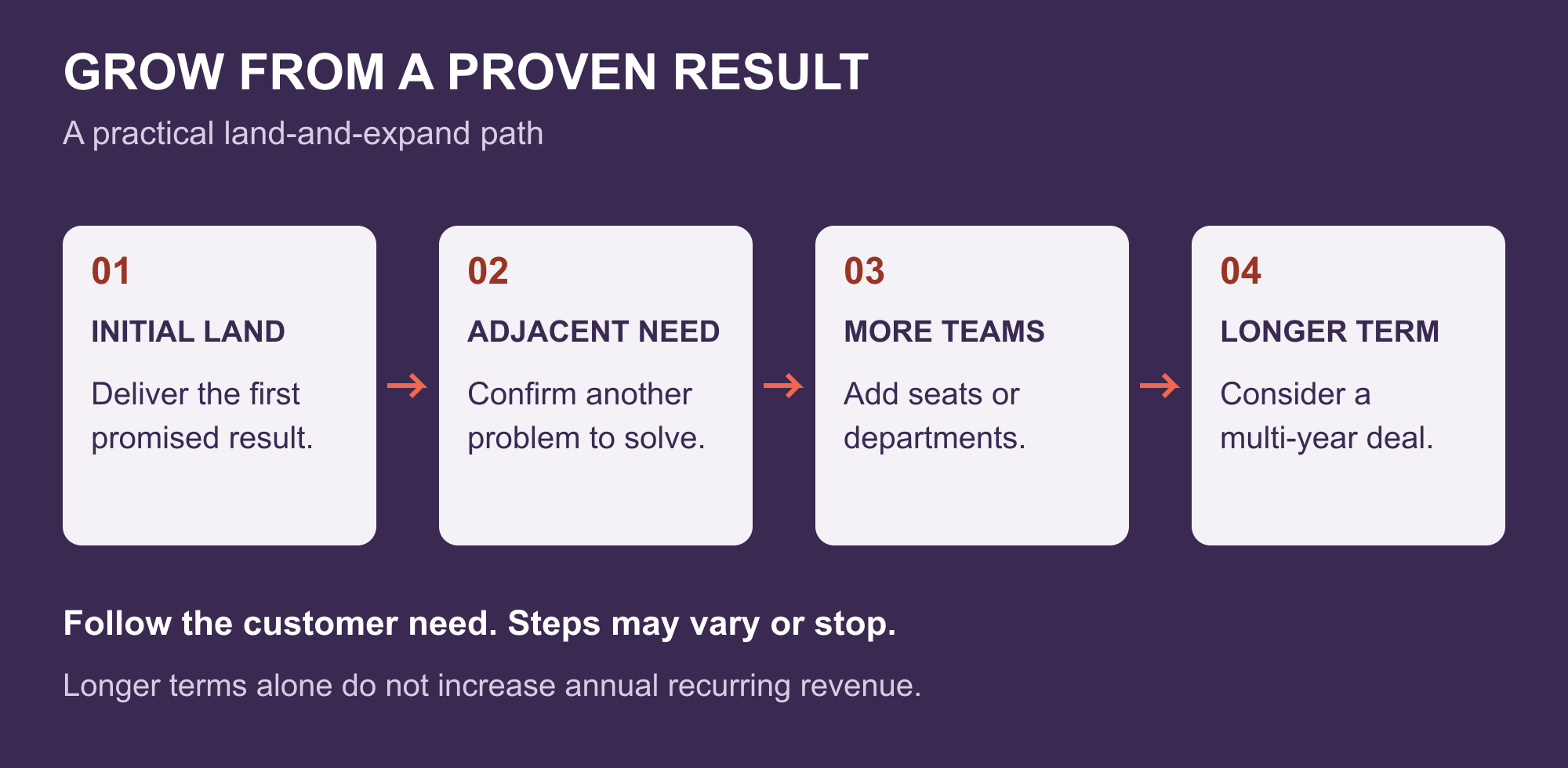
An expansion playbook gives the team a way to find a new need, confirm its value, and earn the next agreement. Start with the customer's results. Then work toward a purchase that makes sense for both businesses.
The customer bought once. Your team still has to earn the next yes.
1. Find the next problem inside the account
Start with proof of the first result
Before you discuss an upgrade, pull the original sales notes. What did the customer expect to improve? Who agreed to that result? What evidence shows progress?
Ask the account owner to answer those questions with the customer. A successful onboarding checklist doesn't prove business value. Neither does a friendly email. You need the buyer's view of what changed and what still needs work.
For example, a customer may confirm that weekly reporting now takes two hours instead of six. Treat that as an account-specific result only if the customer supplied or verified the numbers. Don't turn an internal guess into a sales claim.
If the first purchase isn't working, write a recovery plan with an owner and review date. Don't use an expansion pitch to avoid that conversation. More scope can make an unresolved delivery problem harder to fix.
Map three practical paths
Look for more of the same need: additional users, locations, or volume. Then look for an adjacent problem your current offer can solve. Finally, look for another department with a similar problem and its own buyer.
Those paths require different discovery. Ten additional seats may fit the existing agreement. A new department may require security review, separate funding, and a different implementation plan. The company name is familiar; the buying process may be new.
Salesforce's account planning guidance recommends documenting customer priorities, pain points, and success measures in a shared account plan. Keep your version short enough for your team to use during a call.
Record the current result, possible next need, affected team, relevant contact, and unanswered question. Label unconfirmed ideas as hypotheses. An account map helps you decide what to investigate. It does not belong in the forecast as booked business.
2. Know when to expand and when to wait
Use signals to open discovery
A rise in usage is worth investigating. Ask whether it reflects lasting demand, a temporary project, or people struggling to complete a task. A spike alone doesn't tell you which one is true.
New hires can point to more users or a new leader's priorities. Ask which roles are being added and how their work connects to your offer. Company growth doesn't guarantee growth in your account.
A new use case deserves a closer look when the customer describes a problem your team can solve. Ask who owns that problem, what it costs to leave it alone, and why it matters now.
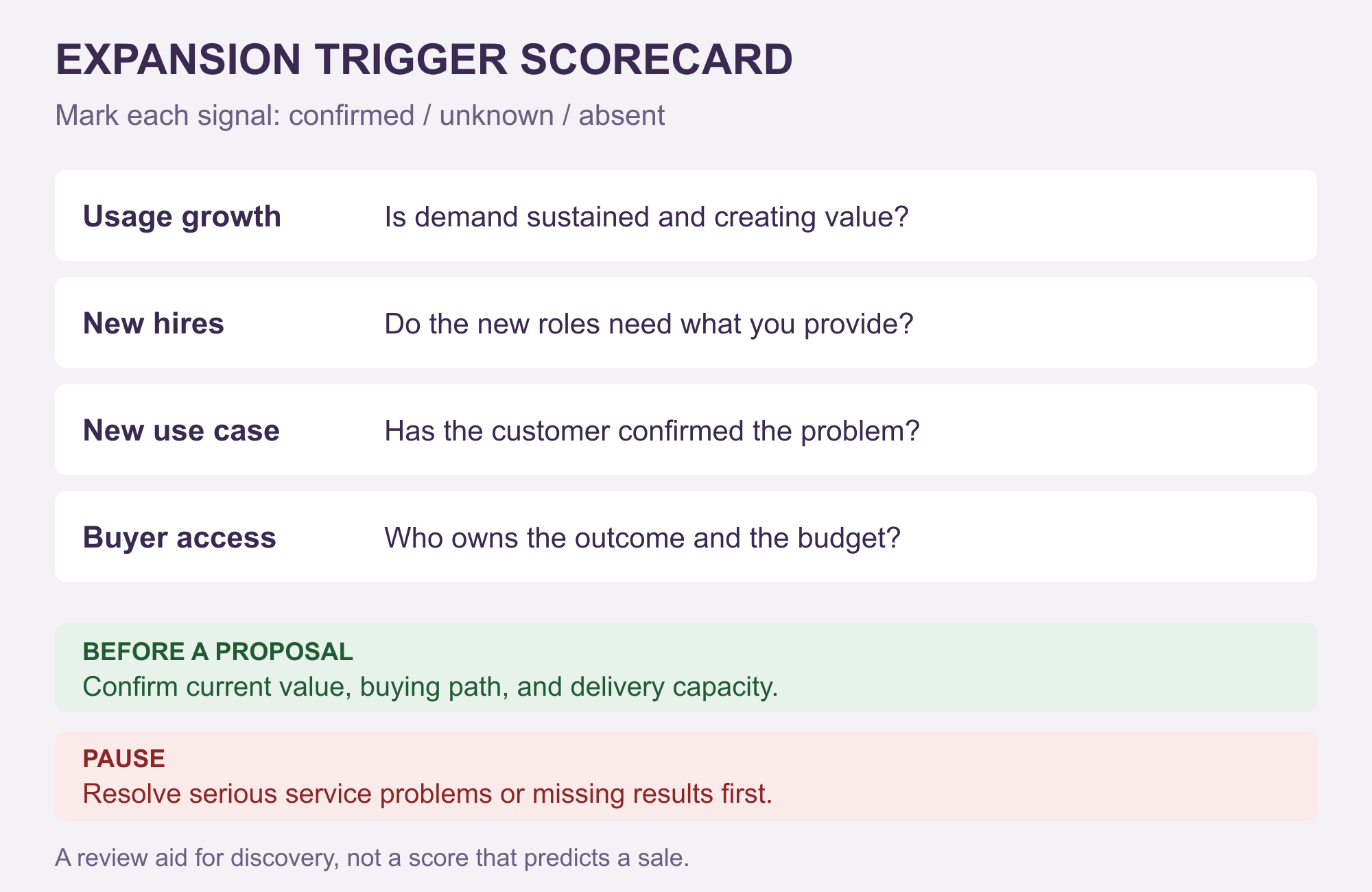
Use the following scorecard as a review aid, not a statistical prediction. Mark each signal confirmed, unknown, or absent. Then decide which conversation would resolve the most important unknown.
Apply a readiness check before proposing
Before a proposal, confirm four things: the customer recognizes current value, the new problem matters, someone can make the buying decision, and your team can deliver the added scope.
If any answer is unknown, assign a next step. If current value is missing or a serious service issue remains unresolved, address that first. A calendar reminder saying "upsell at day 90" should never overrule the account facts.
An exception needs a clear explanation. Sometimes additional scope directly solves the current problem. Explain what belongs in the original commitment, what is new, and why the customer would pay for the difference. Don't charge an expansion fee to correct work you already promised.
Agree on the timing with the customer. Their planning cycle, hiring date, or operating deadline is more useful than your quarter-end target. Record the event and the buyer's words in the CRM.
3. Run an expansion call that earns a next step
Ask about the work before discussing the package
Start with what the customer has achieved. Ask what remains difficult. Then explore the signal your team noticed without pretending you already know the answer.
For a hypothetical customer adding a second operations team, the conversation might start: "You mentioned another team coming on board. How will they handle the reporting process we built with your first team?"
Follow with questions that make the need concrete. Who will use it? What happens if the current process stays in place? Who approves the spend? What would a successful rollout look like? Which date matters, and why?
Don't ask your existing contact to speak for everyone. Request an introduction to the person responsible for the new team's outcome. Give your contact a short explanation they can forward, based on the problem they confirmed.
Build a small, credible business case
Summarize the current result, the next problem, proposed scope, expected benefit, implementation work, and price. Separate customer-confirmed facts from assumptions that still need checking.
Here's an illustrative revenue example. An account pays $24,000 a year. An added department would pay another $12,000 a year for recurring service. If signed and active under your revenue policy, the account reaches $36,000 ARR and the expansion contributes $12,000 ARR.
That doesn't mean the full $12,000 is profit. Estimate onboarding, support, staffing, and any special work before quoting. A bigger contract that consumes your delivery capacity can leave the business worse off.
Agree on a next action with a person and a date. "Send me something" is weak evidence. "Our operations lead and budget owner will review the scope with you Thursday" gives the rep a defined step to run.
A signal starts a question. A customer commitment moves the opportunity.
Treat a multi-year agreement as a separate decision
Once the customer sees repeatable value, a longer agreement may make sense. Discuss the benefit to both sides, delivery commitments, scope, and commercial terms. Don't make a longer term the required destination for every account.
A $24,000 annual agreement extended to three years at the same annual price still represents $24,000 ARR. The $72,000 total contract value isn't $72,000 in annual recurring revenue. Keep term extension and scope expansion separate in your reporting.
4. Give the team ownership and clear sales stages
Name one commercial owner
A small company doesn't need a new department to start. It needs a named person who coordinates account discovery, proposal work, and follow-through. Delivery can surface signals while the commercial owner manages the sale.
Put that responsibility in the Accountabilities Document. Define who contacts the customer, who approves scope and pricing, and who handles implementation. Make time for the work. Expansion will lose to urgent new sales if it has no place in the weekly schedule.
Set an escalation rule for founder involvement. Perhaps you join a strategic executive meeting or approve an unusual commitment. That is different from taking over every call because you know the account best.
Move stages only when the customer acts
Keep unqualified signals on the account record. Create an expansion opportunity when the customer confirms a new need and agrees to explore it. Link it to the existing account and separate it from the renewal opportunity so the team doesn't count the same revenue twice.
Use a short sequence with explicit exit criteria:
- Need confirmed: The customer describes the problem, affected team, and reason to act.
- Buying process confirmed: The decision maker, funding path, and timing are understood.
- Scope reviewed: The customer reviews the proposed work and expected result; delivery confirms capacity.
- Decision scheduled: Remaining questions and the decision date are agreed with the buyer.
- Agreement signed: The added scope, price, and start date are documented and handed to delivery.
A rep sending a proposal doesn't prove the customer reviewed it. An internal close date doesn't prove the buyer agreed to decide. Coach the distinction during pipeline reviews.
Keep the proposed increase separate from the account's existing revenue. If the account already pays $24,000 and the opportunity would add $12,000, the expansion pipeline amount is $12,000. Use the same recurring-revenue basis throughout.
5. Install the playbook in thirty days
Start with a manageable account list
In week one, choose ten accounts as a practical starting point, not a required benchmark. Pick accounts where your team can check results and speak with a relevant contact. Assign owners and collect the facts before setting expansion targets.
In week two, review the strongest signals and schedule discovery. Role play the questions before the calls. Ask the rep to explain the customer's possible need and what evidence would disprove it.
In week three, review what customers actually said. Advance qualified needs. Return weak ideas to the account plan. Bring delivery into scope discussions before the team promises more work.
In week four, examine the process. Where did reps need help? Which fields were missing? Which opportunities required you to rescue the conversation? Update the Sales Playbook with the questions, stage criteria, and handoff details that proved useful.
Measure growth and independence together
Track qualified expansion opportunities, signed incremental recurring revenue, time to close, and the source of expansion. Separate added scope from price increases. For project businesses, measure additional project revenue separately from ARR.
Check the accounts after delivery begins. Did the added team adopt the service? Did the promised result happen? Review churn and contraction alongside expansion so a large win doesn't hide a weakening customer base.
Also record which calls the team ran without you and where founder help was needed. Use those notes for coaching, not punishment. Your goal is a process the team can repeat with sound judgment.
Thirty days may produce better account information and qualified opportunities before it produces signed revenue. That is useful progress. Don't pressure reps to manufacture expansion just to prove the playbook works.
Frequently Asked Questions
Q: What is expansion revenue?
Expansion revenue is additional revenue from existing customers. It can come from more seats, added services, another department, or higher pricing. When reporting expansion ARR, include only the recurring increase and keep one-time work separate.
Q: How is upselling different from cross-selling?
Upselling usually means a larger or higher-tier version of the current purchase. Cross-selling means an additional product or service. Both need a clear customer problem, a credible benefit, and a buying decision.
Q: When should we ask a customer to expand?
Start discovery when a relevant signal appears. Propose when the customer recognizes current value, confirms the new need, and has a buying path. Check delivery capacity before making commitments. Time in the account alone isn't enough.
Q: Who owns expansion before we hire an account manager?
Assign one commercial owner from the current team and define the work in the Accountabilities Document. Delivery should share account signals and help assess scope. The founder should coach and handle agreed exceptions rather than own every sale.
Q: Does a multi-year renewal count as expansion?
A longer term at the same annual price doesn't increase ARR. It changes the contract commitment. If the customer also adds recurring scope or accepts higher annual pricing, report that annual increase as expansion under your measurement policy.
Q: Can expansion replace new customer sales?
It can contribute to growth, but existing accounts have limits. Build separate plans for expansion and new customers. Watch customer concentration so your growth doesn't depend on one account continuing to buy more.
Build an expansion process your team can run.
If account growth keeps landing on your calendar, Fractional Sales Leadership may help you define ownership, build the Sales Playbook, and coach the team. Learn how I work at LouieBernstein.com.
Schedule a 30-Minute CallAbout the Author
Louie Bernstein
Louie Bernstein is a Fractional Sales Leader who helps B2B founders at $1M to $10M ARR build repeatable sales systems, develop their teams, and reduce founder dependence.