Key Takeaways:
- A win/loss analysis is a structured debrief of a closed deal, win or lose, so you learn why it went the way it did and change one thing before the next one.
- The reason your rep typed into the CRM is almost never the real reason. Clozd found 85% of logged loss reasons are wrong, and buyer and seller agree on the cause only 15% of the time.
- Companies with a formal win/loss program see up to a 50% lift in win rate and a 15–30% revenue increase (Gartner). 63% report win-rate gains, rising to 84% after two years (Clozd).
- Run the interview within about three weeks of the decision, while the buyer still remembers. Response rates run 30–80%, far above a survey.
- The founder is the worst person to run the loss interview. Buyers won't tell you to your face. A neutral third party gets more than double the satisfaction with feedback quality.
- Findings you don't act on are just nicely formatted regret. Every debrief must end with one specific change to your process.
Years ago I lost a deal I was sure I had won. The prospect loved the product. Loved my team. Told me on a Friday we were "basically there." The following Wednesday, they signed with someone else.
I logged it in the pipeline the way everyone logs it. "Lost on price." Closed the record and moved on.
Two weeks later I called the buyer anyway, mostly to keep the relationship warm. And she told me the truth. It wasn't price. My competitor had gotten to her CFO, the person who actually signed, while I'd been busy charming the champion who couldn't sign anything. I never got in the room with the real decision-maker. That's why I lost.
"Lost on price" would have taught me nothing. It would have sent me into the next deal cutting my rate for no reason. The real answer told me exactly what to fix. That's the entire point of a win/loss analysis, and most founders running their own sales never do it.
Why "We Lost on Price" Is Almost Always a Lie
A win/loss analysis is a structured review of a deal after it closes, win or lose, to figure out what actually drove the outcome. It's not a feeling. It's not the one-line reason a rep types at 5pm on a Friday to clear a stuck record out of the pipeline. It's a deliberate process to get the truth, because the truth is the only thing you can act on.
And here's the problem with what's sitting in your CRM right now: it's mostly fiction. Clozd's research found that 85% of the loss reasons logged in CRMs are wrong. When they compared what sellers thought and what buyers actually said, the two lined up only 15% of the time. Your reps aren't lying to you. They just don't know. Nobody asked the buyer.
This matters more the smaller you are. When you're a founder between $1M and $10M in revenue, you don't lose fifty deals a month where the pattern averages out. You lose a handful, and each one is a data point you can't afford to misread. Guess wrong about why, and you "fix" the wrong thing. You discount when the issue was follow-up. You rebuild the demo when the issue was that you never reached the buyer with budget authority.
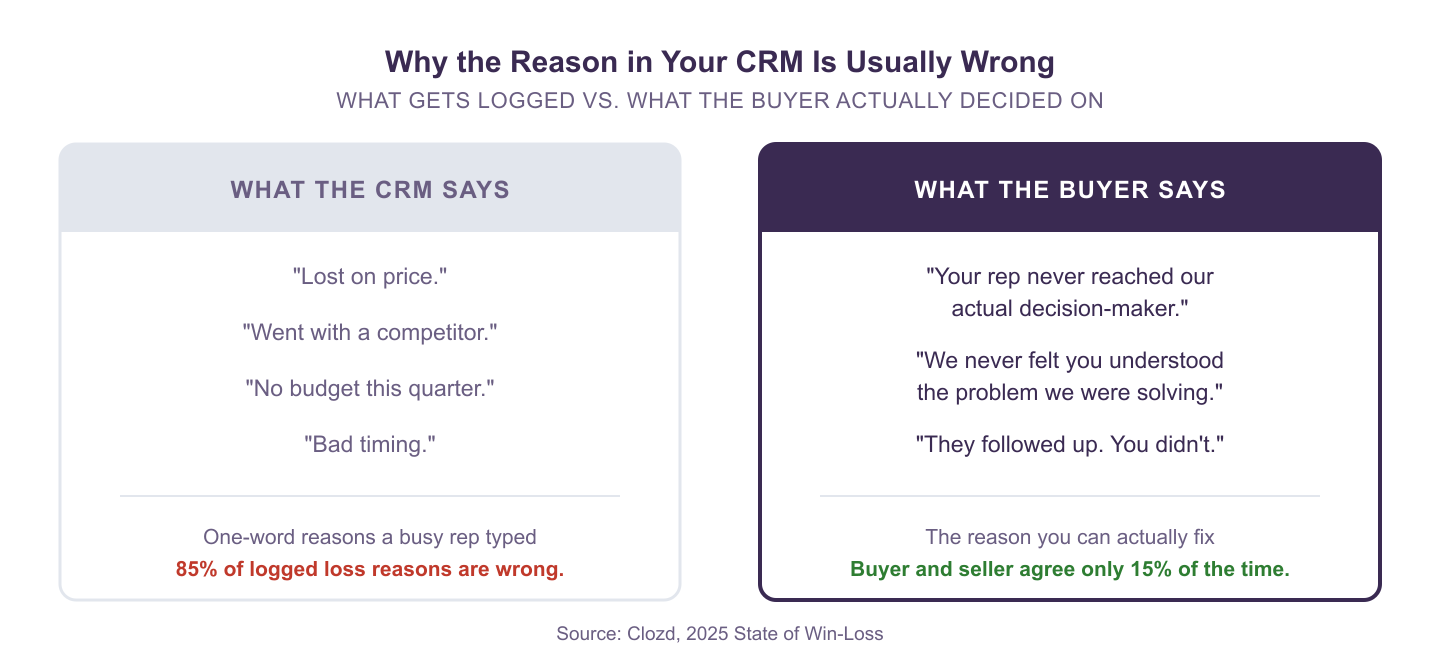
The reason in your CRM is a guess your rep made to close a record. The reason from the buyer's mouth is the one you can actually fix. Those are rarely the same sentence.
How to Run the Win/Loss Meeting, Step by Step
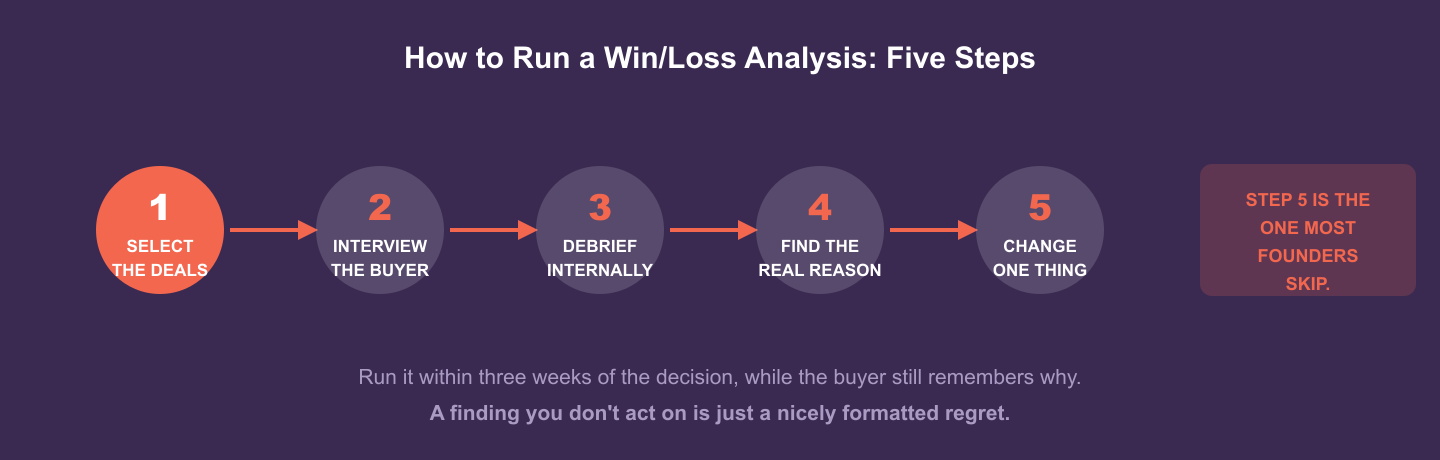
I've run this drill after every meaningful deal for as long as I've been selling. In my playbook I call it debriefing a deal, and the rule is simple: we either win, or we learn. There is no third outcome. Here's the process I teach.
Step 1: Select the deals worth reviewing
You don't debrief every $500 deal. You debrief the ones that teach you something: your bigger wins, your painful losses, and any deal where the outcome surprised you. If you closed it and can't cleanly explain why, that deal goes on the list. Review both wins and losses. Wins tell you what to repeat. Losses tell you what to stop.
Step 2: Interview the buyer
This is the step almost everyone skips, and it's the one that matters most. Call the buyer. Not an email survey, a real conversation. Tell them you're not trying to reopen the deal, you're trying to get better, and their honest feedback would mean a lot. People help when you ask like that. Win/loss interviews get response rates between 30% and 80%, far higher than any survey you'll send.
Ask open questions and then be quiet. "Walk me through how you made the final decision." "When did you start leaning toward the other option?" "What almost made you go the other way?" The gold is in what they volunteer when you stop talking.
Step 3: Debrief internally against a fixed list
Then sit down with your own notes and the buyer's answers and go through the same questions every time. Same list, every deal. That's what turns anecdotes into a pattern. Here's the exact list I use:
- What did we do right?
- What did we do wrong?
- What were the signs we missed?
- Do we know the exact reason they bought, or didn't?
- Was the final approver and signer involved? When did they get involved?
- Did we ask all of our prepared qualifying questions?
- How many closing questions did we ask? How many meetings did we actually have?
- Is there a chance to win their business in the future? If so, how?
Notice how many of those are about your process, not the buyer's mood. "Was the signer involved, and when?" is the single most predictive question on that list. In my lost deal it was the whole story.
Step 4: Name the real reason
Now force yourself to write one honest sentence about what actually decided it. Not "price." A real cause: "We never got a meeting with the economic buyer." "Our follow-up went cold for nine days and theirs didn't." "We qualified on need but never confirmed budget." If you can't say it in a sentence a competitor could exploit, you haven't found it yet.
Step 5: Change one thing
Every debrief ends with one change to how you sell. One. Add a qualifying question that forces you to identify the signer by the second call. Set a follow-up cadence nobody's allowed to break. Build a specific answer to the objection that keeps beating you. A finding you don't turn into a rule is entertainment, not analysis.
When to Do It, and Who Should Ask
Timing: within about three weeks
Do it too early and the buyer is still guarded, maybe still finishing paperwork with the winner. Do it too late and the details blur. The sweet spot most practitioners land on is roughly 7 to 21 days after the decision, and no later than four weeks. Recent enough that they remember the specifics, settled enough that they'll be candid. The closer to the decision you ask, the higher your response rate.
Who asks: not you
This is the hard part for founders. You are the worst possible person to run your own loss interview. The buyer likes you. They don't want to tell the founder to his face that his rep dropped the ball or that the demo missed. So they soften it, and you hear "price" again. Companies that use a neutral third-party interviewer are more than twice as likely to be satisfied with the quality of the feedback: 70% versus 34% for internal programs.
You don't need a research firm at your stage. You need someone who isn't emotionally attached to the deal asking the questions and writing down what's actually said. This is one of the quiet, high-leverage things a Fractional Sales Leader does. I can call your lost buyer and get an honest answer precisely because I'm not the person they turned down.
Buyers will tell a neutral party what they'll never tell the founder. That gap between the polite answer and the honest one is exactly where your next ten wins are hiding.
What to Do With the Findings
A win/loss finding is worthless until it changes behavior. This is where most programs die. The report gets written, everyone nods, and the next deal is run exactly the same way. The companies that actually see the win-rate lift do three things with what they learn.
Turn each finding into a process rule
If you keep losing because the signer shows up late, you don't remind people to "engage decision-makers earlier." You add a hard gate: no deal advances past discovery until the economic buyer is named and, ideally, met. Findings become rules, and rules go into your sales process where they get followed every time, not just when someone remembers.
Share it beyond the sales conversation
Loss reasons aren't only a sales problem. Sometimes the answer is a missing feature, a confusing onboarding promise, or a pricing model that scares mid-market buyers. Clozd found that 68% of companies that share win-loss insights across departments report an increase in win rate. When you're the founder, you sit on top of product and sales at once, which is an advantage. Use it. Feed what you learn into the roadmap, not just the pitch.
Look for the pattern, not the one-off
One lost deal is a story. Five debriefs with the same root cause is a diagnosis. The reason you use the same question list every time is so the pattern can surface. When three of your last five losses trace back to the same weak spot in qualification, you've found the highest-return fix in your entire business, and you found it for the price of a few phone calls. That's the compounding effect. Gartner ties formal win/loss programs to up to a 50% improvement in win rate and a 15–30% revenue increase, and Clozd's data shows the gains grow over time: 63% of programs lift win rates, climbing to 84% once the program has run two years.
Separate the Losses You Can Fix From the Ones You Can’t
Not every loss is fixable. Some deals die to budget freezes, acquisitions, or a competitor with a fundamentally different price point. Those are uncontrollable losses: note them, learn from them, and don’t obsess over them.
The money is in the controllable losses: a rep skill gap, an unclear value proposition, the economic buyer brought in too late, or a proposal that never addressed the real objection. Sort every reviewed deal into one of those two buckets before you look for patterns.
Then turn the controllable pile into three specific actions: one change to your ICP or targeting, one change to your sales process or playbook, and one coaching focus for your reps. Give each an owner and a 60-day checkpoint.
The Founder Blind Spot
When you close most of the deals yourself, every loss feels personal, and that's exactly why founders avoid this. Picking apart a deal you ran means admitting you might have run it wrong. So the record gets marked "lost on price," the pain gets filed away, and the same mistake gets made again next quarter. Win rates across B2B have been sliding, from around 29% to 19% in a single year by one 2025 measure, which means the deals you're already generating matter more than ever. You can't afford to keep learning nothing from the ones you lose.
A win/loss habit is one of the cheapest, highest-leverage systems you can install, and it's a natural first project when you bring in help you're not ready to hire full time for. You don't need a VP of Sales to start debriefing deals. You need the discipline to ask, someone honest enough to hear the answer, and a rule that every finding turns into one change. Do that after every meaningful deal and your close rate climbs without adding a single lead.
Frequently Asked Questions
Q: What is a win/loss analysis, in one sentence?
It's a structured debrief of a closed deal, win or lose, where you get the buyer's real reason for the decision, compare it to what your team believed, and turn what you learn into one concrete change to how you sell. The goal isn't a report. It's a higher close rate on the next deal.
Q: How soon after a deal closes should I do the interview?
Within about three weeks. The commonly cited window is 7 to 21 days after the decision, and no later than four weeks. That's recent enough that the buyer remembers the specifics and settled enough that they'll be candid instead of guarded. The sooner you ask, the more likely they are to take the call.
Q: Why can't I just trust the loss reason my rep logged in the CRM?
Because it's usually wrong. Clozd found 85% of CRM loss reasons don't match reality, and when they compared seller assumptions to buyer answers, the two agreed only 15% of the time. Your rep isn't lying. They're guessing, because nobody asked the buyer. "Lost on price" is the default guess, and it sends you cutting rates when the real problem was follow-up or access to the decision-maker.
Q: Should I interview lost deals only, or wins too?
Both. Losses tell you what to stop doing. Wins tell you what to repeat, and they're the ones founders forget to study. A won deal quietly reveals your real strengths, the moment the buyer decided, and the objection you handled without realizing it. If you only ever autopsy losses, you'll fix weaknesses and accidentally break the things that were working.
Q: Isn't a formal win/loss program overkill for a company my size?
The tooling might be. The habit isn't. You don't need software or a research vendor between $1M and $10M in revenue. You need a fixed question list, a phone call to the buyer, and a rule that every debrief produces one change. Start with your five biggest deals this quarter. The discipline is what drives the win-rate lift, not the platform.
Q: The buyer already told me why they didn't pick us. Do I still need to ask?
Yes, and preferably not by you. What a buyer tells the founder in the moment is the polite version. The honest version comes out when a neutral person asks a week or two later, with no deal on the line. Companies using a third-party interviewer are more than twice as satisfied with the feedback quality, 70% versus 34%, for exactly this reason. The comfortable answer and the true answer are rarely the same.
Q: Can win/loss analysis help with pricing decisions?
Yes, and it’s one of the most underused applications. When you compare wins and losses by deal size and decision driver, price objections usually cluster around deals where value was never clearly established, not deals where the product was genuinely too expensive. Most “price losses” are really value-communication losses.
Q: How often should I run a win/loss review?
Review every closed deal briefly within a few weeks of the decision, and do a deeper pass across all of them once a quarter. The quick reviews catch emerging patterns; the quarterly pass is where you pick the three actions.
You're losing deals for a reason you haven't heard yet.
The answer isn't in your CRM. It's in a ten-minute call with the buyer who turned you down, asked by someone they'll actually be honest with. Let's spend 30 minutes on your last few losses and find the one change that lifts your close rate.
Schedule a 30-Minute CallAbout the Author
Louie Bernstein
Fractional Sales Leader with 50 years of sales experience helping $1M–$10M ARR companies build scalable, repeatable sales systems. Founder of MindIQ (INC 500). LinkedIn Top Voice in Sales Management, Sales Operations, and Sales Coaching.