Key Takeaways:
- Likes and comments are attention, not pipeline. Attention only has value if you move it toward a conversation.
- There is a path from a like to a booked call, and every stage has one action that moves a person to the next one.
- Your posts get you noticed. Your profile does the selling. Fix the profile before you chase more reach.
- The outreach that works gives before it asks. The pushy pitch to a stranger gets ignored or blocked, every time.
- Ask for the call only after you have earned it, and make it easy to say yes with a specific reason and time.
- Track every conversation in your CRM. If it isn't in the CRM, it never happened, and you cannot tell what is working.
You posted something on LinkedIn and it did numbers. Fifty likes. A string of thoughtful comments. A few new followers. You refresh the notifications and it feels like progress. It feels like the top of a hill you have been climbing.
Then the week ends and you look at your calendar. No new calls booked. No qualified conversations started. The post did well, and nothing happened. You are busier than ever on the platform and no closer to a customer.
I have watched a lot of founders fall into this. You are at $1M to $10M ARR, still closing most of the deals yourself, and someone told you LinkedIn is where your buyers are. They were right. But being where your buyers are is not the same as turning them into buyers.
A like is a hand raised for a second. Someone saw your name, agreed with a thought, and moved on. That is worth something. It is not worth much until you do something with it. The comment section is the start of the work, not the reward for it.
The good news is that this is a system, not a talent. There is a clear path from a stranger liking your post to a real buyer sitting on your calendar. Let me walk you through it.
“A like is a hand raised for a second. A booked call is a hand raised for a reason. Your job is to close the gap between the two.”
Why Likes Feel Like Progress
Attention is easy to measure, so we treat it like a score. The number goes up, and the brain reads it as a win. But a like costs the other person nothing. It is a reflex. Most people who like your post will not remember your name an hour later.
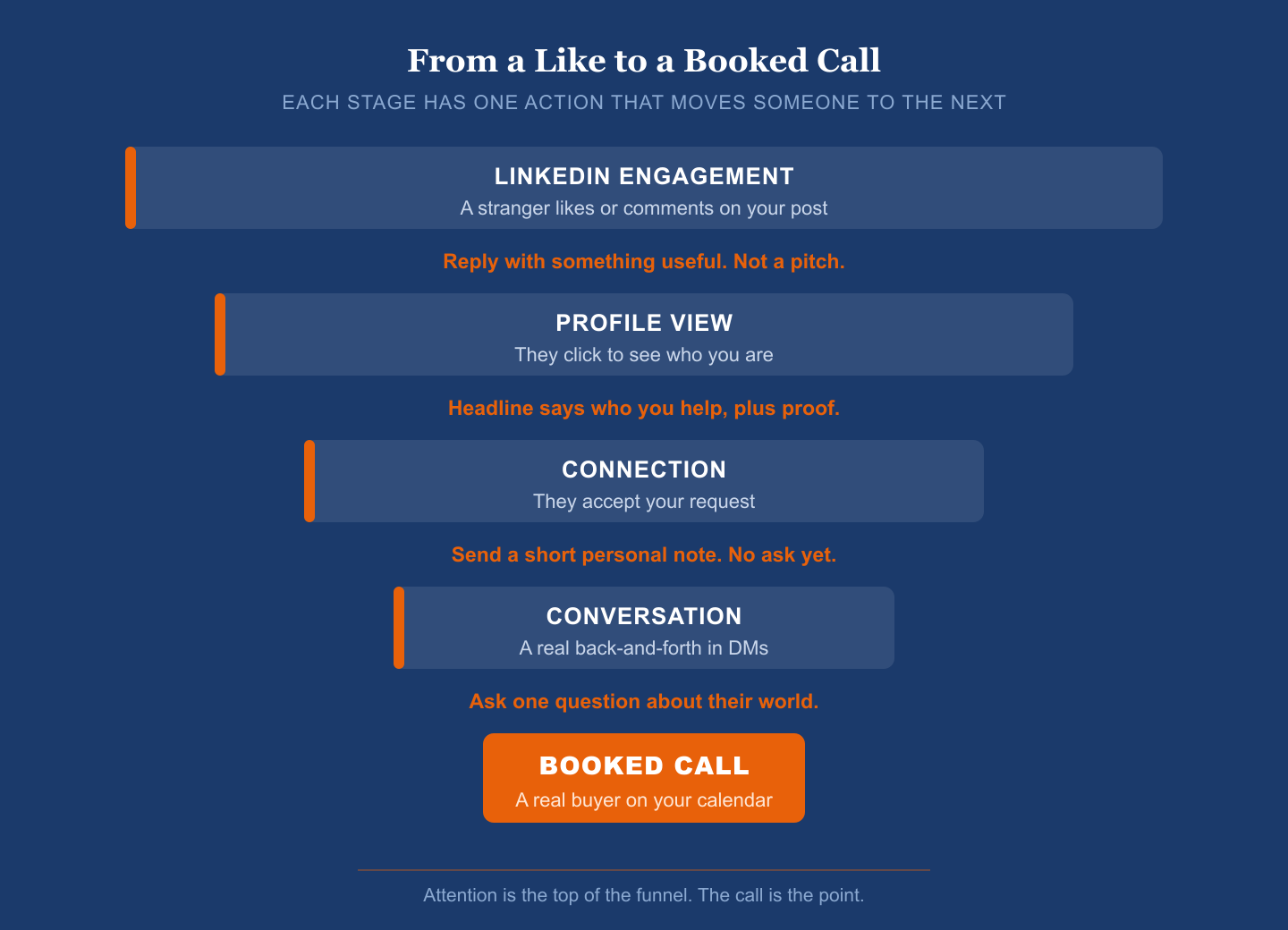
Pipeline is different. Pipeline is a person who has a problem, believes you might solve it, and has agreed to spend real time finding out. The distance between a like and that person is not one big leap. It is a handful of small, deliberate steps, and each one has an action attached to it.
Look at the funnel above. Engagement leads to a profile view. A profile view leads to a connection. A connection leads to a conversation. A conversation leads to a call. Skip a step and the whole thing stalls. Try to pitch a call to someone who just liked a post, and you have jumped four stages at once. That is why it does not work.
Start With the Post, Not the Pitch
Nothing downstream works if the post at the top does not attract the right person. Reach for its own sake is a trap. A post that goes viral with the wrong audience fills your notifications with people who will never buy. You want the right hundred readers, not the wrong ten thousand.
Write for one person, not the feed
Picture a single buyer. A founder who is drowning in deals they cannot hand off. Write to that person as if they are the only one who will read it. When you write for everyone, you sound like no one. When you write for one specific person, everyone like them feels seen.
Teach something you would normally keep to yourself
The posts that earn the right kind of attention give away something useful. A real lesson from a real deal. The thing you figured out the hard way. You are not giving away the store. You are proving you know the street. A buyer who learns something from you for free starts to wonder what working with you would be worth.
Show up in other people's comments
You do not have to post every day to win here. Some of the best pipeline starts in the comments under someone else's post, where your buyers already gather. Leave a comment that adds a point the author missed. Not "great post." A real thought. People click the names of commenters who say something worth reading. That click is the next stage of the funnel, and you triggered it without posting a word of your own.
Make Your Profile Do the Selling
Here is the part almost everyone skips. When your post lands, the interested reader does one thing before anything else. They click your name. Your profile is the first real sales call, and it happens without you in the room. If it reads like a resume, you lose them there.
Your headline is a promise, not a title
Most headlines say a job title and a company. That tells the buyer nothing about whether you can help them. Change it to who you help and what changes when they work with you. "I help B2B founders get out of doing all the selling themselves." A buyer reads that and knows in one second whether you are for them.
Put your proof where they can see it
Under the headline, a buyer is asking one quiet question. Can I trust this person? Answer it before they finish asking. Pin the post that got them here. Feature a short case, a result, a link to something you built. Fifty years in sales, twenty-two years running a company that made the INC 500, whatever your version of proof is, make it the first thing they see. Proof is not bragging. It is the buyer's shortcut to a yes.
Get the profile right and the connection request that comes next is easy. The buyer already knows who you are and why you might matter. You are not a stranger anymore. You are the person whose post they liked and whose profile made sense.
Move From Public Post to Private Conversation
This is where most founders either freeze or blow it. They have a warm connection and no idea what to say, so they either say nothing or they say the worst possible thing: a pitch. The connection request is accepted, and thirty seconds later a sales pitch lands in the inbox. It is the fastest way to turn a warm lead cold.
“Nobody was ever pitched into trusting you. Give first, ask second, and the ask stops feeling like an ask.”
Connect like a human
When you send the request, add one line. Not a hook. Not a teaser. A real reason you are connecting. "Your post on your first sales hire was sharp. I have opinions on that one too." That is it. No ask. You are opening a door, not walking through it.
Open with something useful, not a demo
Once you are connected, the first message decides everything. Look at the two messages below. They go to the same person, at the same moment, and they get opposite results. One talks about the sender and asks for time. The other references the buyer's world, gives a real idea, and ends with a question instead of a calendar link.
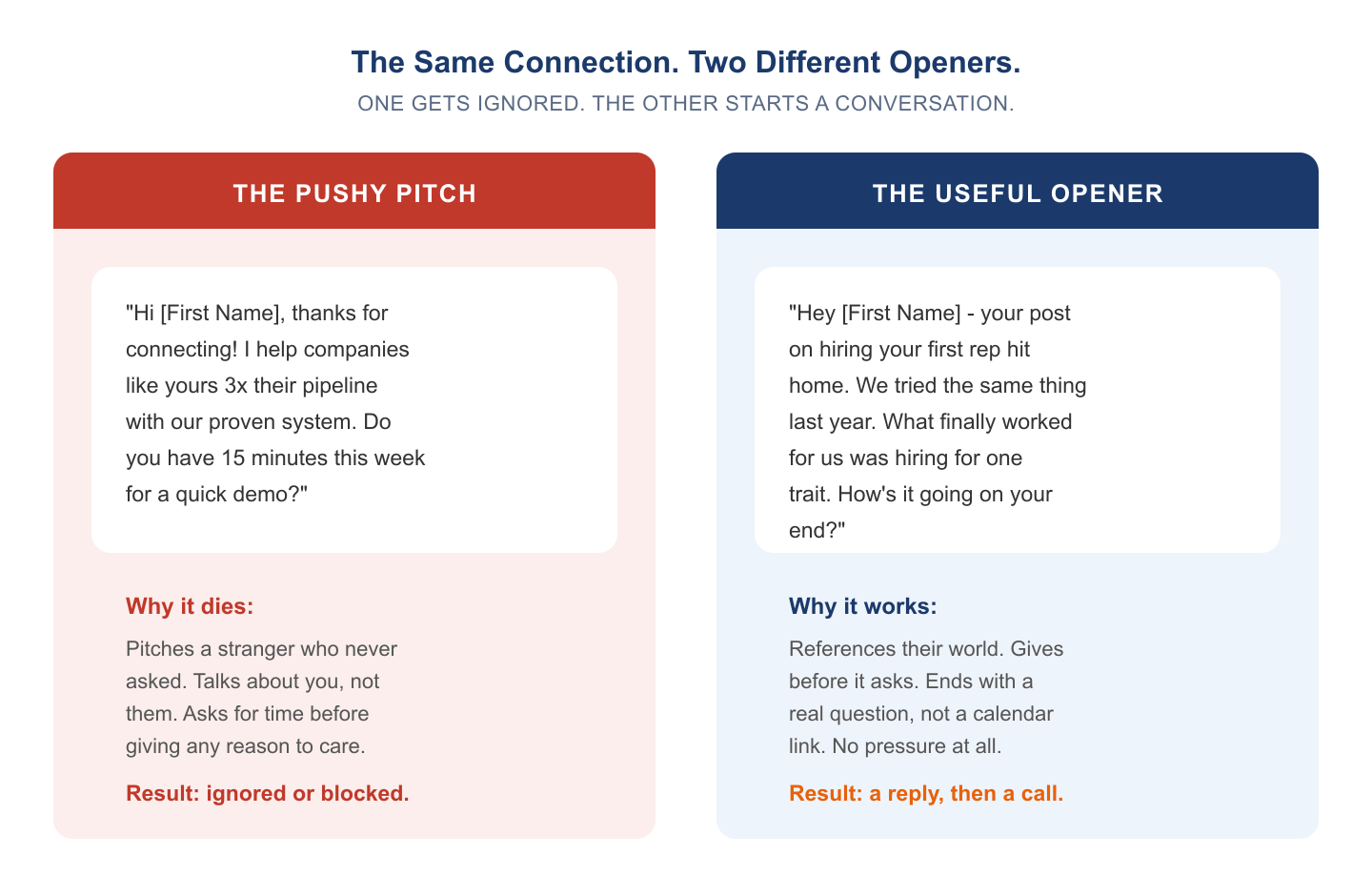
The message on the right is not clever. It is just human. It proves you read their stuff, it hands them a small idea, and it makes it easy to reply. Most buyers will not book a call off a first message. They will reply. A reply is the whole game. Now you are in a conversation, and a conversation is where calls come from.
Ask for the Call the Right Way
You have connected, opened a real conversation, and traded a few messages. The buyer has told you something about their world. Now, and only now, you can ask for the call. The timing is everything. Ask too early and you are the pushy pitch. Ask at the right moment and it feels like the obvious next step to both of you.
Earn the ask by listening first
Somewhere in the back-and-forth, the buyer will name a problem. They always do, if you ask about their world instead of talking about yours. That problem is your opening. You do not need a script. You need to have been paying attention.
Tie the call to their problem, not your calendar
The weak ask is "Do you have 15 minutes?" The strong ask names the reason. "You mentioned every deal still runs through you. I have helped a few founders build a way out of that. Worth a 30-minute call to walk you through how it works?" Now the call is about their problem, not your pitch. Give them a specific reason and a specific length, and the yes gets easy. When they agree, get a day and time before you leave the thread. A call left to "sometime next week" dies in the inbox.
Track It, or It Never Happened
Here is the part that separates a real motion from random effort. Every one of these conversations belongs in your CRM. The connection, the first message, the reply, the problem they named, the call you booked. Not in your head. Not in the LinkedIn inbox that buries everything after a week. In the system.
Do this and two things happen. You stop letting warm conversations rot because you forgot to follow up. And you start to see which posts, which openers, and which problems actually turn into calls. That is how a lucky month becomes a repeatable motion. Systems before people. Build the motion and see the numbers first, then you can hand it to someone else with confidence.
“If it isn't in the CRM, it never happened. The conversation you cannot see is the pipeline you cannot build on.”
LinkedIn rewards the founder who treats it like a channel, not a slot machine. The likes are the noise at the top. The system underneath them is what fills your calendar. Post to get noticed. Fix the profile so it sells. Reach out like a human. Give before you ask. Then ask at the right moment, and write it all down. Do that for a few months and the comment section stops being a distraction. It becomes the front door to your pipeline.
Frequently Asked Questions
Q: How many LinkedIn connections do I need before this starts working?
Fewer than you think. This is not a numbers game where you need fifty thousand followers to book a call. A founder with two thousand well-chosen connections in their target market will out-book someone with fifty thousand random ones. The motion works on quality of audience and quality of conversation, not size. Start with the connections you have. If your buyers are in there, the system runs.
Q: Should I use automation tools to send connection requests and messages?
No. The whole point of this motion is that it feels human, because it is. Automated requests and templated messages are the exact pushy-pitch behavior that gets ignored, and LinkedIn restricts accounts that run them. Worse, automation removes the one thing that works: reading the person's world and responding to it. You cannot automate paying attention. Do it by hand. It is slower and it is the only version that produces calls.
Q: How often do I need to post to get sales calls?
Less than the gurus tell you. Posting every day with nothing to say hurts you. A useful post once or twice a week, plus real comments on other people's posts, is plenty to keep you visible to the right buyers. Consistency beats volume. Two good posts a week for six months will do far more than a burst of daily posts you cannot keep up.
Q: What do I do when someone replies, then goes quiet before booking?
Follow up once, and make it useful, not needy. Do not send "just circling back." Send them something that helps: an article on the problem they named, a short answer to a question they raised. It keeps the door open without pressure. If they go quiet again, let it rest and come back in a few weeks. Warm does not mean now. Some of the best calls I have booked came from a follow-up two months after the first quiet stretch. This is why you track it. You cannot follow up on a conversation you forgot you had.
Q: Is a paid LinkedIn account like Sales Navigator worth it?
Eventually, not at the start. Sales Navigator helps you find and organize the right people once you know exactly who you are looking for and your motion already produces. If you are still learning what a good post and a good opener look like, a paid tool just lets you do the wrong thing faster. Get the free version working first. When you are booking calls by hand and want to scale who you reach, the paid tool earns its keep.
Q: How long before this turns into real pipeline?
Expect the first booked calls within a few weeks and a steady flow within a quarter. The early weeks feel slow because you are building the audience and finding your voice. Then the connections compound. A post reaches people who saw the last one, a conversation you started a month ago comes back around, and the calls start to stack. It is a flywheel, not a switch. Give it ninety days of steady work before you judge it, and track every step so you can see it building even when the calendar is still filling.
Getting attention on LinkedIn but no calls on the calendar?
Let's spend 30 minutes turning the attention you already have into a repeatable way to book conversations with real buyers.
Schedule a 30-Minute CallAbout the Author
Louie Bernstein
Fractional Sales Leader with 50 years of sales experience helping $1M–$10M ARR companies build scalable, repeatable sales systems. Founder of MindIQ (INC 500). LinkedIn Top Voice in Sales Management, Sales Operations, and Sales Coaching.