Key Takeaways:
- Inbound is a great source of leads. It is a dangerous only-source, because you do not control the tap.
- Inbound-only growth hits a ceiling. Your reach is capped, it grows slowly, and when it dips you have no lever to pull this quarter.
- Watch for the early signals: flat lead volume, longer gaps between deals, rising cost per customer, fewer net-new logos.
- The fix is not to kill inbound. It is to add a source you can turn up, mainly outbound and referrals.
- Add the second source while inbound still feels great, not the month it stops. That is the difference between a plan and a scramble.
- If it isn't in the CRM, you cannot see the dip coming. Track every source, or you are flying blind.
The good months feel like you cracked it. Leads show up in your inbox. Demos get booked without you chasing anyone. You close a good share of them, and the pipeline seems to fill itself. You start to think you have finally built a machine that runs on its own. Inbound is working, and it is easy to believe it always will.
Then a quiet month arrives. Fewer leads than usual. You tell yourself it is seasonal, or the holidays, or a slow week that will bounce back. The next month is quiet too. Now the well is running low, and you reach for the tap to turn it up, and there is no tap. Inbound does not have a dial. It comes when it comes, and this month it is not coming.
I have been in sales for over 50 years, and this is one of the most common traps I see with founders at $1M to $10M ARR. They grew on inbound. Word spread, content landed, a few good referrals rolled in, and the calendar filled. So they came to believe inbound is a permanent engine. It is not. It is a source you do not control, and any source you cannot turn up is a single point of failure.
The danger was never that inbound is bad. Inbound is wonderful. The danger is making it your only source. When 100% of your pipeline depends on people finding you, you have handed the growth of your company to luck and timing. The month that stops, you have nothing to pull. And by then it is too late to build the thing that would have saved you.
“Inbound is a great source. It is a terrible only-source. The day it dips, you have nothing to turn up.”
Let me show you why inbound-only always tops out, how to spot it before it hurts, and what to add so your growth does not live and die on leads you cannot control.
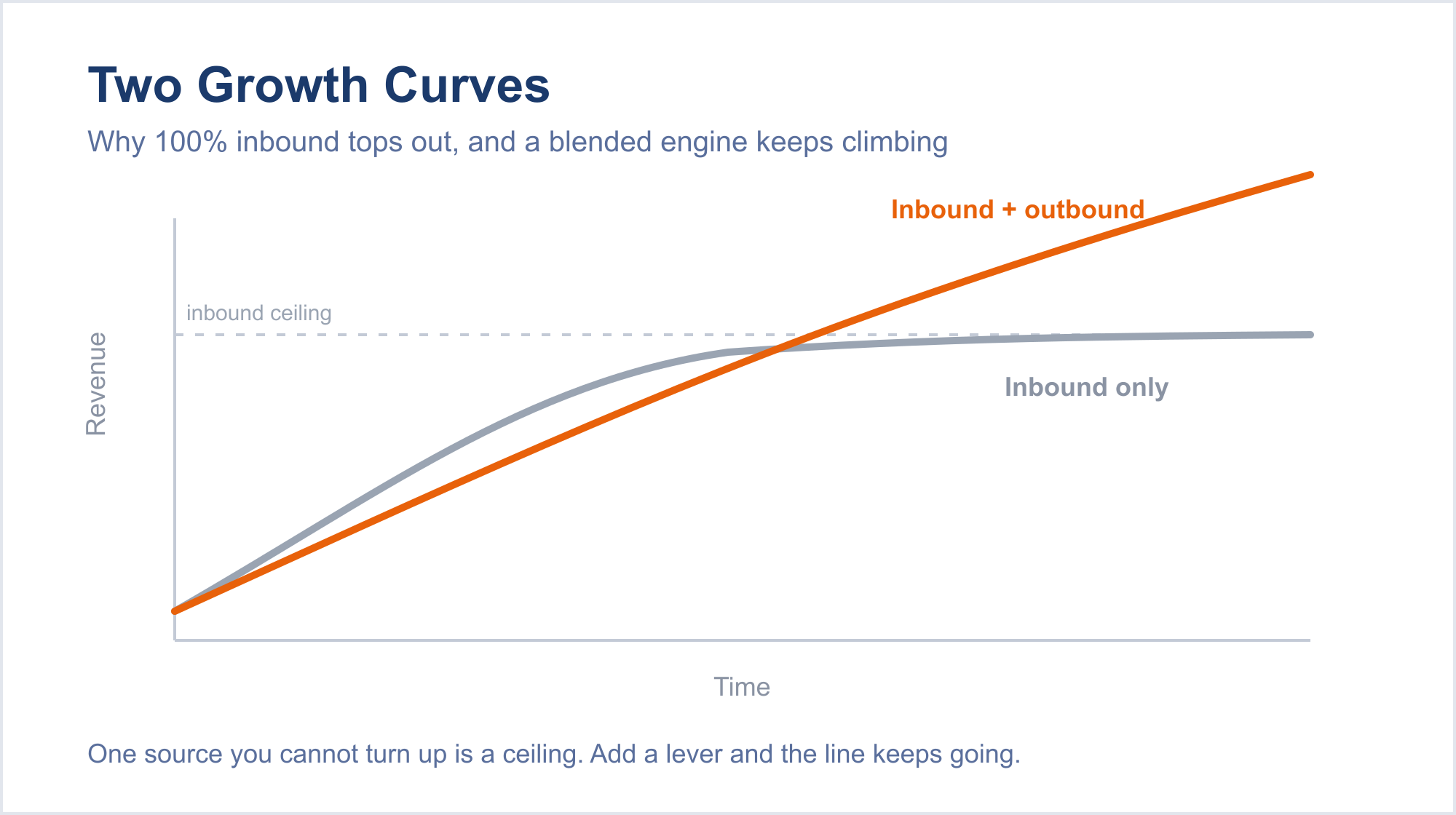
Why Inbound-Only Always Hits a Ceiling
Inbound feels like it should scale forever, because in the early days it grows fast. But it has a shape, and the shape bends flat. Understand why, and you will stop treating a temporary run as a permanent engine. There are three reasons an inbound-only motion tops out, and all three are baked in from the start.
You do not control the tap
This is the whole problem in one line. Inbound leads arrive on their schedule, not yours. You cannot decide on Monday that you need ten more demos by Friday and make inbound produce them. It responds to your content, your reputation, and your market, all of which move slowly and none of which you can turn on command. When the number you need is higher than the number showing up, inbound gives you no way to close the gap. A pipeline you cannot turn up is not something you own. It is something that happens to you.
Your reach is capped by your audience
Inbound only reaches people who already know you exist. Your followers, your readers, the folks who got a referral, the searchers who happen to find your page. That is a real audience, but it is a finite one, and it grows slowly. Every month you convert a slice of the people who found you. Once you have worked through the ones ready to buy, the well thins out, no matter how good your product is. You are fishing the same pond, and the pond has a bottom. Growing the pond takes months of audience-building before it pays, which is fine, but it means inbound can never move as fast as your quarter needs it to.
When it dips, you have no lever
Here is where the ceiling actually bites. Say a good competitor shows up, or the market gets quiet, or your best content stops ranking. Inbound drops. Now you need pipeline, and the only source you have is the one that just failed you. There is no button to push, no list to work, no calls to make, because you never built any of that. You get to wait and hope, which is not a plan. The founders who sleep well are the ones who can manufacture pipeline in a bad month. Inbound-only founders cannot, and they find that out at the worst possible time.
How to Tell Your Inbound Is Topping Out
The ceiling does not announce itself with a crash. It creeps. Inbound rarely stops all at once, which is what makes it so easy to miss. It thins, slowly, while the good months in your memory tell you everything is fine. The founders who get caught are the ones who wait for a bad quarter to admit there is a problem. The ones who stay ahead of it read the early signals and move before the dip becomes a hole. Here is what to watch for.
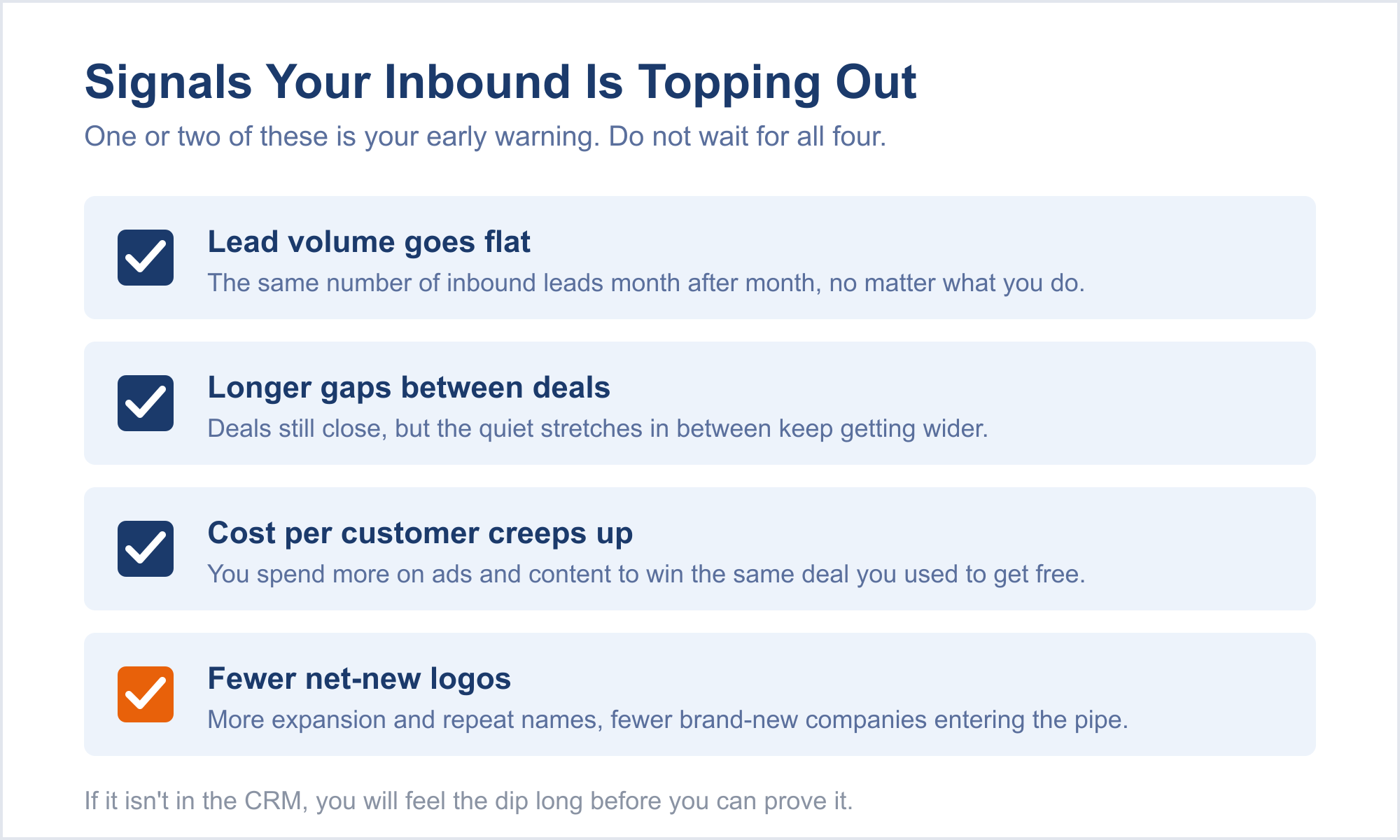
Lead volume goes flat
The first sign is a number that stops moving. You used to see inbound leads climb month over month. Now it is the same count, over and over, no matter what you publish or post. Flat is not stable. Flat is the top of the curve. When your best growth channel stops growing, that is the ceiling telling you it is near, and it is your cue to add a source that can still climb.
The gaps between deals get longer
Deals still close, so nothing feels broken. But look at the calendar. The quiet stretches between closes are getting wider. You used to book a new deal every couple of weeks, and now it is a month, then longer. Lumpy revenue is one of the earliest tells that your top of funnel is thinning, because fewer new conversations means the deals that do close are spread further apart. If your revenue is starting to feel unpredictable, that is a signal, not a mood.
Your cost per customer creeps up
Watch what it costs you to win a deal. When inbound is healthy, deals come cheap, because people find you. As it tops out, you start spending more to get the same result, more on ads, more on content, more time coaxing a smaller crop of leads across the line. A rising cost per customer on a channel that used to be free is a clear sign you are scraping the bottom of the pond. You are working harder for pipeline that used to arrive on its own.
Fewer net-new logos
Look at where your revenue is coming from. If more of it is expansion, renewals, and repeat names, and fewer brand-new companies are entering your pipeline, your inbound is drying up even if the top-line number looks okay. Expansion is great, but it hides a problem. A business that stops adding new logos is a business quietly running out of new demand. That is the ceiling wearing a disguise, and the CRM is where you catch it. If it isn't in the CRM, you will feel the dip months before you can prove it, and by then you have lost your head start.
What to Add Before the Well Runs Dry
The answer is not to abandon inbound. It works, and you should keep feeding it. The answer is to stop depending on it alone, by adding sources you can control. The goal is simple. You want at least one lever you can pull in a bad month, so growth stops being something that happens to you and starts being something you can steer. Here is where to start.
Build an outbound motion while inbound still works
Outbound is the lever inbound never gives you. A clear list of the companies you want, a simple sequence, and someone working it every week. That is a source you can turn up on purpose. When you need more pipeline, you add more names and make more touches, and the machine responds. The mistake is waiting until inbound dies to start, because outbound takes weeks to warm up. Build it while the inbound months are still good, so it is producing by the time you actually need it. You do not have to love cold outreach to run a steady, respectful outbound motion from day one. You just have to build it before the panic, not during it.
Turn your customers into a referral source
Your happiest customers are pipeline you already earned. Most founders leave referrals to chance, the same way they leave inbound to chance, and get the same unpredictable result. Ask on purpose, at the right moment, in a way that is easy to say yes to, and you add a warm, cheap, high-trust source that does not depend on ads or algorithms. A deliberate referral engine is one of the fastest sources to stand up, because the relationships already exist. You are just building the habit of asking.
Do not kill inbound, blend it
This is not inbound versus outbound. The strongest pipeline a founder can build is blended, several sources feeding it at once, so no single dip can sink you. Keep publishing, keep nurturing the audience that finds you, and add outbound and referrals alongside it. When one source has a slow month, the others carry the quarter. That is the whole point of more than one source. You are not replacing what works. You are making sure your growth does not rest on one thing you cannot control. If you want to see whether your numbers can even survive a slow inbound month, run the pipeline math and find out before the market decides for you.
Track every source, or you are guessing
You cannot manage what you do not measure. Tag every deal with where it came from, inbound, outbound, or referral, and watch the mix over time. That record is how you catch inbound thinning while there is still time to react, and how you know which new source is actually working. Systems before people. Get the tracking in place first, so that when you hand this off to a rep, they are running a motion you can see, not a black box. If it isn't in the CRM, it never happened, and you are back to running your company on a feeling.
“The best time to add outbound is the month inbound feels great. The worst time is the month it stops.”
Frequently Asked Questions
Q: Isn't inbound higher quality than outbound?
Often, yes. An inbound lead came to you, so they already have a problem and some intent. That is real, and it is why you should never stop feeding inbound. But quality does not help you when the volume dries up. A great lead you never get is worth nothing. Outbound lets you decide who you talk to instead of waiting to be found, and a sharp list aimed at your exact buyer produces strong conversations too. The point is not to trade quality for volume. It is to have a second source so a quiet inbound month does not become a quiet quarter.
Q: Inbound is working right now. Why fix what isn't broken?
Because the month inbound is working is the only good time to build the alternative. Outbound and referrals take weeks to warm up before they produce. If you wait until inbound breaks, you are starting from zero in the exact month you needed pipeline yesterday. Building a second source while the first is healthy is not fixing what isn't broken. It is buying insurance while you can still afford it. The founders who get caught flat-footed are the ones who waited for a reason to act instead of acting before they had one.
Q: How much of my pipeline should come from each source?
There is no magic split, and it will shift as you grow. A useful rule of thumb is that no single source should be so large that losing it would sink you. If inbound is 90% of your pipeline, one bad quarter for that channel is a bad quarter for the whole company. Getting outbound and referrals up to a meaningful share, even a third between them, changes the math, because now a dip in one is a bump the others can absorb. Watch the mix in your CRM and rebalance toward whatever is under-built.
Q: I hate cold outreach. Do I really have to do outbound?
You do not have to blast strangers or read a pushy script. Good outbound is a short, respectful, well-targeted note to someone who genuinely has the problem you solve. It reads like a helpful message from a peer, not a spam cannon. And you do not have to do it forever yourself. You build the motion, prove it works, and hand it off. If cold outreach makes you cringe, referrals are a warmer place to start, but you still want outbound in the mix, because it is the one source you can turn up on command. That control is worth the discomfort of getting started.
Q: How long before a new source starts producing?
Referrals can produce almost immediately, because the relationships already exist. You ask a happy customer today and a warm intro can land this week. Outbound is slower. Expect several weeks to a couple of months to dial in the list, the message, and the rhythm before it produces steadily. That lag is exactly why you start while inbound is healthy. If you wait until you are desperate, the source will not be warmed up in time to save the quarter. Plant it early and it is bearing fruit by the time you need it.
Q: Doesn't adding outbound mean I need to hire an SDR?
Not yet. Hiring a rep before you have a working motion just puts a person in front of a machine that does not exist, and they fail through no fault of their own. Systems before people. Build the list, the sequence, and the tracking yourself first, or with a fractional leader who has done it before. Prove that the motion produces. Once it works and you can see the numbers, then you hire someone to run the thing you already know works. The order matters. A rep handed a proven motion succeeds. A rep handed a blank page quits.
Don't wait for inbound to dry up to build your next source.
Let's spend 30 minutes mapping the sources you can control, so a quiet inbound month never turns into a quiet quarter again.
Schedule a 30-Minute CallAbout the Author
Louie Bernstein
Fractional Sales Leader with 50 years of sales experience helping $1M–$10M ARR companies build scalable, repeatable sales systems. Founder of MindIQ (INC 500). LinkedIn Top Voice in Sales Management, Sales Operations, and Sales Coaching.