Key Takeaways
- Start with three numbers: logo churn, gross revenue churn, and net revenue retention.
- Measure the same starting customers over the same period. Keep new customers out of retention calculations.
- Separate cancellations and downgrades from expansion. A strong net number can hide losses.
- Use monthly recurring revenue, even for annual contracts. Keep one-time fees out.
- Give one person the tracker, a review date, and a clear responsibility to follow up.
You closed three deals this month. Revenue is up. Then someone mentions that an existing customer cut its contract in half. Another account quietly disappeared. Did the business get stronger, or did new sales cover the losses?
If you're a B2B founder at $1M to $10M ARR, you may know every important customer and still struggle to answer that question. You remember conversations. You don't have a consistent record of what changed.
You don't need a customer-success department or new software to begin. Pull your customer list, recurring contract amounts, and effective change dates. A spreadsheet and a named owner are enough to build your first retention report.
The three numbers below tell you where revenue has already slipped. Pair them with customer follow-up to catch the next problem before it becomes a cancellation.
New sales tell you what you won. Retention tells you what you kept.
1. Set the Rules Before You Count
Start with one completed month
Choose a month you can reconcile against contracts and billing records. List the paying customer accounts active at its start. That fixed group is your starting customer base. Keep those accounts in the report even if they leave.
Use customer accounts, not individual users or seats. A customer that removes five seats but keeps paying is a downgrade. It becomes a lost logo only when the whole paying account leaves under your written churn rule.
Write down when a change counts. For this tracker, use the date a recurring contract change takes effect. A cancellation notice for next quarter belongs in the risk notes now. It becomes measured churn when the subscription ends.
Put revenue on one basis
Use monthly recurring revenue, or MRR. A $24,000 annual subscription contributes $2,000 of MRR throughout its active year. It does not contribute $24,000 in the payment month and zero afterward.
Exclude setup fees, project work, taxes, and other nonrecurring charges. Use consistent currency conversion rules if you sell in multiple currencies. Ask your bookkeeper to help reconcile the first report. This is a recurring-revenue operating view, not your cash collection report.
If most of your work consists of one-time projects, don't force it into a subscription metric. Track repeat customers and repeat purchases over a period that fits the buying cycle instead.
2. Calculate Three Numbers From the Same Customers
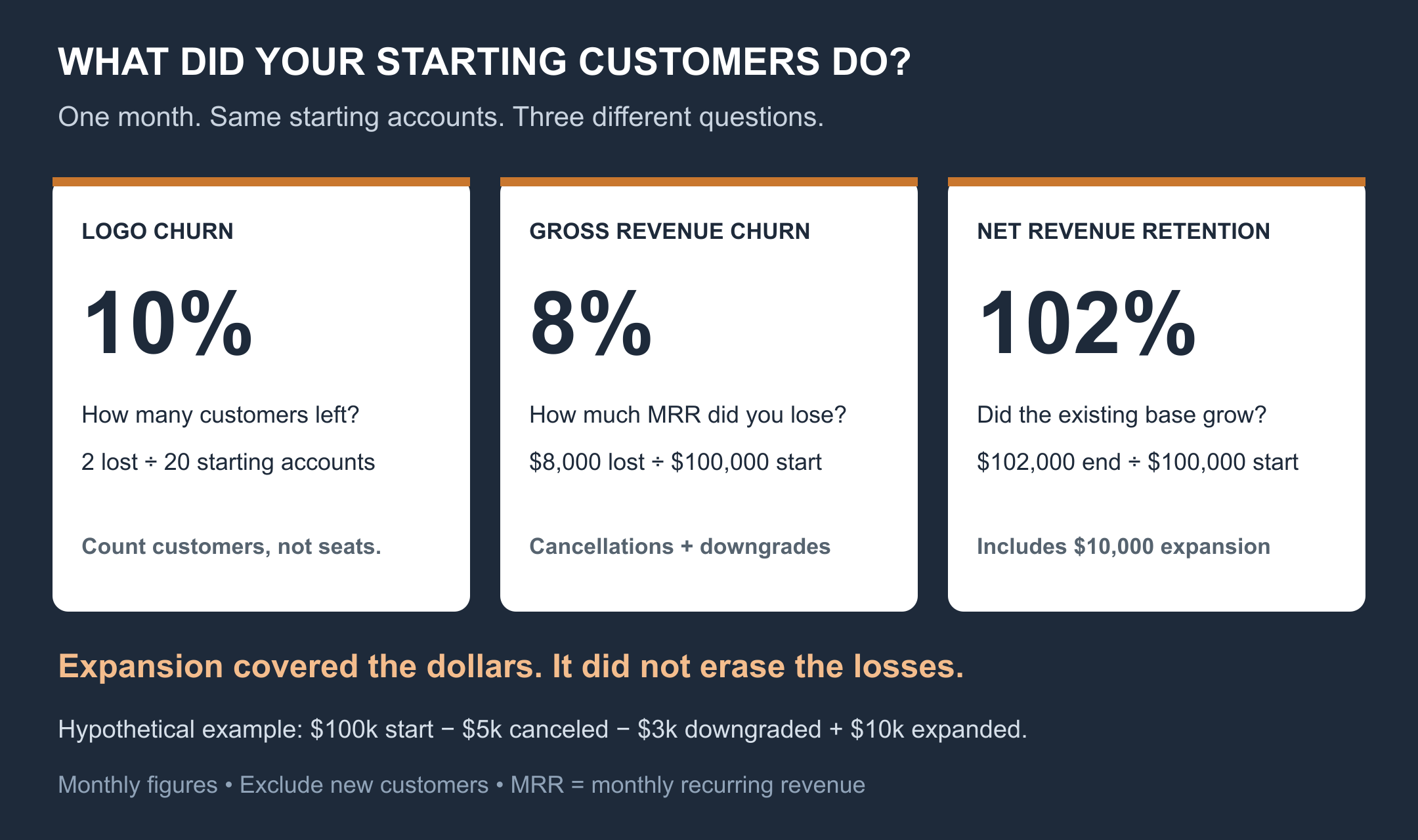
Logo churn: how many customers left?
Logo churn = starting customers no longer active at period-end ÷ customers at the start × 100.
Suppose you start with 20 paying accounts and two leave. Logo churn is 10% for that month. Any new accounts signed during the month stay out of this calculation.
Keep the count beside the percentage: "2 of 20 accounts." Small customer bases produce sharp percentage swings. One loss deserves attention, but it doesn't prove that every part of your retention process is broken.
Gross revenue churn: how much recurring revenue did you lose?
Gross revenue churn = (canceled MRR + downgrade MRR) ÷ starting MRR × 100.
Imagine those 20 accounts start at $100,000 MRR. The two cancellations remove $5,000. Other accounts reduce their contracts by another $3,000. Gross revenue churn is $8,000 divided by $100,000, or 8%.
For this same period and calculation, gross revenue retention is 92%. One measure describes the loss; the other describes what remains before expansion. ChartMogul's gross retention definition likewise excludes expansion and includes losses from cancellations and contraction.
Don't subtract an upsell from the loss column. You need to see the full loss even if a different customer buys more.
Net revenue retention: did the existing base grow?
NRR = (starting MRR − canceled MRR − downgrade MRR + expansion MRR) ÷ starting MRR × 100.
Now suppose customers from the starting group add $10,000 MRR. You finish with $102,000 from that group. Net revenue retention is 102%. Stripe's NRR guide explains this distinction: expansion counts, while new-customer revenue does not.
All figures in this example are hypothetical. The point is that 102% NRR can sit beside 8% gross revenue churn and two lost customers. Expansion covered the dollars. It did not explain why those accounts left.
Review all three numbers together. Logo churn treats every account equally. Gross revenue churn shows the financial size of the losses. NRR shows the combined result after expansion.
3. Build a Spreadsheet You Can Reconcile
Give each starting account one row
Create columns for customer ID, customer name, starting MRR, canceled MRR, downgrade MRR, expansion MRR, and ending MRR. Enter losses as positive amounts so the formula subtracts them once.
For a simple layout with starting MRR in column C, cancellation in D, downgrade in E, and expansion in F, put =C2-D2-E2+F2 in G2. Copy it down. Total each money column at the bottom.
Add a separate lost-logo flag. Mark a starting customer as lost when its entire recurring relationship ends, not when one subscription or seat is removed. Divide the total lost logos by the number of starting accounts.
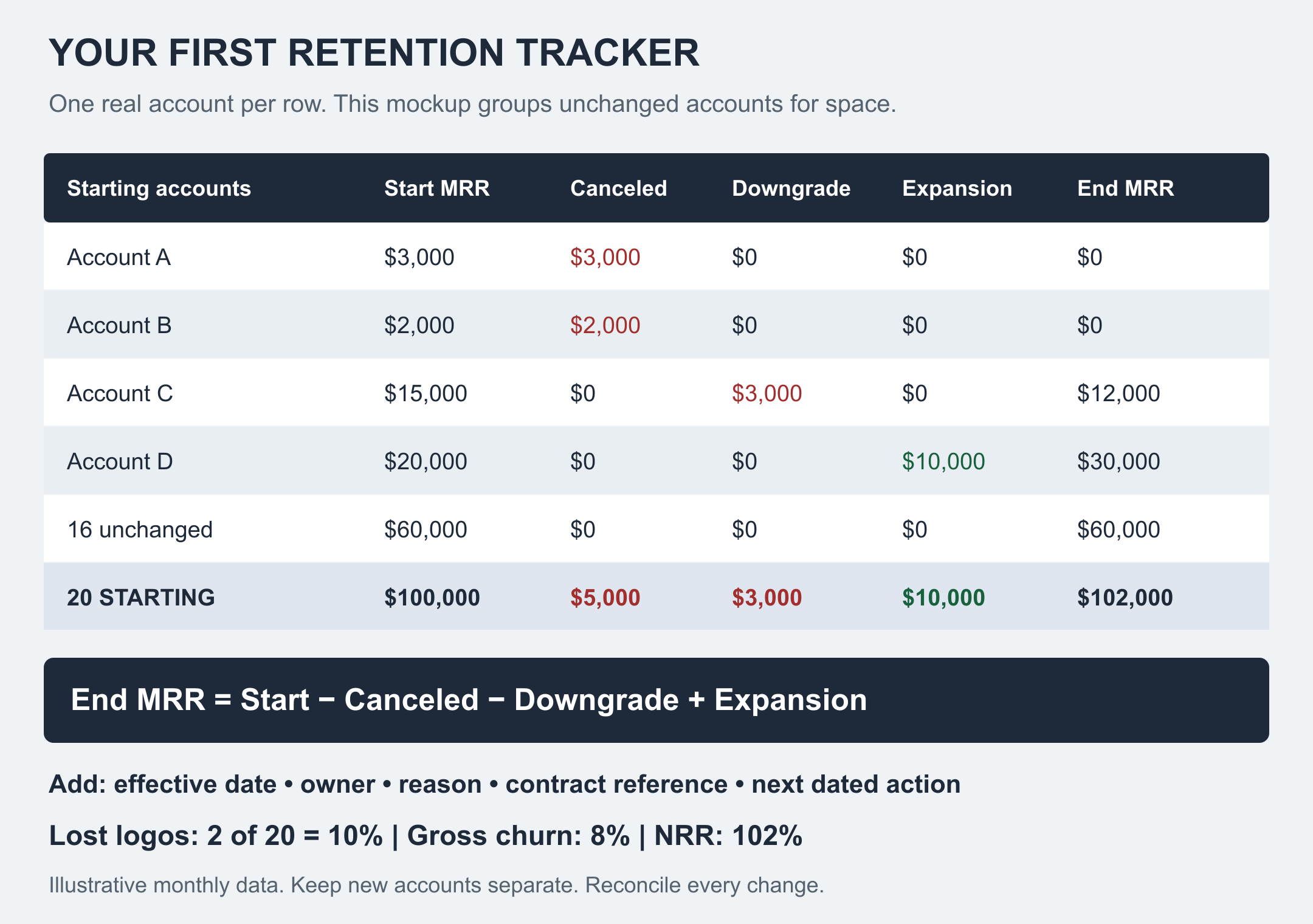
In the mockup, the unchanged accounts are grouped to keep the graphic readable. In your file, give each account its own row. That is how you trace a total back to the customer and contract behind it.
Record the evidence behind each change
Add the effective date, billing or contract reference, account owner, reason, and next action. Use specific reasons such as "removed unused seats" or "project sponsor left." If the reason is unknown, write "unknown" and assign someone to ask.
Keep a separate new-customer list. Your overall MRR check should reconcile ending MRR from the starting group plus MRR from accounts outside that group to total ending MRR. Investigate every difference before using the report.
If an account changes more than once, keep a dated change log behind its row. Don't count the original MRR again at each change. A downgrade followed by cancellation must reconcile to the actual remaining contract value.
Handle exceptions in writing
For this starting-group report, keep customers who were inactive at the start outside NRR even if they return this month. Track that reactivation separately. If a starting customer cancels and returns within the month, record both events, reconcile ending MRR, and don't count it as a lost logo at month-end.
Billing platforms can use different movement and reactivation rules. Document yours so a future software report doesn't silently change what the number means. Show unusual cases separately until you understand the difference.
When the starting customer count or starting MRR is zero, show "not applicable" for the affected rate. A percentage with no starting base isn't useful. Keep the raw amounts visible and establish the first valid comparison period.
4. Turn the Numbers Into Customer Actions
Review losses before celebrating expansion
Set a monthly review with the person who maintains the tracker and the people who own affected accounts. Start with cancellations and downgrades. Ask what changed, when the team learned about it, and what evidence supports the reason.
Then review expansion. Was it more usage, more locations, a broader scope, or a price increase? Those changes can all raise revenue, but they tell you different things about customer progress. Don't label every increase as proof of better adoption.
Choose one process change from the review. If customers keep cutting unused seats, examine how the original quantity was sold. If losses follow a missed kickoff, repair the handoff. Coach the behavior you can identify.
Watch risk between monthly reports
These three metrics record outcomes. They won't warn you about a customer that still pays but has stopped making progress. Keep a short weekly risk list alongside the monthly totals.
Useful entries include a missed first outcome, an unresponsive sponsor, an unresolved delivery issue, or a renewal without a confirmed next step. Record the observation, the recurring revenue exposed, the owner, and the next dated action. Avoid a red status with no explanation.
Have the account owner prepare the customer conversation. Ask them to explain what they know, what they need to learn, and what they will do next. Help them improve the plan without taking every account back yourself.
A retention number should end with an owner and an action, not just a color on a dashboard.
Compare periods that mean the same thing
Label every rate with its period. Monthly logo churn and annual logo churn are different measures. Don't compare a monthly result with an annual benchmark or multiply a monthly percentage by 12 and call it your actual annual result.
As records build, calculate longer-period retention from the customers active at the beginning of that longer period. Check first-year customers separately when you have enough history. Don't average monthly percentages and assume that gives you annual retention.
5. Assign the Work Before You Hire the Team
Make the responsibility small and clear
You need an owner before you need a department. Someone already working with billing, operations, or accounts can maintain the record if they have access and time. Customer follow-up still belongs to the person responsible for that relationship.
Put the duties in an Accountabilities Document: update changes, reconcile totals, flag missing information, prepare the review, and track agreed actions. Set a deadline, such as the fifth business day after month-end, that your team can meet.
Start with the last completed month. Confirm the starting list, calculate the three numbers, and investigate the largest loss. Then repeat next month. A short report people trust is enough to begin changing decisions.
Let the work tell you what to hire for
After a few cycles, look at what keeps slipping. Is the problem gathering billing data, getting customers through onboarding, planning renewals, or managing a growing account load? Those are different jobs.
A customer-success hire should receive a defined customer base, a record of recurring revenue, and clear account responsibilities. Build that foundation now. It gives your future hire something to run and gives you a way to judge whether the work improves.
Frequently Asked Questions
Q: What should I track before hiring a customer-success team?
Start with logo churn, gross revenue churn, and net revenue retention for one completed month. Keep account counts and dollar amounts beside the percentages, then assign follow-up on cancellations, downgrades, and current risks.
Q: Can NRR exceed 100% while customers are leaving?
Yes. Expansion from the starting customers can exceed revenue lost through cancellations and downgrades. That is why you should read NRR alongside gross revenue churn and lost-logo counts.
Q: How do annual contracts fit a monthly tracker?
Normalize the recurring contract value to MRR. A $24,000 annual subscription contributes $2,000 monthly while active. Record a cancellation when the recurring relationship ends under your policy, rather than treating months without an invoice as churn.
Q: Is an overdue invoice a lost customer?
Not automatically. Track payment problems separately and apply a consistent policy for when an account becomes inactive. Keep collection risk visible without turning every late payment into a cancellation.
Q: How often should I review retention?
Close the numbers monthly and review current account risks weekly. Add longer-period comparisons as your history grows. With few customers or annual renewal cycles, inspect the individual accounts before drawing conclusions from one month's percentage.
Build a system your team can own.
If customer problems keep pulling you back into every account, Fractional Sales Leadership can help clarify sales promises, handoffs, and accountabilities. Learn how I work at LouieBernstein.com.
Schedule a 30-Minute CallAbout the Author
Louie Bernstein
Louie Bernstein is a Fractional Sales Leader who helps B2B founders build repeatable sales systems, strengthen team accountabilities, and reduce dependence on founder-led sales.