A sales-to-customer-success handoff protects a new account when the next owner can explain what the buyer expects, what sales promised, and how the customer will recognize progress. For a founder-led B2B company, use one shared record, an accepted transfer of responsibility, and a first-month plan. Confirm the outcome at kickoff, test progress with the customer, and resolve gaps before they become renewal objections.
Key Takeaways
- A sales-to-CS handoff needs an accepted owner, a clear promise, and a customer-confirmed first outcome.
- Use the first 30 days to check expectations and progress. Thirty days is a planning window, not a universal renewal deadline.
- Give CS the customer's buying reason, commitments, success criteria, people, risks, and next dated action in one shared record.
- At kickoff, have CS restate the buyer's goal and ask for corrections. Don't make the customer repeat discovery.
- Review your next five handoffs against customer-confirmed progress, not just completed onboarding tasks.
The deal closes. The customer gets a welcome email. Someone schedules training.
Two weeks later, the buyer calls you: “When are we getting the thing we talked about?” Your team has been busy. The customer still can't see the result they bought.
If you're running a $1M to $10M ARR business and closing most sales yourself, the missing piece may be something you never wrote down. The handoff has to carry your understanding of the sale into work another person can own.
The handoff isn't finished when CS knows what you sold. CS needs to know what the customer will count as progress.
What should a sales-to-CS handoff actually accomplish?
A sales-to-CS handoff should let the customer continue toward the result they bought without depending on the founder to explain every decision. The signed agreement alone rarely contains the whole buying context. Transfer the intended outcome and the limits around the promise, then check that the next owner understands both.
Carry the reason for buying into delivery
“They bought our reporting package” tells CS what to activate. “The operations manager needs a reliable weekly capacity decision” tells CS what the customer is trying to accomplish.
Those descriptions lead to different kickoff conversations. One starts with menus and logins. The other starts with the decision, the people making it, and the information they need.
Rocketlane's 2025 research covered more than 950 onboarding and implementation professionals across industries. Over 40% of organizations reported customer requests or preferences for personalized onboarding (Rocketlane, 2025). That's a reason to carry the buyer's specific goal forward, not evidence that every account needs a custom project.
Use 30 days to expose gaps early
The first month gives you a useful inspection window. Has the buyer confirmed the plan? Have the right people participated? Has anything useful happened?
No sound rule says every renewal is decided in 30 days. Complex implementations take longer, and later product or budget changes matter. The point is to uncover disagreement while the team can still correct the plan.
For a longer implementation, agree on an early proof point. An approved design can show readiness, but don't label readiness as realized business value. Record which kind of milestone you've reached.
What must sales hand off before the customer kickoff?
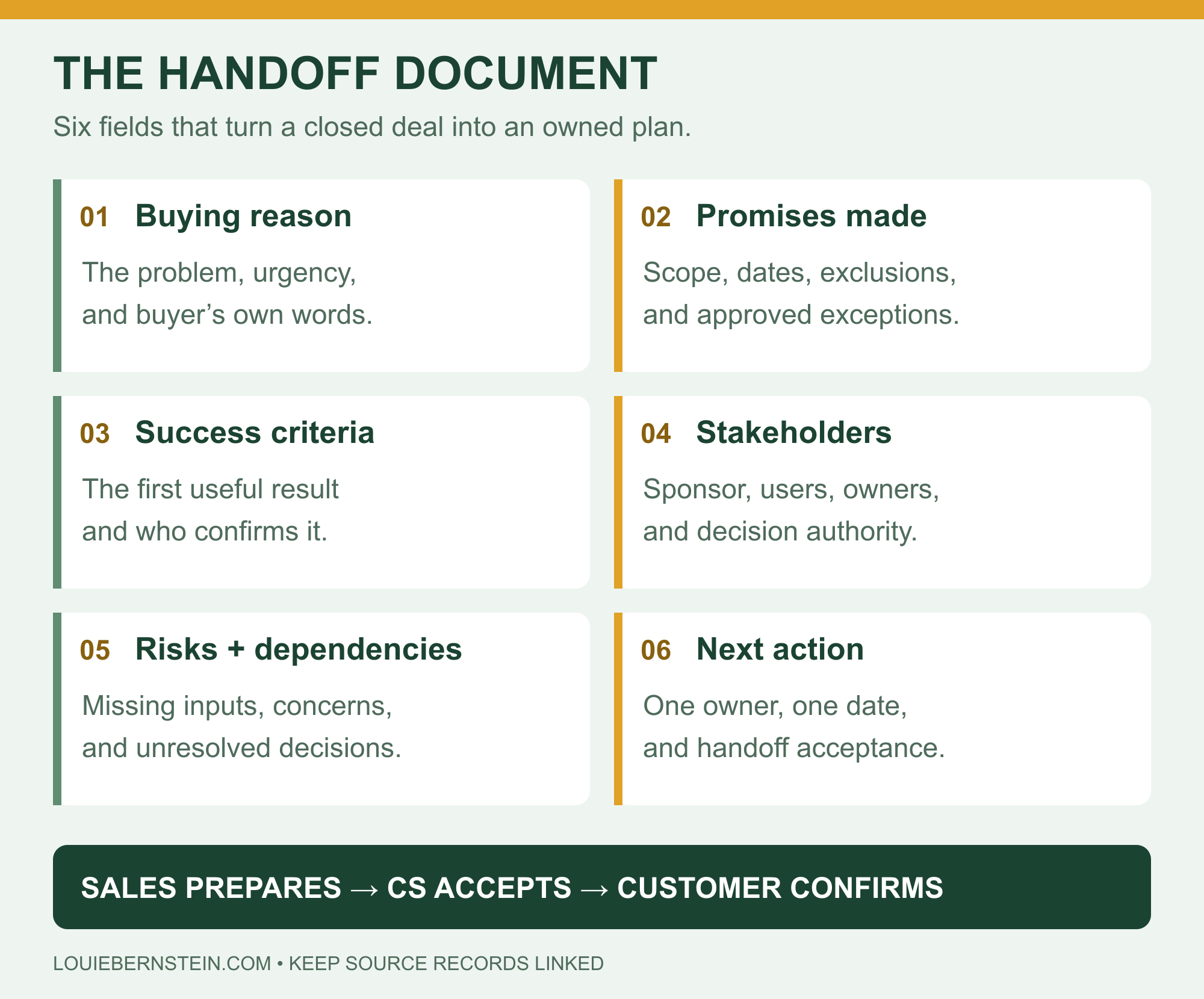
Sales must hand off the buying reason, promises, success criteria, stakeholders, risks, and next action before the customer kickoff. Each item should help CS make a decision or run a conversation. Keep the summary in one shared record, with links to the agreement and supporting notes, so nobody has to reconstruct the sale.
Use six fields with evidence behind them
- Buying reason: What business problem prompted the purchase? Capture the buyer's language and why solving the problem matters now.
- Promises made: Include scope, exclusions, dates, approved exceptions, and any expectation sales still needs to clarify. Link the signed agreement.
- Success criteria: Define the first useful result, the starting point, and who will confirm the result. Separate a hoped-for improvement from a commitment.
- Stakeholders: Name the sponsor, day-to-day owner, users, and people providing access or data. Identify who can approve a change.
- Risks and dependencies: Note missing inputs, staffing constraints, concerns raised during the sale, and unresolved technical questions.
- Next action: Give the next step an owner and date. Name the CS lead and record whether that person accepted the handoff.
Make unresolved promises visible
A blank field and a known gap aren't the same thing. “Data migration timing still needs approval; Alex will confirm Friday” gives the team something to manage. An empty timing field hides the decision.
Sales prepares the record. CS reviews the commitments and accepts responsibility for the agreed plan. Record blockers separately, with a decision owner. Don't quietly turn an unapproved promise into a CS obligation.
Keep Closed Won accurate under your booking rules. A separate handoff status tells you whether delivery is ready. Don't use the handoff process to rewrite whether a signed sale occurred.
Include outside implementers when they own part of the work. Rocketlane's 2025 research reported that 49.4% of organizations involved external partners in onboarding (Rocketlane, 2025). For your business, the practical question is who owns each dependency across company boundaries.
How do I run a kickoff without making the buyer start over?
Run the kickoff by having CS present its understanding of the customer's goal, first milestone, and responsibilities, then ask the buyer to correct the summary. The customer should hear continuity from the sales conversation. Sales joins to explain commitments and introduce the owner; CS leads the plan and the next steps.
What I've learned from the second sales call
I've written about sitting in on a second sales call where my salesperson asked for the business before restating the problem. We had done discovery. The missing step was bringing the customer's actual situation back into the conversation.
I apply the same lesson to kickoff. A new person presenting a standard onboarding agenda can skip the very reason the customer agreed to buy. Have CS explain the problem in the buyer's words before walking through the work.
Try: “You told us your managers don't trust the weekly report, so you're checking the numbers yourself. Our first goal is a report your operations lead can use for the Monday meeting. What needs correcting in that summary?”
That's illustrative wording, not a client result. The test is whether the buyer recognizes their situation and can correct the plan.
Leave with a usable agreement
Use a short agenda: confirm the goal, review the first milestone, name customer inputs, settle the next action. Ask who needs to participate but isn't in the room.
If the buyer says, “I thought your team was doing the data cleanup,” stop and resolve the mismatch. Don't bury the issue under a product tour. Record the decision, owner, and effect on timing in the same account record.
CS sends the recap. Sales checks any changed promise. The customer gets one clear plan and knows who to contact.
A kickoff is your first chance to find out whether the customer and your team believe they bought the same thing.
What should happen during the first 30 days?
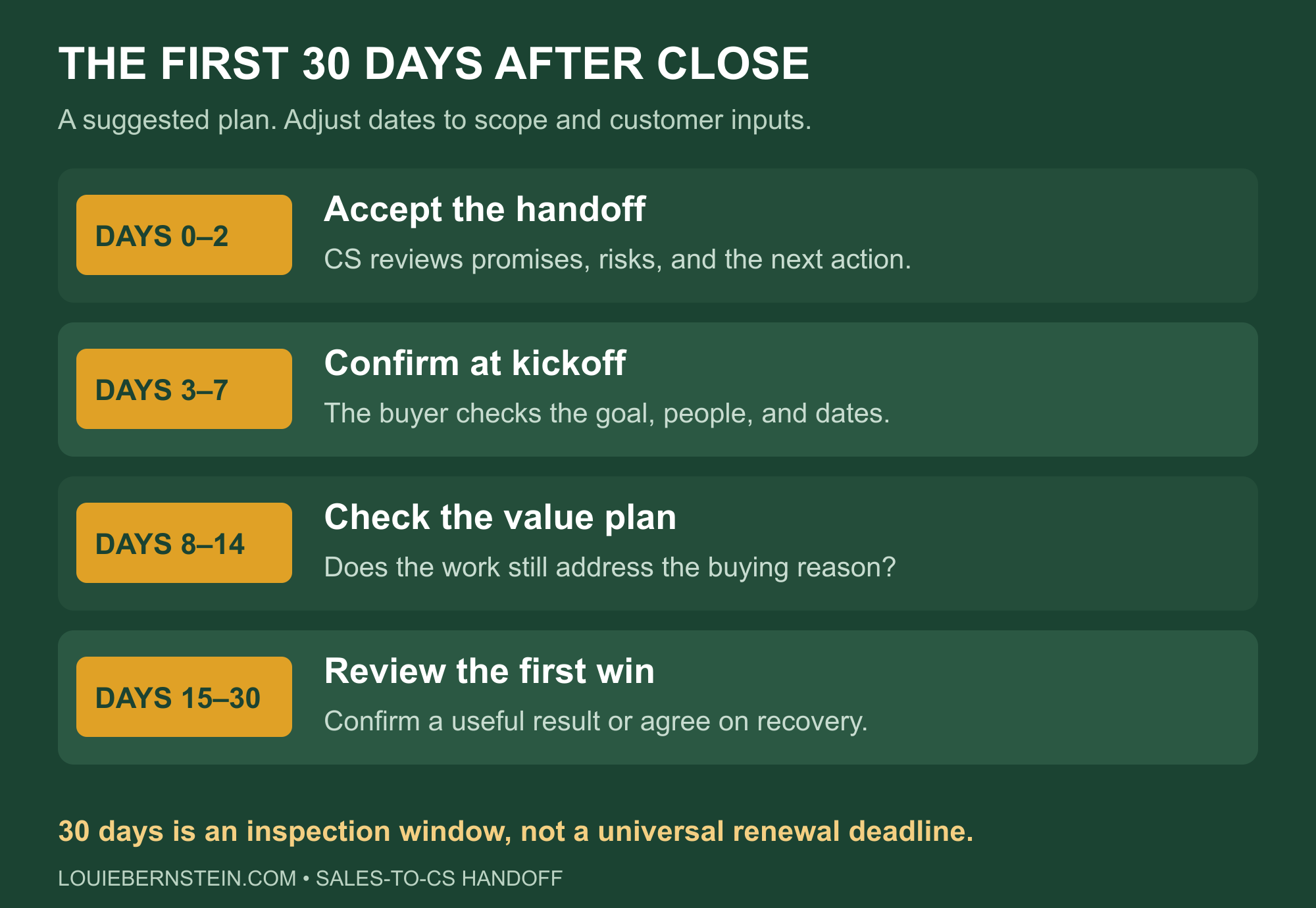
The first 30 days should move the account from an accepted handoff to a confirmed plan and visible progress toward the first useful result. Set dates around the work and customer dependencies. Use the schedule below as a starting proposal, then agree on realistic milestones instead of promising every customer a day-30 outcome.
Put evidence beside each milestone
| Suggested window | Milestone | Evidence to record |
|---|---|---|
| Days 0–2 | Internal handoff accepted | CS owner, reviewed commitments, open decisions assigned |
| Days 3–7 | Customer kickoff | Buyer confirms the goal, responsibilities, and next date |
| Days 8–14 | Value confirmation | Customer agrees the work still addresses the buying reason |
| Days 15–30 | First-win review | Customer validates a useful result, or agrees on the blocker and recovery plan |
“Value confirmation” means checking whether the plan still matters to the buyer. It doesn't mean claiming value has already been delivered. A sponsor's priorities can change before implementation finishes.
Consider an illustrative reporting customer. Creating accounts is setup. Training a manager is preparation. The manager using an accurate report to make a real staffing decision is a candidate for the first win. Agree on that distinction before everyone starts checking boxes.
Respond to missed milestones with a decision
If customer data is late, identify what work can continue and what must move. If your team missed a commitment, name the correction and the date. A vague “still in progress” update makes the customer do the investigating.
At the first-win review, ask what changed, what remains difficult, and what the next useful result should be. Save the customer's answer. Renewal preparation needs evidence the customer recognizes, not just a history of your team's activity.
Learning may need to continue after launch. In Rocketlane's 2025 research, 34% of respondents had re-onboarded customers to introduce advanced features or support ongoing value (Rocketlane, 2025). Don't treat completion of the first plan as the end of customer education.
How do I know the handoff works without managing every account?
Check whether accounts reach agreed milestones with clear ownership and customer-confirmed evidence, then review exceptions with the person responsible. A founder doesn't need to attend every kickoff to inspect the handoff. Start with a small account sample and a few measures that reveal missing information, delayed decisions, and work still coming back to you.
Review the next five accounts
For each account, compare the sales promise, kickoff recap, and first-win evidence. Ask the owner to explain any gap and recommend the next action before you offer an answer.
- Handoffs accepted on time: Show the count and percentage against your agreed internal deadline.
- Promise mismatches at kickoff: Record the actual disagreement and where it entered the sale.
- First wins confirmed: Count accounts with customer evidence by their agreed date. Keep overdue and blocked accounts visible.
- Founder interventions: Separate decisions only you can make from missing context the team should already have.
If four of five handoffs meet the deadline, that's 80%. It's also only five accounts. Use the result to inspect the missed handoff, not announce a reliable retention benchmark.
Coach the transfer of judgment
Put the handoff duties in the Accountabilities Document and the steps in your Sales Playbook. Let the account owner practice the kickoff summary with you. Correct the unclear promise before the customer has to.
After an escalation, ask what information or authority would have helped the owner act sooner. Then fix that part of the process. If you solve the account problem but leave the same missing information, the next customer will bring you back.
You can start before you have a full sales system or a dedicated CS hire. Assign an existing person with capacity, use one record, and test the process. The founder's knowledge becomes useful to the business when someone else can act on it.
Related ReadingChurn Isn't a Product Problem. It's a Sales Handoff Problem. →
Frequently Asked Questions: What else should founders know about sales-to-CS handoffs?
Founders should scale handoff effort to account complexity while keeping ownership and commitments clear on every account. The common edge cases involve lightweight onboarding, separate implementation teams, automation, and absent buyers. Handle those exceptions with explicit rules so the team can keep customers moving without asking you to redesign the process each time.
Does a small, self-service account need a live handoff meeting?
No. A standard account can use a reviewed record and automated introduction when the commitments are routine. Reserve live internal discussions for exceptions, unclear scope, or coordination that written information alone won't resolve.
Who owns the customer if implementation and CS are separate?
Name one lead customer contact and specify what implementation owns. Record when implementation transfers ongoing responsibility to CS. The buyer shouldn't have to decide which department is accountable for the next answer.
Can AI write the handoff summary?
AI can draft a summary from approved account records, but the salesperson should verify promises, dates, and scope against the source material. CS still needs to review and accept the plan. A confident summary doesn't establish that a commitment was approved.
What if the economic buyer won't attend kickoff?
Ask the buyer to confirm the success criteria and name an authorized delegate before kickoff. Run the working session with the people doing the work, then send the buyer a concise outcome summary and any decision requiring their approval.
Should we change sales commissions to enforce the handoff?
Start by defining and inspecting the required behavior. Don't improvise retroactive commission penalties because a record is incomplete. If incentives need changing, review the compensation plan separately and communicate prospective rules clearly.
Stop being the only person who remembers the promise
Fractional Sales Leadership can help you connect discovery, your Sales Playbook, and the customer handoff. Let's look at where the sale loses context and build a process your team can run.
Learn about working with Louie
Schedule a 30-Minute CallAbout the Author
Louie Bernstein is a Fractional Sales Leader with 50 years of sales experience and the founder of MindIQ. He helps B2B founders at $1M–$10M ARR build repeatable sales processes, Sales Playbooks, and teams that operate with more independence.