Key Takeaways:
- The silent killer of $5M ARR companies isn't competition, pricing, or product. It's a sales motion that lives entirely in the founder's head and calendar.
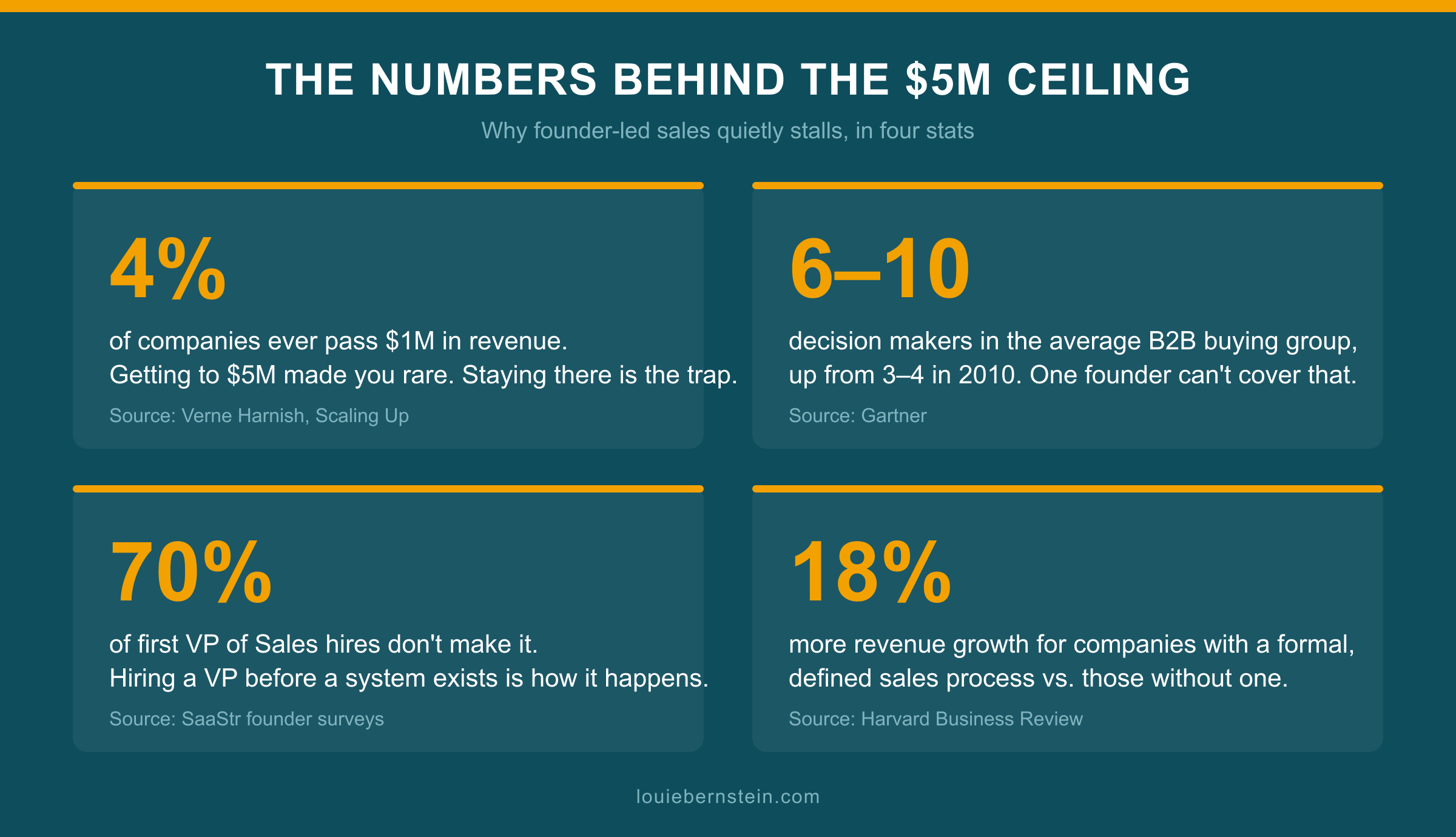
- Only 4% of companies ever pass $1M in revenue (Verne Harnish, Scaling Up). The founder-led motion that beat those odds is the same one that caps you at $5M.
- The average B2B buying group is now 6–10 decision makers, up from 3–4 in 2010 (Gartner). One founder can't charm a committee at scale.
- Companies with a formal, defined sales process grow revenue 18% faster than those without one (Harvard Business Review).
- Hiring a VP of Sales before a system exists is how 70% of first VP hires fail (SaaStr), with average tenure down to 19 months (Gong).
- The fix is a documented sales system: a written process, pipeline math, a scoreboard, hires who plug into it, and a stage-by-stage exit for the founder.
A founder called me a few months ago. Great product. Happy customers. $4.8 million in ARR and three flat quarters in a row. He wanted to talk about his roadmap, because he was sure the next feature would restart growth.
I asked him one question. "Who closed your last ten deals?"
Long pause. "I did."
There it is. The silent killer of $5M ARR companies isn't your competition, your pricing, or your product. It's that every dollar of revenue routes through one person, and that person is out of hours. I've been selling for 50 years. I built my own company, MindIQ, onto the INC 500 list, and I've watched this stall from the inside and the outside. It's predictable, it's diagnosable, and it's fixable. Here's how.
The Silent Killer Isn't Competition. It's Dependence on You.
Founder-led sales is exactly right from zero to about $1M. Nobody knows the product, the market, or the pain like you do, and nobody sells it with more conviction. That's not the problem. The problem is that the thing that got you here is now the thing capping you here.
Understand how rare your position is. Only 4% of companies ever pass $1M in revenue (Verne Harnish, Scaling Up). You beat those odds on talent, hustle, and a product people want. But the next stage doesn't reward the same muscle. It rewards a system, and most founders never build one because the ceiling doesn't announce itself. It shows up quietly, as symptoms you can explain away one at a time:
- The pipeline swells when you prospect and dries up when you get busy closing.
- Every deal over a certain size "needs you on the call."
- The salespeople you've hired support deals instead of closing them.
- The forecast is a feeling, not a number.
- Revenue is flat while everyone works harder than ever.
If three of those sound familiar, you don't have a product problem. You have a dependence problem.
Founder-led sales doesn't fail loudly. It fails quietly, one "I'll just take this call myself" at a time.
Why a Better Product Can't Break the Ceiling
Committees don't buy charisma
The average B2B buying group now runs 6 to 10 decision makers, up from 3 to 4 back in 2010 (Gartner). Think about what that means for a founder-led motion. You can win the champion in the demo. You can't sit in the internal meetings where the deal actually lives or dies. A sales system arms your champion with the case, the numbers, and the follow-up to win those rooms for you. A founder can only charm the room he's in.
Your authority skips the hard questions
When the founder sells, prospects behave differently. They take the meeting because you're the founder. And you skip qualification steps because asking about budget and signing authority feels beneath the relationship. Deals close on trust in you personally, not on a process anyone can repeat. Then a rep inherits that pipeline, the founder halo disappears, and the deals collapse. I wrote a whole piece on that shadow pipeline problem, because it's where the ceiling usually shows up first.
The math doesn't care how good the demo is
Count your real selling hours. You're also running product, hiring, fundraising, and putting out fires, so maybe you get 15 honest hours a week in front of buyers. Divide those hours by the meetings it takes to close one deal and you get a hard number of deals you can physically work per quarter. That number is your growth cap. Your calendar is your total addressable market now, and no feature release adds hours to it.
How Do I Avoid That Pot Hole?
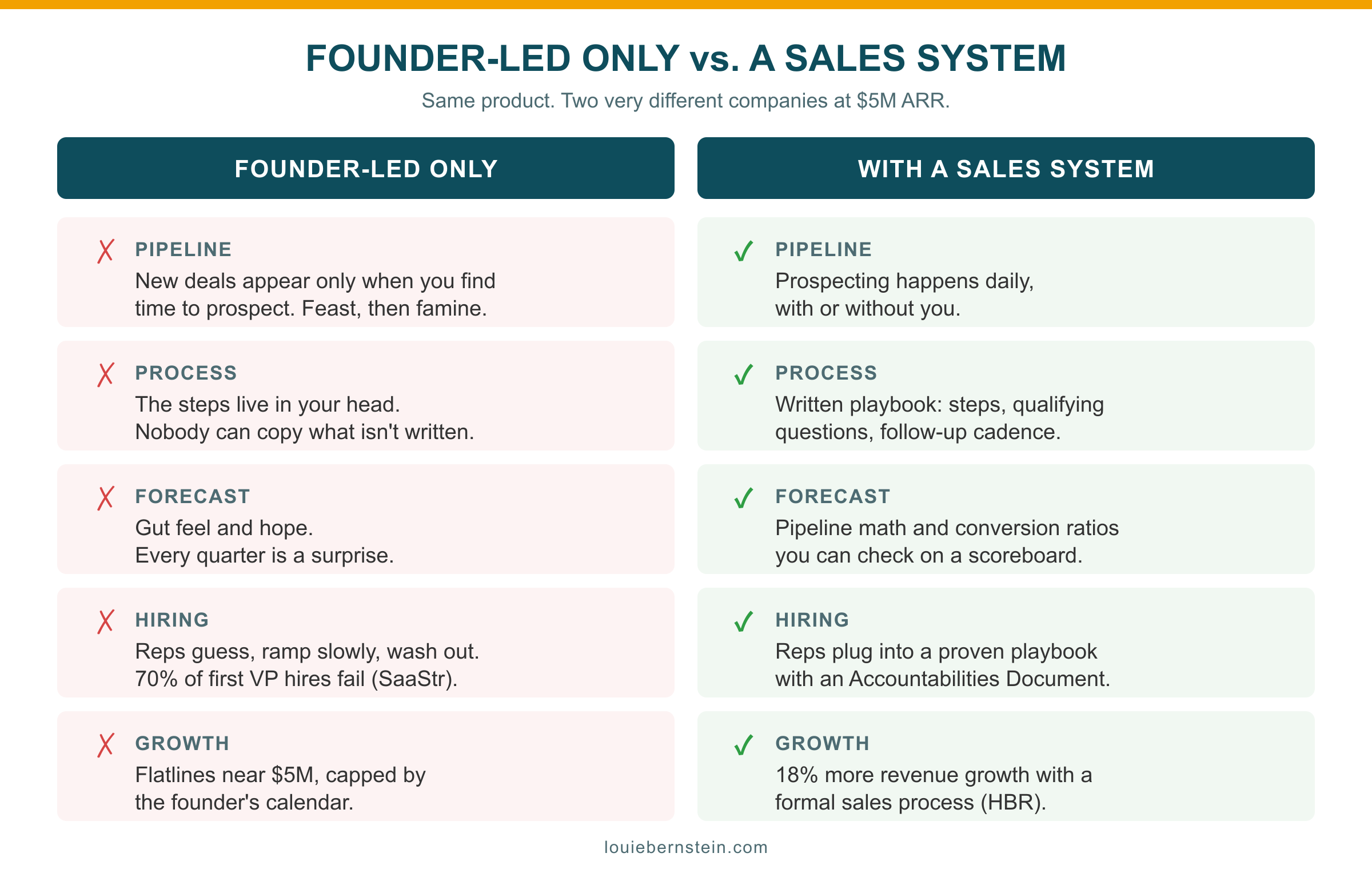
You build the sales system while you're still the best salesperson in the company. Not after your first bad hire. Not after growth stalls. Companies that defined a formal sales process grew revenue 18% faster than companies that didn't (Harvard Business Review). That gap isn't glamorous work, which is exactly why most founders skip it. Here's the sequence I install, step by step.
Step 1: Write down how you sell, this week
Everything you do instinctively goes on paper. The steps of your sale in order. Your qualifying questions. The objections you hear and the answers that work. Your follow-up cadence. Your closing questions. In my Sales Playbook, every salesperson commits to a simple standard: "I know the steps in my sales process and take them at exactly the correct time." That's impossible when the steps aren't written anywhere. If it's not written, it's not a process. It's a personality.
Step 2: Do the pipeline math
In my book, How to be a Professional Salesperson, I make every rep run this drill, and founders need it more than reps do. Say your target this year is $1M. It's July 1st and you've closed $400k, so you need $600k. You look at a pipeline showing $630k and feel fine. Now apply your real close rate. At 80%, that $630k produces $504k. You're $96k short and you didn't know it. Don't trust your pipeline until you do the math. Sales is simple. It's just not easy.
Step 3: Put up a scoreboard
Selling is part science, and science gets measured. Track a short set of numbers every week: outreach touches, conversations, meetings booked, proposals sent, deals closed. The ratios between those numbers tell you exactly where your system leaks. Lots of conversations but few meetings? Your qualifying is off. Lots of proposals but few closes? You're pitching before the pain is confirmed. Review the scoreboard the same day, same time, every week. No exceptions, including for you.
Step 4: Hire to the system, not to the rescue
The most expensive mistake at this stage is hiring a VP of Sales to "figure it out." The numbers on that bet are brutal: 70% of first VP of Sales hires don't make it (SaaStr founder surveys), and average VP of Sales tenure has dropped from 26 months to 19 (Gong). That's a $250k+ experiment with a coin flip's odds, and the failure costs you a year you can't get back. Hire salespeople into a documented system instead, and never hire just one. Give every hire an Accountability Document: the numbers they own, the activities expected, and when. No ambiguity, no drama.
Step 5: Exit one stage at a time
Don't hand over "sales." Hand over stages. Prospecting first, because it's the most systematic and the biggest drain on your calendar. Then discovery. Then demos. Keep closing the longest, because that's where your judgment is worth the most while your team ramps. And debrief every deal during the transition, win or lose. My rule has always been the same: we either win, or we learn. There is no third outcome. That habit is what keeps your close rate alive through the handoff.
Where a Fractional Sales Leader Comes In
Nothing in those five steps requires genius. What they require is time, judgment, and repetitions you don't have while you're running product, people, and payroll. That's the gap a Fractional Sales Leader fills. I build the system with you: the written playbook, the pipeline math, the scoreboard, the hiring plan, and the coaching cadence that keeps it running. You get the system a great VP of Sales would build, without betting $250k and a year of runway on a hire the data says fails 70% of the time.
The first 90 days look like this: we document how you sell, we do the math on your real pipeline, we put up the scoreboard, and we map which stage you exit first. From there, every hire plugs into something proven instead of guessing next to you.
You don't need another feature. You need a sales motion that works when you're not in the room.
Frequently Asked Questions
Q: What is the silent killer of $5M ARR companies?
Founder dependence. The entire sales motion, the relationships, the qualifying instincts, the closing judgment, lives in the founder's head and calendar. Revenue grows until the founder runs out of hours, then flatlines. It's silent because nothing looks broken. Customers are happy, the product keeps improving, and everyone's busy. The company just quietly stops growing.
Q: Why does founder-led sales stop working around $5M ARR?
Three forces converge. The founder's selling hours are capped, so deal volume is capped. Buying committees have grown to 6–10 decision makers (Gartner), so deals get decided in rooms the founder can't attend. And because the process was never written down, nobody else can run it. Any one of those is survivable. All three together is the ceiling.
Q: Can't I just hire a VP of Sales to fix it?
That's the most common move, and the data says it's the most likely to fail. 70% of first VP of Sales hires don't make it (SaaStr founder surveys), and average VP of Sales tenure has fallen to 19 months (Gong). The reason is almost always the same: the VP was hired to build a system that should have existed before they arrived. Build the system first, then hire into it.
Q: What does a real sales system include?
A written sales process with steps in order, a fixed set of qualifying questions, documented objection answers, a follow-up cadence, pipeline math based on your real close rate, a weekly scoreboard of activity and conversion metrics, and an Accountability Document for every sales hire. If a smart new rep can't pick it up and run a deal from it, it's not a system yet.
Q: How long does it take to get out of founder-led sales?
Documenting the process takes weeks, not months. The full exit takes two to four quarters, because you hand off one stage at a time: prospecting first, then discovery, then demos, with closing last. Founders who try to hand off everything at once usually watch the pipeline collapse and then conclude, wrongly, that nobody can sell this but them.
Q: My product really is better than the competition. Won't that eventually win?
No, and the growth data backs that up. Companies with a formal sales process grow revenue 18% faster than those without one (Harvard Business Review). Same markets, similar products, different systems. A better product with no sales system loses to a decent product with a great one, because the buying committee never experiences your product's edge. They experience your sales process.
Your product got you to $5M. It won't get you to $10M.
If revenue has gone flat while you work harder than ever, the problem isn't your roadmap. It's the sales system you haven't built yet. Let's spend 30 minutes mapping which stage you exit first and what your pipeline math really says.
Schedule a 30-Minute CallAbout the Author
Louie Bernstein
Fractional Sales Leader with 50 years of sales experience helping $1M–$10M ARR companies build scalable, repeatable sales systems. Founder of MindIQ (INC 500). LinkedIn Top Voice in Sales Management, Sales Operations, and Sales Coaching.