Key Takeaways:
- 46% of new hires fail inside 18 months, and 89% of the time it's attitude, not skill (Leadership IQ, 20,000 hires studied). You can't interview your way around that with a nicer gut feeling. You need a process.
- The wrong salesperson isn't bad at interviews. They're great at them. Selling and interviewing are the same skill. The product they're selling you is themselves.
- Hiring right is a four-stage system: Define, Attract, Test, Ramp. Skip a stage and you're back to hiring on charisma, which is how founders burn $250,000 without meaning to.
- If you can't write the Accountability Document before you post the job, you're not ready to hire. You're shopping.
- A great rep on a bad onboarding plan looks exactly like a bad rep. The first 90 days decide whether they ramp or quit, and you own those 90 days, not them.
- You won't fix hiring with a better instinct. You'll fix it with a sharper process and the discipline to follow it when the room feels good.
Here's a number that should stop you cold. 46% of newly hired employees fail within 18 months, and when they do, 89% of the time it's attitude, not a lack of skill (Leadership IQ, from a study of 20,000 hires). The single biggest reason those hires wash out isn't that they couldn't do the work. It's that they couldn't take feedback.
Now put a salesperson in that seat, at a company doing between $1M and $10M ARR, where one bad hire eats a year of pipeline. That's why I'll say it plainly. Hiring the wrong salesperson is the most expensive mistake a founder can make. It's more expensive than a slow product launch. It's more expensive than a bad marketing quarter. Because when the wrong salesperson underperforms, you don't just lose their salary. You lose the deals they were supposed to close and never will.
The good news is that hiring right isn't luck and it isn't a gift. It's a system. I've hired, fired, coached, and rebuilt sales teams for fifty years, and the founders who get this right all do the same four things in the same order. Let me walk you through them.
What the Wrong Salesperson Actually Costs You
Founders underprice this mistake because they only count the salary. Look at the full bill.
The floor for any bad hire is at least 30% of that person's first-year earnings (U.S. Dept. of Labor). The Society for Human Resource Management puts the cost of replacing an employee at 50% to 200% of their annual salary (SHRM). For a salesperson those numbers run high, because a rep who doesn't close isn't a neutral cost. They're a negative one. Every account they touched and stalled is an account nobody else was working.
Then there's the churn tax. Sales turnover runs around 35% a year, roughly three times the average across other jobs (Xactly). Average tenure for an account executive is about 18 months, which is right around the point they'd finally hit full stride (Bridge Group). And ramp isn't instant. A B2B account executive takes roughly five months to reach full productivity (Bridge Group), drawing a full salary the whole way. Hire the wrong one and you pay for the ramp, then pay again to replace them, then ramp the next one.
Add it up at your stage and a wrong sales hire costs about $250,000 once you fold in salary, commission draw, ramp, lost pipeline, and the six months it usually takes a founder to admit it isn't working. I've written the severance checks. I've eaten the lost quarters. The math is real.
"The interview is the cheapest place to be wrong about somebody. Everywhere after that, being wrong gets expensive fast."
So the goal isn't to hire faster. It's to be wrong in the interview room, where it's free, instead of eleven months in, where it costs a quarter of a million dollars. Here's the system that gets you there.
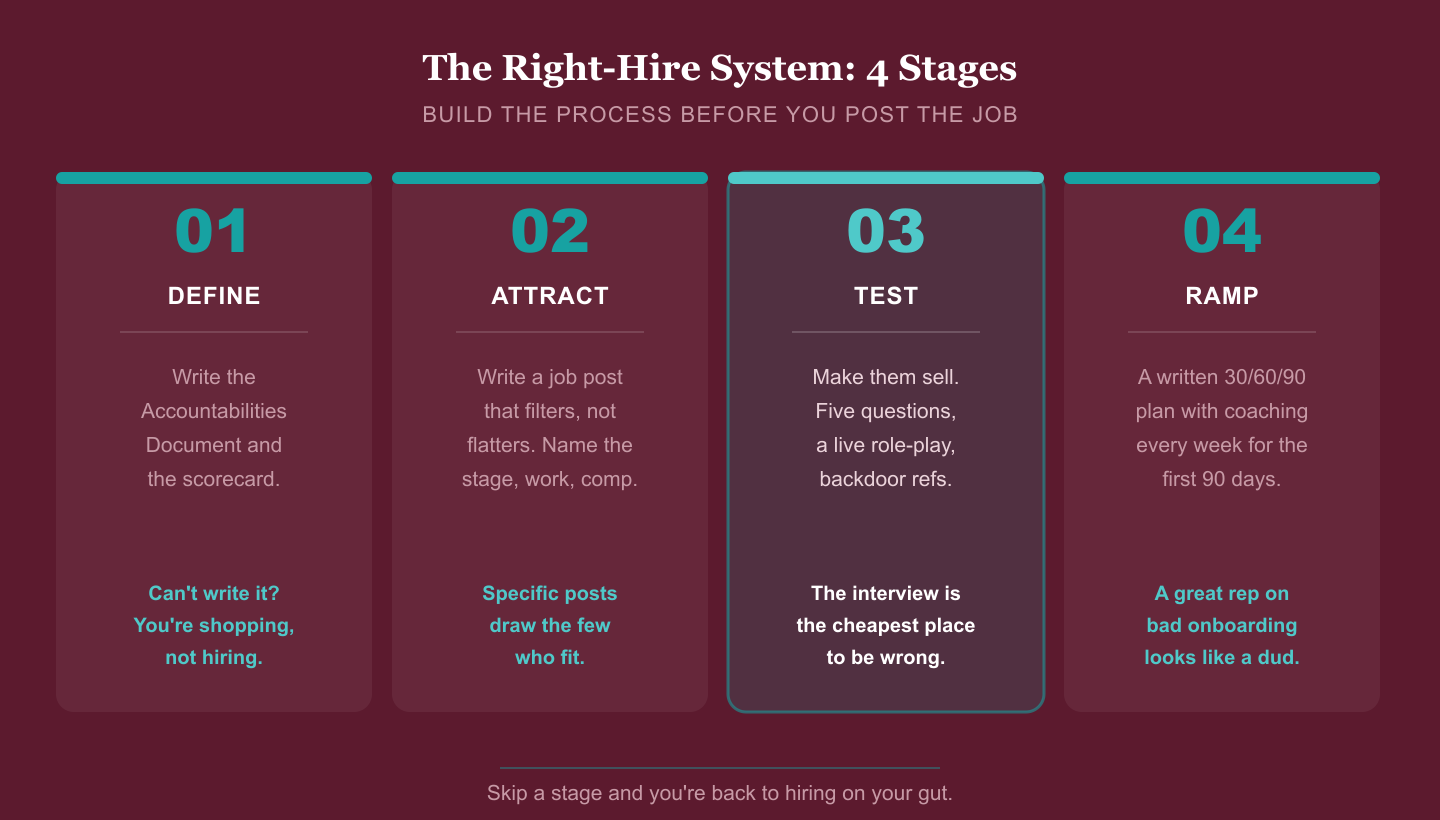
Stage 1: Define Who You're Actually Hiring
Most founders start hiring by writing a job post and taking calls. That's backwards. You can't recognize the right person until you've defined them on paper, in specifics, before a single candidate shows up.
Write the Accountability Document first
The Accountability Document is the contract of clarity between you and the person you hire. It names the number they'll carry. The weekly activities they'll be measured on. The decision rights they have and the ones they don't. The coaching cadence. The behaviors that get them promoted and the ones that get them fired.
If you can't write that in under an hour, you don't have a clear standard yet, and no candidate can hit a target you haven't defined. Hiring without an Accountability Document is how founders end up with a salesperson who is technically employed and structurally useless. Nobody knows what they're being held to, so nobody holds them to anything, and a year disappears.
Turn it into a scorecard
List the 15 to 20 questions you'll ask every candidate. Put a 1-to-5 rating next to each one. Leave a column to write down their actual words. Decide your pass threshold before you interview anyone, then score every candidate the same way, right after the call while it's fresh.
This sounds bureaucratic. It's the opposite. Without a scorecard you're not interviewing, you're having a nice conversation, and a nice conversation is exactly what a good salesperson is trained to give you. The scorecard is a discipline. The document just makes the discipline possible.
Write a job post that filters, not flatters
A vague post gets you 200 applicants and 5 you'd hire. A specific post gets you 40 applicants and 15 you'd hire. Specificity is the lever. Name your stage out loud: "We're a $3M ARR company where the founder still does most of the selling, and we're hiring the rep who takes that over." Name what they'll actually do, the real comp, and the real trade of what they'll learn. The right candidate reads that and leans in. The wrong one clicks away. Both outcomes save you time.
Stage 2: Test With Questions That Force Proof
Here's the trap. Salespeople are paid to be persuasive, to handle objections, to make you believe. That makes the interview the easiest part of the job for them and the hardest part of the job for you. Confident answers tell you almost nothing. So I don't interview for fit. I interview for proof.
There are five questions I ask before I'll recommend any salesperson for any role. Ask them in order, then stop talking and let the silence do the work.
- The math. "Walk me through your numbers for the last four quarters." Quota, attainment, average deal size, cycle length, win rate, off the top of their head. Real closers live in their numbers. The pronoun shift from "I" to "we" when you ask for personal numbers is a tell I've seen a thousand times.
- The process. "Walk me through how you sold your last deal, end to end." First touch to signed contract. You're listening for a repeatable process that includes the hard parts, cold outreach, multi-threading, procurement. If all you get is "we just clicked and got it done," that's a love story, not a process. You can't replicate it.
- The loss. "Tell me about the deal that hurt the most to lose." This separates owners from blamers in the first ten seconds. "They ghosted us" is a blamer. "I should have multi-threaded to the CFO sooner" is an owner. You hire the answer to this question. Everything else is paperwork.
- The change. "What's the last thing you changed in how you sell, and why?" This is the coachability test hidden inside a craft question. A specific, recent change means a learner. "I've always done it the same way and it works" means someone who stopped growing. Remember: 26% of failed hires wash out precisely because they can't take feedback (Leadership IQ).
- The why. "Why this role, why now, why us?" Make them answer all three. This is the question that screens out the hire who leaves in eleven months for a slightly better offer. If they can't say something specific about your company, they didn't prepare, and salespeople who don't prep for an interview don't prep for discovery calls either.
Then make them sell
This is the step most founders skip, and it's the one that matters most. Run a live role-play. Ask them to sell you on the last product they sold, the one they know cold. Then play hardball. Push on price. Name a competitor. Go quiet. In ten minutes you'll learn more than in three rounds of "tell me about yourself." Real salespeople love this exercise. The wrong hire hedges, resists, or tries to turn it back into a conversation about themselves. That tells you everything. For the full question-by-question breakdown, see my piece on the five interview questions that separate real salespeople from great storytellers.
Call the references they didn't give you
The references a candidate hands you are coached. They'll say lovely things. What's useful is the backdoor reference, a former manager, peer, or customer who wasn't on the list. LinkedIn makes this easy. Ask one specific question: "Would you hire them again into a company where they'd have to build pipeline from cold?" The pause before the answer tells you more than the answer does.
Stage 3: Read the Signals That Predict Performance
After the interviews, sit with your scorecard and sort every answer into two columns. You're not scoring personality. You're forcing yourself to look at the pattern instead of the charisma. The same resume and the same charm sit on both sides of this table. The signals are what separate them.
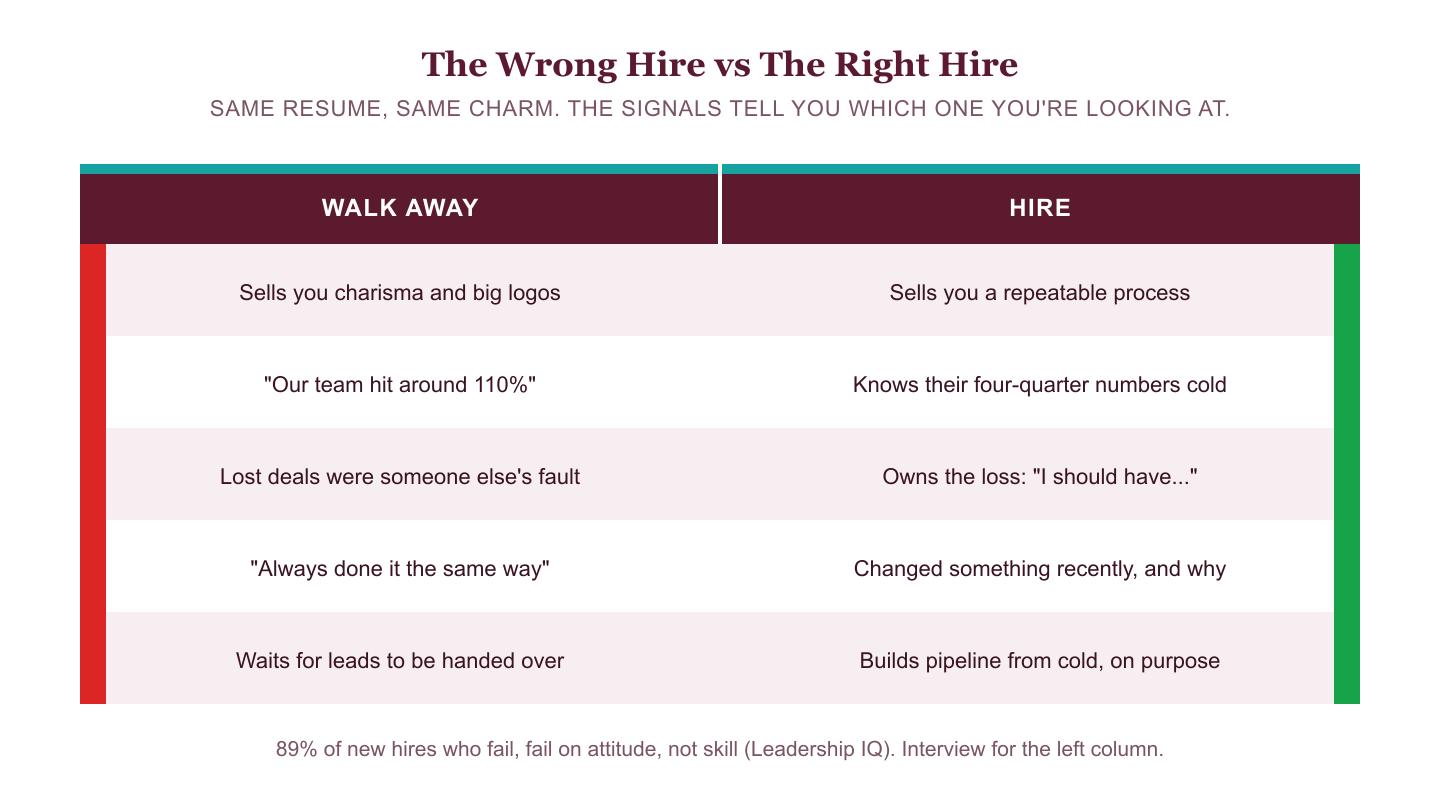
A candidate doesn't need five perfect answers. They need at least four landing in the right column, and the borderline one has to be something you can teach. You can teach product. You can teach process. You cannot teach ownership and you cannot teach work ethic. If those are weak, walk away no matter how much you liked the person. This is the same reason 89% of hiring failures trace back to attitude and only 11% to skill (Leadership IQ). Hire for the column you can't coach.
"Liking a candidate isn't a hiring criterion. It's a tiebreaker between two people who already cleared the bar. Score them first, then let your gut vote last."
Stage 4: The First 90 Days Decide It
You can hire the best rep in the market and still watch them fail if you hand them a login and tell them to book meetings by Friday. A great rep on a bad onboarding plan looks identical to a bad rep. The difference is you built the trap. Here's the ramp that works.
- Days 1 to 30, soak it in. No quota, no solo calls. They learn the product, the ICP, the CRM, the objections, and shadow every call you take. By week four they can tell you, in their own words, who you sell to, what problem you solve, and why you win.
- Days 31 to 60, drive with a co-pilot. They run calls with you in the room. They open, they ask the discovery questions, they handle objections. You debrief within 30 minutes of every call. That debrief is where coaching actually happens, not in a quarterly review.
- Days 61 to 90, take the wheel. They run calls solo, you review recordings and pipeline. By day 90 they should have closed at least one deal (longer, obviously, for enterprise cycles). That first close is the most important psychological moment in a new rep's tenure. It proves the system works.
If day 90 arrives with no deal and no real pipeline, ask the honest question before you blame the rep: did you give them a plan, real leads, and weekly coaching? If yes, yes, yes and they still didn't move, it's the rep. If no, no, no, it's you. A rep who hasn't ramped in 90 days almost never ramps in 180. In fifty years I've seen it happen maybe twice. Be kind in the delivery and ruthless in the timing.
Why This Is So Hard to Do Alone
The system works, but only if the interviewer will ask the hard questions, sit through the awkward silence when a candidate fumbles, and write down the real answer instead of the one they wanted to hear. That's brutally hard for a founder. You're charming yourself while the candidate is charming you, and you carry a deep desire to believe this hire will finally fix the pipeline so you can stop running discovery calls. The room wants to close the deal even when the answers say don't.
A Fractional Sales Leader sits on your side of the table without the rose-colored glasses. Same questions, same standard, but without the relational pull that makes founders hire the person they liked instead of the person who can do the job. We write the Accountability Document with you, build the scorecard, standardize the interview, run the backdoor references, and coach the new hire through their first 90 days. It costs a fraction of a $300K VP of Sales, and a lot less than the $250K mistake of getting it wrong. If you want to see exactly how that works for a founder in your seat, my breakdown on avoiding the wrong hire covers the interview mechanics in more depth.
"You won't avoid the wrong hire with a better gut. You'll avoid it with a sharper process and the discipline to stick to it when the room feels good."
One honest caveat before you hire anyone
If you have no sales process written down, no pipeline that generates without you, and no clear definition of what good looks like, then hiring a salesperson isn't your next move and neither is any leader who's only there to hire one. You'd be handing a rep a job with no map. Build the foundation first. Get your process on paper, get real data in your CRM, and be able to describe in one paragraph exactly what's breaking in your sales today. Then hire. If you're not sure where you stand, that's a great first conversation to have, and I'll tell you the truth about whether you're ready.
Frequently Asked Questions
Q: How do I hire the right salesperson if I've never managed one before?
This is the moment the risk is highest and the cost is highest. A founder hiring their first rep solo is the most common way I watch $250,000 disappear at $1M to $10M ARR. Follow the system: write the Accountability Document, build a scorecard, run the five questions and a live role-play, and put the new hire on a written 90-day plan. If you can borrow the experience of someone who's hired dozens of reps for a fraction of the cost of getting it wrong, do it. Don't learn this by losing six months and a quarter-million dollars.
Q: What's the single biggest predictor of a good sales hire?
Coachability. The data is blunt: 89% of new hires who fail, fail on attitude, not skill, and 26% specifically because they can't accept feedback (Leadership IQ). That's why my fourth interview question asks what they've changed recently and why. A rep who's still learning will adapt to your market and your product. A rep who's "always done it the same way" is a finished product, and your $1M to $10M company is moving too fast to carry one.
Q: Should I hire a rep from a big-name company like Salesforce or Oracle?
Only if they actually built pipeline there instead of riding inbound. Big companies hand reps warm leads, brand recognition that opens doors, and SDR teams that fill the funnel. At your stage, your new hire has to dig their own wells. The logo on the resume isn't proof. The four-quarter numbers and the deal walkthrough are. Ask how they sourced their last deal. If the honest answer is "marketing handed it to me," you've found your risk.
Q: I love the candidate but the answers were weak. Should I hire them?
Pass. I know it's hard to hear. Liking someone isn't a hiring criterion. The room feels good in an interview because that's the salesperson's entire job, to make rooms feel good. Yours is to find out whether they can actually sell. If the answers don't hold up, the chemistry won't save you. It'll just make the conversation about why they're leaving in nine months more painful.
Q: What if I'm not even sure I'm ready to hire a salesperson yet?
Then don't hire one yet. If your sales process isn't written down, your pipeline can't generate without you making the first call, and you can't define what good looks like on paper, a new rep will drown and it won't be their fault. Build the system first. Honestly, that readiness gap is where I do some of my most valuable work with founders, getting the foundation solid so the hire actually sticks. A rep dropped onto no system is just a faster way to spend $250,000.
Stop hiring the $250,000 mistake.
I help founders between $1M and $10M ARR build the system that hires the right salespeople and ramps them fast, without a full-time VP of Sales. See how it works and whether you're ready for it.
See How It Helps CEOs →Prefer to talk it through? Grab 30 minutes on my calendar.
About the Author
Louie Bernstein
Fractional Sales Leader with 50 years of sales experience helping $1M–$10M ARR companies build scalable, repeatable sales systems. Founder of MindIQ (INC 500). LinkedIn Top Voice in Sales Management, Sales Operations, and Sales Coaching.