Key Takeaways:
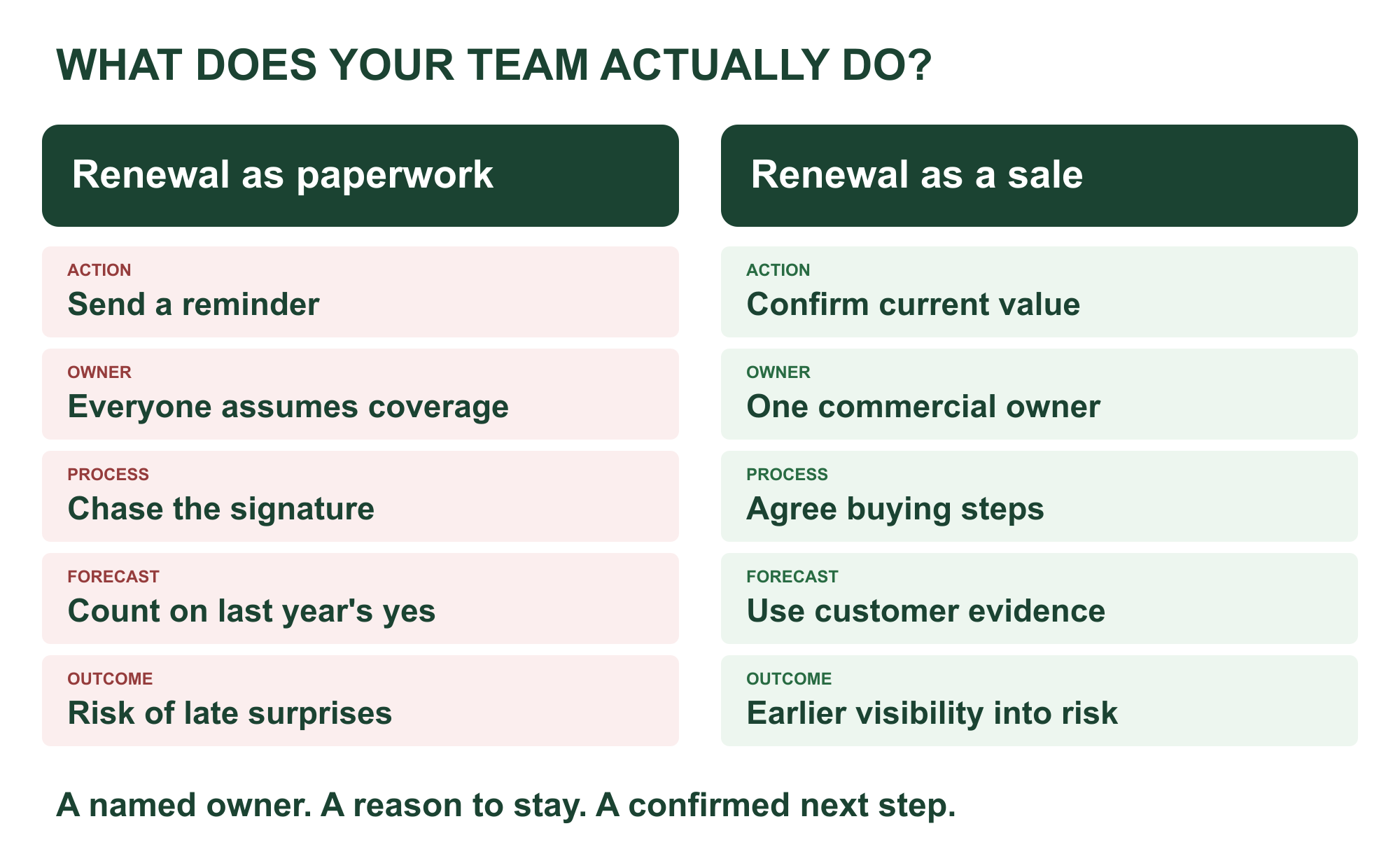
- A renewal is a fresh buying decision. Last year's signature doesn't prove next year's value.
- Give each renewal one commercial owner, even when several people help.
- Work backward from the customer's decision deadline, with 90-, 60-, and 30-day checkpoints as a starting point.
- Confirm results, current priorities, budget ownership, and approval steps before sending a proposal.
- Advance renewal stages on customer evidence, not emails sent.
- Coach your team to run renewals so every difficult account doesn't return to the founder.
Your team sends the renewal paperwork. The customer replies, "We're reviewing our options." Now you're in the account, calling someone you haven't spoken with in months, trying to save revenue you already counted.
Nobody forgot the expiration date. They forgot to sell the renewal. Support answered tickets. Finance prepared the invoice. Your salesperson assumed a happy customer would stay. But nobody confirmed why the buyer should commit for another year.
For a B2B founder at $1M to $10M ARR, this creates a second sales job. You close new business, then get called back to rescue existing business. Both depend on your relationships. Neither gets easier until you put a process around the work.
Renewals aren't automatic. Treating them as a paperwork formality instead of a sale lets accounts slip away while everyone thinks someone else has them covered. Here's how to put that decision back in your sales process.
The contract tells you when the term ends. It doesn't tell you whether the customer wants another one.
1. Find the buying decision hiding behind the renewal date
A satisfied user isn't the whole buying committee
Your daily contact may love the product. The person approving the budget may never use it. If your team talks only with users, it can miss the conversation that decides whether the account stays.
Ask who owns the budget now. Ask who approves another term. Ask whether procurement needs a review and whether the customer is comparing alternatives. These are normal sales questions. An existing account doesn't make them unnecessary.
Your original champion may have changed jobs. The company may have a different priority. A useful service can still lose funding when the buyer cannot explain its value to someone else.
Separate past performance from next year's reason to buy
Start with what the customer bought, what happened, and what remains unfinished. Then ask what they need during the next term. Don't assume last year's problem is still the most pressing one.
For example, imagine a customer bought help reducing manual reporting. The reports now run on time, but the new department leader wants better visibility across locations. That's an illustrative situation, not a client story. The renewal discussion needs to connect the work you do with that current priority.
If the need has disappeared or your offer no longer fits, recognize it. A renewal process should reveal that early enough to make a sound decision. It shouldn't pressure a customer into paying for work they no longer need.
2. Give the renewal an owner before it becomes urgent
Name one person accountable for the commercial result
In a small company, that person might be an account manager, a salesperson, or someone in customer success who can handle commercial conversations. The title matters less than clear authority and the ability to do the work.
Write the responsibility in the person's Accountabilities Document. They maintain the renewal plan, confirm the buying process, coordinate the proposal, update the forecast, and raise blockers. Finance can prepare paperwork. Delivery can explain results. One person still keeps the decision moving.
Don't assign ownership without discussing workload. A rep chasing new business may give renewals attention only when an account threatens to leave. Review account coverage and make renewal work part of the weekly plan.
Put the handoff and the next step in the CRM
At the first sale, record the renewal date, relevant notice deadline from the agreement, customer goals, commercial owner, and next review date. Keep those details with the account so they survive a staff change.
For an active renewal, add the budget owner, proposed scope, current annual recurring amount, expected renewed amount, risks, and next customer-confirmed action. Keep expansion separate so a larger proposal doesn't hide uncertainty about the existing business.
If it isn't in the CRM, it never happened. That doesn't mean adding twenty required fields. It means the next person can see what the customer agreed to and what needs to happen next without calling you.
3. Run the renewal backward from the decision deadline
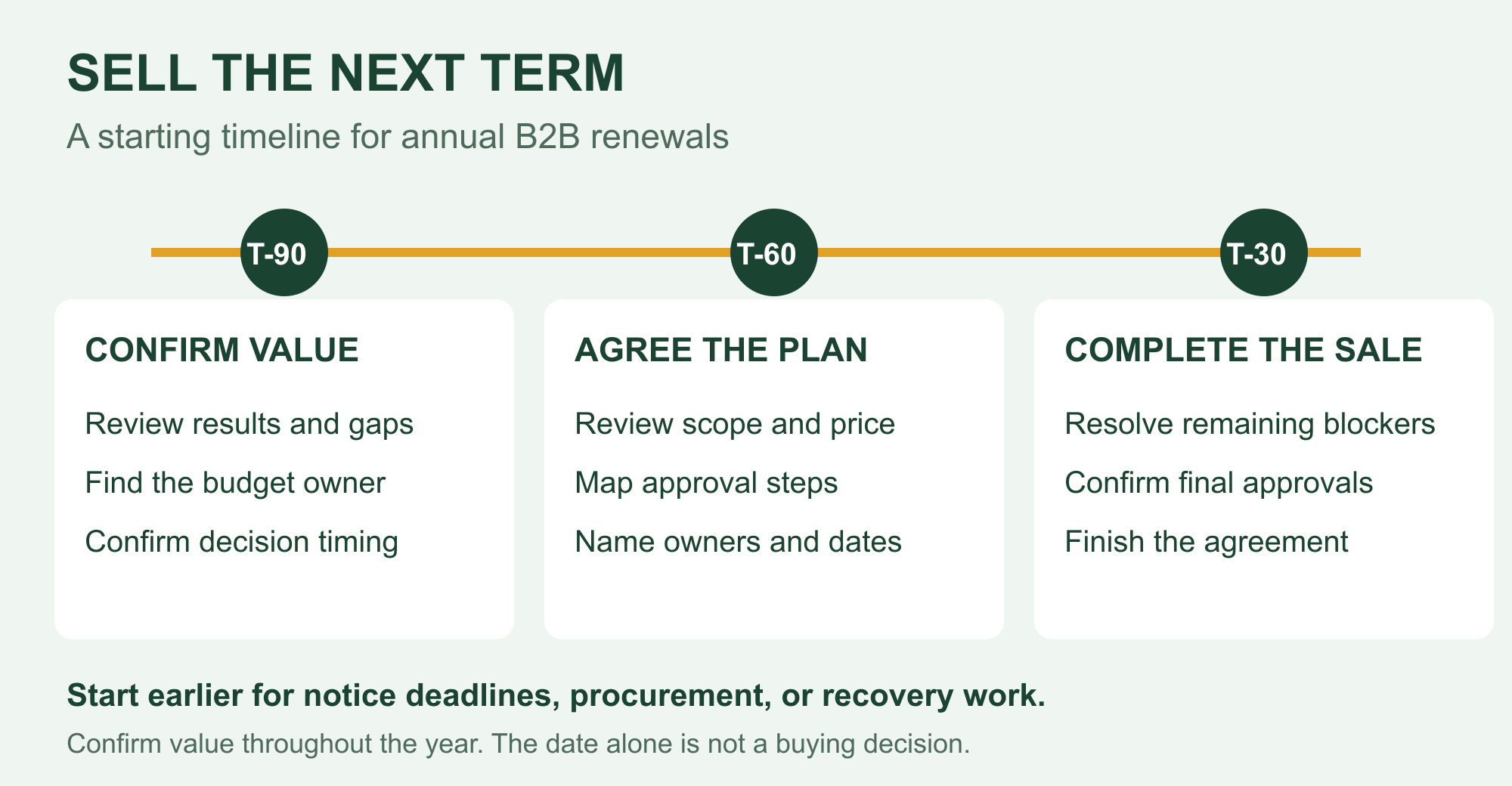
The following checkpoints are a proposed starting process for annual B2B agreements. They are not a universal timetable. Start earlier when procurement, a budget cycle, a notice deadline, or a delivery problem requires more time. For monthly accounts, use a shorter process that fits the relationship.
T-90: Confirm value, people, and risk
Before the customer meeting, review the original goals with delivery. Gather evidence the customer can check: completed work, adoption of the agreed workflow, unresolved issues, and results against the starting point. Don't turn a login count into a claim about business value.
Ask the customer: "What has improved? What hasn't? What would need to be true for another year to make sense?" Then confirm who will take part in that decision and when they need to make it.
Leave with a short shared record of results, gaps, owners, and dates. If results are weak, agree on a recovery plan with delivery. A promise to fix everything before renewal is useless if nobody has checked capacity.
T-60: Agree the next term and the approval path
Discuss the scope the customer needs, the proposed price, and any changes from the current agreement. Surface budget concerns now. Waiting to mention a price change until the signature request creates an avoidable surprise.
Map the steps between a verbal yes and a completed agreement. Who reviews the proposal? Who approves the spend? Does a purchase order need to be issued? When does each step need to happen?
Send a plain recap with named owners and dates. Ask the customer to confirm or correct it. A seller's close plan becomes useful when it reflects the buyer's actual process.
T-30: Resolve blockers and complete the agreement
By this point, you want the commercial decision understood and remaining steps visible. Check whether approvals have happened, whether the document reflects the agreed scope, and whether the signer has what they need.
If the customer still hasn't confirmed value or a decision maker, don't label the deal "paperwork pending." Record the missing evidence and the risk. A late renewal needs an honest recovery plan, not a more confident forecast.
When the agreement is completed, confirm the next term's goals and first review date with delivery. Closing the renewal starts the next period of accountability. It doesn't end customer management.
4. Forecast renewal evidence instead of customer friendliness
Give each stage a clear exit rule
Use a small set of stages your team can explain. For example: review scheduled, value and needs confirmed, proposal reviewed, approvals underway, and completed. Define what the customer must have done before the renewal moves forward.
"Proposal sent" proves your rep sent something. "Proposal reviewed with the budget owner; scope confirmed; procurement review booked" tells you where the decision stands. The second description gives you something to manage.
Keep risk separate from stage. An account can be reviewing paperwork and still have a budget cut hanging over it. Record the risk, its likely effect, the person addressing it, and the next checkpoint.
Review retained revenue and lost revenue separately
Suppose an account currently pays $40,000 a year and may renew at $32,000. That's an illustrative $8,000 contraction even if you keep the customer. Calling the account "renewed" without recording the reduction hides part of the result.
Track recurring revenue due for renewal, revenue retained, contractions, losses, and expansion using consistent definitions. Also track accounts with no named owner or no customer-confirmed next step. Those gaps give you work to do before the financial result arrives.
Don't assign a confident probability because a contact was pleasant on the last call. Use customer evidence and your own renewal history. If your history is thin, say what remains uncertain instead of inventing precision.
A friendly account is a relationship. A confirmed next step is something you can manage.
5. Coach the process so the founder isn't the rescue plan
Review exceptions in a short weekly meeting
Start with renewals approaching a decision deadline, then look at accounts with missing evidence or unresolved risk. Ask the owner what changed, what the customer committed to, and where they need help. Avoid a long tour of every healthy account.
When someone says, "Can you call them?" ask what the call needs to accomplish. Help the rep prepare the questions. Role play the budget objection. Review the value summary. Teach them how to run the conversation before taking it away from them.
Join when your authority is needed for a business decision or an executive relationship. Let the account owner lead, send the recap, and own the next step. Otherwise, your intervention teaches the team to wait for you.
Put the repeatable work in your Sales Playbook
Document the checkpoint questions, stage exit rules, approval limits, escalation rules, and meeting recap. Include one example of a clear renewal record with identifying details removed. Reps need to see what good work looks like.
After a loss or late scramble, review where the evidence went missing. Was the value unclear? Did ownership change? Did your team discover procurement too late? Fix the process at that point instead of adding another reminder email.
Begin this week with the next five renewals. Assign owners, confirm decision deadlines, and book the missing conversations. Five is a manageable starting batch, not a performance benchmark. Build a routine your team can repeat before buying another tool or making another hire.
Related Reading
Churn Isn't a Product Problem. It's a Sales Handoff Problem.Frequently Asked Questions
Q: When should we start a B2B renewal conversation?
For an annual agreement, 90 days before renewal can be a useful starting checkpoint. Work backward from the customer's decision process and any earlier deadlines. Begin sooner if the account needs substantial recovery work or a long approval cycle. Review value throughout the year.
Q: Should sales or customer success own renewals?
Choose one commercial owner with the skills, authority, and capacity to run the decision. Customer success or delivery should contribute results and unresolved issues. Sales may lead pricing and negotiation. Write down the responsibilities so the customer doesn't have to coordinate your team.
Q: Do auto-renewing accounts still need a renewal process?
Yes. An automatic transaction doesn't confirm ongoing value or protect the relationship from a future cancellation. Use a level of contact that fits the account and confirm current needs. Keep the actual agreement's dates and requirements visible to the responsible team.
Q: Should we offer a discount to save a renewal?
First identify the problem. A discount won't fix missing results, poor fit, or an absent budget owner. If price is the issue, discuss scope and approved options. Make sure any agreement is one your team can deliver and your business can support.
Q: How do we handle a customer who stops responding?
Check whether your contact is still responsible and use established relationships to identify the current owner. Send a specific reason to meet, tied to the customer's goals and decision timing. Record silence as uncertainty. Repeated unanswered emails are activity, not evidence of a renewal.
Build a renewal process your team can own.
If every renewal risk pulls you back into selling, Fractional Sales Leadership may help you define ownership, build the Sales Playbook, and coach the team. Learn how I work at LouieBernstein.com.
Schedule a 30-Minute CallAbout the Author
Louie Bernstein
Louie Bernstein is a Fractional Sales Leader who helps B2B founders at $1M to $10M ARR build repeatable sales systems, develop their teams, and reduce founder dependence.