What Buyer Behavior Signals That Human Help Is Needed?
A salesperson should step into a SaaS free trial when a suitable account shows a buying question that human help can resolve, or the buyer explicitly asks to talk. Look for real work, team involvement, and questions about rollout, pricing, or approval. Route setup failures to support first. A signup, frequent logins, or an approaching expiration date alone does not justify a sales meeting.
Key Takeaways
- Bring a salesperson into a SaaS free trial when the buyer needs help making a purchase decision, not simply because the trial started.
- Account fit, meaningful product use, and a buying obstacle together create a stronger handoff than login counts.
- A blocked import is usually a support issue. A question about a company rollout may need sales.
- In a January 2026 study of 200 B2B software products, 80% of free-trial products had human touchpoints for enterprise trial users.
- Write one routing rule for each signal, including the owner, the help offered, and the next buyer action.
A new trial account appears. The company looks promising. Your rep sends a calendar link before anyone has done anything useful in the product. The buyer wanted to test a workflow. Your team wants a meeting. Those are different goals.
For a founder at $1M to $10M ARR, there is another problem. Every uncertain trial lands on your desk because nobody has defined when sales should get involved. You become the routing system.
The best reason to contact a trial user is a useful job your team can do for that buyer.
Which trial behaviors signal that a buyer needs sales help?
Trial behaviors signal a need for sales help when they reveal an evaluation moving beyond individual use into a business decision. Real data, repeated completion of a valuable workflow, new stakeholders, and commercial questions deserve attention together. Confirm what the behavior means before treating the account as a qualified opportunity.
Look for work that resembles a purchase
Imagine a purchase-approval product. A user uploads real requests, completes an approval, and invites a department manager. Later, the user asks whether finance can manage permissions across departments. The sequence suggests an evaluation of broader use. A salesperson can help define the rollout and identify who must approve it.
Each event still has another possible explanation. An invitation may be a test. A pricing-page visit may be curiosity. A user may import data and discover the product is wrong for the job. Treat signals as reasons to ask a relevant question, not as permission to declare buying intent.
Separate the person using from the account buying
Watch the account as well as the individual. One enthusiastic user may lack authority to buy. Several colleagues may share a practical problem without having an approved project. Ask who needs the result, who will use the product, and how a purchase would be approved.
Use a focused discovery conversation to learn the business problem. Start with what the buyer has already tested. Making an active user repeat the entire signup story wastes the evidence the trial has produced.
How do you distinguish buying intent from a support problem?
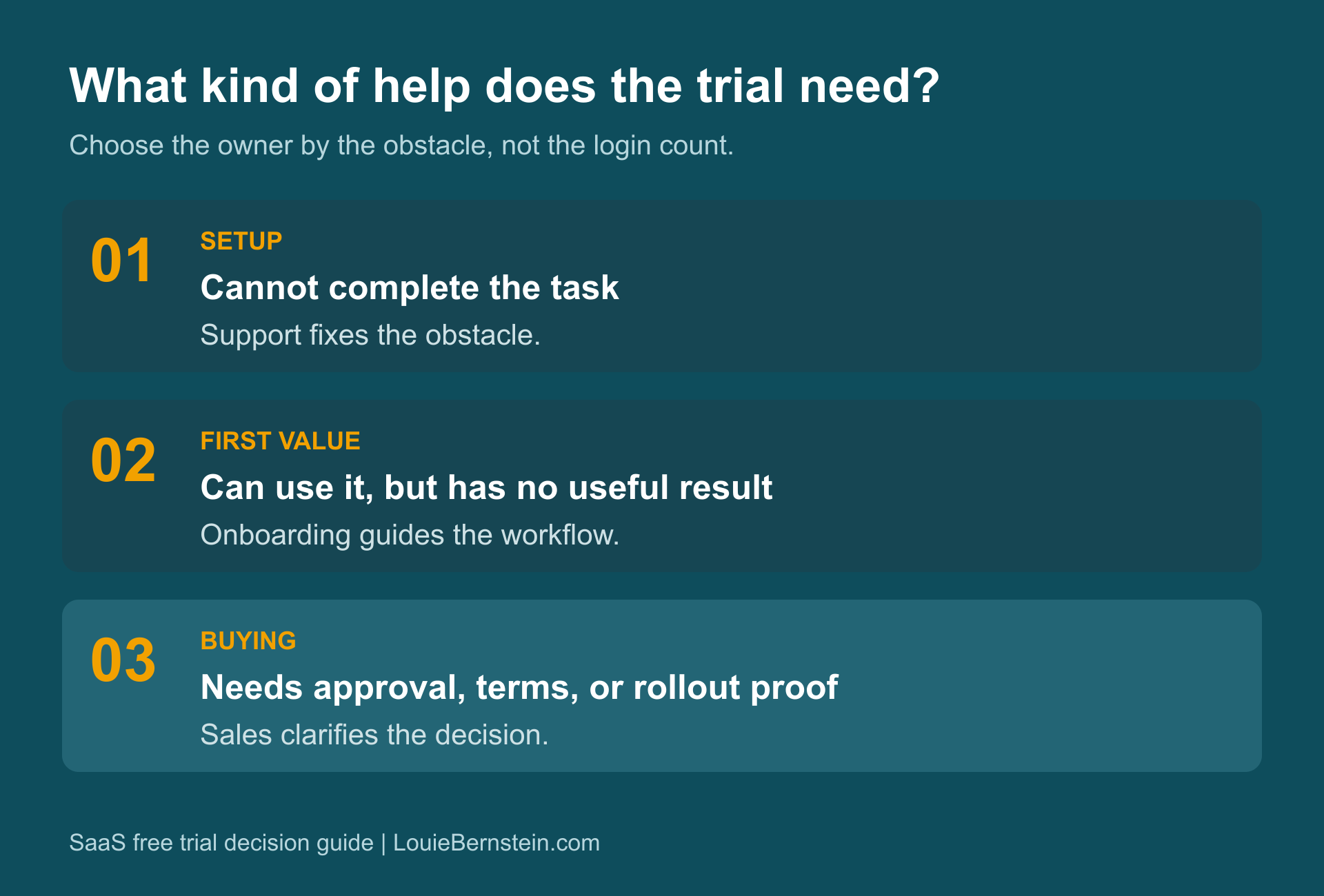
Distinguish buying intent from a support problem by asking what the user cannot do next. If the obstacle prevents basic product use, support or onboarding should lead. If the obstacle concerns business fit, stakeholders, commercial terms, or a rollout decision, sales should lead and bring technical help when needed.
Assign the right owner before sending a meeting link
| Observed behavior | Likely first response | What to confirm |
|---|---|---|
| Repeated import failures | Support fixes the setup obstacle | Can the user complete the intended task? |
| Core workflow completed with real data | Offer relevant guidance without requiring a call | Did the result solve a meaningful problem? |
| Team invited, rollout question raised | Sales clarifies the buying decision | Who evaluates and approves broader use? |
| Security review requested | Sales coordinates the technical or security owner | Which requirement blocks approval? |
| Trial inactive after signup | Offer a simple onboarding path | Was there a real evaluation to begin with? |
A large company domain does not turn a bug into a sales opportunity. If a user cannot connect the product, fix the connection. Sales can stay informed when a purchase is under discussion, but the buyer should not have to attend a discovery call to receive promised support.
Define activation around a useful result
For your product, write one sentence that describes the first useful result. In the approval example, creating an account is not the result. Completing a real approval with the right people is closer. Different customer segments may need different definitions. Validate the definition against actual customer behavior.
Do not confuse silence with satisfaction or rejection. A trial can go quiet because the user is busy, the setup failed, or another priority won. One brief offer of help can clarify the situation. Repeated sales messages cannot substitute for that understanding.
When should a rep reach out during a free trial?
A rep should reach out during a free trial when the next useful intervention is clear, rather than on a fixed day alone. Respond promptly to a direct request. For observed behavior, confirm fit and relevance, then offer help tied to the task or decision the buyer appears to be working through.
Make the outreach about the buyer’s next task
A useful message might say: “If you’re evaluating a rollout across departments, I can help map the approval steps and check the permissions you’ll need. Would that be useful?” The message offers a specific outcome. The buyer can accept, decline, or explain a different need.
Avoid a message that lists every action the user took. Product activity should help your team understand context. It should not make the user feel watched. Follow your privacy commitments, use authorized data, and describe the help in ordinary language.
Use the trial clock to plan proof
The January 2026 research from Growth Unhinged, ChartMogul, and ProductLed covered 200 B2B software products. Among free-trial products, 62% used a 14-day trial, and 80% included human touchpoints for enterprise trial users. These figures describe surveyed products, not the share of individual users who needed sales (Growth Unhinged, 2026).
Human involvement is compatible with a trial. The survey does not establish the best contact day, show that every touchpoint was sales-led, or prove that intervention caused conversion. Your team still has to determine which help makes sense for your buyer.
If an evaluation needs a security review, waiting until the final afternoon may leave too little time. Ask what needs proving and when the people involved can review the evidence. Extend a trial only when there is a defined task, an owner, and an agreed review date. More days without a plan are not progress.
How can founders make trial handoffs work without taking over?
Founders can make trial handoffs work without taking over by documenting the judgment behind intervention. Give reps clear signals, named owners, and a standard for the next buyer action. Coach the choice of help. A list of automated alerts will not replace the reasoning a rep needs to handle an unfamiliar account.
Apply the lesson from my second sales call
In my article about the second sales call after discovery, I describe a meeting with one of my salespeople where an unresolved support question interrupted a planned presentation. We won the sale, but the conversation took an avoidable detour. We needed to confirm where the buyer stood before presenting.
The trial version of that lesson is simple: do not assume product activity means the buyer is ready for your commercial conversation. Ask what worked, what failed, and what still needs proving. A user who invited a manager yesterday may have discovered a serious limitation this morning.
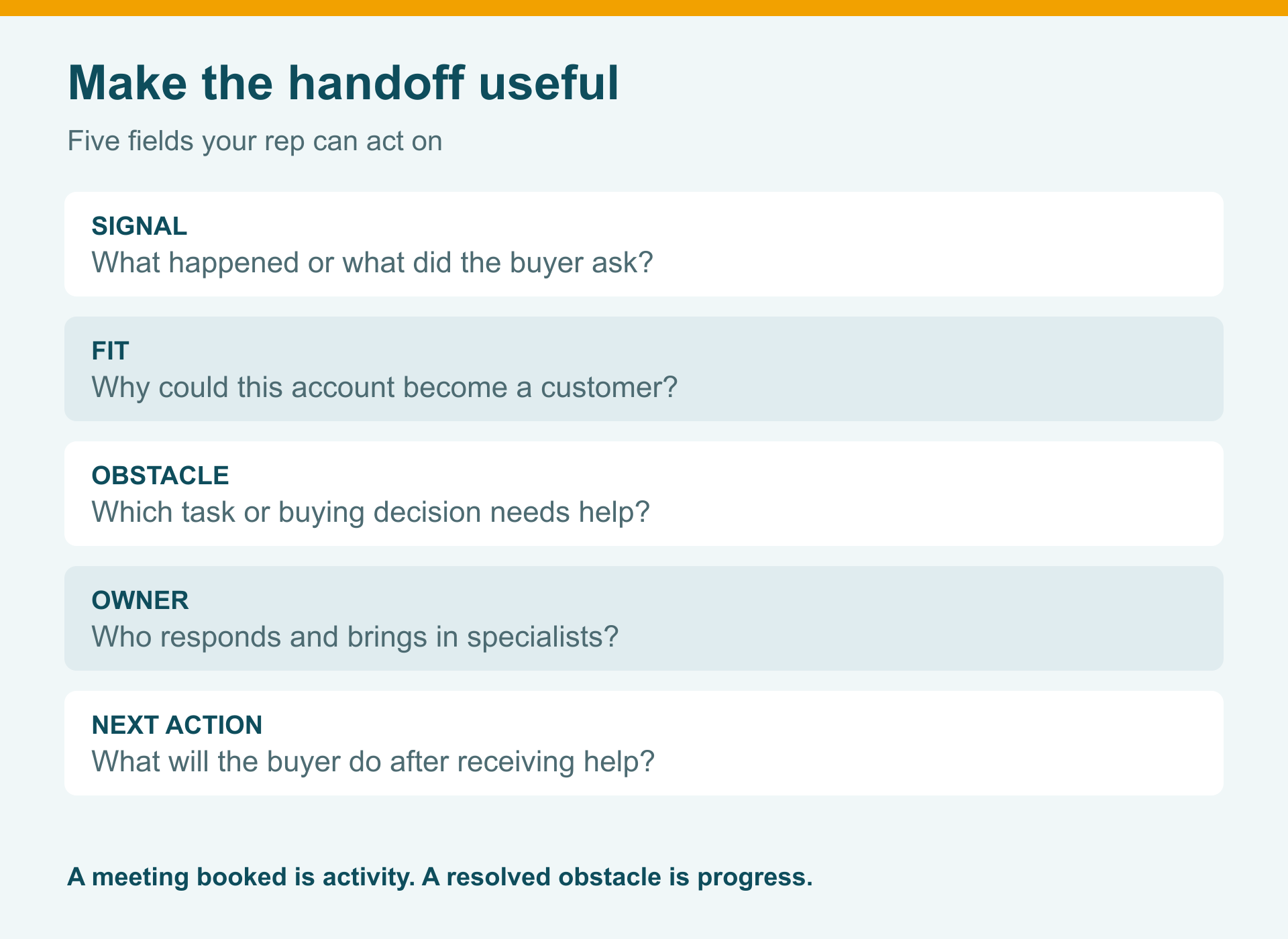
Put five fields in the Sales Playbook
- Signal: the event or request that deserves review.
- Fit: why the account could become a suitable customer.
- Obstacle: the specific task or decision needing help.
- Owner: the person responsible for responding and coordinating specialists.
- Next action: what the buyer agrees to do after receiving help.
Keep the record short enough to use. “Three teammates joined” is a signal. “Operations needs to validate department permissions before finance reviews the purchase” describes a buying task. The second statement gives the rep something useful to do.
Role play a failed import, a genuine rollout question, and a busy user who wants to explore alone. Have the rep choose the owner and write the response. Build those examples into your Sales Playbook. Teach the judgment so the next trial does not require your approval.
How do you know whether sales assistance improves trial results?
Judge sales assistance by whether comparable trial accounts make better buying progress and become suitable paying customers at a reasonable cost. Track the signal, the intervention, the outcome, and the rep time. Comparing every assisted account with every unassisted account can mislead you because reps often select the strongest prospects.
Measure the same accounts over the same window
The 2026 conversion study defined free-to-paid conversion as becoming a paying customer within six months. Its median across all products was 8%. That is a broad survey reference, not your target or an end-of-trial conversion measure (Growth Unhinged, 2026). Choose and label your own observation window consistently.
Start with a small report grouped by customer segment and trigger. Record activation, conversion within the chosen window, time to purchase, rep time, and early retention. Include refunds or poor-fit customers so a rushed sale does not look like a success.
Test an intervention rather than rewarding activity
Where volume permits, randomly assign otherwise eligible accounts to the normal experience or an added offer of sales help. Keep requested support available to both groups. With small samples, review individual outcomes and treat conclusions as tentative. Record changes in pricing, onboarding, and traffic sources that could explain differences.
Start with one signal and one useful response. Review whether the conversation resolved the stated obstacle. A meeting booked is activity. A buyer completing the evaluation task is stronger evidence of progress. If the same setup issue appears repeatedly, send the pattern to product and onboarding instead of hiring more reps to work around it.
Frequently Asked Questions
Q: Should trial users have to book a call before seeing pricing?
Give buyers enough pricing information to judge fit before asking for a meeting. Complex contracts may need a conversation, but hiding basic commercial information can make a simple evaluation harder. Explain what changes the price.
Q: Should we require a credit card to start a trial?
Treat a credit-card requirement as a separate funnel decision. Measure signup completion, paid conversion, refunds, and customer fit together. A higher conversion rate among a smaller, more committed signup group does not automatically mean more suitable customers.
Q: Can a product-qualified lead go straight into our forecast?
Product qualification alone should not put a deal in the forecast. Establish a real buying process, timing, and evidence for the opportunity stage. Usage can identify an account worth reviewing without proving a purchase will happen.
Q: Who should own trial accounts if we have no customer success team?
Name one accountable owner and document when that person brings in support or sales. In a small team, one employee may cover several roles. The buyer still needs a clear contact and the right expertise for the question.
Q: What if a buyer says they do not want sales contact?
Respect the preference and keep the agreed support route available. Provide useful self-service guidance and a clear way to request a person later. Continued activity in the product does not cancel an explicit request to explore independently.
Build a trial process your team can run
If every promising trial still lands on your desk, I can help you define the handoffs, coach your reps, and build a repeatable sales process. As a Fractional Sales Leader, my job is to help your team make better sales decisions without depending on you for every account.
Schedule a 30-minute conversationAbout the Author
Louie Bernstein is a Fractional Sales Leader with 50 years of sales experience and has worked as a Fractional Sales Leader since 2017. He helps B2B founders build Sales Playbooks, sales processes, and teams that can sell without the founder on every call.