How Do You Know Which Growth Model Fits Your Product and Buyer?
Most B2B SaaS companies between $1M and $10M ARR should be sales-led, with product-led pieces added where they help buyers move faster. Choose product-led growth only when the user can sign up, see value, and pay without a meeting, and when your average deal is small enough that a salesperson costs more than the deal returns. Deal size, buyer complexity, and time to value decide the model, not fashion.
Key Takeaways
- A B2B SaaS company should be sales-led when deals need several approvers, real configuration, or a business case, and product-led when one user can buy alone.
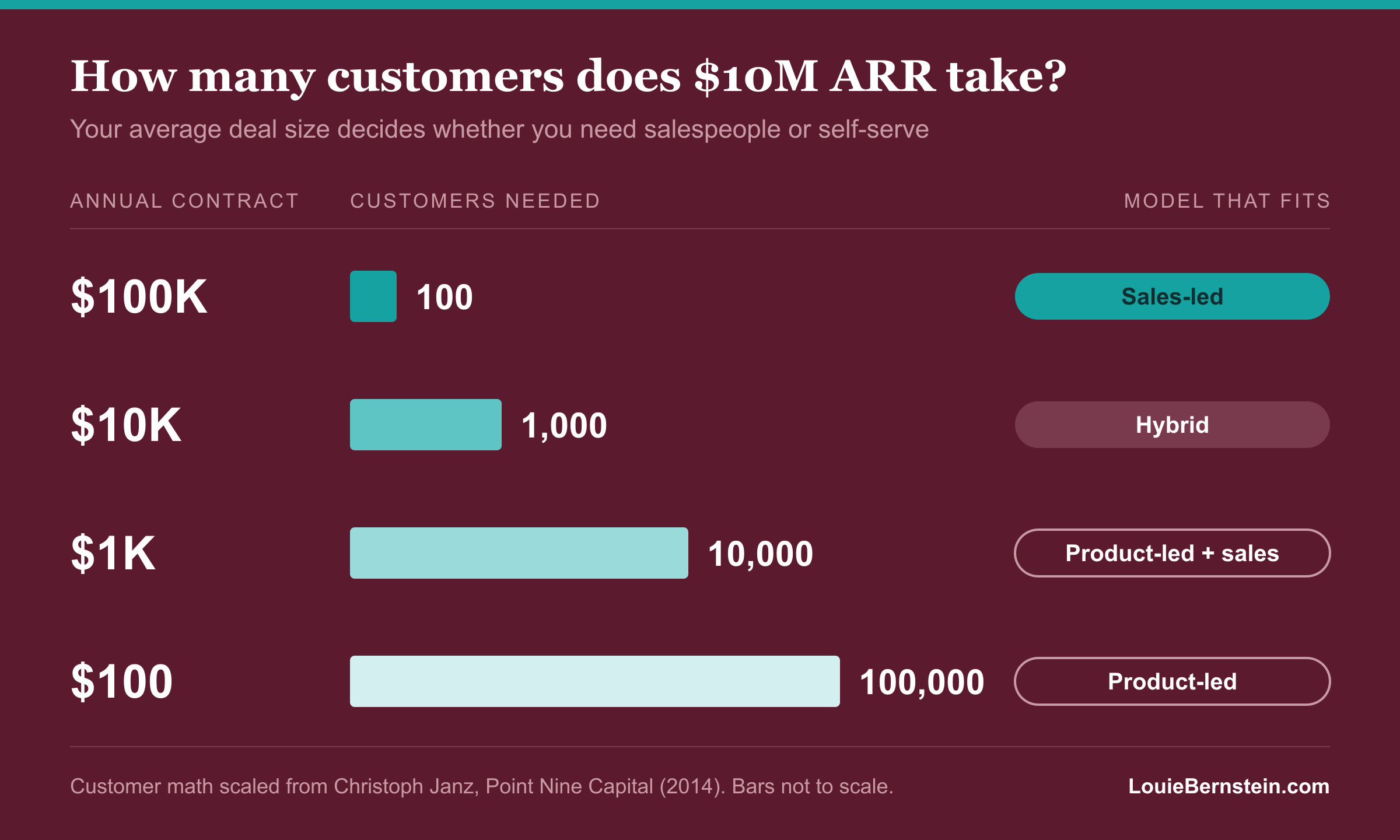
- Deal size sets the math: reaching $10M ARR takes 10,000 customers at $1,000 a year but only 100 customers at $100,000 a year.
- Product-led doesn't mean salesperson-free. In Pocus's 2022 survey of 200+ product-led companies, 49% already ran a product-led sales motion.
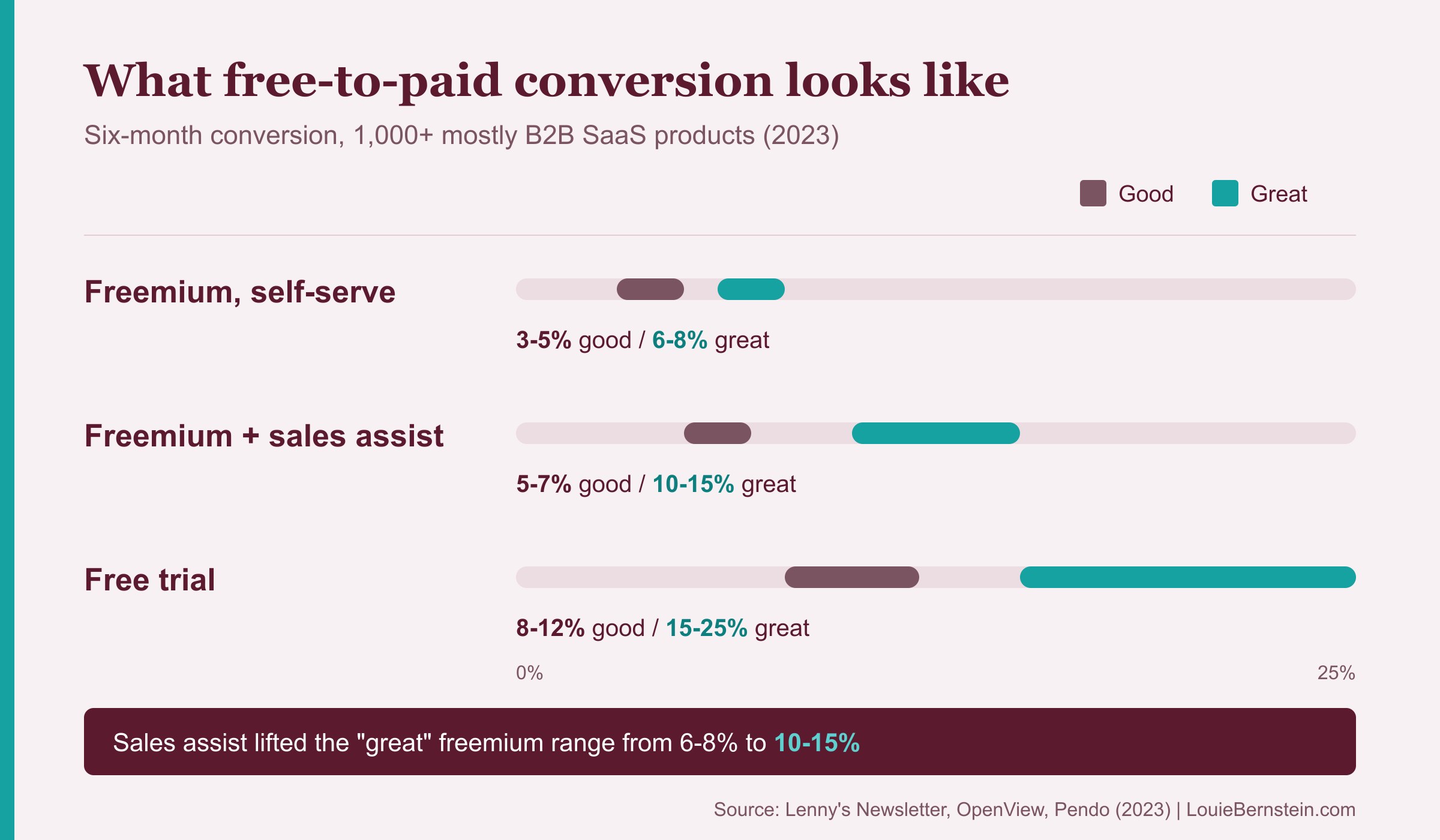
- Good free-to-paid conversion is 3% to 5% for freemium and 8% to 12% for free trials, per a 2023 OpenView and Lenny's Newsletter study of 1,000+ products.
- Before choosing a model, score your last 10 closed deals on who signed, how many people approved, and how long the buyer took to see value.
Picture a founder who announces the company is going product-led. The board likes the idea. The founder is tired of being on every sales call. A free tier sounds like a way out.
Now picture the last ten deals. Most needed a security review. Most had a finance approver. Several took a custom data import before anyone saw a result. That company isn't product-led. It's sales-led with a free tier nobody converts.
Your growth model isn't a strategy you pick. It's a fact about how your buyers already buy.
The good news: you don't have to guess. Your own closed deals already tell you which model fits.
What's the difference between sales-led and product-led growth?
Sales-led growth means a salesperson guides the buyer from first conversation to signed contract. Product-led growth means the product does that job: users sign up, get value, and pay without talking to anyone. The difference is who carries the buyer to a decision, a person or the product.
What each model looks like day to day
- Sales-led: marketing creates leads, salespeople run discovery, demos and proposals, and the deal closes on a contract. Revenue depends on the number and skill of your salespeople.
- Product-led: a free tier or trial creates users, the product shows its value quickly, and a credit card or self-serve upgrade closes the sale. Revenue depends on sign-ups, activation, and conversion.
- Hybrid, often called product-led sales: the product brings in users, and salespeople step in when usage shows a team or company is ready for a bigger contract.
Most product-led companies still sell
Product-led companies rarely stay salesperson-free. In the 2022 Product-Led Sales Benchmarks Report from Pocus, OpenView and others, 49% of 200+ product-led companies surveyed already had a product-led sales motion in place (Pocus, 2022). The free tier finds the users. A person usually closes the account.
So the real question for a founder at $1M to $10M ARR isn't "sales or product?" It's "where in my buyer's journey does a person add value, and where does a person just slow things down?"
Which growth model fits my deal size?
Deal size is the first filter for choosing sales-led or product-led growth. Small annual contracts can't pay for a salesperson's time, so they need the product to sell itself. Large annual contracts can't close without one, because more people, more risk, and more money are involved in the decision.
Run the customer-count math
Investor Christoph Janz laid out this math in 2014 for reaching $100M ARR: 1,000 customers at $100,000 a year, or 100,000 customers at $1,000 a year (Janz, Point Nine Capital). Scale it down to the stage you care about and the choice gets obvious.
| Average annual contract | Customers needed for $10M ARR | Model that usually fits |
|---|---|---|
| $100,000 | 100 | Sales-led |
| $10,000 | 1,000 | Hybrid: sales-led with self-serve trials or tours |
| $1,000 | 10,000 | Product-led, with sales help for larger accounts |
| $100 | 100,000 | Product-led |
At a $1,000 contract, a salesperson who closes 10 deals a month brings in $120,000 a year in new revenue. That doesn't cover most salespeople's pay. At a $100,000 contract, the same 10 deals a month would be a dream, and nobody spends that much without talking to a person first.
The middle is where founders get stuck
The $5,000 to $25,000 range is the hardest. The contract is big enough that buyers want a conversation, and small enough that a long sales cycle eats your margin. Companies in this range usually do best with a sales-led core and self-serve pieces that shorten the cycle: a public product tour, honest pricing guidance, a guided trial. My article on when B2B SaaS demos still help covers how to decide which pieces to offer.
How do I know if my buyer can buy without a salesperson?
Your buyer can buy without a salesperson when one person can evaluate, approve, and pay for your product, and can see value in days rather than months. If buying requires a committee, a security review, a data migration, or a business case for finance, the buyer needs a person to guide the decision.
Buyers want to self-serve. They don't always do it well.
Gartner's June 2025 release reported that 61% of 632 B2B buyers surveyed in August and September 2024 preferred an overall rep-free buying experience (Gartner, 2025). That sounds like a vote for product-led growth.
Look at the earlier Gartner research before you cancel your sales hires. In a survey of nearly 1,000 B2B customers in late 2020, purchase regret was 23% higher for customers who preferred a rep-free experience than for customers who worked with a sales rep (Gartner, 2021). Buyers prefer doing it themselves. On complex purchases, doing it themselves often goes worse.
The 5-question growth model test
Score your last 10 closed deals on these questions. Use real deals, not the deals you wish you had.
- Who signed? If the person who used the product also paid for it, that points product-led. If someone else signed, that points sales-led.
- How many people approved the purchase? One or two points product-led. Three or more points sales-led.
- How fast did the buyer see value? Within a day or a week points product-led. Weeks of setup or a data migration points sales-led.
- What was the annual contract value? Under about $5,000 points product-led. Over about $25,000 points sales-led. In between points hybrid.
- Did the buyer need a business case? If finance or a board needed an ROI story, a salesperson helped write it. That's sales-led.
If eight or more of your deals point the same way, you have your answer. If they split, you're hybrid, and the useful work is deciding which accounts get a person and when. Those cutoffs are my working rules of thumb, not industry benchmarks. Adjust them to your market.
What free-to-paid conversion should a product-led motion hit?
A product-led B2B SaaS motion should convert roughly 3% to 5% of freemium sign-ups, or 8% to 12% of free-trial users, to paid. Those are the "good" ranges from a 2023 study of more than 1,000 products. Rates well below them usually mean the buyer needs more help than the product gives.
The benchmarks
The 2023 survey by Lenny's Newsletter, OpenView, Growth Unhinged and Pendo covered 1,000+ mostly B2B SaaS products and measured conversion over six months (Lenny's Newsletter, 2023):
- Freemium, self-serve: 3% to 5% is good, 6% to 8% is great.
- Freemium with sales assist: 5% to 7% is good, 10% to 15% is great.
- Free trial: 8% to 12% is good, 15% to 25% is great.
Notice the middle line. Adding a salesperson to a freemium product moved the "great" range from 6% to 8% up to 10% to 15%. That's the hybrid case in one number.
What to measure before you trust a free tier
- Activation rate: the share of sign-ups who reach the first real result. If users never reach value, conversion can't follow.
- Time to value: days from sign-up to that first result. Long setup kills self-serve.
- Free-to-paid conversion over a fixed window, compared with the ranges above.
- Expansion: how many paid accounts grow into team or company contracts, and whether a person was involved.
If you can't measure these four numbers yet, you aren't ready to call yourself product-led. You're running an experiment, and that's fine, as long as you treat it like one.
Where do founders usually get this decision wrong?
Founders usually get the sales-led or product-led decision wrong by choosing a model to escape a problem instead of to fit the buyer. Going product-led because you're tired of selling doesn't remove the selling. It moves the selling to the larger accounts, where the founder still ends up closing them alone.
What I see when I audit sales teams
I've spent 50 years in B2B sales, and I've worked as a Fractional Sales Leader since 2017. Here's the pattern I see over and over at companies that call themselves product-led: the small accounts upgrade on their own, and every account big enough to matter still runs through the founder. Nobody wrote down how those bigger deals get closed. There's no qualification, no handoff rule, no playbook. The free tier didn't replace founder-led sales. It hid it.
The opposite mistake happens too. A founder with a simple, low-priced product insists every prospect book a demo. The calendar fills up with meetings that don't need to happen, and buyers who wanted to try the product go elsewhere.
Product-led growth doesn't fix founder-led sales. It just moves the founder to the deals that matter most.
The user is rarely the buyer on a big deal
In my experience, the larger the purchase, the less likely the person using your product is the person who signs. The user loves your product. The CFO has never heard of it. A free tier wins the user. A salesperson, or a champion your salesperson has coached, wins the CFO. If your growth plan depends on bigger contracts, plan for that second conversation from day one.
What to do in the next 30 days
- Score your last 10 closed deals with the 5-question test above.
- Write down the contract size where buyers stop upgrading on their own. That's your handoff line.
- Above the handoff line, document how deals get closed: qualification, discovery, proposal. That becomes part of your SaaS sales process.
- Below the line, remove one meeting buyers don't need, such as a required demo for basic product questions.
- Review the numbers after 60 to 90 days, by deal size, before you change anything else.
If you can't tell where the handoff line is because your customers are all over the map, start with your ideal customer. My article on what to do if you don't know your ICP walks through it.
Frequently Asked Questions
Q: Can I switch from sales-led to product-led later?
Yes, but it takes product work, not just a pricing page. The product has to deliver value without setup help, and you'll need sign-up, activation and conversion tracking. Most companies add self-serve for their smallest customers first and keep salespeople on larger accounts.
Q: Should my first sales hire be different in a product-led company?
Yes. A first salesperson in a product-led company works warm accounts that already use the product, so they need to read usage data and expand teams into company contracts. A sales-led first hire spends more time creating pipeline and running full discovery from scratch.
Q: What's a product-qualified lead?
A product-qualified lead is a user or account whose behavior in your product shows buying intent, such as inviting teammates, hitting a usage limit, or connecting a key integration. In a hybrid model, product-qualified leads tell your salespeople which free accounts deserve a conversation.
Q: Will a free tier hurt my enterprise deals?
A free tier can help enterprise deals when it lets users inside a large company prove value before procurement gets involved. It hurts when buyers treat the free version as good enough. Keep enterprise needs such as security controls, admin features and support in paid plans.
Q: Does AI change the sales-led vs product-led decision?
AI makes self-serve onboarding and product education cheaper, which helps product-led motions at smaller deal sizes. It doesn't change who approves a large purchase. If a deal needs a committee and a business case, a person still guides the decision.
Find out which growth model your deals are telling you to run
If you're still closing every meaningful deal yourself, the growth model isn't the only question. As a Fractional Sales Leader, I help founders figure out where a salesperson adds value, build the sales process for those deals, and get the team selling without the founder on every call.
Schedule a 30-minute conversationAbout the Author
Louie Bernstein is a Fractional Sales Leader with 50 years of sales experience and has worked in fractional sales leadership since 2017. He helps B2B founders build repeatable sales systems, coach their teams, and reduce their dependence on founder-led selling.
LouieBernstein.com