When Does a Demo Help the Buyer, and When Does It Create Friction?
Your B2B SaaS company still needs sales demos when buyers need help proving that your product fits their workflow, requirements, or business case. A live demo creates friction when buyers must book a meeting to get basic information they could understand themselves. Give buyers an easy way to explore first, then use a focused conversation to resolve the questions that actually block a decision.
Key Takeaways
- B2B SaaS sales demos still help when they resolve a specific question about product fit.
- A product tour, a live demo, and a trial answer different buyer questions. Offer the format that matches the uncertainty.
- In TrustRadius's 2026 technology-buyer research, 47% consulted product demos. Demo use is still substantial.
- Before booking a demo, write down the buyer's question, the proof needed, and who must evaluate it.
- Review qualified opportunities and buying progress, not demo bookings alone, before changing your sales process.
You look at the calendar and see demos all week. Your salespeople are busy. You’re busy. The pipeline looks active. But the buyers keep asking for another call, another walkthrough, or another version of the same presentation.
For a founder at $1M to $10M ARR, those meetings carry a second cost. Every routine demonstration you personally run takes time away from building a team that can sell without you.
A demo earns its place when the buyer leaves with less uncertainty, not just more information.
When does a live sales demo help a B2B SaaS buyer?
A live sales demo helps a B2B SaaS buyer when a conversation can resolve a question that a standard product tour cannot. The strongest reasons involve a specific workflow, a difficult tradeoff, or a requirement that needs clarification. The meeting should produce evidence the buyer can use to judge fit.
Separate seeing the product from proving the fit
“What does the dashboard look like?” is usually a different question from “Can our regional managers see only their own accounts while finance sees everything?” The first may need a screenshot. The second may need a live walkthrough with the person who understands permissions.
Imagine a SaaS product that handles purchase approvals. A buyer needs to know whether a request can move through two departments without losing its audit history. Show that workflow, including what happens when someone rejects the request. Don’t spend half the meeting on reports the buyer hasn’t asked about.
Gartner’s June 2025 release reported that 61% of 632 B2B buyers surveyed in August and September 2024 preferred an overall rep-free buying experience. The same research says buyers prefer seller input for contextual tasks such as assessing company fit. That distinction matters more than the headline (Gartner).
Use a focused discovery conversation to identify the question. You don’t need a separate meeting for every step. You do need enough understanding to show something useful.
Name the decision before opening the screen
Ask: “What would you need to see today to decide whether this deserves further evaluation?” If the answer is basic product education, provide that education efficiently. If the answer is a business-critical requirement, build the demonstration around that requirement and invite the person who can judge the result.
When does requiring a demo create friction?
Requiring a demo creates friction when a buyer has to trade calendar time for basic product information. Scheduling, qualification forms, and repeated introductions add work before the buyer knows whether your software belongs on the shortlist. For a small SaaS team, the same requirement also consumes scarce selling time.
Stop using meetings as the price of admission
Review what buyers can learn before contacting you. Can they see the main workflow? Understand the intended customer? Find meaningful pricing guidance, even if final pricing needs a conversation? Learn about important limitations? A “Book a demo” button cannot answer all those questions.
The problem is especially clear when a salesperson repeats the website, then books another meeting for someone else to show the product. The buyer has spent time and still has no useful proof. Remove repeated steps before adding a new demo platform.
Don’t confuse less friction with hiding your sales team. Some buyers want help immediately. Give them a clear route to a person alongside an honest way to explore on their own. The useful choice is between forms of help, not between being abandoned and being screened.
Make the founder’s time visible
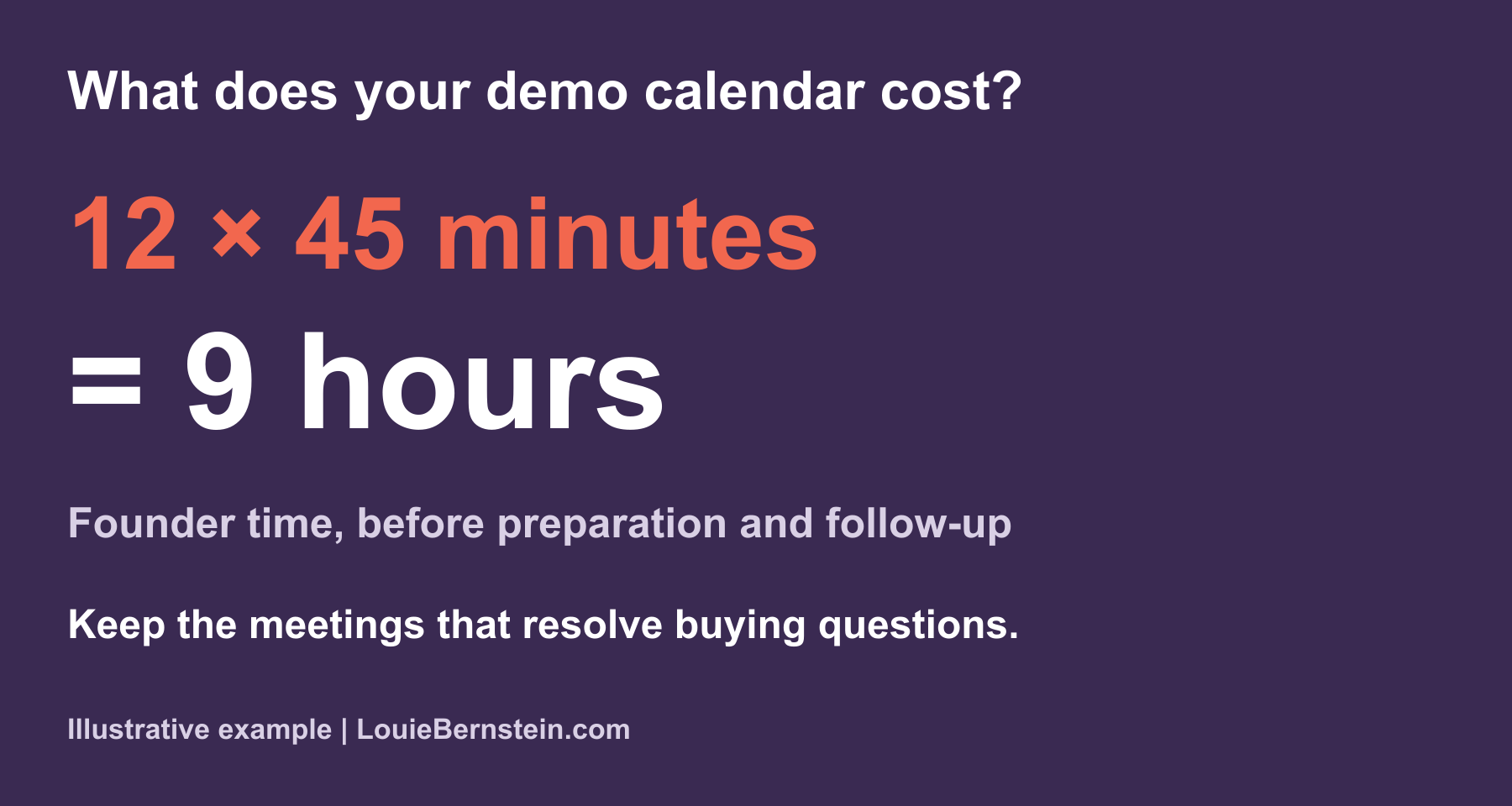
Here’s illustrative math, not a benchmark: 12 routine demos at 45 minutes each use nine founder hours. Preparation and follow-up add more time. If a short tour answers the same early questions, some of those hours can go toward coaching reps or working through a real buying obstacle.
You won’t save all nine hours simply by publishing a video. Buyers may still need help. The calculation tells you where to investigate, not what result to promise. Review which questions repeat and which meetings actually require your judgment.
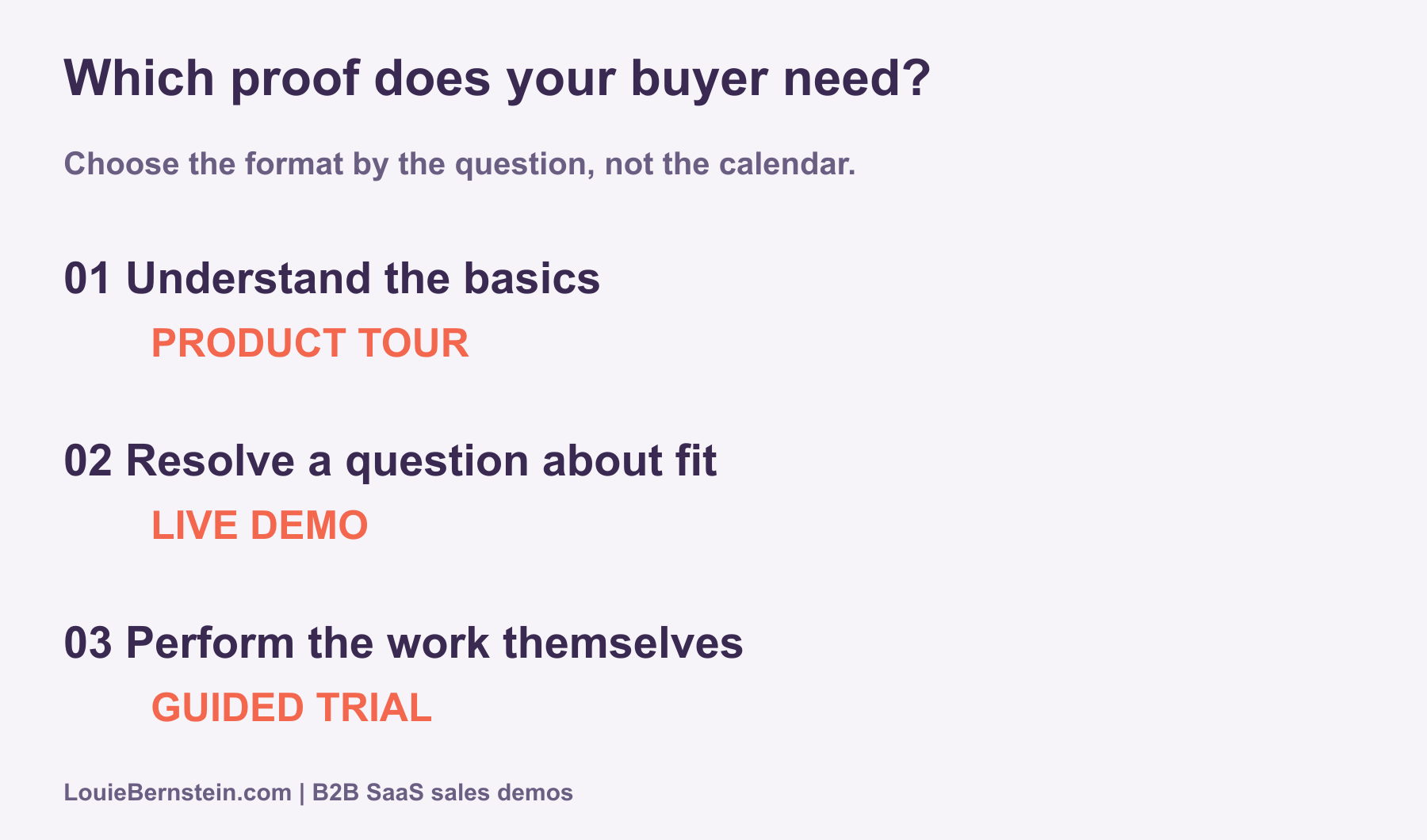
Should you offer a product tour, a live demo, or a trial?
Offer a product tour for orientation, a live demo for questions about fit, and a trial when buyers need to perform the work themselves. These formats can support the same sale. Choose the next format by the evidence the buyer needs, rather than forcing every account through an identical sequence.
Match the format to the unresolved question
| Buyer’s question | Useful next step | Watch out for |
|---|---|---|
| What does this product do? | Short recorded or interactive tour | Showing an unrealistic perfect workflow |
| Will it handle our process? | Focused live demo | Answering with generic features |
| Can our team actually use it? | Guided trial with a defined task | Leaving users alone with an empty account |
| Will it meet technical requirements? | Technical review or scoped validation | Treating a polished demo as integration proof |
TrustRadius’s 2026 B2B Buying Disconnect research reports that 47% of surveyed technology buyers consulted product demos. Among users of each resource, demos scored 73% and free trials or accounts 77% as most influential resources. Those are different resource-user groups, not conversion rates or proof that trials outperform demos (TrustRadius, 2026).
The practical lesson is to preserve useful product evidence. Removing live meetings should not remove the buyer’s opportunity to see and test what matters. A self-guided tour also needs a clear route to ask a question when the standard path doesn’t fit.
Don’t offer a trial your buyer cannot evaluate
A trial may be a poor first step if useful results require a major data migration or several teams to configure the account. Start with a demonstration using clearly labeled sample data. Then agree on a limited validation task, the support required, and the conditions for success.
Be clear about what the demo environment proves. A simulated integration is not a working connection to the buyer’s systems. A preloaded report is not proof that the buyer’s data will be clean. State the boundary before the buyer builds a business case on a false assumption.
How do you keep demos useful without the founder?
Keep demos useful without the founder by documenting how reps choose what to prove, then coaching them to make that choice. A repeatable sales process needs judgment as well as product knowledge. Reps should know when a standard demonstration is enough, when to ask more questions, and when to bring in technical help.
What my second-call lesson means for demos
In my article on running the second sales call, I describe a real meeting where an unresolved support question interrupted the conversation with the decision-maker. We won the sale, but took an avoidable detour. The lesson was to confirm where things stood before presenting.
That lesson belongs in your demo process. Yesterday’s discovery notes are a starting point, not a guarantee that everyone arrives with the same understanding. Ask what has changed. Find out whether a new participant has a requirement that hasn’t been discussed. Then confirm the question you’re there to answer.
Before your rep shows the solution, make sure the buyer still agrees on the problem.
Put a short proof brief in the Sales Playbook
Have the rep prepare three lines: the buyer’s question, the evidence to show, and the person who must evaluate it. Add the known limitation if one matters. That is enough to expose whether the meeting has a purpose without turning preparation into paperwork.
Role play the decision with your reps. Give them a buyer who only wants orientation, a buyer with a serious workflow concern, and a buyer whose request the product cannot meet. Ask them to choose the next step and explain why. Coach their reasoning instead of taking over the demonstration.
When a rep needs your help, ask for the unresolved question before joining the call. The founder should not become the default rescue for weak preparation. If technical expertise is required, define exactly what that expert needs to establish and let the rep keep ownership of the sale.
How can you tell whether your demo process is working?
Judge your demo process by qualified buying progress and the time required to achieve it. Demo bookings alone measure activity. Compare similar opportunities, record the questions resolved, and track whether buyers complete an agreed next step. A new self-service option can change who books meetings, so raw demo conversion can mislead you.
Start with a small audit
Review your last 10 demos as a working sample, not a statistically reliable study. For each meeting, write down what the buyer needed to learn, what the rep showed, who attended, and what happened afterward. Look for repeated questions that could be answered before a call.
Separate an agreed next step from an action completed. “Send me the deck” is different from the buyer introducing their operations lead for a workflow review. Record both honestly. A pleasant meeting without a buyer-owned action may tell you very little about purchase intent.
Test one change and watch the whole path
Try making one common workflow available without a meeting. Keep the live-demo option visible. Track qualified opportunities, progression, wins, cycle time, and rep or founder time per opportunity. Separate results by customer size and use case so a change in deal mix doesn’t masquerade as improvement.
If bookings fall but qualified buying progress holds steady with fewer routine calls, the change may be helping. If buyers stop reaching useful proof or qualified opportunities fall, investigate the missing step. Wait long enough for the relevant opportunities to mature before judging wins. A short test cannot establish a long sales-cycle result.
Put the findings into your sales process and review them with the team. You’re building a way for buyers to reach a sound decision and for reps to guide them there. Keep the meetings that do that work. Fix or replace the ones that don’t.
Frequently Asked Questions
Q: Should I publish a recorded demo if competitors can watch it?
Publish enough to help a real buyer judge basic relevance. Keep confidential data and sensitive configuration details out of public recordings. Protecting every screen behind a sales call can make buyers pay for competitive secrecy with their time.
Q: Can an AI demo replace a salesperson?
An AI demo can help with repeatable explanations if its answers are accurate and its limits are clear. Give buyers a human route for unusual requirements, commercial commitments, or questions the tool cannot verify. Don’t let automated answers promise capabilities the product lacks.
Q: Should we charge for a proof of concept?
Consider charging when validation requires substantial implementation work and delivers defined value. Agree on scope, responsibilities, success criteria, and the decision afterward. A paid proof of concept is a separate commitment from a basic product demonstration.
Q: What if a prospect asks to see everything?
Ask which decisions the prospect needs to make and propose an agenda around those decisions. Offer a broader tour separately if useful. A request to see everything may reflect uncertainty about requirements, so help the buyer name what matters.
Q: Should we record every live demo?
Record with appropriate consent and follow your company’s privacy and retention rules. A recording can help absent stakeholders, but label the relevant section and summarize what was established. Don’t make a new evaluator search an hour of video for one answer.
Build a sales process that earns the buyer’s time
If every demo still needs you, the next step may be a better process and stronger coaching. As a Fractional Sales Leader, I help founders build Sales Playbooks and teams that can move deals forward without depending on the founder for every call.
Schedule a 30-minute conversationAbout the Author
Louie Bernstein is a Fractional Sales Leader with 50 years of sales experience and has worked in fractional sales leadership since 2017. He helps B2B founders build repeatable sales systems, coach their teams, and reduce their dependence on founder-led selling.
LouieBernstein.com