B2B buyers take a long time to decide when the purchase still needs internal agreement, budget approval, risk checks, or an owner for implementation. Your sales process can add delays when reps mistake a completed demo or sent proposal for buyer progress. Before chasing a signature, identify the buyer's next unresolved decision, who owns it, and what evidence will help them make it.
Key Takeaways
- Slow B2B decisions often reflect unfinished buying work, including agreement on the problem, funding, risk, and implementation.
- A completed sales activity doesn't prove a completed buyer decision. Sending a proposal is different from getting approval to buy.
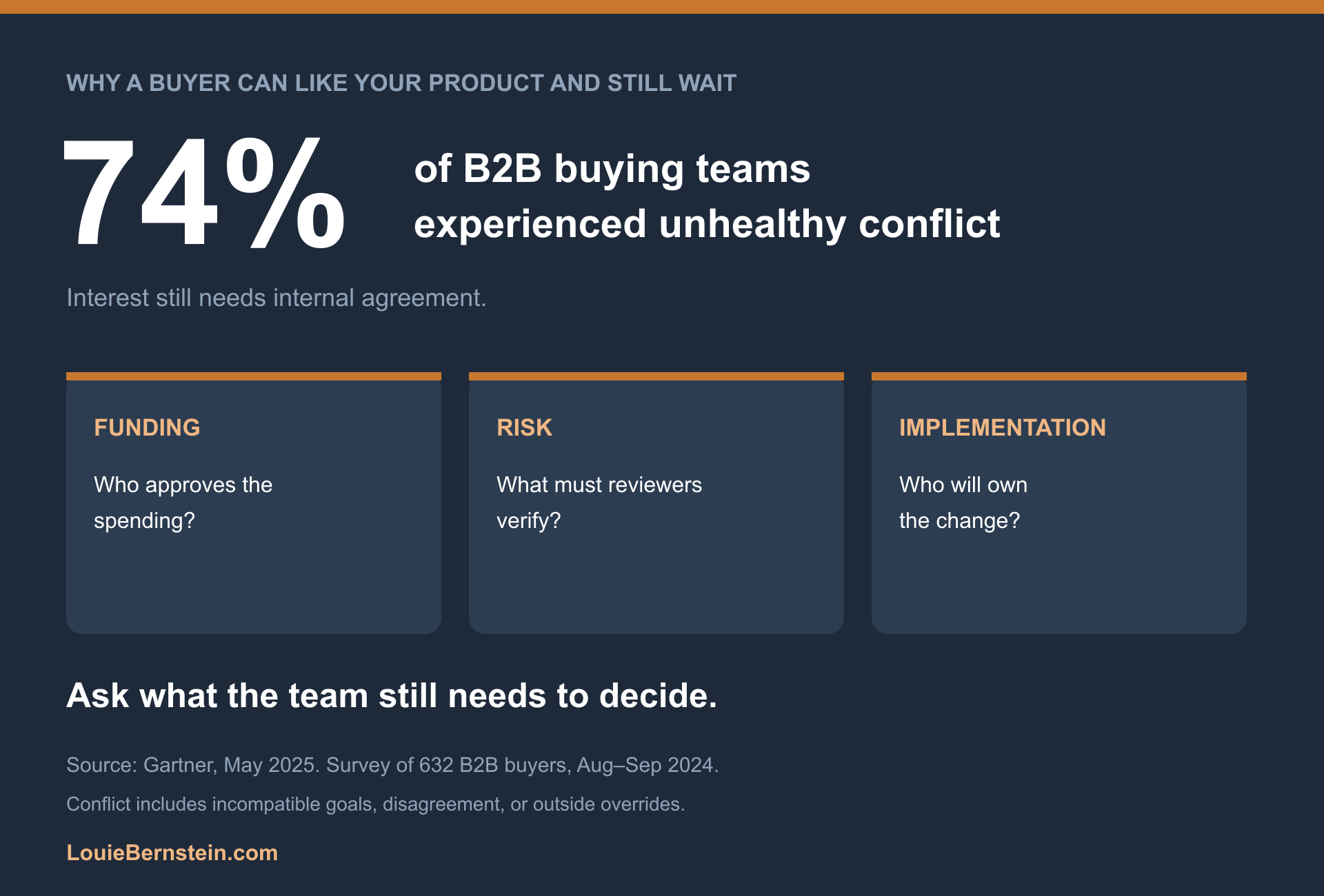
- Gartner reported in 2025 that 74% of B2B buying teams experienced unhealthy conflict, based on a survey of 632 buyers conducted in 2024.
- Review five delayed opportunities and record the next buyer decision, its owner, the missing evidence, and an agreed date for each.
- Forecast from buyer commitments and approval requirements. Your quarter-end deadline doesn't establish the buyer's decision date.
Your rep says the demo went well. The prospect likes the product. The proposal is out. Everyone expects a decision Friday.
Friday becomes next week. Next week becomes next month. You join the call because you're the founder and you're supposed to get the deal moving.
Before you take over, find out what the buyer is actually waiting for. If nobody can name the unfinished work, another call from the founder may just add one more conversation to an already crowded calendar.
Is the Problem Your Sales Process or Their Buying Process?
The problem is your sales process when your team can't explain the buyer's remaining work. The problem is inside the buying process when the work is known but an approval, disagreement, or resource constraint blocks it. In either case, the next step should address a specific obstacle rather than add another generic follow-up.
Compare seller activity with buyer evidence
Your sales process describes how your team qualifies, discovers, presents, and closes. The buying process describes how the customer agrees to spend money and take responsibility for a change. Those processes should connect at every stage.
| What your CRM says | What you still need to verify |
|---|---|
| Discovery complete | The buyer agrees on the problem, its impact, and why action matters. |
| Demo complete | The people evaluating the solution agree on what it must prove. |
| Proposal sent | The sponsor knows how funding and approval will happen. |
| Contract in review | The reviewers, open issues, and approval sequence are known. |
Start with five delayed opportunities. Ask each rep to explain the last decision the buyer made. Then ask which decision comes next. A meeting is an event. A decision changes what the buyer is prepared to do.
If the answer is "they're reviewing," ask what they're reviewing, who is reviewing it, and what happens after the review. Unknown answers are discovery gaps. Known answers reveal work you can help move forward.
A sales stage should tell you what the buyer has agreed to, not just what your salesperson has finished.
What Makes a B2B Buying Team Take So Long?
B2B buying teams slow down when people must agree on different consequences of the same purchase. Finance evaluates spending, users evaluate usefulness, and operations evaluates the work of making the change. A strong sponsor can want your solution while still lacking agreement from the people responsible for funding, approving, or using it.
Agreement on the product isn't agreement on the purchase
Gartner's survey of 632 B2B buyers, conducted in August and September 2024 and published in May 2025, found unhealthy conflict in 74% of buying teams. The research also associated consensus with a 2.5-times greater likelihood of buyers reporting a high-quality deal (Gartner, 2025). That measures reported deal quality, not a promised improvement in your win rate.
Ask your sponsor: "Who will have to change how they work if you buy?" That question can reveal someone who never attends the demo but can still stop the purchase.
For example, a department head may want your software while the operations manager has nobody available to implement it. The buyer doesn't need another feature presentation. The buyer needs a realistic implementation plan and agreement about staffing.
Long doesn't always mean longer than last year
Don't assume every buyer is getting slower. In its 2025 global study of nearly 4,000 B2B buyers, 6sense reported an average buying journey of 10.1 months, down from 11.3 months in 2024. Buyers first contacted sellers about 61% of the way through the journey (6sense, 2025).
Those are full buying journeys, including research before seller contact. The study's median purchase was between $200,000 and $300,000, so the average isn't a target for a founder selling a $15,000 service. Compare your own similar deals before blaming the market.
How Can You Help Buyers Make a Decision Without Pressuring Them?
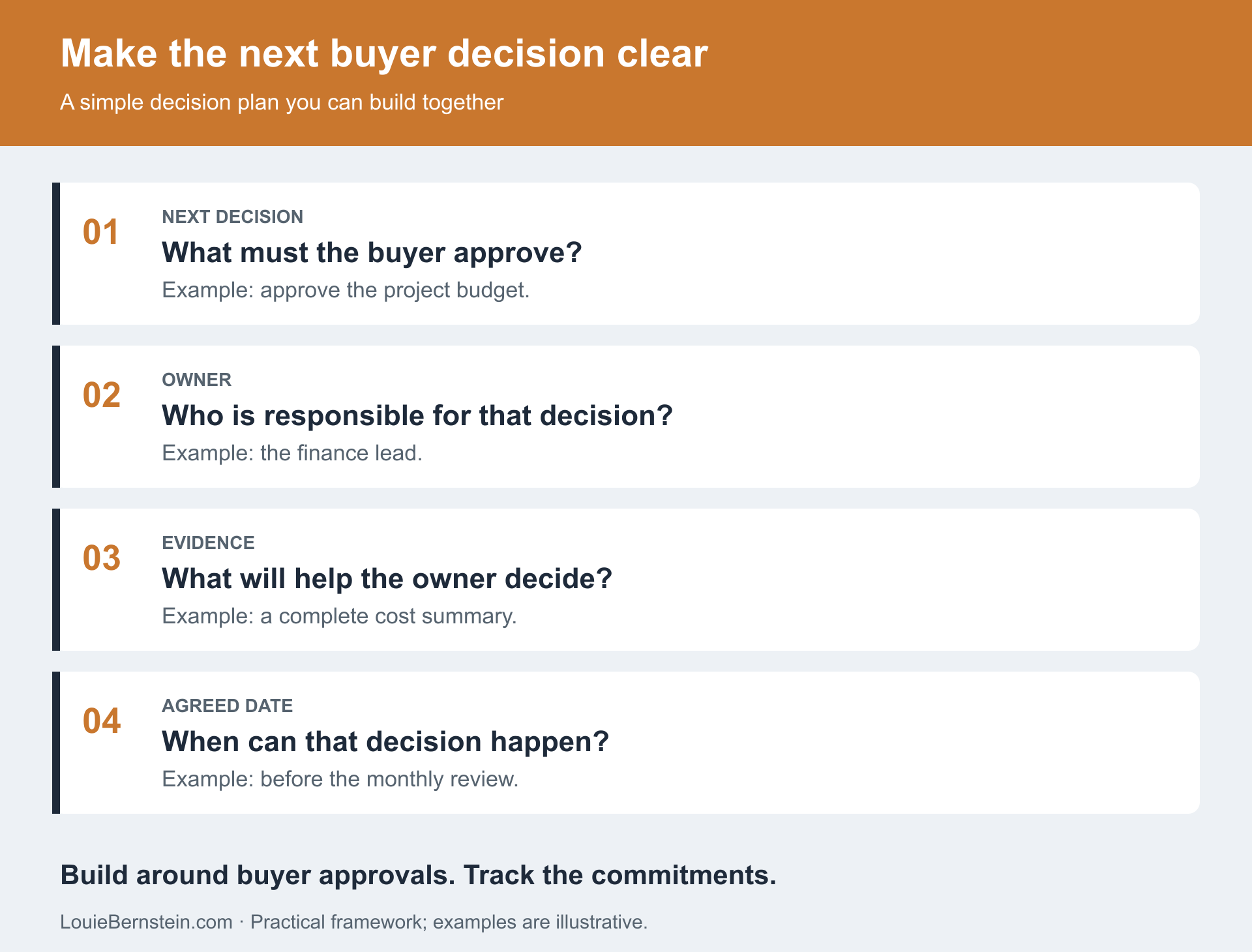
Help B2B buyers decide by making their remaining work clear and easier to complete. Build a short decision plan with the sponsor, connect proof to the concern it resolves, and agree on realistic dates. Buyer pressure falls when people know what they need to decide and have the information to do it.
Build the plan with the buyer
A decision plan can fit in one shared page or an email. You don't need software to start. You need the buyer's agreement that the plan reflects how their company purchases.
- Confirm the reason to act. Ask what happens if the company leaves the problem alone. Use the buyer's numbers when available. Don't invent a cost of delay.
- Name the people involved. Identify who owns the outcome, who approves funding, who checks risk, and who handles implementation. One person may hold several roles.
- List the open decisions. Write "finance approves the budget" rather than "send finance a deck." Put an owner next to each decision.
- Match proof to the question. A reference call can address delivery concerns. A scoped rollout can clarify workload. A security document can help a reviewer evaluate data handling.
- Agree on dates and dependencies. Work backward from the customer's needed start date. Include review time and the steps that must happen first.
Here's a hypothetical example. A buyer wants a January launch. Operations needs six weeks to prepare, and finance meets monthly. The decision date comes from that sequence. Your December discount doesn't remove either dependency.
Give the sponsor something useful to share
Write a short summary the sponsor can correct and circulate: the problem, the agreed outcome, total cost, implementation requirements, open risks, and next decision. Keep the same business case across the group so different departments aren't debating different versions of your offer.
Ask, "What would your finance lead question in this summary?" Listen before making another deck. You're helping the sponsor prepare an honest recommendation, including the limits of your solution.
If the buyer won't help define any next step, take the signal seriously. They may be researching, facing a higher priority, or unwilling to tell you no. More documents won't establish a commitment that doesn't exist.
What Have I Seen Founders Miss When Deals Stall?
I've seen a sale lose momentum because the salesperson moved toward a close while an unresolved buyer concern remained. Founders should check for unfinished commitments before adding another closing conversation. A concern that seems small to your team can change the discussion when someone responsible for the purchase hears about it for the first time.
An unresolved support request changed the call
I was on a call with one of my salespeople when he asked the decision-maker for the business. Another participant asked whether we'd resolved a support request. The decision-maker hadn't heard about it. We spent the next twenty minutes working through concerns. We eventually won, but we'd made the route harder.
The lesson goes beyond preparing for a second call. Your team can believe a deal is ready because the presentation is ready. The buyer may still be waiting for proof that you'll handle a basic commitment.
Coach the rep through the gap
Before joining a delayed deal, ask the rep to show you unresolved questions, promised answers, and concerns raised by anyone involved. Review the notes or recording together. Have the rep explain how they'll address the open item and confirm whether the answer is sufficient.
Then role-play the conversation. Ask, "What would have to be resolved before your team could recommend moving forward?" Give the rep practice hearing an uncomfortable answer without immediately defending the product.
Step in when your authority is needed for a real decision, such as a delivery commitment. Keep the rep responsible for preparation, follow-through, and the CRM record. Otherwise, every delayed deal teaches the team to wait for you.
What Should You Measure Before Changing Your Sales Process?
Measure where comparable opportunities wait, what buyer action is missing, and how often promised dates slip. Separate your team's response time from customer approval time. Those measures help a B2B founder see whether the fix belongs in rep coaching, qualification, proposal preparation, or support for the customer's internal decision.
Use a small weekly review
Start with a spreadsheet if your CRM can't capture the details yet. Track these items for qualified opportunities:
- Days in the current stage: Compare similar deal sizes and customer types. A large security review and a small renewal need different expectations.
- Last completed buyer decision: Record evidence such as agreed evaluation criteria or confirmed budget approval.
- Next decision and owner: Count how many opportunities have both. Missing names expose gaps in your forecast.
- Open commitments: Track answers your team owes and tasks the buyer has agreed to complete.
- Slipped dates and reasons: Separate internal approval delays, missing seller answers, changed priorities, and no response.
Don't celebrate a shorter cycle without checking win rate and deal mix. Dropping every complex opportunity can make average time to close look better while reducing revenue. A useful review explains outcomes as well as speed.
Change the forecast when the evidence changes
A buyer can remain a good fit while moving out of this month's forecast. If the required approval meeting won't happen until next month, adjust the expected close date. Keep the relationship active with a relevant next action.
If budget disappears and nobody can name a new trigger, move the opportunity to nurture under your documented rules. Don't keep it in the active forecast just because the prospect was friendly.
For a founder without a defined sales process, start here. Write simple stage exit criteria around buyer evidence, then teach the team to use them. A Fractional Sales Leader can help turn those criteria into a Sales Playbook, weekly coaching, and a forecast the business can use.
Related Reading
How to Run the Second Sales Call After a Strong Discovery →Frequently Asked Questions
Should I offer a discount to speed up a slow decision?
Offer a discount only when price is a verified obstacle and the terms make business sense. A lower price won't resolve an unavailable implementation team or an unfinished security review. Ask which remaining approval would become possible at the proposed price before changing your offer.
Can I ask to speak with the budget owner?
Yes. Explain what the budget conversation needs to resolve and involve your sponsor in arranging it. Going around the sponsor can damage trust. If access isn't possible, ask how the budget owner evaluates requests and what the sponsor needs to make the case accurately.
Should I use a pilot when a buyer is uncertain?
Use a pilot when a defined test can resolve a specific uncertainty. Agree on scope, success criteria, responsibilities, cost, and the decision after the test. An open-ended pilot can postpone the purchase while creating unpaid work for your team.
How often should I follow up when procurement is reviewing?
Agree on a review cadence with the buyer based on procurement's actual steps. Ask when comments are expected and who will consolidate them. Follow up at the agreed time or when you have information that helps the review, rather than sending daily requests for an update.
What if the buyer says a competitor is moving faster?
Ask which part of the competitor's process is faster and whether that difference matters to the needed outcome. Compare scope, implementation responsibilities, and approval requirements fairly. If your team is slow to provide answers, fix the delay. Don't promise an impossible delivery date to keep pace.
Find out where your buyers are getting stuck.
If you're running a $1M to $10M ARR B2B company and every delayed deal lands back on your desk, I can help you build a sales process your reps can run. Learn about Fractional Sales Leadership at LouieBernstein.com, or bring a stalled opportunity to a conversation.
Schedule a 30-Minute CallAbout the Author
Louie Bernstein is a Fractional Sales Leader with 50 years of sales experience. He's helped founders build repeatable sales systems as a Fractional Sales Leader since 2017. His work focuses on Sales Playbooks, defined sales processes, coaching, pipeline management, and helping teams sell without depending on the founder for every decision.