How do you check what a buyer actually meant before you pitch, price, or forecast the deal?
Founders hear buying signals that aren't there because they need the deal, they believe in the product, and their brain fills gaps in what the buyer said with what they hoped to hear. The fix is a habit: write down the buyer's exact words, say them back, put money and terms in writing, and test every deal before it reaches the forecast. If the buyer didn't say it, don't count it.
Key Takeaways
- "Happy ears" means hearing a buying signal the buyer never sent. Founders are especially prone to it because they built the product and need the revenue.
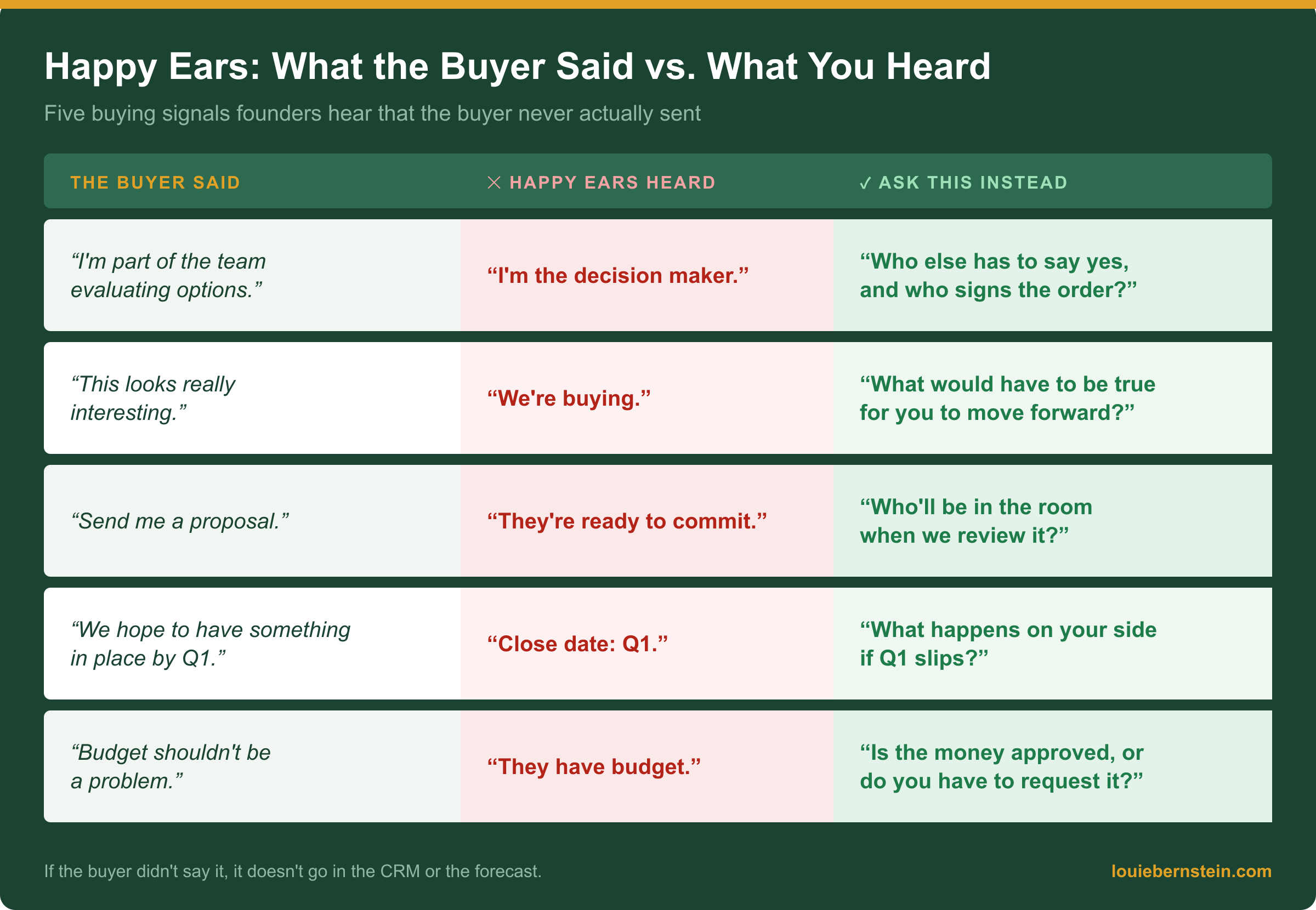
- "I'm part of the team evaluating options" is not "I'm the decision maker." Treat every signal as unconfirmed until the buyer confirms it in their own words.
- Only 45% of sales leaders and sellers have high confidence in their forecast (Gartner, 2020). Deals built on misheard signals are one reason that number is so low.
- Use the Heard-It Check on every deal: write the buyer's words, say them back, recap money and terms in writing the same day, and test the deal before it goes in the forecast.
- This week, pick your three biggest open deals and ask who signs, whether budget is approved, and what happens if the date slips. Move any deal without clear answers out of your commit.
I had a salesperson whose pipeline always had more deals in it than anyone else on the team. He also had the fewest closed deals.
At first I thought he was padding the pipeline to look busy. He wasn't. He believed every deal in there was real. When I drilled down, deal by deal, I found the problem. The customer was telling him one thing, and he was hearing what he wanted to hear.
A prospect had told him, "I'm part of a team that's evaluating solutions." By the time it reached the CRM, that prospect had become the decision maker.
Your pipeline is only as honest as your hearing.
Founders do this even more than salespeople do. Here's why, and how to stop it.
What does "happy ears" mean in sales?
"Happy ears" means hearing a buying signal the buyer never actually sent. The seller hears "interesting" and records "buying," hears "Q1" and records a close date. It happens because hope fills the gaps in an unclear answer, and an unchecked assumption then drives the pitch, the proposal and the forecast.
The five signals founders mishear most
Almost every misheard signal falls into one of five buckets: who decides, how interested they are, how ready they are, when they'll buy, and whether the money exists. The buyer says something vague and polite. The seller files it as a commitment.
None of these misreadings are lies. Buyers are being courteous, and sellers are being optimistic. Optimism is a good trait in sales. I've always said you should believe in your heart you'll win every deal. But believing you'll win and believing you've already won are two very different things.
Buyers have happy ears too
Mishearing runs both ways. I once told a prospect, "James, if you can commit to a three-year contract, I can probably get you a discount." What James heard was, "I can get you a discount." Nothing about the three years. Nothing about "probably."
That's why anything involving price, terms or special considerations has to be confirmed in writing. Never take for granted what you think the buyer heard, and never take for granted what you think you heard.
Why are founders more likely to hear buying signals that aren't there?
Founders are more likely to hear false buying signals because they built the product, they need the revenue, and they're usually rushing to the next call. A founder who believes the product is the obvious answer will hear agreement in almost any polite reply. Pressure plus conviction is the perfect setup for happy ears.
Your brain is filling the gaps
Ralph Nichols, the University of Minnesota researcher often called the father of listening research, found we speak at about 125 words a minute but think at 400 to 500. That spare capacity doesn't sit idle. While the buyer is still talking, your brain is already finishing their sentence. If you love your product, it finishes the sentence with a yes.
Founders also tend to talk too much on calls, because they know the product better than anyone. That makes the problem worse. Gong found reps talked 57% of the time on deals they won and 62% on deals they lost (Gong, 2025). The more you talk, the less of the buyer's actual words you collect, and the more you have to fill in yourself.
Buyers say what they value, and it isn't your pitch
When LinkedIn asked B2B buyers what they want most from a salesperson, active listening came out on top at 42%. Only 26% of sales managers said they look for it when they hire (LinkedIn State of Sales, 2020). Buyers notice when you hear them correctly. They also notice when you don't, and they rarely tell you. They just go quiet.
If you want the attention side of this, read my article on full-body listening and the three-second rule. This article is about the next step: checking that what you heard is what the buyer meant.
What does happy ears do to your pipeline and forecast?
Happy ears fills your pipeline with deals that were never real, so your forecast looks strong right up until the quarter ends. Every misheard signal becomes a stage, a close date and a dollar amount. Only 45% of sales leaders and sellers have high confidence in their forecast (Gartner, 2020), and misheard deals are a big reason why.
What I see when I drill into a founder's pipeline
When I sit down with a founder to review their pipeline, I ask the same five questions I asked that salesperson years ago, deal by deal:
- Are you speaking with the decision maker?
- Are you speaking with the person who can sign the order?
- Do they have budget, or can they get it?
- When do they want to implement, and why then?
- Have we proven it works for them?
The pattern I see over and over is that the founder can answer the first question with confidence and the next four with "I think so." That gap is the happy ears. The deal sits in the pipeline because of what the founder concluded, not because of what the buyer committed to.
Here's a quick way to tell a real pipeline from a hopeful one. Look at the salesperson, or the founder, with the biggest pipeline and the lowest close rate. In my experience, that's almost never a lead problem. It's a hearing problem.
Stalled deals hide behind polite answers
Forrester found 86% of B2B purchases stall at some point in the buying process (Forrester, 2024). A stalled deal doesn't announce itself. The buyer keeps saying nice things, and the seller keeps hearing progress. If you're running a regular sales pipeline review, the five questions above are the fastest way to separate stalled deals from moving ones.
Good news or bad, you have to hear the facts. Nothing disappoints you more than a pipeline built on what you imagined you heard.
How do you check what the buyer actually meant?
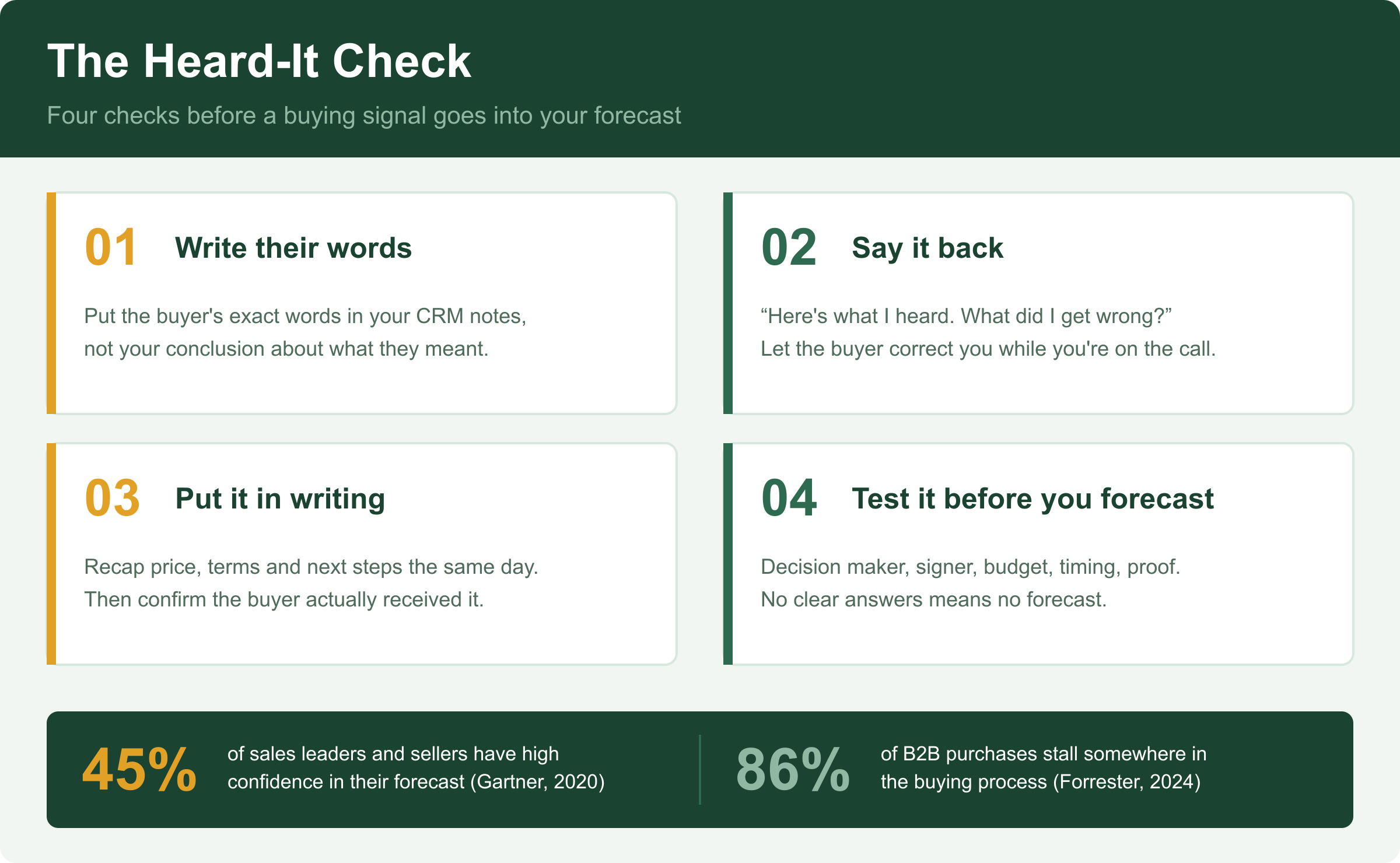
You check what the buyer meant by running the Heard-It Check: write down the buyer's exact words, say them back and invite correction, recap money and terms in writing the same day, and test the deal before it goes in your forecast. Each check takes minutes. Together they stop a hopeful assumption from becoming a forecasted deal.
1. Write their words, not your conclusion
Your CRM notes should quote the buyer. "Said she's part of a team evaluating three vendors" is a fact. "Decision maker, hot" is a conclusion. When you write the conclusion, you lose the fact, and nobody can check your thinking later, including you.
A trick I've taught for years: record your calls, and listen back while you enter your CRM notes. It keeps the facts straight and realistic.
2. Say it back and ask what you got wrong
Before you move to your pitch, summarize what you heard and invite the buyer to correct you. "Here's what I heard: the reporting problem is costing your team about a day a week, and you'd like it fixed before your board meeting. What did I get wrong?"
"What did I get wrong?" works better than "Did I get that right?" Most buyers will politely say yes to the second question. The first one gives them permission to fix your mistake, and that correction is often the most valuable thing you hear on the call. It's also a core habit of a good discovery call.
3. Put money, terms and next steps in writing the same day
After any call where price, terms, timing or a decision came up, send a short written recap. Then, on the next call, confirm the buyer received it: "James, I want to make sure you got my email about the three-year terms." Too often people hear what they want to hear. A written follow-up fixes it on both sides, and you'll stand out from the average salesperson who never sends one.
4. Test the deal before it goes in the forecast
Run the five questions on every deal before it moves stages: decision maker, signer, budget, timing and proof. Map the answers to your stages. A deal can't be in Validate if you don't know who signs. A deal can't be in Close if the budget still has to be requested. No clear answers, no forecast.
How do you stop your first salespeople from catching happy ears?
You stop your first salespeople from catching happy ears by making the Heard-It Check part of your sales process, not a personal habit. Put the five questions in your pipeline review, require buyer quotes in CRM notes, and listen to recorded calls. Salespeople copy what the founder does, so you have to go first.
Fix your own hearing before you hire
If you're still in founder-led sales, your habits become the team's habits. A founder who forecasts on hope will hire salespeople who forecast on hope, and then wonder why the numbers never land. Run the Heard-It Check on your own deals for a month before your first hire starts.
Coach it in the pipeline review
When a salesperson's pipeline looks out of line with their closed deals, don't argue about the deals. Ask the five questions. The answers show you exactly where the salesperson stopped listening and started hoping. It's rarely intentional, and you can coach it.
If your company has no sales process at all, start there. The Heard-It Check works best as one step inside a process with defined stages and clear entry rules. Without that structure, there's nothing to test a deal against.
Frequently Asked Questions
Is happy ears the same as being optimistic?
No. Optimism is believing you can win a deal, and it helps you sell. Happy ears is believing the buyer committed to something they didn't. Keep the optimism. Check the facts before they go in your CRM or your forecast.
Won't saying it back to the buyer sound awkward?
Not if you keep it short and natural. One or two sentences, then "What did I get wrong?" Buyers rarely find it awkward. Most appreciate it, because it shows you were actually listening and gives them a chance to add what they forgot to mention.
How often should I send a written recap?
After every call where price, terms, timing, decision makers or next steps came up. For a founder running deals at $1M to $10M ARR, that's most serious sales calls. Keep the recap to a few lines, and ask the buyer to reply with any corrections.
What if the buyer won't answer the five questions?
That's an answer. A buyer who won't tell you who signs or whether budget exists either doesn't know yet or isn't serious yet. Either way, the deal isn't ready to forecast. Keep working it, but take it out of your commit until you get real answers.
When should I bring in outside help?
When your pipeline keeps looking bigger than your closed revenue, and you're still the one hearing and forecasting most of the deals. A Fractional Sales Leader can put the pipeline reviews, stage rules and coaching in place for roughly half the cost of a full-time VP of Sales.
Find out which of your deals are real
Bring your three biggest open deals to a 30-minute call. We'll run the five questions together and see which ones belong in your forecast.
Schedule a 30-minute callAbout the Author

Louie Bernstein Fractional Sales Leadership
Louie Bernstein is a Fractional Sales Leader with 50 years of sales experience and has worked as a Fractional Sales Leader since 2017. He built and ran MindIQ for 22 years. He helps B2B founders at $1M to $10M ARR build repeatable sales systems so selling doesn't depend on the founder.