How do you make the numbers agree before judging your reps?
Sales KPIs tell different stories when reports count different deals, use different dates, or apply different definitions of success. Before judging a rep, write down what each number includes, what it excludes, and which period it measures. For a B2B founder at $1M to $10M ARR, matching those rules across reports makes performance reviews fairer and helps separate a reporting problem from a sales problem.
Key Takeaways
- Conflicting sales KPIs often measure different populations or periods. Reconcile the underlying deal lists before changing targets.
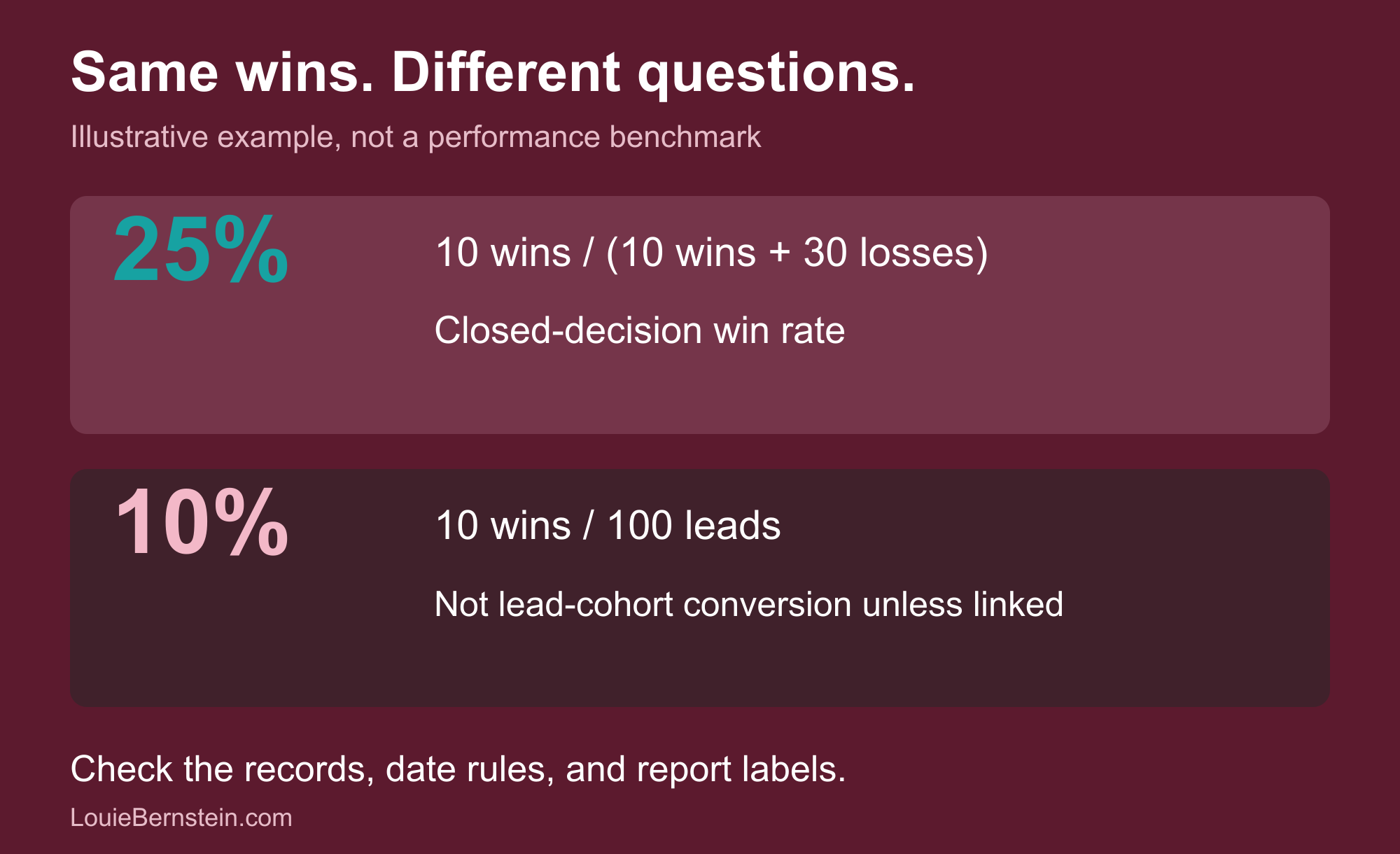
- In an illustrative example, 10 wins divided by 40 closed decisions equals 25%. Dividing those same wins by 100 leads equals 10%. Those percentages answer different questions.
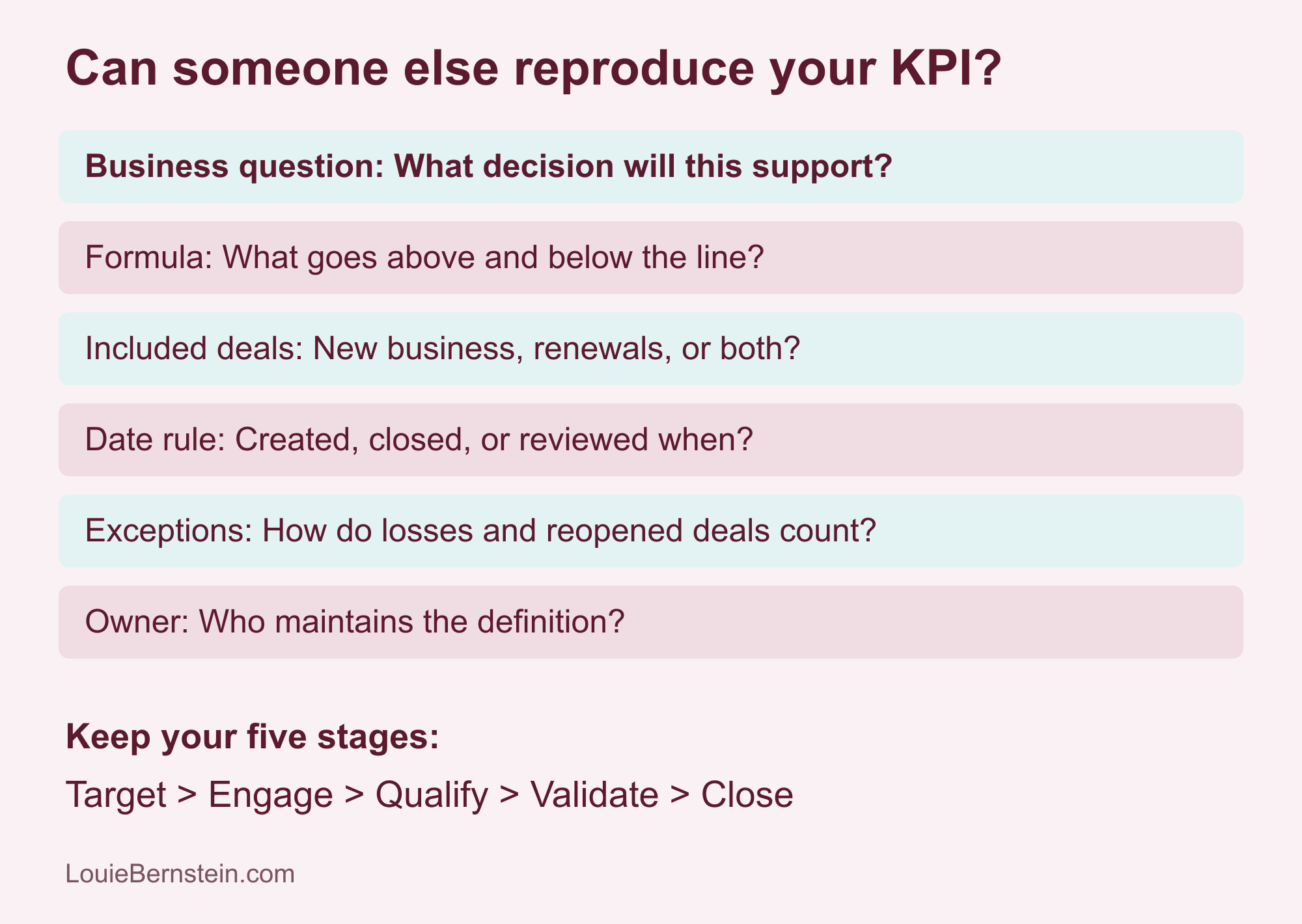
- Keep Target, Engage, Qualify, Validate, and Close as your five sales stages. Define the evidence needed to enter each stage before calculating stage conversion.
- Separate founder-assisted deals from rep-led deals when evaluating whether your team can sell independently.
- Choose one disputed KPI this week. Have two people reproduce it from the same written definition and the same dated export.
Your CRM says the team wins 25% of its deals. The spreadsheet says 10%.
Now you're in a meeting about whether the reps need more training. You haven't established whether the two reports are counting the same work.
I think founders need to settle the meaning of a number before they use that number to manage someone. More dashboards won't settle an argument about what belongs in the calculation.
Before you ask a salesperson to improve a number, make sure you can both calculate it.
Why can two accurate reports show different sales results?
Two accurate sales reports can disagree because each answers a different question. One may count deals closed this quarter, while another follows leads created this quarter. Both calculations can be correct. A founder gets into trouble when the reports carry the same label and the team treats the results as interchangeable.
Start with the deals underneath the percentage
Here's an illustrative example, not a benchmark or a client result. During a quarter, your team closes 10 deals won and 30 lost. The closed-decision win rate is 10 divided by 40, or 25%. Those 40 decisions may include opportunities opened in earlier quarters.
A second report divides the 10 wins by 100 leads generated during the quarter. The result is 10%, but the wins may not come from those 100 leads. Without matching the leads to their eventual outcomes, the report doesn't establish the conversion rate of that lead group.
That distinction matters before you cut a prospecting channel, raise activity targets, or put a rep on a performance plan. Ask which records produced the numerator and denominator. A percentage without those records can send the team in the wrong direction.
HubSpot's win-rate guidance, updated in July 2025, also calls for specifying the period and qualifying criteria. Choose a definition suited to the decision, then keep the label and calculation consistent.
Separate a definition problem from a data problem
A definition problem means people count different things. A data problem means the records are wrong or incomplete. Duplicate opportunities, missing losses, and close dates changed without explanation are data problems. A discussion about whether renewals belong in a new-business report is a definition problem.
Salesforce's 2026 State of Sales report says 46% of sales professionals with agents reported that data quality issues hurt sales. The report surveyed 4,050 sales professionals across 22 countries in August and September 2025. That finding concerns sales professionals using agents, not every small B2B team. It supports checking the records before trusting an automated output (Salesforce, p. 15).
What should you write down for each sales KPI?
Write down the sales KPI's business question, calculation, included records, date rule, and accountable owner. Specify exclusions and how exceptions are handled. For a small B2B team, a short definition in the Sales Playbook is enough if another person can use it to reproduce the result without asking you what you meant.
Give each metric a usable definition
For closed-decision win rate, write: new-business opportunities marked closed-won during the quarter, divided by new-business opportunities marked closed-won or closed-lost during that same quarter. Multiply by 100. State whether a buyer choosing to do nothing counts as a loss. My recommendation is to include a qualified opportunity that ends in no decision as closed-lost, with a separate reason.
Then name the source report, the fields used, and the person responsible for correcting exceptions. Keep renewals and expansion separate from new business unless the report is explicitly intended to combine them. A combined company view can be useful, but it won't tell you whether new-customer selling improved.
Put the agreed measurement in the rep's Accountabilities Document. Put the detailed calculation in the Sales Playbook. The two documents should point to the same rule, so a rep's expectations don't change depending on who runs the meeting.
What I've learned about unwritten expectations
I've written about a real salesperson who hit 135% of quota, moved into a different role, and ended up on a PIP. Nobody had written down what the new job required. The rep and the manager were working from different expectations.
That experience is why I care about the definition behind a score. The lesson applies to sales KPIs: a rep shouldn't discover during a performance review that the manager has been measuring a different outcome. Agree on the calculation before the period starts. If the role changes, review the measurement with the rep.
You can read the underlying example in the article about the rep at 135% of quota. The point here is how to prevent a report from quietly changing the expectations you've already agreed to.
How do your five sales stages affect the numbers?
Your five sales stages affect the numbers because stage conversion measures movement between defined buying conditions. Keep Target, Engage, Qualify, Validate, and Close. Write down the evidence required for advancement. Otherwise, one rep's qualified opportunity may be another rep's first conversation, making the conversion comparison unfair before any calculation begins.
Count completed buying work
Moving a CRM card is easy. Establishing that a buyer has a real problem, a workable purchase path, and a reason to act takes sales work. Your stage definitions should reflect that work. A proposal sent doesn't prove that the buyer has agreed to evaluate it.
For an illustrative stage conversion calculation, suppose 20 opportunities enter Qualify during a defined month. By the review date, eight have reached Validate. That's 40% observed conversion so far. If six remain active in Qualify, don't describe 40% as the group's final conversion rate.
Write the review date beside the result. Show how many opportunities are still unresolved. Compare groups with similar time to progress. A group created last week hasn't had the same chance to advance as one created three months ago.
Make skipped meetings visible without adding stages
A prepared buyer may satisfy a stage's requirements without the usual meeting. Record the evidence and stage timestamps. Don't invent a sixth stage to explain a shorter buying path, and don't record a meeting that never happened just to make the report look complete.
Keep stage entry rules steady while you compare periods. If you tighten qualification, note the effective date. A lower opportunity count after the change may mean better screening. You need to inspect the change before declaring that prospecting has deteriorated.
Should founder-assisted sales count toward rep performance?
Founder-assisted sales should count toward rep performance according to the credit rules agreed in advance. Also report founder involvement separately when assessing team independence. A company can reach its revenue target while still depending on the founder to rescue late-stage deals. Revenue credit and the ability to sell independently answer different management questions.
Keep credit and coaching clear
Don't take commission credit away after a win because you joined a call. Honor the compensation agreement. For coaching, record whether the founder supplied a relationship, handled an objection, negotiated terms, or led the closing conversation. Those details show what the rep still needs to learn.
Consider a separate illustrative example. The founder helps on eight closed opportunities and six are won. The rep handles 12 other closed opportunities and wins two. The blended win rate is eight out of 20, or 40%. The founder-assisted group is 75%; the rep-led group is about 17%.
Those small groups don't prove that the founder causes better results. The founder may join different types of deals. They do give you a reason to review the calls, deal sizes, and buyer sources before telling yourself the team can operate without you.
Teach the work the founder keeps doing
If you repeatedly handle pricing objections, use an actual call to show the rep how you responded. Role-play the conversation. Let the rep lead the next suitable call while you observe. Write the useful questions and responses into the playbook.
I think founders should ask what the team learned from their involvement. If every difficult conversation returns to your calendar, a healthy revenue report can hide a management problem. Track the help so you know what to teach next.
How can you check a disputed KPI this week?
Check a disputed KPI by having two people calculate it independently from the same dated export and written definition. Compare the included records before comparing percentages. Resolve mismatches, record the agreed rule, and rerun the report. A founder should leave with a reproducible number and a clear sales decision to make from it.
Work through one disagreement
Pick the number currently driving a real decision, such as whether a rep needs coaching on qualification. Save the source export with the reporting period and extraction date. Ask the rep and the sales leader to identify the records that belong in the calculation.
If the totals differ, compare the lists. Look for excluded losses, duplicate opportunities, renewals, changed owners, and different date filters. Resolve each mismatch against the written business question. Don't average the two percentages to end the discussion.
Once the reports agree, decide what the result calls for. A qualification problem may require call reviews and practice. A shortage of qualified opportunities may require prospecting work. A reporting error calls for a corrected report before a performance judgment.
Give someone ownership of the rule
Name one person to maintain the definition and record changes. When a change materially affects a trend, show comparable historical results where possible and label any break in the series. Keep a dated copy of the old definition so future reviews can explain the difference.
A Fractional Sales Leader can help connect those definitions to your Sales Playbook, Accountabilities Documents, and coaching. The useful outcome is a team that understands its numbers and knows what to do next without waiting for you to translate the dashboard.
Frequently Asked Questions
Can I start with a spreadsheet?
Yes. A spreadsheet can establish shared definitions before you automate reporting. Keep a dated source export and protect the formula cells. Use the same inclusion rules when you later move the calculation into your CRM.
Should win rate be measured by deal count or dollars?
Both can be useful if labeled separately. Deal-count win rate measures the share of closed opportunities won. Dollar-weighted win rate measures the share of closed opportunity value won. A large loss can affect the dollar measure far more than the count measure.
What should happen when a lost opportunity reopens?
Write a reopening rule that preserves the original decision history. Record the new buying event and retain the earlier loss date and reason. Check how your CRM treats reopened records so an old quarter doesn't silently change when a buyer returns.
Can a rep be compared with a new hire?
Compare equivalent responsibilities and selling conditions. Show tenure, ramp status, territory, and lead source when they affect opportunity quality. A new hire learning the role shouldn't be judged against a fully ramped rep without the expectations agreed for that ramp period.
Who decides if finance and sales disagree on revenue?
Finance owns the accounting policy for recognized revenue. Sales and finance should agree on the separate definitions for bookings, recurring contract value, and cash collected. Label each report clearly; a signed contract and collected cash can occur in different periods.
Make your next sales review useful
If your numbers keep starting arguments, let's review what they measure and connect them to clear accountabilities and coaching.
Schedule a 30-minute callAbout the Author

Louie Bernstein Fractional Sales Leadership
Louie Bernstein is a Fractional Sales Leader with 50 years of sales experience and has worked as a Fractional Sales Leader since 2017. He built and ran MindIQ for 22 years. He helps B2B founders at $1M to $10M ARR build repeatable sales systems so selling doesn't depend on the founder.