Most founders at $1M to $10M ARR underprice because fear set the price, not value. A 1% price increase lifts operating profit about 8% at average S&P 1500 company economics (McKinsey, 2003), far more than 1% more volume does. The fix isn't one bold price change. The fix is making someone own price inside the sales process, where price is actually won or lost.
Key Takeaways:
- Founders underprice because of four fears: fear of hearing no, anchoring every deal to the first customer's price, copying competitor prices without knowing their economics, and pricing to what the founder would personally pay.
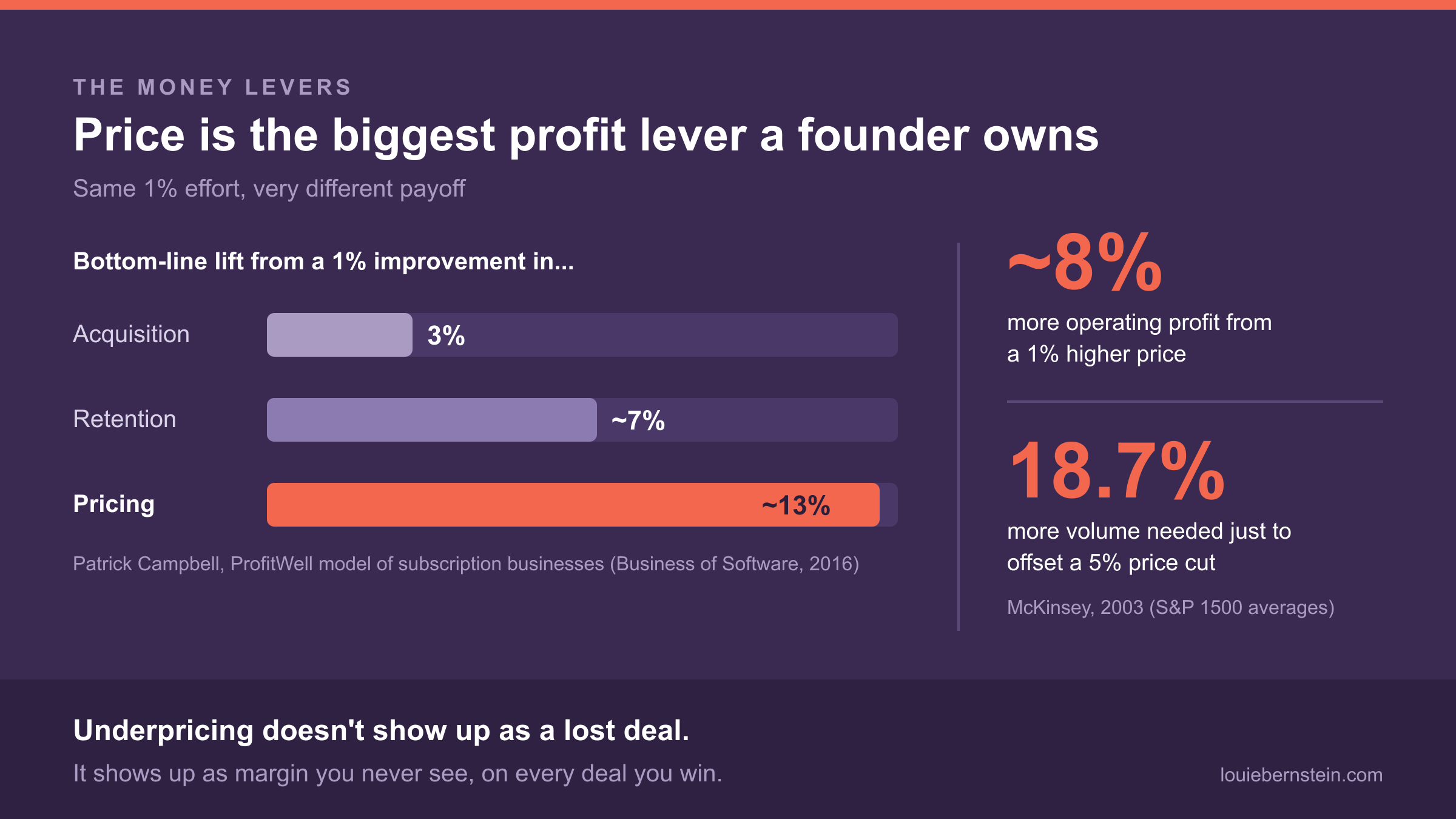
- Pricing is the biggest profit lever a founder owns. In ProfitWell's model of subscription businesses, a 1% improvement in monetization lifted the bottom line just under 13%, compared with 3% for a 1% improvement in acquisition (Patrick Campbell, 2016).
- A $4M ARR company priced 10% below what customers would pay leaves about $400,000 a year on the table. Most of that money would be profit, because the cost to deliver doesn't change.
- Fast closes with no negotiation, almost no price objections, and a price that hasn't changed since launch are three of the clearest signs a B2B company is underpriced.
- This month, pull your last 10 closed deals and write down the quoted price, the final price, and whether the buyer pushed back on price at all. That list shows whether price is a real conversation in your sales process or a number nobody questions.
Xaver Lehmann charged his first customer €500 a month. Six months in, he learned that customer was saving €15,000 a month using his product. The customer would have paid €5,000. Lehmann, who writes The Honest Founder on Substack, did the math: €4,500 a month for 12 months, or €54,000, from one customer.
Then it got worse. His third customer paid €500 a month too, because that's what Customer #1 paid. By the time he figured out pricing at month 18, he estimates he'd left more than €200,000 on the table. His explanation is honest. He was too scared to charge what the product was worth.
I've never met a founder who set out to underprice. But I've met plenty who did it anyway, and almost none of them knew. Underpricing doesn't send you a lost-deal notice. It just quietly takes a slice of every deal you win.
An overpriced deal tells you it's overpriced. An underpriced deal thanks you and signs.
How much money does underpricing cost a $1M–$10M company?
Underpricing usually costs a $1M to $10M company hundreds of thousands of dollars a year, and nearly all of that is lost profit, not lost revenue. Price changes drop almost straight to the bottom line because the cost to deliver stays the same. That's why a small price gap does more damage than a bad sales quarter.
The research on price as a profit lever
McKinsey's "The Power of Pricing" (2003) looked at the average economics of S&P 1500 companies. A 1% price increase, with volume holding steady, produced about an 8% increase in operating profit. The same study found that after a 5% price cut, volume would have to rise 18.7% just to earn the same profit. Very few markets respond to price cuts that strongly.
Software shows the same pattern. Patrick Campbell, then CEO of ProfitWell, modeled subscription businesses from ProfitWell's data in a 2016 Business of Software talk. A 1% improvement in acquisition lifted the bottom line 3%. A 1% improvement in retention lifted it just under 7%. A 1% improvement in monetization lifted it just under 13%. Both studies are older, but the arithmetic behind them hasn't changed. Price is multiplied across every customer you already have.
Run the numbers on your own company
Here's simple arithmetic, not a benchmark. Say you're at $4M ARR and your customers would pay 10% more without blinking. That gap is $400,000 a year. If your average deal is $25,000, you'd need 16 more new deals to bring in the same money. And those 16 deals come with sales time, onboarding, and support. The $400,000 from better pricing comes with almost none of that.
I already wrote about the reverse version of this math in The Discount Trap. A discount pulls the same lever in the wrong direction, one deal at a time. Underpricing pulls it on every deal, before the discount even starts.
Why do founders underprice in the first place?
Founders underprice because the first price is usually set by fear, not by the value the customer gets. Early on, every "no" feels like it could sink the company, so founders pick a number buyers won't argue with. I see four fears behind almost every underpriced product. Most founders have at least two.
Fear #1: Hearing no
When you have three customers, losing a deal hurts. So you price where nobody says no. The trouble is, a price nobody says no to is a price that's too low. A few lost deals on price are healthy. They tell you where the ceiling is.
Fear #2: Breaking from the first customer's price
The first customer's price feels like a promise. Charging the next customer more feels unfair, even when the product is better and the second buyer gets more value. So every new deal gets anchored to a number you picked when you knew the least.
Fear #3: Being more expensive than a competitor
Founders look up a competitor's price and land just below it. But you don't know the competitor's costs, win rate, or whether they're losing money on every deal. Copying their price means copying their mistakes. And if you're competing on price, you've already said your product isn't different.
Fear #4: Pricing to your own wallet
This one is sneaky. The founder asks, "Would I pay $60,000 for this?" and the answer is no. But the founder isn't the buyer. The buyer is a company with a painful problem and a budget, comparing your price to what that problem costs them. Lehmann's first customer was saving €15,000 a month. €500 looked cheap to that buyer. It only looked fair to the founder.
What 50 years in sales has taught me about price
I've said this for decades, and I wrote it into my sales training: price isn't leverage. Your competitor can always drop their price at the last minute, and you lose that leverage instantly. Your real leverage is the value of your product against how badly the buyer needs it. Most multi-call B2B deals aren't decided on price.
Founders who underprice have it backwards. They treat a low price as their advantage, when the low price is actually hiding the value they should be selling. When you believe price wins deals, you'll always find a reason to lower it.
Price isn't leverage. Value is. A founder who sells on price is telling the buyer the product isn't different.
How did my first customer's price become my price ceiling?
The first customer's price becomes the ceiling because it gets copied into every proposal that follows, and nobody is assigned to question it. In founder-led sales, the price lives in the founder's head. Reps learn it from old proposals, not from a pricing decision, so a guess made at the start turns into company policy.
Here's how it happens. You close Customer #1 at a friendly price. Customer #2 hears about it, or you just feel better quoting the same number. You hire your first rep, and the rep copies your last proposal. Two years later, the price has never been decided. It was inherited.
| Price lives in the founder's head | Price lives in the sales system |
|---|---|
| ✕ Reps copy the last proposal | ✓ Reps quote from a written price list |
| ✕ Discounts are decided on the call | ✓ Discount limits are written down, with approvals |
| ✕ Price objections are forgotten | ✓ Price objections are logged in the CRM |
| ✕ Renewals roll over at the old price | ✓ Renewals include a scheduled price review |
| ✕ New customers pay what early customers paid | ✓ New customers pay today's price for today's product |
| ✕ Nobody knows when the price last changed | ✓ Price changes are dated and reviewed |
You don't have to raise prices on your early customers to fix this. Many founders keep early customers at their original price for a while and charge new customers the new rate. What you can't do is let the early price keep setting the rate for customers who never had anything to do with it.
How do I know if I'm underpriced right now?
You're probably underpriced if buyers accept your price quickly, rarely push back, and never cite price when they leave. Those signals mean price isn't part of the buying decision at all. A healthy price gets some pushback. Look for these seven signs in your last 10 to 20 deals.
- Deals close fast with no negotiation. The buyer signs the first number you send.
- Price objections are close to zero. If nobody ever says you're expensive, you probably aren't.
- Churn reasons never mention price. Customers leave for fit or timing, never because it cost too much.
- Proposals never go to procurement. The deal is small enough that your champion can sign it alone.
- Customers expand without being asked. They add seats or services on their own because it's an easy yes.
- Reps discount anyway. Buyers aren't pushing, but reps cut the price to close faster. That's a sales-process problem sitting on top of a pricing problem.
- The price hasn't changed since launch. The product got better every quarter. The price stayed the same.
What I see when I audit sales teams
In my sales training, I list "accepting the price as quoted without asking for a discount" as a buying signal. For one deal, a buyer who accepts your price as quoted is a good sign. When every buyer does it, that's not a buying signal anymore. That's a pricing signal.
The pattern I run into over and over in fractional engagements is that nobody is counting. The founder can't tell me how many deals had a price objection last quarter, because it was never tracked. When I do hear a price objection, I teach reps to ask one clarifying question first: "How high is it?" If the buyer says they were thinking $48,000 on a $50,000 quote, that's a small gap. If they say half, that's a value problem. Both answers are pricing data. Most founders throw that data away.
Who should own pricing inside my sales process?
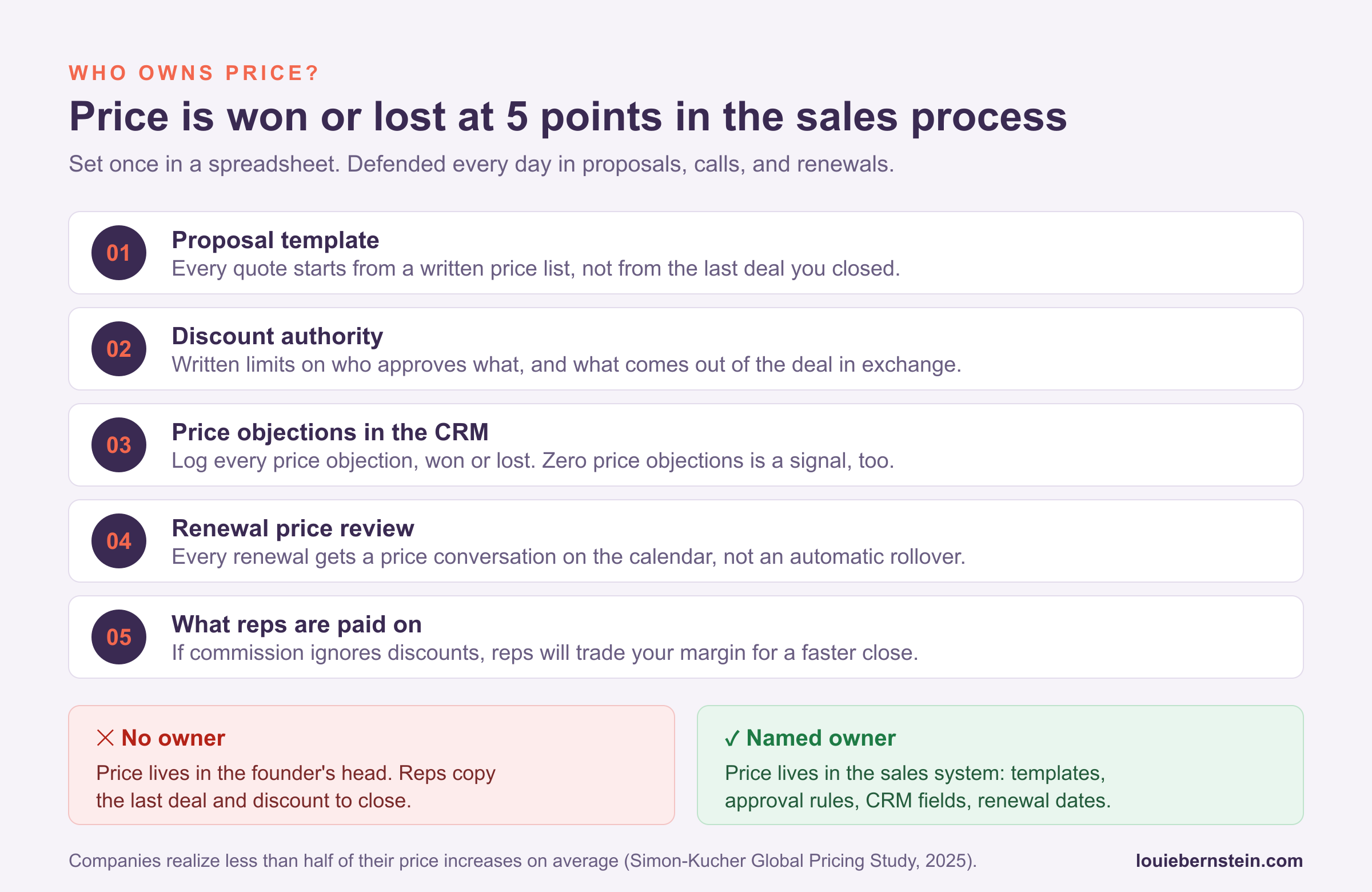
The founder should own the pricing decision, and one named person should own how price is defended inside the sales process. Price gets set once in a spreadsheet, but it's won or lost every day in proposals, discount calls, objections, and renewals. Without an owner, the price you set and the price you collect drift apart.
That gap is real, even at big companies. Simon-Kucher's Global Pricing Study 2025, a survey of more than 2,200 business leaders in 28 countries, found companies realize less than half the amount of their price increases on average. Deciding a price is the easy part. Getting it through the sales process is where most of the money leaks.
The five places price gets won or lost
Put an owner and a written rule on each of these: the proposal template, discount authority, price objections in the CRM, renewal price reviews, and what reps are paid on. If commission is paid on bookings with no penalty for discounts, your reps will trade your margin for a faster close every time. They're doing exactly what you pay them to do.
What a Fractional Sales Leader does here, and what I don't do
I'm a Fractional Sales Leader, not a pricing consultancy. I don't run willingness-to-pay studies or conjoint analysis. If you need to rebuild your pricing model from scratch, or you sell into a market where one pricing mistake could cost you a segment, hire a pricing specialist for that study.
What I do is put price discipline into the sales system: the proposal templates, the discount approval rules, the CRM fields that track price objections, and the comp plan that rewards reps for holding price. That's the work that makes sure the price you choose is the price you actually collect. It's also the work that tells you whether your price is too low in the first place, which is where the next article in this series starts: what it means when every prospect says yes.
Related ReadingThe Discount Trap: Why Founders Give Away Margin to Close Deals →
Frequently Asked Questions
Q: Should I raise prices on my existing customers or only on new ones?
Start with new customers. Charging new buyers today's price for today's product is the lowest-risk move, and it gives you real data within one or two sales cycles. Existing customers can move to the new price at renewal, with notice and a clear explanation of what's improved since they signed.
Q: Won't a higher price lower my win rate?
A higher price may lower your win rate a little, and that's usually fine. If your win rate drops slightly but every deal is worth more, total profit goes up. McKinsey's 2003 analysis found volume would have to rise 18.7% just to offset a 5% price cut. Watch revenue per deal and profit, not win rate alone.
Q: How much should I raise my price the first time?
There's no universal number, and anyone who gives you one without seeing your deals is guessing. Test a higher price on a set of new proposals, keep everything else the same, and track the results in the CRM. If close rates barely move, you have room to go further.
Q: Can my salespeople set prices?
Salespeople shouldn't set list prices, but they should work inside written pricing rules. Give reps a price list, a discount range they can approve on their own, and a clear approval path above that range. Every exception should require something back from the buyer, like a longer term or a smaller scope.
Q: When do I need a pricing consultant instead of a sales leader?
Bring in a pricing consultant when you need to redesign packaging, change your pricing model, or research willingness to pay across segments. Bring in a sales leader when the price exists but isn't being held in proposals, discounts, and renewals. Many underpriced companies need the second fix before the first one pays off.
Stop leaving money on the table.
If your price lives in your head and your last proposal, let's put it into a sales system your team can defend. Learn how Fractional Sales Leadership can help you collect what your product is worth.
Schedule a 30-Minute CallAbout the Author
Louie Bernstein
Louie Bernstein is a Fractional Sales Leader with 50 years of sales experience. He founded and ran MindIQ for 22 years, earning a place on the INC 500. He helps founders build sales systems their teams can run.