Is there an advantage to getting the sales foundation built first?
Hire a Fractional Sales Leader before you have salespeople because the first job is building the sales system your salespeople will run. In 12 weeks, a Fractional Sales Leader turns the way you sell into a written Sales Playbook, a sales process, a CRM pipeline, an Accountabilities Document and a hiring plan. Your first salespeople then start with instructions. For a B2B founder at $1M to $10M ARR, building first costs less than a failed hire.
Key Takeaways
- A Fractional Sales Leader with no salespeople to manage spends the time building: the Sales Playbook, the sales process, the CRM pipeline, the Accountabilities Document, the comp plan and the hiring scorecard.
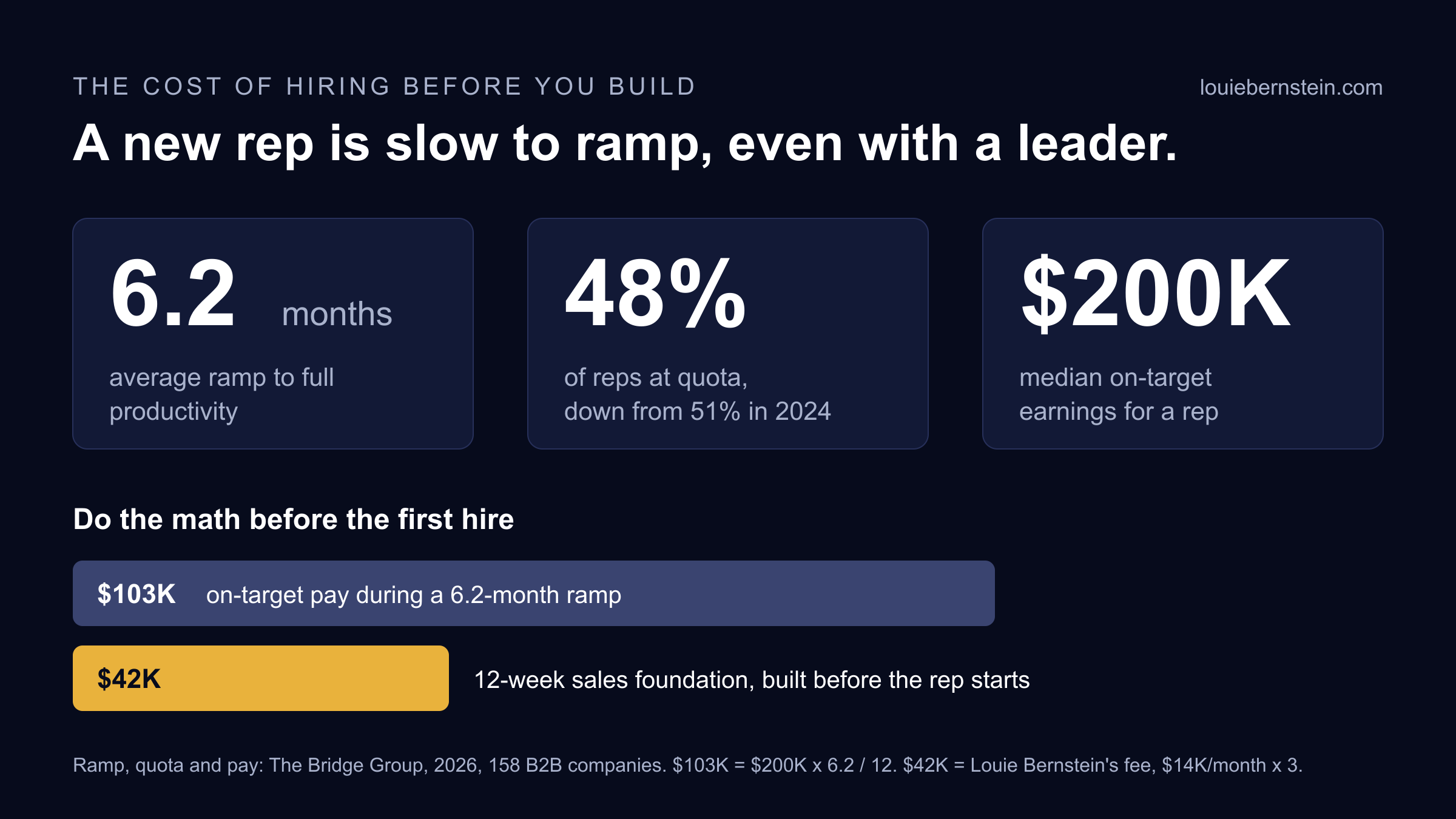
- New account executives take an average of 6.2 months to reach full productivity, and only 48% of reps hit quota (Bridge Group, 2026, 158 B2B companies). Most of those companies already have sales leadership.
- At the $200K median on-target earnings Bridge Group reports, a 6.2-month ramp is about $103K of on-target pay before a rep is fully productive. My 12-week foundation engagement is $42K.
- Before you post a sales job, write down who you sell to, the steps from lead to close, and what a new salesperson must do in the first 30 days.
- Wait on a Fractional Sales Leader if you're under $1M ARR or haven't closed enough deals yourself to see a pattern. There's nothing to document yet.
"Why would I pay a sales leader when there's nobody to lead?"
It's a fair question. A sales leader leads salespeople. No salespeople, no need for a leader. Hire the reps first, then bring in someone to manage them.
I think that order is backwards. The founder who hires reps first is paying salespeople to guess. They guess who to call. They guess what to say. They guess what a good week looks like. And you're the only person who knows the answers, so they keep coming back to you.
You create the machine before you hire the operator.
What does a Fractional Sales Leader do when there are no salespeople?
A Fractional Sales Leader with no salespeople builds the sales system the first salespeople will run. The work is getting the way the founder sells out of the founder's head and onto paper, then turning it into a process, a pipeline and a hiring plan. Managing people comes later, once there's something for them to follow.
Six things get built before anyone is hired
- Ideal Customer Profile. Who buys, why they buy, and who you should stop chasing.
- Sales process. The steps from lead to close, with a clear rule for moving a deal from one stage to the next.
- Sales Playbook. Your discovery questions, objections, answers, emails and stories. If you've never seen one, start with what a Sales Playbook is and what goes in it.
- CRM pipeline. Stages in the CRM that match the sales process, so a forecast means something.
- Accountabilities Document and comp plan. What the salesperson owns, the numbers they're measured on, and how effort turns into income.
- Hiring scorecard and onboarding plan. What you're hiring for, the interview questions, and what the new salesperson does in the first 30 days.
You keep selling while the foundation gets built
A Fractional Sales Leader doesn't take your deals. You still close. I sit in on your calls, read your proposals, and go through your wins and losses with you. What you do well by instinct, I write down so someone else can learn it.
That's the part founders can't easily do alone. You've sold the product so many times you no longer notice what you're doing right.
Is there an advantage to building the sales foundation before the first hire?
Yes. Building the sales foundation before the first hire gives a new salesperson written instructions on day one, and gives the founder a way to tell a slow rep from a broken setup. Without a foundation, the founder pays a full salary while the salesperson invents the job.
Ramp is already slow, even with a leader in the building
The Bridge Group's 2026 study of 158 B2B companies found the average account executive takes 6.2 months to reach full productivity. That's the longest ramp in the study's history. Only 48% of reps were at quota, down from 51% in 2024.
Look at who answered that survey: VPs of Sales, CROs and RevOps leaders. The Bridge Group says its sample leans toward companies with engaged revenue leaders. So 6.2 months and 48% are the numbers when someone is running sales. Your first rep, with no playbook and no manager, starts from a worse spot. I can't give you a verified number for how much worse. Nobody surveys that.
Do the math on your own first hire
The same study puts median on-target earnings for an account executive at $200K. At that pay, 6.2 months of ramp is about $103K of on-target pay before the rep is fully productive. Your first rep may cost less than the median. Run the math with your number.
A 12-week engagement with me is $14K a month, or $42K. I won't promise you a foundation cuts ramp by a set number of months. I haven't seen a study that proves one. What a foundation does is tell you by month three whether the salesperson is following a process that works, or struggling with one that doesn't exist.
I have a rule I call Sales Physics: before you hire your first salesperson, you need the money to pay them for one full sales cycle. If your sales cycle is 90 days, you won't know much in 45.
Good salespeople ask to see the system
The Bridge Group also found companies now require 3.7 years of experience at hire, up from 2.7 years in 2022. Experienced salespeople have options. They'll ask about your sales process, your pipeline and your comp plan in the interview. A-players don't want to walk into chaos. They want a system they can run and win with.
Onboarding is weak almost everywhere. Gallup found only 12% of employees strongly agree their company does a great job onboarding new people. That finding covers all jobs, not just sales, and it's several years old. I have no reason to think small sales teams beat it.
What gets built in the 12 weeks before a salesperson starts?
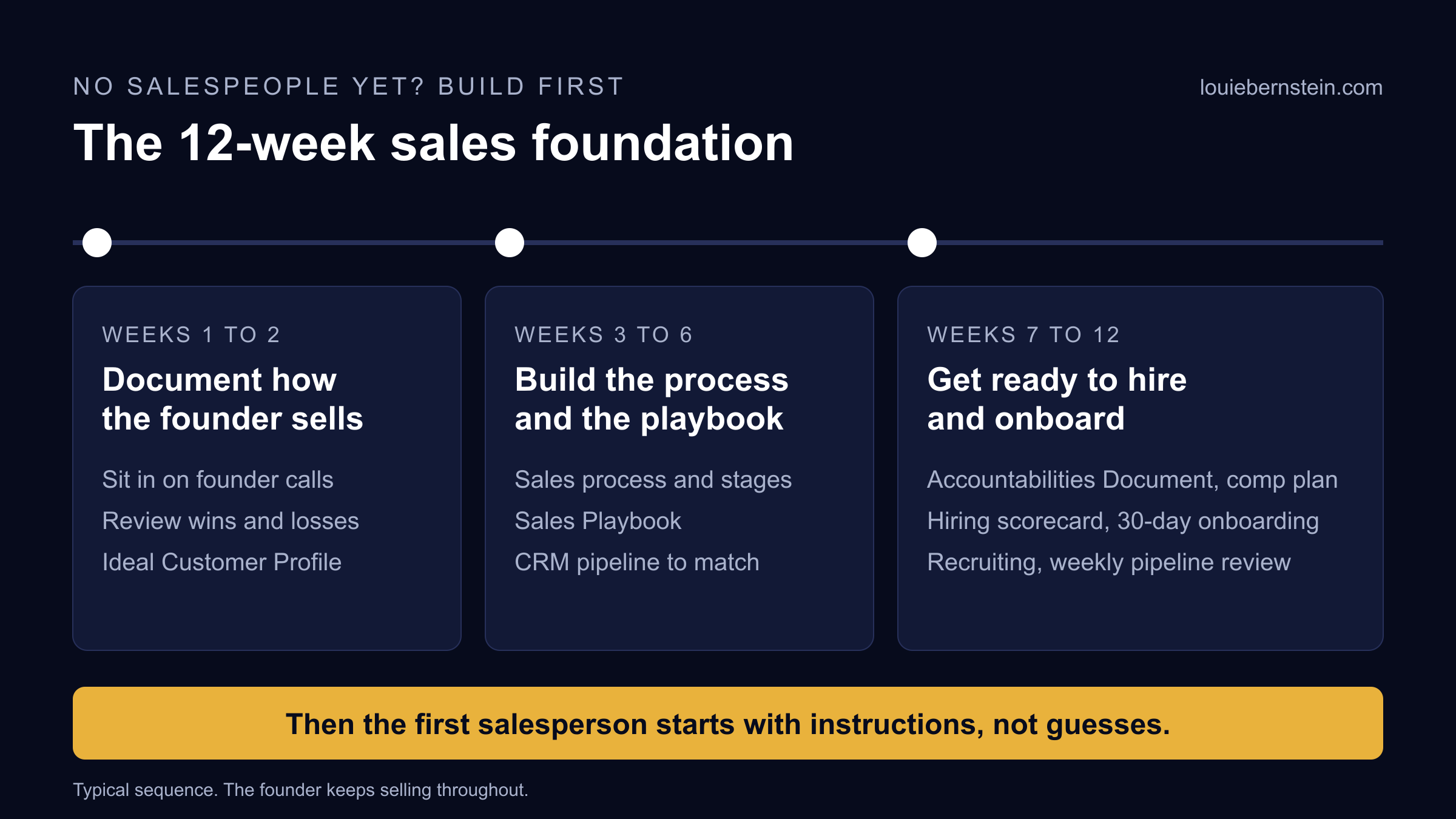
In the 12 weeks before a salesperson starts, a Fractional Sales Leader documents how the founder sells, builds the sales process and Sales Playbook, sets up the CRM, and prepares the hiring and onboarding plan. The order matters because each piece depends on the one before it.
Here is the usual sequence. It shifts depending on what you already have.
| Weeks | What gets built | What you have at the end |
|---|---|---|
| 1 to 2 | Sit in on founder calls. Review recent wins and losses. Write the Ideal Customer Profile. | A written answer to "who do we sell to and why do they buy?" |
| 3 to 6 | Define the sales process. Write the Sales Playbook. Set up the CRM stages to match. | A process a new person can read and follow, and a pipeline you can inspect. |
| 7 to 12 | Write the Accountabilities Document, comp plan, hiring scorecard and 30-day onboarding plan. Start recruiting. Set the weekly pipeline review. | A job a good salesperson will want, and a first month that's already planned. |
The document founders skip
The one founders skip most is the Accountabilities Document. It's one or two pages that say what the salesperson owns and the numbers they'll be measured on. Without it, you and your new rep will each have a different idea of what "doing well" means. You'll find that out around month four, and it won't be a pleasant conversation.
What mistake do founders make when they hire salespeople first?
The most common mistake founders make is hiring a salesperson with a strong resume and expecting that person to build the sales process. A salesperson is hired to sell. Most have never written a playbook, and the ones who try are building when they should be selling.
What I've seen in real sales teams
I've watched this play out the same way for years. The founder finds someone with a great track record somewhere else. Six months later, the rep has barely closed a deal. The rep is frustrated. The founder is frustrated. And the founder says, "I knew it. I'm the only one who can sell this."
That conclusion is wrong, and it's expensive. With no playbook, no stages and no written expectations, the founder never tested the rep. The founder tested whether a stranger could guess how the company sells. Then the founder goes back to closing every deal, more convinced than ever that nobody else can.
The call I'd rather get is the one before the job gets posted.
The other mistake: hiring a full-time VP to build it
Some founders see the gap and hire a full-time VP of Sales to fill it. A full-time VP of Sales costs $250K to $400K a year. Hiring one with no sales process is like asking a chef to cook a gourmet meal with an empty pantry. A VP is at their best scaling a team that's already working.
A Fractional Sales Leader builds the foundation at roughly half the cost. Other fractional sales leaders run $10K to $20K a month. My fee is $14K a month for 20 to 35 hours a week.
Hire a rep into nothing and you learn nothing about the rep.
When is it too early to hire a Fractional Sales Leader?
It's too early to hire a Fractional Sales Leader when there's no repeatable sale to document. A founder under $1M ARR, or one who hasn't closed enough deals to see a pattern, should keep selling. A Fractional Sales Leader can't write a playbook from deals that haven't happened yet.
Hold off if any of these are true:
- You can't describe your best customer. If every deal looks different, the Ideal Customer Profile would be a guess.
- You haven't sold it yourself. Someone has to prove the product sells before anyone can write down how.
- You can't fund a salesperson for one full sales cycle. The foundation is only worth building if a hire follows it.
- You won't give up any time. The knowledge is in your head. I can't document calls I'm not allowed to hear.
If you're not there yet, coaching is the lighter option. My Founders Corner coaching is $1,400 a month for one session a week over 12 weeks. You do the building. I tell you what to build next.
What happens after the sales foundation is built?
After the sales foundation is built, the Fractional Sales Leader helps the founder hire the first salespeople, onboards them on the Sales Playbook, and runs the weekly pipeline review until the team can sell without the founder. Hiring and ramp happen after the first 12 weeks, so most engagements continue past them.
Most of my fractional clients renew for 6 to 12 months total. The first 12 weeks build the system. The months after are for hiring, coaching and fixing what breaks when real salespeople use it. Something always breaks. That's how the playbook gets better.
I like to hire two salespeople when the budget allows. With one rep, you can't tell whether a slow start is the person or the process. With two on the same playbook, you can compare. If you're not sure you're at that point, here's how to tell when you're ready to hire your first sales rep.
The full-time VP of Sales comes later, when there's a working system and a team to scale. By then you'll know exactly what you need that person to do.
Related Reading
What Does a Founder Need to Create Before Making Their First Sales Hire? →
Frequently Asked Questions
Q: Who does the selling while the sales foundation gets built?
The founder keeps selling while the sales foundation gets built. A Fractional Sales Leader builds and leads the sales system and doesn't carry a quota. I'll join your calls and coach you on live deals, but you close until your first salespeople are ready.
Q: Can't I build the sales foundation myself?
You can build the sales foundation yourself if you have the time and you've built one before. Most founders at $1M to $10M ARR are closing deals and running the company, so the playbook stays half-written. If you go it alone, start with three pages: who you sell to, your sales stages, and a first-30-days plan.
Q: Does a Fractional Sales Leader cost less when there's no sales team?
No. My fee is $14K a month for 20 to 35 hours a week on a 12-week engagement, with or without a sales team. The hours go to building. Other fractional sales leaders run $10K to $20K a month.
Q: How much of my time does building the sales foundation take?
Building the sales foundation takes the most founder time in the first two weeks, when I'm learning how you sell. After that, plan on a few hours a week to review drafts and answer questions. You'll get that time back when your salespeople stop asking you the same things.
Q: What if I already hired one salesperson and it isn't working?
If you already hired one salesperson and it isn't working, build the foundation now, with the rep in the room. A struggling rep can tell you exactly where the instructions run out. Give the salesperson a written process and clear numbers before you decide whether the hire was wrong.
Build the sales foundation before you make the hire.
Tell me how you sell today and who you plan to hire. In 30 minutes, we'll work out what has to be in place before your first salesperson starts.
Schedule a 30-Minute CallAbout the Author
Louie Bernstein
Fractional Sales Leader with 50 years of sales experience helping $1M–$10M ARR companies build scalable, repeatable sales systems. Founder of MindIQ (INC 500). LinkedIn Top Voice in Sales Management, Sales Operations, and Sales Coaching.
Full bio | LinkedIn | Subscribe to The Sunday Starter | YouTube