Honest forecasts. Better sales management.
When salespeople tell you what sounds safe, the forecast becomes a guessing game. Give your team permission to estimate, require buyer evidence, and take responsibility for the number you use to run your business.

By Louie Bernstein·Last updated October 16, 2026
Short answer: Poor sales forecasts create a bad climate when salespeople feel pressure to inflate deals or hide uncertain opportunities. Fix the forecast by separating estimates from guarantees, requiring evidence of buyer commitments, and reviewing each salesperson's top 10 to 20 prospects weekly. The sales manager owns the realistic number, including bad news.
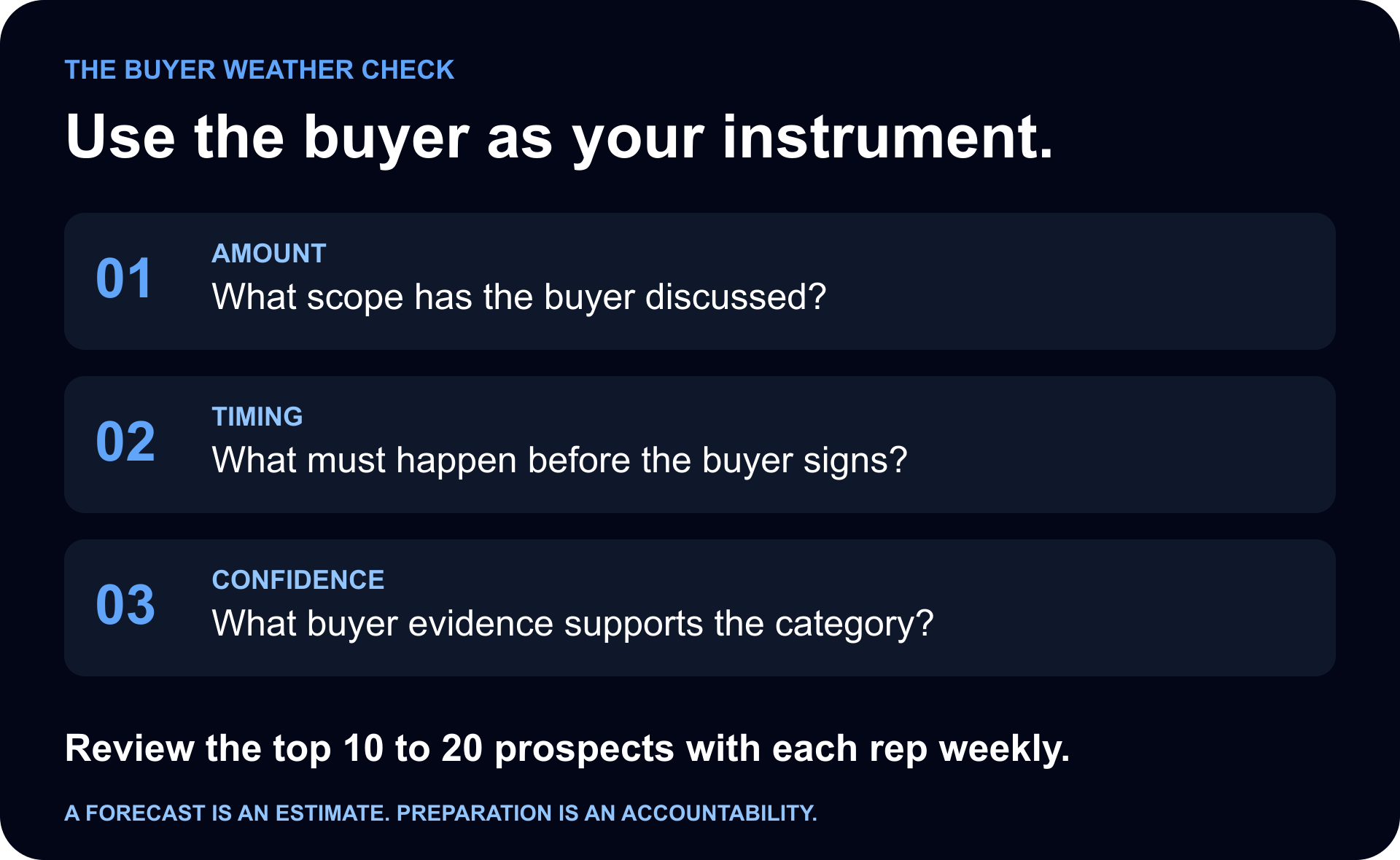
The Buyer Weather Check is a weekly forecast review that tests amount, timing, and confidence against the buyer's recorded actions and commitments. Those three checks give your team a common way to discuss uncertainty without making the number arbitrary.
A weather forecast doesn't promise sunshine. The meteorologist makes the best estimate the available instruments support. Your salespeople need the same permission, and the same discipline. If every forecasted deal were guaranteed to close, you wouldn't need a forecast. You'd need a list of completed orders.
Your target says what the business needs. Your forecast says what the current evidence supports. Keep both visible. If you need $200,000 this month and the evidence supports $140,000, the gap is $60,000. Calling the forecast $200,000 doesn't fill that gap. It hides the work your team must do. Keep the target ambitious while allowing the estimate to be honest.
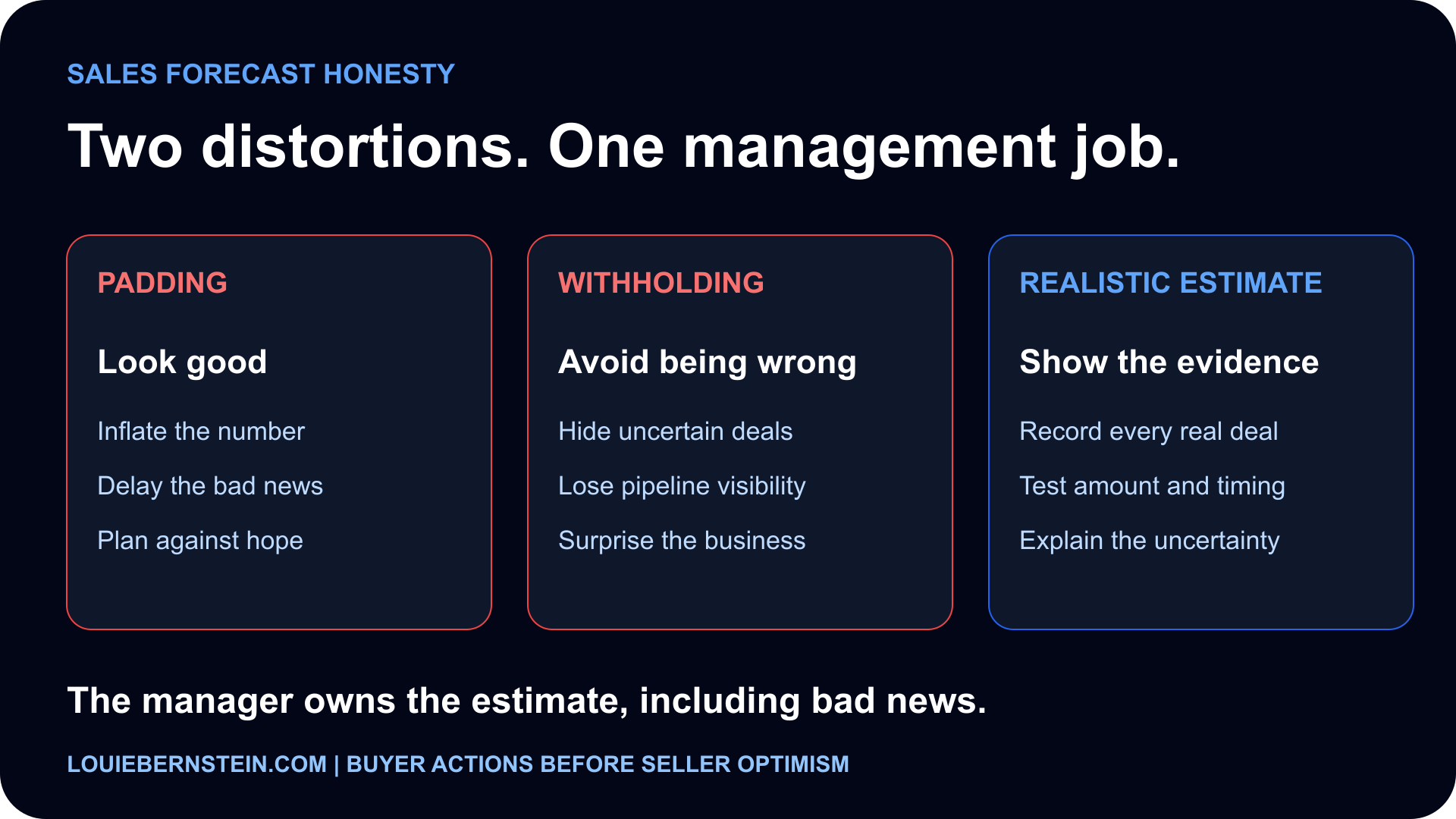
One salesperson pads the number to look good to the boss. Another leaves a prospect out because being wrong feels worse than saying nothing. Record every genuine opportunity in the pipeline, then mark its forecast category and unresolved conditions. A deal can be real without being ready for this month's likely number. Don't label every cautious salesperson dishonest. Ask whether your reaction to a previous miss taught the person to keep uncertain business out of sight.
Move from tracking your sales cycle to understanding the customer's buy cycle. A proposal sent is your action. A buyer arranging a review with the budget owner is buying evidence. Ask who approves the purchase, what the buyer has completed, and what the buyer has agreed to do next. Record the source and date. Let confidence rise when the buyer makes progress, not when the salesperson gets excited.
The sales manager must do more than collect totals. Review the top 10 or 20 prospects with each salesperson once a week. Start with changes since the previous review, then inspect the deals that could change the period's result. Look for missing prospects as well as weak deals already in the number. Ask what the buyer committed to, what remains, and whether the timing still works. If you have fewer than 10 prospects, review the whole list.
Save the forecast before the period ends. Compare that snapshot with what actually closed, including deals nobody forecasted. Separate timing changes, amount changes, losses, and opportunities that were missing. A big beat may be welcome revenue and still reveal a weak forecast. Thank the salesperson who reports a buyer delay promptly. Address missing notes or repeated unsupported dates directly. Honest uncertainty deserves coaching. Deliberately false information and skipped responsibilities require accountability.

A founder at $1M to $10M ARR often wears two hats: the person asking for the number and the person who needs that number to cover hiring, delivery, and cash commitments. Salespeople can hear that pressure even when you don't say it. If a lower estimate starts an argument, the easy response is a higher estimate. If an uncertain deal becomes a personal promise, the easy response is to leave the deal out. Both responses make your business harder to manage.
Tell the team exactly what a good forecast looks like: a complete view, a supported estimate, and a clear account of what could change. Then behave consistently when the news gets worse. Ask for the evidence before asking for a bigger number. The underlying funnel still needs clear stages and metrics; the basics are covered in sales forecasting for small business.
The management climate determines whether those inputs reach you. A weekly review won't help if a salesperson is afraid to mention a delayed approval. For the wider standard of honesty, including what gets left unsaid, read the value of integrity for your sales team.
I've spent 22 years as a bootstrapped founder and have worked as a Fractional Sales Leader since 2017. Founders have to make decisions while the outcome is still uncertain. My sales management homework is straightforward: start with your funnel, define precise metrics at each stage, and review the evidence every week. Your ability to produce a realistic forecast reflects how well you manage the business. Passing along your salespeople's totals isn't enough.
Read more about LouieOther sales practitioners also connect forecast quality with management behavior. Altify discusses sandbagging as a relationship and coaching problem. Bedford Consulting recommends regular deal reviews and rewarding honest forecast changes. The practical lesson for a founder is to change the conversation and inspect the evidence together. Permission to estimate doesn't remove the responsibility to prepare.
A realistic forecast makes uncertainty visible. Use the same standard for the optimistic salesperson, the cautious salesperson, and yourself.
| A climate that distorts the number | A climate that supports a real estimate |
|---|---|
| The boss needs $200,000, so the estimate becomes $200,000. | The target and evidence-based estimate stay separate. |
| A prospect stays hidden until the signature feels certain. | Every real opportunity is recorded with its remaining risks. |
| Proposal sent means the deal is nearly closed. | Buyer approval steps determine confidence and timing. |
| The close date moves to month-end without an explanation. | A dated buyer commitment supports the expected close. |
| The manager rolls up whatever the salespeople report. | The manager inspects the top prospects and owns the estimate. |
| A miss triggers blame; an unexpected win ends the discussion. | Misses and beats both get checked for forecasting lessons. |
Open the CRM with one salesperson and test the largest opportunities first. Keep the salesperson responsible for the next buyer conversation. Your job is to coach the reasoning, resolve obstacles, and distill the number. Taking over every deal only rebuilds founder-led sales.

Use the scope the buyer has discussed, not the largest package you could sell. In a hypothetical $60,000 annual deal, a buyer who is only considering a $15,000 pilot hasn't supported a $60,000 forecast. Record the pilot separately from a possible expansion. Be consistent about whether you are forecasting bookings, recurring revenue, recognized revenue, or cash. Signing a contract and collecting the money are different events.
Work backward from the buyer's intended start date. Identify budget approval, security review, legal review, purchasing, and the signer where they apply. Assign an owner and a date to the next step. If the buyer hasn't confirmed the path, label the close date as an assumption. Don't let your month-end become the customer's deadline simply because the CRM needs a date.
Write your own rules for pipeline, best case, and commit, then use them consistently. Commit should require stronger evidence of an achievable close within the period, but it still isn't a guarantee. Best case should name the condition that must change. Early pipeline remains visible without entering the likely number. Check the categories against your own outcomes over time. Don't turn a CRM's default percentage into a claim about your business.
Before the next review, put these responsibilities in your Sales Playbook and the relevant Accountabilities Document. Clear expectations help a salesperson prepare without needing the founder to interpret every deal.
Louie Bernstein, Fractional Sales Leader who helps B2B founders at $1M–$10M ARR escape founder-led sales.
I have 50 years of sales experience. I help founders put Sales Playbooks, CRM discipline, coaching, and accountabilities into daily use so their teams can sell without the founder doing everyone's work.
Read more about LouieSandbagging means understating expected sales or holding back likely opportunities. Sometimes a salesperson wants an easy number to beat. Sometimes the salesperson fears that an estimate will be treated as a guarantee. Ask why the deal is missing, require complete pipeline reporting, and use clear forecast categories rather than assuming every cautious estimate is dishonest.
Forecasts fail when amounts, dates, or confidence depend on what a salesperson wants the manager to hear. Inflated deals and hidden opportunities both distort the picture. Check buyer evidence, keep targets separate from estimates, and have the manager inspect the underlying prospects instead of just adding up totals.
Record every genuine opportunity, define stages using buyer actions, and review the top 10 to 20 prospects with each salesperson weekly. Test amount, timing, and confidence. Save forecast snapshots and compare them with actual results, including unexpected wins. Use the differences to improve judgment and stage rules.
Use a weekly review as your standing rhythm and report material changes when they happen. A buyer delay on Tuesday shouldn't wait until Friday if the delay affects hiring, delivery, or cash plans. Adjust the depth of the review to the number, value, and risk of your opportunities.
Salespeople own complete opportunity reporting, current notes, and evidence from the buyer. The sales manager owns the review and the final realistic estimate. In a founder-led company without a sales manager, the founder holds that responsibility until a capable leader takes it over. Software can support the work but can't own the judgment.
If you're still chasing every salesperson for the real story, let's look at the process together. As a Fractional Sales Leader, I can help you install clear stages, useful CRM records, and a weekly review your team can run. Bring your current forecast to a 30-minute conversation.