Key Takeaways
- Sell à la carte when the buyer needs a defined job occasionally.
- Sell a subscription when value continues between purchases and the buyer has a recurring need.
- Compare the full cost at the buyer's expected use, including setup, support, and overages.
- A subscription doesn't have to mean unlimited work. Define delivery limits.
- Give reps discovery questions and recommendation rules so every pricing decision doesn't come back to you.
- Test new offers with a defined buyer group before changing existing customer agreements.
Subscription looks better on your books. À la carte can look better on theirs. Pick the model that matches how your buyer actually buys, or they'll do the math and walk.
You want recurring revenue. Your prospect wants to finish one project. Your rep pitches an annual agreement, the buyer asks about a single purchase, and the call ends with “I'll discuss it with my team.”
That may be a packaging problem. For a founder still closing most deals, it becomes another rescue call. You explain the price, create an exception, and teach the team that you're the only person who can make the offer fit.
You need a choice your reps can explain and your buyer can defend. Start with the work the buyer needs done, then choose how to charge for it.
Your desire for recurring revenue isn't a reason for the buyer to make a recurring commitment.
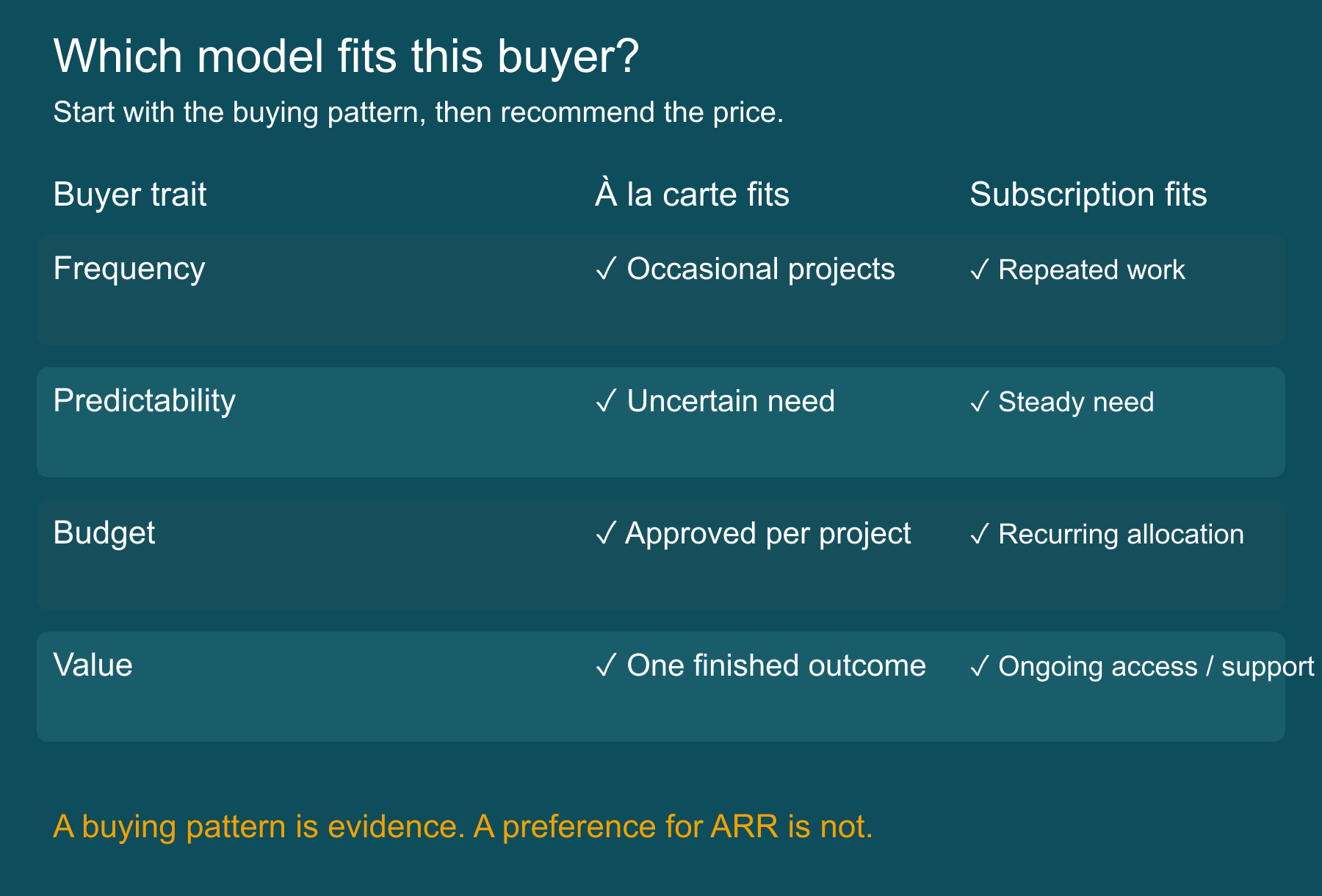
1. Find Out What the Buyer Is Actually Buying
Separate a finished job from an ongoing need
À la carte means buying a defined item or service separately. A subscription means paying on a recurring schedule for an agreed service or access. Neither tells you, by itself, how much value the buyer gets.
A company may need one assessment before entering a new market. Another may need monthly reviews because its market changes. The deliverable can look similar. The buying pattern is different.
Ask what happens after the first job is finished. If the honest answer is “nothing until next year's planning,” don't invent a monthly need. If the buyer needs monitoring, support, or continued access, explain what that ongoing work does.
Ask four questions before quoting
Put these questions in your Sales Playbook:
- How many times did you need this in the last 12 months?
- What creates the next need, and how predictable is it?
- Who approves the spending, and is the budget per project or recurring?
- What value do you need between individual jobs?
Ask for evidence. “We'll use it all the time” is a guess. A project calendar, past order history, or a named team using it each week gives the rep something to work with.
If the buyer has no history, use a range. Build low, expected, and high use cases together. Don't turn their most optimistic answer into the only price comparison in the proposal.
2. Run the Math the Buyer Will Run
Compare the same work over the same period
Here's an illustration, not a client result. Suppose a defined job costs $500 à la carte. A subscription costs $300 a month and includes enough capacity for the jobs shown below. Assume equal scope and service, with no setup fees or overages.
At two jobs a year, à la carte costs $1,000. The subscription costs $3,600. At ten jobs, à la carte costs $5,000. The same subscription costs $3,600. Under these assumptions, the subscription becomes cheaper above 7.2 jobs a year, which means eight whole jobs.
The decision changes if the subscription includes something the single purchase doesn't. Reserved capacity, continuing support, and access between jobs may matter. Name those benefits and ask whether the buyer values them. Don't bury them in “premium service.”
Don't promise a universal crossover month
A chart showing cumulative cost needs a use schedule. In this illustration, demand starts slowly and grows. The lines cross between months five and six because jobs accumulate faster later in the year. That's a feature of this scenario, not a rule about subscriptions.
The crossover marker is an estimate between plotted monthly totals. Actual job purchases happen at specific times, so the buyer's bills may move in steps rather than follow a smooth line.
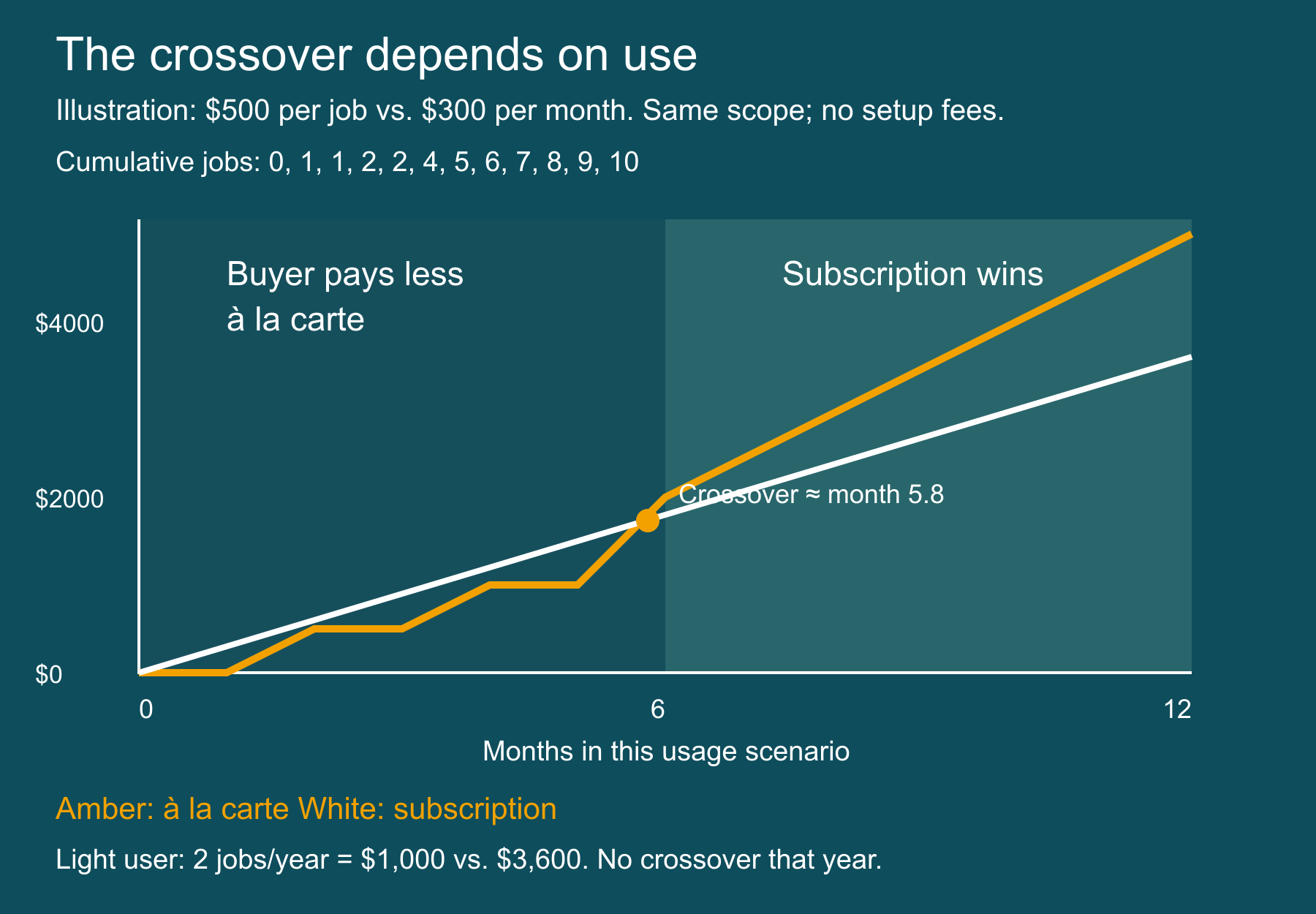
If use stayed at two jobs for the year, the buyer would never reach that crossover. A rep who ignores this will hear the same objection at renewal, with the customer's invoices attached.
Give the buyer a plain comparison: expected use, included work, annual cost, extra charges, and commitment. Check whether an annual payment is due upfront. A lower total price can still require more cash today than a project budget allows.
A discount doesn't fix a subscription the buyer won't use. It just makes the mismatch cheaper.
3. Protect Your Margin in Both Models
Price the whole à la carte job
A single purchase still creates sales, setup, delivery, and support work. If you charge only for the visible deliverable, each small order can consume more time than its price supports.
Define what one purchase includes: inputs the buyer supplies, revision limits, delivery timing, and the support period. Set a minimum order where the work requires it. A buyer can understand a minimum when your rep explains the work involved.
Keep the comparison honest. If à la carte requires setup on every order, include that in its cost. If setup is charged once and reused, don't charge it twelve times in your sales example to make the subscription look better.
Put boundaries around subscriptions
Recurring billing doesn't make delivery free. An agreement that promises unlimited custom work can become a margin problem as soon as the buyer takes you at your word.
Specify included units, turnaround times, support hours, and what triggers a separate quote. Explain whether unused units expire, carry over, or have no unit limit because the offer is access rather than delivery.
Check a heavy-use case with the person responsible for delivery. Can you honor the promise at the stated price? If the answer depends on buyers not using what they bought, fix the offer before teaching reps to sell it.
Review contribution per customer after direct delivery costs, along with sales effort and service load. A larger contract isn't automatically a better deal. You can build a recurring burden as easily as recurring revenue.
4. Use a Hybrid Only When It Solves a Clear Problem
Match each charge to a different job
Some buyers need ongoing access plus occasional extra work. A base subscription with a defined charge for additional units may fit them. Others may want a single assessment followed by an optional service agreement.
These are real billing options. Stripe's pricing documentation lists flat-rate, per-seat, tiered, and usage-based models, including a fixed fee with overage charges. The billing tool can support the structure. You still have to explain why the buyer needs it.
That distinction matters for your sales team. A subscription describes recurring payment. Usage-based pricing describes how the amount is calculated. You can bill usage monthly. À la carte, bundles, and subscriptions aren't always opposite choices.
Keep the offer repeatable
Write the hybrid in one sentence: “The monthly price covers ongoing access and four jobs; additional jobs cost this amount.” Then define each job. If your rep needs a spreadsheet to explain the sentence, reduce the variables.
Give buyers a way to see use before extra charges arrive. Identify who receives notifications and what happens at the included limit. A surprise invoice can undo the trust your rep built during discovery.
Avoid creating a private pricing model for every prospect. Start with one standard offer and a clear exception path. A hybrid should solve a common buying pattern, not become permission for reps to negotiate every line.
5. Teach the Team to Recommend, Then Test the Offer
Build a recommendation rule
Your rep should be able to say, “You expect two projects this year, with no need between them. I'd start with the single-project option.” For a different buyer: “Your team needs this each month and requires ongoing access. Here's what the subscription covers.”
Those recommendations show that discovery changed the offer. They also give your champion language to repeat to finance. “The founder gave us a special deal” doesn't explain why the purchase makes sense.
Record expected use, budget owner, selected model, and the reason in the CRM. Add the buyer's next decision step. A quote sent is seller activity. A buyer confirming scope, cost, and the approval path is evidence of progress.
Put pricing authority in an Accountabilities Document. Define who can approve an exception, its limits, and what information they need. Otherwise, every unusual buyer still lands on your calendar.
Role play the objection before the next call
Have a rep practice with a light user who says, “I don't want another subscription.” Score whether the rep asks about the work, compares costs, and recommends a fit. Don't score whether they force the buyer into your preferred billing model.
Then practice with a frequent user who fears an unpredictable bill. The rep should explain included capacity, likely use, and the high-use case. Coach one improvement at a time. Let the rep repeat the conversation rather than taking over.
Run a small, defined test
Pick one buyer group for new quotes. Write the offer, the qualification rule, and the measures before the test starts. Review completed deals by model: win rate, discounting, sales time, expected versus actual use, and delivery margin.
Watch what happens after the sale. A subscription that closes well but produces unused capacity and cancellation requests needs attention. A single purchase that creates repeated orders may reveal buyers ready for a recurring offer.
Don't judge the model on bookings alone. Separate committed recurring fees from estimated future orders. Review retention after enough renewal opportunities exist, and keep early results provisional when the sample is small.
For existing customers, review their agreements and offer changes at an appropriate decision point with clear notice. Show how scope and cost compare. Never treat a new price sheet as permission to rewrite a signed commitment.
Related ReadingWhat Is a Fractional Sales Leader? →
Frequently Asked Questions
Is subscription pricing always better for a B2B company?
No. It fits an ongoing need you can deliver profitably. If buyers need occasional finished jobs, a recurring commitment may create objections and poor renewal value. Compare buyer fit and delivery economics before choosing.
What's the difference between à la carte and usage-based pricing?
À la carte usually means buying individual items or services separately. Usage-based pricing calculates charges from a measured unit. Usage can be billed on a recurring schedule, so a usage-based offer can also be a subscription.
How do I calculate the break-even point?
With equal scope and no extra fees, divide the subscription's total cost for the period by the à la carte unit price. In the illustration, $3,600 divided by $500 is 7.2 jobs. Add setup, support, and overages when they apply. A calendar crossover also requires a use schedule.
Should I offer both models to every prospect?
Only if both are practical to deliver and explain. Give reps a recommendation rule based on use and value. Showing every option without guidance can leave the buyer doing the qualification work your team should have done.
What if a customer wants to leave the subscription?
Ask what changed: use, budget, service, or the original expectations. Compare the options against the agreement and the customer's current need. A suitable single-purchase offer may preserve a relationship. Track the reason so you can fix repeated mismatches in new sales.
Can a Fractional Sales Leader help with this decision?
A Fractional Sales Leader can connect pricing to discovery, qualification, proposal rules, coaching, and pipeline review. Delivery and finance still need to validate costs and capacity. The goal is an offer the team can recommend and fulfill without routing every deal through the founder.
Build an offer your reps can recommend.
If you're still stepping into every pricing conversation, Fractional Sales Leadership can help you turn buyer evidence into a repeatable sales process. Learn more at LouieBernstein.com.
Schedule a 30-Minute CallAbout the Author
Louie Bernstein
Louie Bernstein is a Fractional Sales Leader and the founder of MindIQ. He helps B2B founders build repeatable sales systems through Sales Playbooks, clear sales processes, pipeline management, and coaching.