How Does It Protect Both the Founder and the Rep When Results Start to Slip?
Yes. An Accountabilities Document spots sales underperformance months before a missed quota does, because it holds the rep to weekly commitments (conversations, new pipeline, stage movement) that slip first. When the same line goes red three weeks running, the founder knows something is wrong while there's still time to fix it. The written standard also protects both sides: the rep isn't judged on moving goalposts, and the founder has a fair, dated record.
Key Takeaways
- An Accountabilities Document catches underperformance early because its weekly activity and pipeline lines go red months before quota does. Quota is the last signal to move, not the first.
- Waiting for a quota miss is expensive. The average SaaS Account Executive takes 5.7 months to ramp (Bridge Group, 2024), so a founder who only watches revenue can lose half a year before seeing the problem.
- Treat the same red line three weeks in a row as a pattern, not a bad week. That's the point to sit down with the rep and find the cause.
- Diagnose before you decide: check whether the document is wrong, whether you delivered what you promised, then skill, then effort. Effort is the easiest explanation and usually the last true one.
- The document protects the rep from moving goalposts and protects the founder with a dated record showing one standard applied fairly. When someone is let go, it should never be a surprise.
Most founders find out a rep is failing at the end of a quarter. The number comes in short, the founder looks back, and every warning sign was there in plain sight. Fewer calls in week three. A thin pipeline in month two. A forecast that kept sliding.
None of it registered, because nobody had written down what "on track" looked like.
Quota tells you a rep has failed. The Accountabilities Document tells you a rep is starting to.
If you're a B2B founder at $1M to $10M ARR with your first or second rep, that difference is worth months of salary and pipeline. Here's how to use the document to see trouble early and handle it in a way that's fair to the rep and safe for you.
How does an Accountabilities Document catch underperformance before quota does?
An Accountabilities Document catches underperformance early by measuring the weekly inputs that produce revenue, not just the revenue. Activity floors, new pipeline and stage movement slip weeks or months before a quota miss shows up. A founder who checks those lines every week sees the decline while there's still time to correct it.
Quota is a lagging number
Quota is the end of a long chain. Conversations create meetings, meetings create opportunities, opportunities move through stages, and some of them close. By the time a rep misses quota, the cause happened one or two sales cycles earlier.
A quota miss also doesn't tell you much by itself. In Ebsta and Pavilion's 2024 B2B Sales Benchmarks, 69% of reps missed their targets (Ebsta). When most reps miss, "she missed quota" doesn't separate a struggling rep from a bad territory, a broken process or an unrealistic number. The lines in the document do.
Timing makes the problem worse for a new hire. The Bridge Group's 2024 SaaS AE report, covering 172 B2B SaaS companies, puts average ramp at 5.7 months, up from 4.3 months in 2020 (Bridge Group). If revenue is the only thing you watch, you can't judge a new rep fairly until month six.
The leading lines go red first
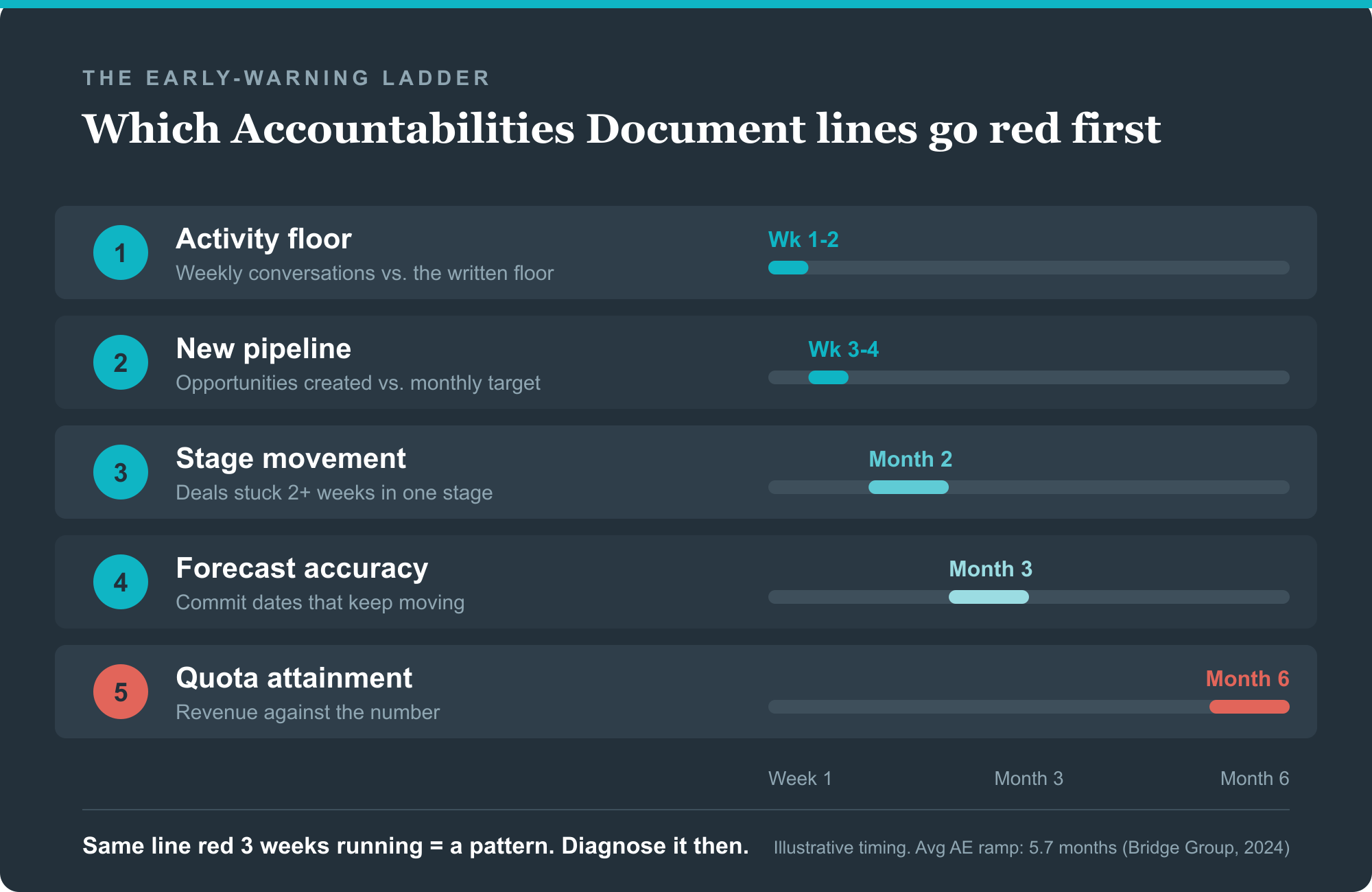
A good sales Accountabilities Document lists three to five outcomes plus the weekly and monthly activities behind them, with dates. Those activity and pipeline lines are your early-warning system. Each one moves before the line below it, so the sooner you see red, the cheaper the fix.
Which early warning signs should a founder watch in the document?
The early warning signs a founder should watch are a missed activity floor, thin new pipeline, deals stuck in one stage, commit deals that keep slipping, and a rep whose self-score stays green while the CRM shows red. Each sign maps to a line in the Accountabilities Document, so you're checking evidence, not a feeling.
Five signals and what they usually mean
| Signal in the document | What it usually means |
|---|---|
| Weekly conversations under the written floor | Time is going somewhere else: admin, internal meetings, or avoidance of the hard part of the job. |
| New pipeline below target for the month | The next quarter is already in trouble, even if this one looks fine. |
| Deals sitting in one stage for two or more weeks | A skill gap in a specific step, often discovery or getting to the real decision maker. |
| Commit dates that keep moving | The rep is forecasting hope instead of buyer actions. |
| Self-score green, CRM red | Either the rep doesn't understand the standard or isn't being straight with you. Both need a conversation this week. |
Use the three-week rule
One red week is noise. Reps get sick, deals slip and holidays happen. The same red line three weeks in a row is a pattern. That's when you stop noting it and start diagnosing it, with the rep in the room and the document on the table. In my experience the founders who get burned aren't the ones who missed the first red week. They're the ones who saw week eight and still called it a slow patch.
How do you tell if the problem is the rep, the founder or the role?
To tell whether underperformance comes from the rep, the founder or the role, check causes in a fixed order: the document itself, the founder's own commitments, the rep's skill, the rep's effort, and finally what's happening in the rep's life. Founders who start with effort usually skip the real cause and coach the wrong problem.
Five causes, checked in order
- The document is wrong. The number came from hope, not your own sales history. Fix it, date the change and move on.
- The founder didn't deliver. You promised a target account list, a case study or fast pricing approvals, and they didn't show up. That miss is yours.
- The rep can't yet do the skill. Listen to a call recording next to one that worked and practice the gap.
- The rep isn't doing the work. Point to the line, name it plainly, agree on what changes by next week and write it down.
- Something outside work is going on. Ask. Don't assume.
My article on running sales 1:1s off the Accountabilities Document shows how to walk through these causes in a 30-minute weekly meeting without turning it into an interrogation.
What 50 years in sales has taught me
Years ago I had a good salesperson start slipping. His numbers told me something was wrong. They didn't tell me what. So I called him into my office to talk about it. While we were talking, I looked out the window and watched a tow truck haul his car out of our parking lot. He was behind on his payments. His marriage was in trouble, his work was suffering, and his commissions were suffering with it.
The lesson has stayed with me. The Accountabilities Document tells you what is slipping and when it started. Only a conversation tells you why. Founders who skip the conversation and go straight to a verdict get the diagnosis wrong more often than they'd like to admit.
The document finds the problem. The conversation finds the cause. You need both before you decide anything.
How does the Accountabilities Document protect the rep when results slip?
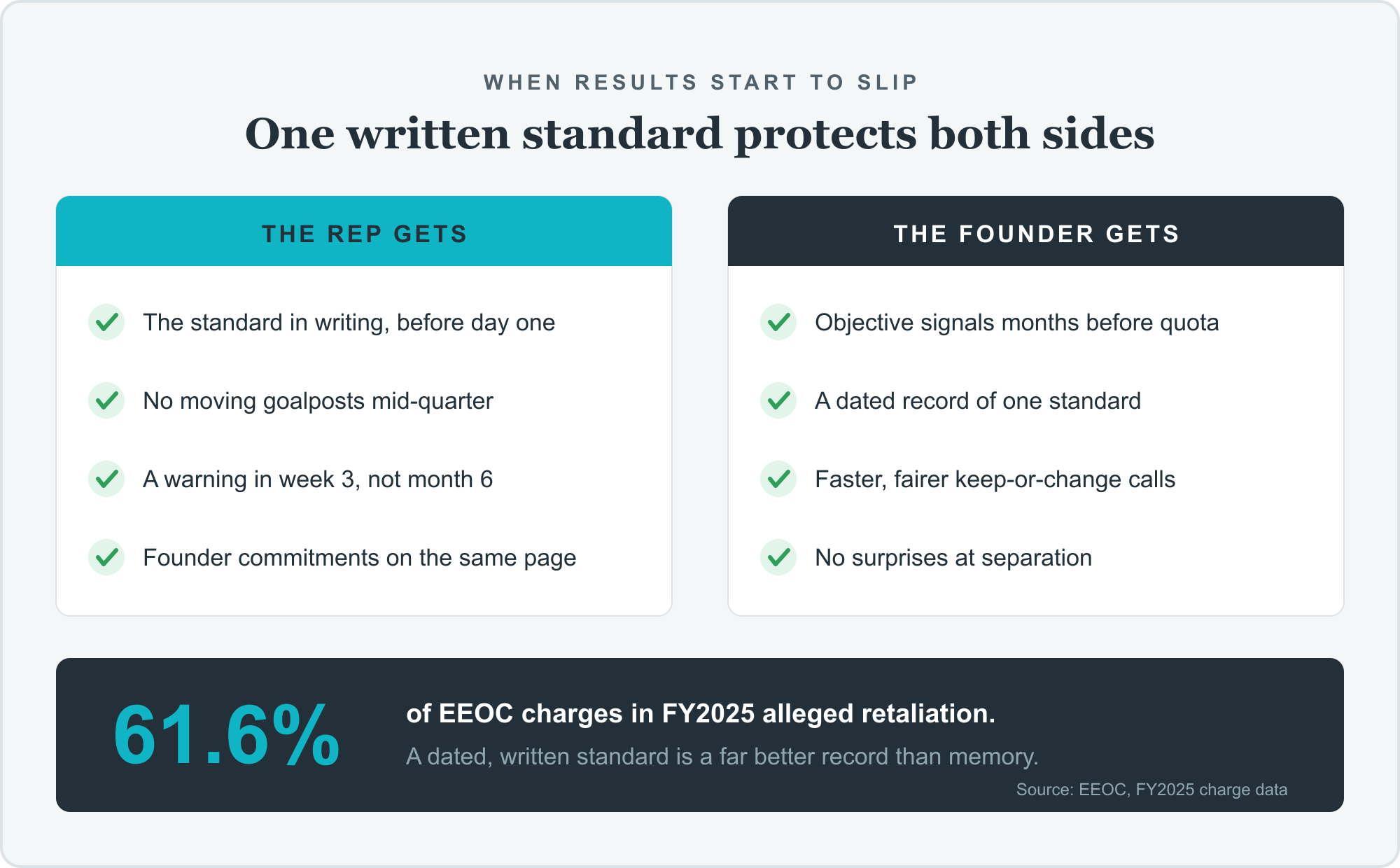
The Accountabilities Document protects the rep by fixing the standard in writing before results slip. The rep knows exactly what "on track" means, can't be judged on expectations that were never stated, and gets weeks of warning instead of a surprise at quarter end. The founder's commitments sit in the same document too.
No moving goalposts
When results slip, the temptation for a founder is to change the target in the moment, usually upward and usually from memory. A dated, signed document stops that. If a target changes, it changes with a new date going forward, never backward. A good rep who's having a slow month can show the activity and pipeline lines are green and earn the benefit of the doubt.
Fair feedback is rare, so the rep notices
Most performance feedback doesn't land. In Gallup's 2019 research, only 14% of employees strongly agreed their performance reviews inspired them to improve (Gallup). That's employees across all jobs, not salespeople alone. The manager matters most here: Gallup estimates managers account for at least 70% of the variance in employee engagement scores (Gallup, 2015). A rep who hears about a problem in week three, against a standard they agreed to, gets a fair chance to fix it. A rep who hears about it in month six doesn't.
How does the Accountabilities Document protect the founder?
The Accountabilities Document protects the founder by turning "it isn't working out" into a dated record of one written standard, applied the same way, with weekly notes on what was missed and what was agreed. That record shortens the decision, keeps the founder from carrying a wrong hire for two quarters, and shows the process was fair.
A dated record beats a gut feeling
Founders often keep a struggling rep too long because they can't explain, even to themselves, exactly what's wrong. The document plus eight or ten weeks of review notes fixes that. You'll know whether the rep improved, stalled or never started, and so will the rep.
The record also matters if a separation is ever challenged. In fiscal year 2025, retaliation was alleged in 61.6% of the 88,201 charges filed with the U.S. Equal Employment Opportunity Commission, more than any other basis (EEOC). I'm not a lawyer, and you should talk to an employment attorney before letting anyone go. But a written standard set on day one, with weekly evidence against it, is a far better position than a founder's memory.
Without the document vs. with it
| Without an Accountabilities Document | With an Accountabilities Document |
|---|---|
| Problems surface at quarter end | Problems surface in week three |
| The standard lives in the founder's head | The standard is written, dated and agreed |
| Targets shift when the founder is frustrated | Targets change only with a new effective date |
| Founder's own misses go unrecorded | Founder commitments sit next to the rep's |
| "It isn't working out" with no evidence | Weekly notes show what was missed and agreed |
| The rep is shocked when let go | Nobody is surprised, either way |
It should never be a surprise
I've said this for years: if a salesperson is shocked when they're let go, it's the fault of one of two people. Either the manager never put in writing what success looks like, or the salesperson didn't take the document seriously when they got it. The Accountabilities Document makes sure it's never the first one. If you'd rather not run this process yourself, my guide on how to manage an underperforming salesperson covers the next steps, and a Fractional Sales Leader can write the document and run the weekly reviews for you.
Related Reading135% of Quota and Put on a PIP: Why Written Accountabilities Save Sales Teams →
Frequently Asked Questions
How soon can I tell if a new sales rep is underperforming?
With an Accountabilities Document, you can usually see a real pattern within three to four weeks, because activity and pipeline lines move long before revenue. Judge a new rep on those leading lines during ramp, and on revenue only after the ramp period written in the document.
Should I tell the rep the first week a number goes red?
Yes, but as a check, not a warning. Mention it in the weekly review and ask what happened. Save the formal conversation for the third week in a row on the same line, so the rep doesn't feel judged on one bad week.
When does an early warning become a performance improvement plan?
Move to a written improvement plan when the same line stays red for about a month after you and the rep agreed on a fix, and you've ruled out a wrong target or a missed founder commitment. The plan should cite the document's existing standard, not a new one.
What if my rep never signed an Accountabilities Document?
Write one together now and give it an effective date a week or two out. Don't judge past work against expectations that weren't written down. That would undo the fairness that makes the document worth having.
Does an Accountabilities Document replace HR advice before a termination?
No. It gives you a clear, dated record of the standard and the rep's results, which is valuable. Before you let anyone go, talk to an employment attorney or HR advisor about your specific situation and state.
See the slip in week three, not month six.
If you're not sure whether your rep is ramping or sinking, let's look at what they're accountable for and what the evidence says. See how Fractional Sales Leadership at LouieBernstein.com can help you build the document, run the reviews and make the call fairly.
Schedule a 30-Minute CallAbout the Author
Louie Bernstein is a Fractional Sales Leader with 50 years of sales experience and has worked as a Fractional Sales Leader since 2017. He helps B2B founders at $1M to $10M ARR build sales processes, define roles, and coach teams to sell without the founder in every deal.
Subscribe to The Sunday Starter for practical sales leadership guidance.