How Do You Inspect Performance Without Turning the Conversation Into an Interrogation?
Run every weekly sales 1:1 and pipeline review off the rep's Accountabilities Document. Open the document, compare each written commitment with the evidence in the CRM, and ask the rep to explain the gaps before you give your view. The conversation stops feeling like an interrogation because you're both checking the same written agreement. You're inspecting the work, not cross-examining the person.
Key Takeaways
- The Accountabilities Document is the agenda for both the weekly pipeline review and the 1:1. If a topic isn't in the document, it's a new expectation, so write it down before you hold anyone to it.
- Interrogation asks the rep to defend themselves. Inspection asks the rep to show evidence against a written standard both of you agreed to.
- Read the CRM before the meeting. Spend the 30 minutes on gaps, causes and next steps, not on having the rep recite data you could have looked up.
- Short, frequent conversations work. Gallup found 15 to 30 minute manager conversations held regularly have more impact than 30 to 60 minute ones held less often.
- When a number is missed, check the document first, then your own commitments, then the rep's skill, then effort. Founders who start with effort usually skip the real cause.
"Why didn't this close?" "What happened on Friday?" "Who told you that?"
If those are the questions your rep hears every Monday, you're not running a pipeline review. You're running a deposition. The rep learns to say whatever ends the meeting fastest, and you leave knowing less than when you walked in.
When there's no written standard, every question sounds like an accusation. When there is one, the same question sounds like a check.
For a B2B founder at $1M to $10M ARR who just hired a first or second rep, the fix isn't a softer tone. It's a better reference point. Here's how I run weekly reviews off the Accountabilities Document so you can inspect hard without wrecking the relationship.
What does it mean to run a 1:1 off the Accountabilities Document?
Running a 1:1 off the Accountabilities Document means the written list of outcomes, activities and deadlines becomes the meeting agenda. Each line turns into one question: what does the evidence show against this commitment? The founder stops improvising questions from memory, and the rep knows exactly what will be discussed before walking in.
The document sets the scope of the conversation
An Accountabilities Document is a one or two page list of what each person is expected to do and when it's due: the three to five outcomes that move revenue, the weekly activities behind them, and the 30, 60 and 90 day milestones. My guide to the sales Accountabilities Document walks through how to write one.
Once it exists, the document does something founders don't expect. It limits you. You can't spend the 1:1 grilling a rep about something they never agreed to own. If you find yourself asking about a task that isn't written down, that's a signal to update the document, not to win the argument.
Why the document matters more than the meeting format
Role clarity is still rare. In Gallup's February 2026 findings, only 49% of U.S. employees strongly agreed they knew what was expected of them at work (Gallup). That's employees across all jobs, not salespeople specifically. Still, if half of the workforce isn't sure what the job is, a weekly meeting that starts from a written answer has an advantage most meetings don't.
How should you structure the weekly pipeline review and 1:1?
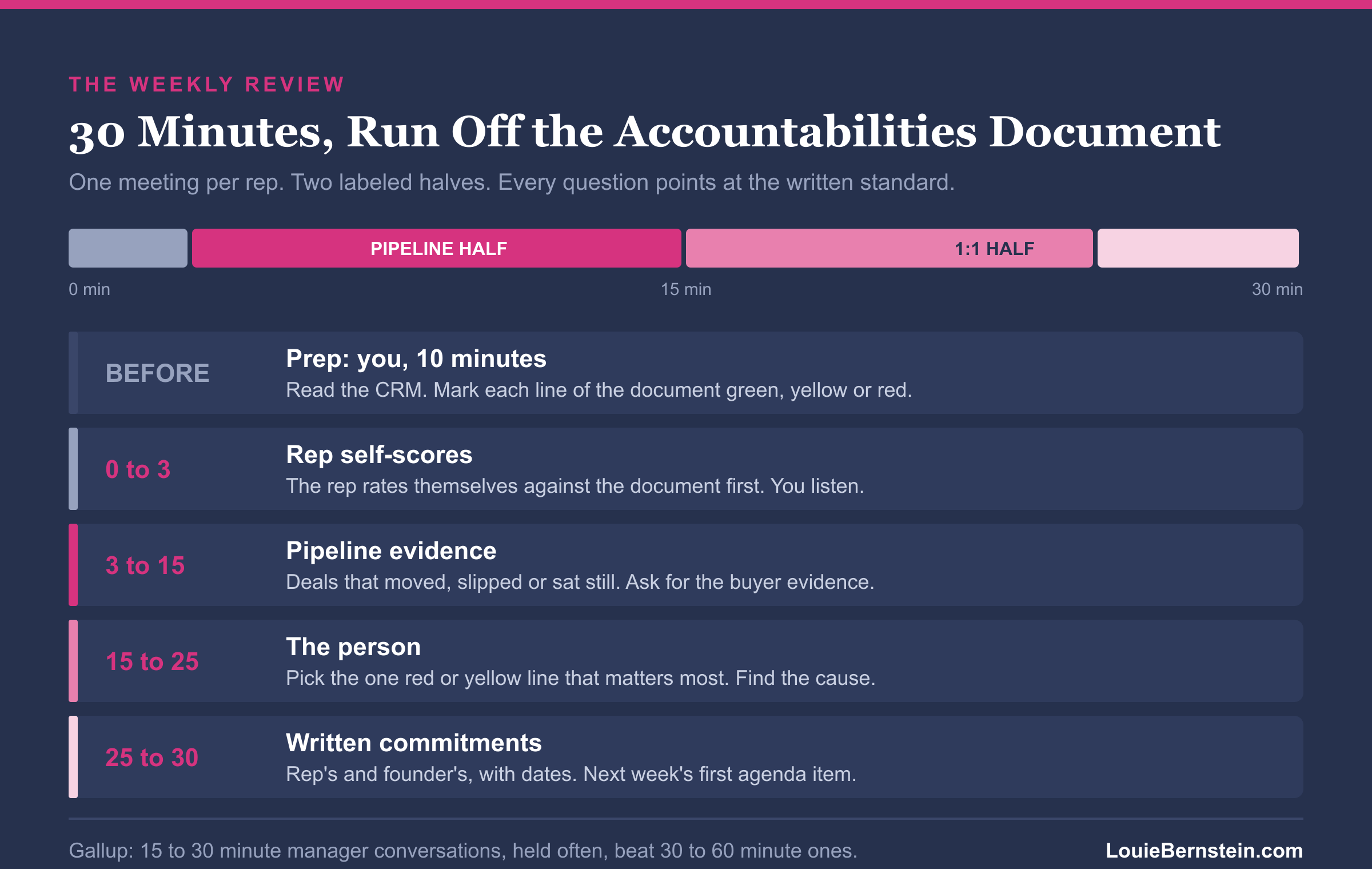
Structure the weekly review as one 30-minute block per rep with two labeled halves: about 15 minutes of pipeline review against the document's pipeline commitments, then about 15 minutes of 1:1 on the person. Separating the halves keeps deal inspection from swallowing coaching, and coaching from softening deal inspection.
Give each half a different job
The pipeline half asks whether deals are where the rep says they are. Every opportunity is checked against your written stage definitions. If your stages don't have exit criteria based on what the buyer actually did, fix that first, because you'll have nothing objective to inspect against.
The 1:1 half asks how the rep is doing the work: which skill is improving, what's blocking them, and what they need from you. My article on how to deliver an effective 1:1 with a salesperson covers that half in depth.
The 30-minute agenda
- Before the meeting (you, 10 minutes): Read the CRM and the rep's activity numbers. Mark each line of the Accountabilities Document green, yellow or red.
- Minutes 0 to 3: The rep scores themselves against the document first. You listen.
- Minutes 3 to 15: Pipeline. Walk the deals that changed stage, slipped a date, or sat still for two weeks. Ask for the buyer evidence behind each one.
- Minutes 15 to 25: The person. Pick the one red or yellow line that matters most and find the cause together.
- Minutes 25 to 30: Write down one or two commitments from the rep and any from you, with dates. Those become next week's first agenda item.
Gallup's research on manager conversations supports the short format: 15 to 30 minutes is enough, but only if the conversations happen frequently (Gallup). A 30-minute meeting held every week beats a 90-minute meeting held when the founder has time.
What questions inspect performance without sounding like an interrogation?
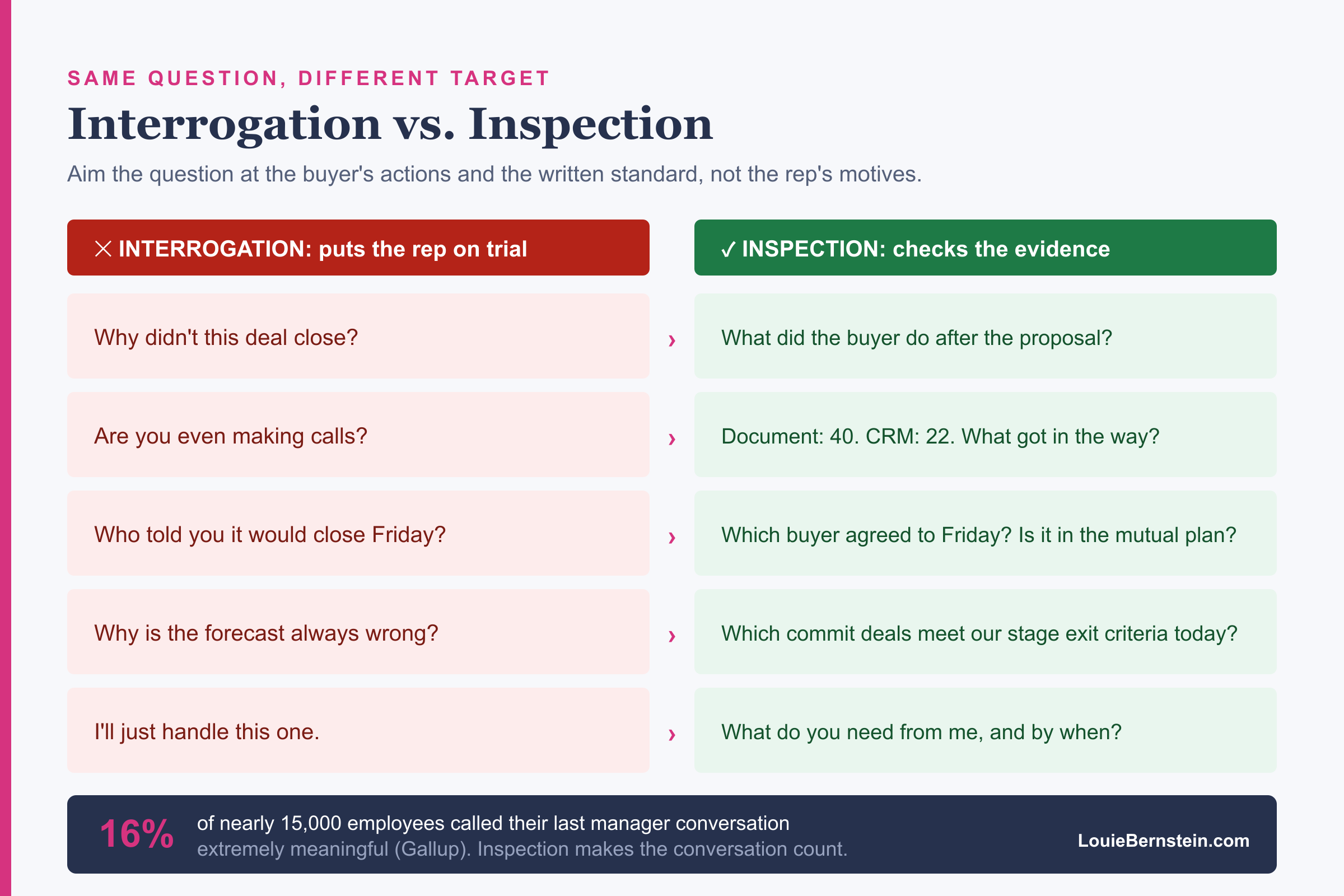
Questions that point at the written standard and the buyer's actions inspect performance; questions that point at the rep's character interrogate. "What did the buyer do that moved this to stage four?" checks evidence. "Why didn't you push harder?" demands a defense. Founders get better information from the first kind because reps can answer it honestly.
Swap the accusation for the evidence check
| Interrogation (avoid) | Inspection off the document (use) |
|---|---|
| Why didn't this deal close? | What did the buyer say or do after the proposal? |
| Are you even making calls? | The document says 40 conversations. The CRM shows 22. What got in the way? |
| Who told you it would close Friday? | Which person on the buyer's side agreed to Friday, and is it in the mutual plan? |
| Why is the forecast always wrong? | Which deals in commit meet our stage exit criteria today? |
| What were you thinking? | If you ran that call again, what would you change? |
| I'll just handle this one. | What do you need from me, and by when? |
The 40 and 22 above are an illustration. Use the activity numbers written in your rep's own document.
Let the rep go first
Ask the rep to score themselves against the Accountabilities Document before you share your view. Most reps are harder on themselves than you'd be, and a rep who names their own red line owns the fix. A rep who's always green while the CRM is red is telling you something too, and it's worth a separate conversation.
The rep should never learn about a problem in the meeting. They should be the one who brings it.
What should you do when a rep misses a number in the document?
When a rep misses a number in the Accountabilities Document, diagnose the cause in a fixed order: the document, your own commitments, the rep's skill, then the rep's effort. Effort is the easiest explanation and usually the last true one. Checking the other three first keeps you from coaching the wrong problem.
Four causes, checked in order
- The document is wrong. The target came from hope, not your sales history. Fix the number, record why, and set an effective date.
- The founder didn't deliver. You promised a target account list, pricing approval or a case study, and it didn't show up. That miss belongs to you.
- The rep can't yet do the skill. Pull a call recording, compare it with a call that worked, and practice the gap in the meeting.
- The rep isn't doing the work. Name it plainly, point to the line in the document, agree on what changes by next week, and write it down.
Write every conclusion down
Add a dated line to the review notes after each meeting: what was missed, the cause you agreed on, and the commitment. Over eight or ten weeks that log becomes the fairest performance record you'll ever have. I've told founders for years: when you let someone go, it should never be a surprise. A written weekly record is how you keep that promise, and it's also how a good rep proves they're improving.
Where do founders usually get weekly sales reviews wrong?
Founders usually get weekly sales reviews wrong by inspecting from memory instead of from the Accountabilities Document, then filling the silence with their own war stories. The rep leaves with the founder's opinion and no clear standard. When I audit sales teams, that pattern shows up far more often than a rep who simply won't work.
What I see when I audit sales teams
Three patterns come up again and again in my fractional work. First, the founder cancels the review when a big deal or a product fire comes up, so the rep learns the meeting is optional. Second, the founder hears about a stuck deal and takes it over on the spot. The deal might close. The rep learns nothing, and next week there's another deal to rescue. Third, the review turns into the rep reading the CRM out loud, which wastes the time of the one person in the company whose job is selling.
That last one matters more than it sounds. Sellers spend just 40% of their time actually selling, according to a survey of 4,050 sales professionals (Salesforce State of Sales, 2026). A review that has the rep recite data you could have read yourself takes more of that 40%.
Weekly for new reps, deeper and less often later
In the checklist I give Sales Managers, the pipeline review with Account Executives is weekly and the full 1:1 is monthly, and I treat them as different meetings. That works once a team has a manager and reps who've ramped. A founder with a first or second rep needs the weekly 1:1 half too, because the rep is still learning your market and you're still learning whether the document's targets are realistic.
How do you know your weekly review rhythm is working?
Your weekly review rhythm is working when the rep raises problems before you find them, commit deals close in the week forecast, and the same red line doesn't repeat for a month. Those three signs show the meeting is producing honest information and changed behavior, not just a recurring calendar invitation.
Measure outcomes, not attendance
Holding the meeting isn't the goal. Gallup found that only 16% of nearly 15,000 employees said their last conversation with their manager was extremely meaningful (Gallup). The same research reports that 80% of employees who received meaningful feedback in the past week were fully engaged. Those are findings across all jobs, not sales benchmarks, but they say the quality of the conversation matters more than the fact that it happened.
Forecasting is the other test. In a 2020 Gartner survey, only 45% of sales leaders and sellers had high confidence in their organization's forecast accuracy (Gartner, 2020). That's an older figure, but founders I work with still describe the same problem. A weekly review that checks every commit deal against written stage criteria is the cheapest forecasting fix available.
When to bring in help
If you've tried to run weekly reviews and they keep collapsing under the rest of your job, that's normal. A Fractional Sales Leader can write the Accountabilities Document, run the weekly pipeline review and 1:1s, and hand you a rhythm that keeps going after the engagement ends.
Related ReadingWhat Does a Working AE Accountabilities Document Look Like? →
Frequently Asked Questions
Should the weekly 1:1 and the pipeline review be separate meetings?
With one or two reps, run them as one 30-minute meeting with two labeled halves. Once you have a sales manager and ramped reps, split them: a weekly pipeline review and a deeper monthly 1:1. The key is that each conversation has its own job.
What if my rep doesn't have an Accountabilities Document yet?
Write a first version together this week and give it an effective date a week or two out. Don't judge past work against new expectations. Until the document exists, use the review to agree on what it should say.
Can I still ask tough questions in a 1:1?
Yes. Tough questions about evidence are the point of the review. What turns a tough question into an interrogation is aiming it at the rep's motives instead of at the buyer's actions or the written standard.
How often should the Accountabilities Document change?
Review it every quarter and change a target only when your sales data supports the change. Date each version and keep the old ones, so nobody quietly moves the goalposts in either direction.
What if the rep keeps missing the same number every week?
After three or four weeks on the same red line with the same agreed fix, the problem is no longer coaching. Move to a written improvement plan tied to the document, with a clear standard and a date. Because the weekly notes already exist, it won't be a surprise to anyone.
Stop running reviews from memory.
If your weekly sales meetings feel like interrogations or keep getting cancelled, let's talk about your Accountabilities Document and a review rhythm your reps can count on. See how Fractional Sales Leadership at LouieBernstein.com can help you inspect the work without carrying it.
Schedule a 30-Minute CallAbout the Author
Louie Bernstein is a Fractional Sales Leader with 50 years of sales experience and has worked as a Fractional Sales Leader since 2017. He helps B2B founders at $1M to $10M ARR build sales processes, define roles, and coach teams to sell without the founder in every deal.
Subscribe to The Sunday Starter for practical sales leadership guidance.